Cretaceous comparisons


I have been in Crete on vacation. Rather than leave my loyal readers in the lurch, with no weekly chess column, I have scoured my archives to find a couple of games from my Cretaceous Period, which have hitherto eluded proper public analysis.
I was astounded to see that our new British Ladies champion, the precocious 11-year-old Bodhana Sivanandan, has been notching up 99 per cent accuracy against her victims in the recently concluded championship. Lamentably, my games this week, up to now submerged under les neiges d’antan, approach nothing like that alarming degree of accuracy. Nevertheless, I hope that my readers will find plenty to entertain in the thud and blunder of those who passed muster as the UK’s leading exponents of the art and science of chess in those days of yore.
I have resurrected the cross tables of my two victories in the Surrey championships from the days of the dinosaurs, 1965 and 1967. In 1965 I was seventeen years old, the same age as Shreyas Royal, Grandmaster and freshly crowned British Champion, is now.
In 1965, winning the Surrey championship at the age of 17 was regarded as an extraordinary achievement. In the prevailing current climate of precocious talent, merely winning a county championship (albeit an elite one) would be regarded as evidence of irreversible mental retardation, in terms of making a future career out of chess.
1965 Surrey Individual Championships – Cross-Table
| Player | 1 | 2 | 3 | 4 | 5 | 6 | 7 | 8 | 9 | 10 | 11 | Total |
|---|---|---|---|---|---|---|---|---|---|---|---|---|
| 1. R.D. Keene | X | ½ | 1 | 1 | 1 | 1 | 1 | 1 | ½ | ½ | ½ | 8 |
| 2. F. Parr | ½ | X | 0 | 1 | ½ | 0 | 1 | 1 | 1 | 1 | 1 | 7 |
| 3=. F.W. Allen | 0 | 1 | X | 0 | 1 | 0 | ½ | ½ | 1 | 1 | 1 | 6 |
| 3=. R.A. Harris | 0 | 0 | 1 | X | ½ | 1 | ½ | 1 | 1 | 1 | 0 | 6 |
| 5=. J.G. Brogden | 0 | ½ | 0 | ½ | X | 1 | 1 | 0 | ½ | 1 | ½ | 5 |
| 5=. J.F. Wheeler | 0 | 1 | 1 | 0 | 0 | X | 0 | ½ | 1 | ½ | 1 | 5 |
| 5=. D.C. Williams | 0 | 0 | ½ | ½ | 0 | 1 | X | ½ | 1 | ½ | 1 | 5 |
| 8. D.G.A. Shallcross | 0 | 0 | ½ | 0 | 1 | ½ | ½ | X | 0 | ½ | 1 | 4 |
| 9. L. Alexander | ½ | 0 | 0 | 0 | ½ | 0 | 0 | 1 | X | ½ | 1 | 3½ |
| 10. F. Conde | ½ | 0 | 0 | 0 | 0 | ½ | ½ | ½ | ½ | X | ½ | 3 |
| 11. W.E.C. Richards | ½ | 0 | 0 | 1 | ½ | 0 | 0 | 0 | 0 | ½ | X | 2½ |
1967 SURREY INDIVIDUAL CHAMPIONSHIP Cross-Table
| Player | 1 | 2 | 3 | 4 | 5 | 6 | 7 | 8 | 9 | 10 | 11 | Total |
|---|---|---|---|---|---|---|---|---|---|---|---|---|
| 1= R.D. Keene | X | 1 | ½ | ½ | 1 | 1 | 1 | 1 | 1 | ½ | ½ | 8 |
| 1= F. Parr | 0 | X | ½ | ½ | 1 | 1 | 1 | 1 | 1 | 1 | 1 | 8 |
| 3. M.J. Franklin | ½ | ½ | X | 0 | 0 | 1 | 1 | 1 | 1 | 1 | 1 | 7 |
| 4. T.C. Fox | ½ | ½ | 1 | X | ½ | 1 | 0 | ½ | 1 | ½ | 1 | 6½ |
| 5. D.M. Andrew | 0 | 0 | 1 | ½ | X | ½ | ½ | 0 | ½ | 1 | 1 | 5 |
| 6= R.A. Doney | 0 | 0 | 0 | 0 | ½ | X | 1 | ½ | 0 | 1 | 1 | 4 |
| 6= A.K. May | 0 | 0 | 0 | 1 | ½ | 0 | X | 1 | ½ | ½ | ½ | 4 |
| 6= D.G. Shallcross | 0 | 0 | 0 | ½ | 1 | ½ | 0 | X | 0 | 1 | 1 | 4 |
| 9. D.C. Williams | 0 | 0 | 0 | 0 | ½ | 1 | ½ | 1 | X | 0 | ½ | 3½ |
| 10= M. Prizant | ½ | 0 | 0 | ½ | 0 | 0 | ½ | 0 | 1 | X | 0 | 2½ |
| 10= M.J. Surtees | ½ | 0 | 0 | 0 | 0 | 0 | ½ | 0 | ½ | 1 | X | 2½ |
John G. Brogden vs. Raymond Keene
Surrey Championship, 1965
Caro-Kann Advance variation
- e4 c6 2. d4 d5 3. e5 g6
An interesting antidote to the advance Caro compared to the more typical 3… Bf5 or…c5.
- Bd3 Bg7 5. c3 c5 6. Ne2?!
This move loses impetus to the more progressive 6. Nf3 f6 7. O-O Nc6 8. Bb5 Bg4 9. Nbd2 cxd4 10. cxd4 fxe5 11. dxe5.
6… Nc6 7. O-O Nh6 8. b3?!
Less accurate than either 8. Nd2 or f4.
8… O-O 9. Bb2?!
Despite this seeming a natural follow-up to White’s last, it hands Black a slight initiative. Both 9. Na3 cxd4 10. cxd4 f6 11. exf6 Rxf6 12. Nc2 and 9. h3 Nf5 10. f4 f6 11. exf6 Rxf6 12. dxc5 b6 13. b4 bxc5 14. bxc5 are preferable.
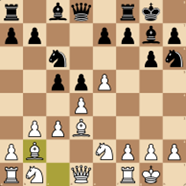
9… cxd4 10. cxd4 f6 11. exf6 Rxf6 12. Nbc3 Kh8?!
More adventurous were 12… Nb4 or …Rf7.
- Rc1 Bf5 14. Bxf5?!
After this inaccuracy, Black once again assumes the initiative. Correct is 14. Nf4 when after 14… e6 15. Nce2 Qd6 16. Bb5 Ne7 or 14… Nb4 15. Bxf5 Nxf5 16. a3 Bh6 17. Nce2 Qd6 18. axb4 Bxf4 19. Nxf4 Qxf4 the position is completely even.
14… Rxf5?!
Black best exploits White’s last error with 14… Nxf5 15. Nf4 Nfxd4 16. Nfxd5 Rd6 17. Ne3 Ne6 18. Qc2 Nb4 19. Qe4 Nxa2 20. Rc2 Nc5 21. Qg4 Rd4 22. Qe2 Nb4 with advantage.
- Na4 Qd6 16. Qd3?!
White can claim a small advantage after 16. Nc5 b6 17. Nd3 Rf7 18. Rc2 Raf8 19. Qc1 Nb4 20. Nxb4 Qxb4 21. Ng3.
16… Raf8 17. f4 Nb4 18. Qb5 a6 19. Qxb7 Nd3 20. Rc8??
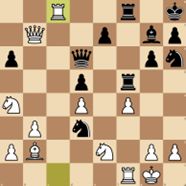
Simply losing. White must try 20. Rc6 Nxf4 21. Nxf4 Rxf4 22. Rfc1 and after
- a) 22… Qd8 23. Qxa6 e5 24. Rc8 Qg5 25. dxe5 Ng4 26. Qd3 Rf5 27. Rxf8+ Rxf8; or
- b) 22… Qa3!
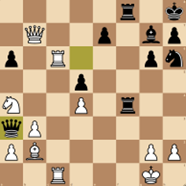
position after 22… Qa3
A striking resource. (White cannot capture due to 23. Bxa3?? Bxd4+ 24. Kh1 Rf1+ 25. Rxf1 Rxf1#)
b1) 23. h3 Bxd4+ 24. Bxd4+ Rxd4 25. Ra1 Ng8 26. Qc7 Qb4 27. Qe5+ Rf6 28. Nc5 Rd2 29. a3 Qb5 30. Rc8 Qe2; or
b2) 23. Rc8 Qd6 24. R8c6 Qd8 (24…Qa3 is obviously good enough for a draw)
- Qxa6 e5 26. Rc8 Qg5 27. dxe5 Ng4 28. Qd3 h5 29. e6 d4 30. Rxf8+ Rxf8; the game position remains completely equal.
20… Qe6 21. Rxf8+ Rxf8 22. Rf2 Qe3 White resigns 0-1
Mate follows in twelve moves.
The next game was not played in the Surrey championships, but in the Blitz decider of the next county I went on to represent, Cambridgeshire. Between the two of us, we went on to win the British Championship title three times.
Raymond Keene vs. William Hartston
Cambridge University Blitz Championship, 1970
Queen’s Gambit Declined Slav Defence Exchange Variation
-
d4 Nf6 2. c4 c6 3. Nc3 d5 4. cxd5 cxd5 5. Nf3 Nc6
The Exchange Slav has been used successfully by world champions, e.g. Capablanca to defeat Lasker, Alekhine to beat Euwe, and Botvinnik to win against Tal. - Bf4 e6
After 6…Bf5 Black still has a number of pitfalls to avoid, not the least of which arises after 7. e3 e6 8. Ne5 as in Keene-Whiteley, British Universities Championship, Manchester 1969.
although in that game, after 8… Nxe5 9. Bxe5 Nd7 10. Qb3 Nxe5 11. dxe5 Qb6 hands the advantage to White, whereas after 11… Be7! 12. Bb5+ Kf8 13. Be2 Qc7 14. f4 g5, Black stays combative. Also worth noting is the machine’s preference after 6… Bf5 for 7. Qb3 Na5 8. Qa4+ Bd7 9. Qc2 Rc8 10. e3 e6 11. Bd3, with a small advantage.
Our trusty machine also slightly favours 6… a6 7. e3 Bg4 8. h3 Bxf3 9. Qxf3 e6, over the move played.
-
e3 Bd6
An earlier game, Keene-Hartston, London League 1962 had continued 7… Be7 8. Bd3 O-O. -
Bg3 O-O 9. Bd3 a6 10. O-O Bxg3 11. hxg3 Bd7 12. Ne5 Be8 13. Rc1 Nxe5 14. dxe5 Nd7 15. f4 Rc8
Black should consider instead, either 15… f6 or …Qb6. -
Ne2 Nc5 17. Nd4 Qb6
White’s domination of the central dark squares promises him an edge.
But Black’s last is the culprit behind White’s advantage. If instead, 17… Ba4 18. Qe2 Qd7 19. Bb1 Bb5 20. Nxb5 Qxb5 21. Qxb5 axb5, the position remains level. -
b3
White misses a critical opportunity to exploit Black’s last: 18. f5 g6 19. Qg4 exf5 20. Nxf5 Qe6 21. Nh6+ Kg7 22. Qxe6 fxe6 23. Rxf8 Kxf8 24. b4 Nxd3 25. Rxc8 with a healthy advantage.
18… Bd7 19. Bb1 a5 20. Qh5 g6
Now White’s presence in the centre translates into a direct kingside attack.
Again, this is influenced by Black’s last inaccuracy: after 20… Ne4 21. Qh4 a4 22. Kh2 Rxc1 23. Rxc1 axb3 24. axb3 Qa5 25. . g4 Qd2 26. Re1 Re8, white’s advantage is markedly smaller.
- Qh6 Bb5
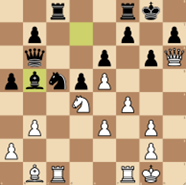
Black’s last is, of course, a catastrophic error. White has no more than a small advantage after 21… f5 22. exf6 Rxf6 23. Nf3 Rc7 24. Rc3 Bc6 25. Rfc1 Nd7 26. Qh4.
-
Nf3
Here White misses a great chance. Best is 22. f5 threatening the terminal f5-f6, imprisoning the black king. The point is that after 22… exf5 23. Nxf5 the lateral pin against the Black Queen prevents White’s murderous knight from being captured.
22… f6
Another near terminal error by Black, who after either 22… Rc7 or 22… f5, could at least maintain the status quo: i.e. White has a solid advantage, though not yet winning.
-
exf6
Here 23. Bxg6 is possible, but after 23… hxg6 24. Qxg6+ Kh8 25. Kf2 (trying to get a Rook to h1) 25…Nd3+ Black would enjoy a healthy advantage. However, after 25. Qh6+ or 25. exf6, White would be clearly winning.
23… Rxf6 24. Ng5 Rc7 25. Rf3 Be2 26. Rf2 Bd3 27. Bxd3 Nxd3 28. Rxc7 Qxc7 29. Rc2
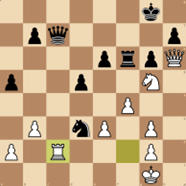
Shock tactics!! This deflection sacrifice is an inspired way to freshen up White’s attack. Sadly….The engine discounts this flight of fancy as restoring equality to the position. White does well in continuing 29. Rd2 Nc5 30. Qh4 Qg7 31. Nxh7 Rf7 32. Ng5 Re7 33. Rd4 Nd7 34. Nf3 Nf8 35. g4, maintaining a sizable advantage.
29… Qxc2
Black has little choice, since if 29… Nc5 30. Rxc5–or 29… Qd7 30. Rc8+ Qxc8 31. Qxh7+ and once again, the WQ erupts into the black camp in decisive fashion.
- Qxh7+ Kf8 31. Qh8+ Ke7 32. Qg7+ Kd6 33. Qxf6
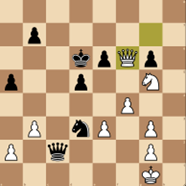
33.. Qc1+
The last hope of resistance lies in the alternative queen check 33… Qd1+ 34. Kh2 Nf2 35. Qxe6+ Kc5 36. g4 Qh1+ 37. Kg3 Qe1 38. Qe7+ Kb6 39. Qd6+ Ka7 with complete equality.
-
Kh2 Nf2 35. Qd8+
The black queen falls to a rear skewer, after which further resistance becomes futile. Black resigns 1-0
Ray’s 206th book, “ Chess in the Year of the King ”, written in collaboration with Adam Black, and his 207th, “ Napoleon and Goethe: The Touchstone of Genius ” (which discusses their relationship with chess) can be ordered from both Amazon and Blackwell’s. His 208th, the world record for chess books, written jointly with the late chess playing artist, Barry Martin, Chess through the Looking Glass , is now also available from Amazon.
A Message from TheArticle
We are the only publication that’s committed to covering every angle. We have an important contribution to make, one that’s needed now more than ever, and we need your help to continue publishing throughout these hard economic times. So please, make a donation.


