Fireworks at FIDÉ


This summer has been a stressful period for presidents and aspirants of world sporting bodies. The President of FIFA, the world football federation, Gianni Infantino remains under severe pressure. Similarly KIRSAN Ilumzhinov declared his candidacy for the presidency of FIDÉ, the world chess Federation, on Monday July 20, World Chess Day. Within days he had withdrawn, allegedly obeying a diktat from The Kremlin. Meanwhile, the incumbent Russian office holder, Arkady Dvorkovich has also suddenly resigned in ignominy, after being sanctioned by the EU. His place — as interim President — has been taken by former world champion, Vishy Anand, while Arkady’s electoral campaign mantle has been inherited by Kazakhstan billionaire Timur Turlov. Meanwhile, no fewer than two separate aspirants from Germany have emerged.
Jan Henric Buettner, Wadim Rosenstein and Timur Turlov are now the three valid candidates standing. Buettner has, sadly in my eyes, promoted the despised varied baseline chess, upon which heresy I hereby pronounce anathema. The heretic is, alarmingly, supported by England’s Malcolm Pein as his running mate. A feature of their ticket is the promise to distribute future FIDÉ largesse to national federations.
Rosenstein (born in Ukraine) is supported by Africa and Latin America, also by the chess loving former Prime Minister of Mongolia, Gombojavyn Zandanshatar, reputedly an intimate of Donald Trump. Turlov has been sanctioned by Ukraine, but has won the support of former world champion Viswanathan Anand.
I have to declare an interest at this point, since I have decided, after careful consideration, to back Wadim Rosenstein. I believe, amongst the most important pledges to which he could commit, would be to restore the prestige of the world chess championship, so horrendously devalued by the resignation of the previously reigning champion, Magnus Carlsen.
I see a parallel between Homer’s Iliad, where Achilles sulks in his tent with Patroclus, and Magnus Carlsen refusing to defend his world title. The comparison is irresistible: the greatest warrior withdrawing from the field, leaving the contest diminished by his absence. The fallout has been catastrophic. Shakespeare described similar baleful effects radiating out from Achilles refusing to fight during a crisis for the Greeks in the Trojan war. Ulysses, also known as Odysseus, King of Ithaca (recently popularised by Christopher Nolan in his silver screen rendition of Homer’s Odyssey) speaks, and by “degree” he means authority and hierarchy, which should be honoured and respected, not arbitrarily tossed away.
ULYSSES
The specialty of rule hath been neglected,
Degree being vizarded,
Th’ unworthiest shows as fairly in the mask.
The heavens themselves, the planets, and this centre
Observe degree, priority, and place,
Insisture, course, proportion, season, form,
Office, and custom, in all line of order.
And therefore is the glorious planet Sol
In noble eminence enthroned and sphered
Amidst the other, whose med’cinable eye
Corrects the influence of evil planets,
And posts, like the commandment of a king,
Sans check, to good and bad. But when the planets
In evil mixture to disorder wander,
What plagues and what portents, what mutiny,
What raging of the sea, shaking of Earth,
Commotion in the winds, frights, changes, horrors
Divert and crack, rend and deracinate
The unity and married calm of states
Quite from their fixture! O, when degree is shaked,
Which is the ladder of all high designs,
The enterprise is sick.
Today, FIDÉ is once again passing through a difficult period. This is not merely a quarrel over one dispute, one country, or one decision; the malaise runs far deeper. It is a crisis of trust, representation, and unity. Most alarming of all is that FIDÉ’s principal sporting symbol, the title of World Classical Chess Champion, has in recent years surrendered part of its former authority and lustre.
Magnus Carlsen—the world’s highest-rated player and one of the greatest champions in the history of chess—voluntarily withdrew from the classical World Championship cycle. He now devotes his energies to developing new formats and participating in projects that exist alongside the traditional World Championship system. This is not the fault of a great chess player; it is a challenge for FIDÉ itself.
The International Federation must create a system in which the strongest players in the world once again regard the battle for the classical chess crown as the highest objective of their careers. A dangerous divide has emerged between the official title and genuine sporting leadership. Since the reunification of the World Championship title in 2006, FIDÉ has never before confronted a situation in which this divide has persisted for so long and gradually threatened to become the new normal.
The World Champion must represent the undisputed pinnacle of the chess system. FIDÉ’s most important title must not exist separately from the strongest players on the planet. FIDÉ must restore the World Championship crown to its unique status, prestige, and unifying power. The best players in the world must aspire to win this title, rather than seek their future outside the principal championship cycle.
FIDÉ now faces a crisis of trust, representation, and unity, particularly concerning the declining prestige of the World Classical Chess Championship. Magnus Carlsen’s withdrawal from the classical championship cycle is evidence of a growing divide between the official title and the world’s strongest players.
Wadim pledges to restore the World Championship’s prestige, strengthen ties with national federations, and ensure that smaller and developing federations are heard, emphasizing chess as a universal space for dialogue, guided by equality, fairness, independence, and respect for all federations, arguing that leadership renewal is essential for democracy and institutional strength.
With elections looming in Uzbekistan and FIDÉ drifting from crisis to contradiction, the ground could scarcely be riper. As I expected at the time, Arkady Dvorkovich—Russian, polished, and seemingly untroubled by the world’s disapproval—was re-elected in Chennai in 2022. The vote took place alongside the relocated Chess Olympiad, which had been wrenched from Moscow and spirited to India at what felt like a day’s notice.
The world’s governments, recoiling from the invasion of Ukraine, demanded that Russia be excluded from international sport and that Russian officials be kept well away from the high tables of global power. Yet FIDÉ, confronted with this chorus, looked the other way, for as long as it could, when its own presidential chair was at stake.
The result has been a display of double standards so brazen that one almost admires the nerve of it. The same authorities who had punished Russia—quite sternly, in fact—for its aggression were willing to make exceptions where personal influence was concerned. Moscow lost the Olympiad within hours of the invasion. Then came a unanimous decree forbidding Russians from playing under their flag, which left no Russian team in Chennai at all.
What made this stranger still was the identity of the man presiding over Russia’s expulsion: the former Russian Deputy Prime Minister and, since 2018, President of FIDÉ, Arkady Dvorkovich. First he appeared to oppose the war. Then, under pressure from the Kremlin’s enforcers—men he had once shown the courage to contradict—he folded. The Times quoted him addressing the Skolkovo Foundation, repeating Moscow’s fiction that the war was a crusade against a “Nazi” regime. He spoke of childhood lessons in patriotism, of his hatred of Nazism, and of his pride in Russian soldiers “who at all times defended their homeland and freedom”.
The backlash was immediate. Many demanded his removal, since statements of that sort hardly suit the leader of a global intellectual pursuit that claims to rise above political brutalities. Sergey Karjakin—alarmingly, once a Ukrainian and now a Russian Grandmaster—was suspended by FIDÉ for making pro-war declarations. More than forty other Russian players, to their great credit, signed an open letter urging Vladimir Putin to stop the war. Yet the FIDÉ President himself, after echoing Kremlin propaganda, remained serenely in place.
Unwilling to risk defeat, Arkady Dvorkovich recruited the immensely popular former world champion, Viswanathan Anand, as his Deputy President. With the election in Chennai, such a partnership was an electoral masterstroke. Predictably, it delivered him victory. Yet now Anand has taken over from the Dvorkovich and will support Turlov in the next election.
We now find ourselves in a curious moral labyrinth: Russia deprived of the Olympiad, the Russian team erased, one of its leading Grandmasters banned—yet the Russian President of FIDÉ, openly aligned with the Kremlin’s narrative, re-elected with enthusiasm in the previous election. Meanwhile Nigel Short, the organisation’s conscience and gadfly, has been quietly pushed into the shadows.
Regular readers will know that after the invasion of Ukraine I hoped Nigel Short might stand for the presidency himself. It was an honourable hope, but it did not prevail. I believe now that Wadim Rosenstein is the candidate best placed to preserve the rich legacy of chess, defend our game both against the Kremlin’s malign influence, and against the encroachment of bastardised forms of chess, such as varied baseline, with which FIDÉ should have no truck.
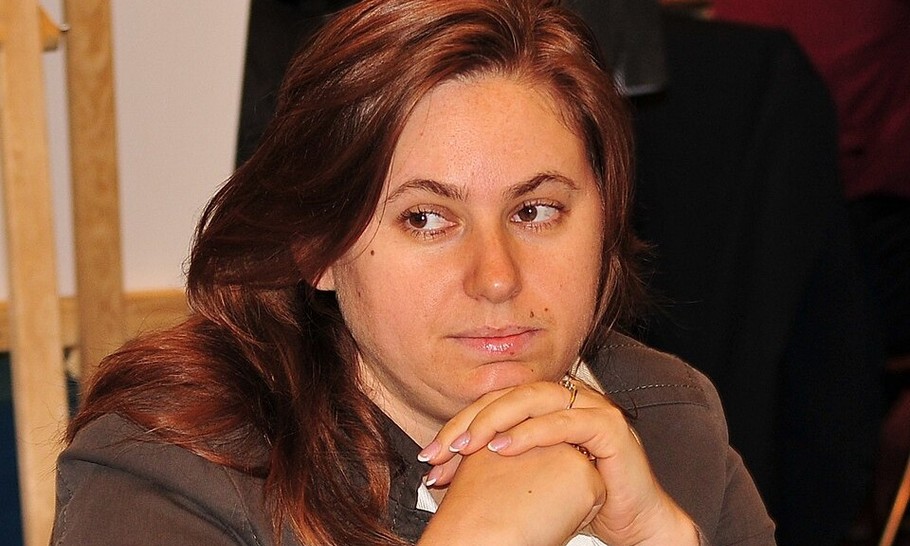
On a second presidential note: on 20th July the astonishing news spread that the new Hungarian Prime Minister, Péter Magyar, had nominated Judit Polgar, hitherto the greatest chess-playing woman of all time, to become Hungary’s new President. Judit’s achievements within the game are truly both prodigious and prestigious, and such a nomination reflects her accomplishments, her resilience and her integrity.
However, in a later announcement, we were sorry to learn that she had officially declined the nomination. Judit Polgar said, “I consider it an honour of my life… However, I do not feel strong enough to take on the historical responsibility of uniting a divided nation.”
One of Judit’s exemplary early performances was beating Grandmaster Lev Gutman at the age of eleven. But Gutman at the time was rated 2500-2520. The 2023 French champion we are about to witness being felled by our own Bodhana Sivanandan is rated 2628. Such a performance is bewildering, given that the 11-year-old, though already a FIDÉ Master and the youngest-ever British Women’s Champion, is rated a mere 2303.
Bodhana Sivanandan vs. Marc Maurizzi
Festival International d’Échecs de Dole, Jura, 2026
- e4 c5 2. Nf3 e6 3. g3 Nc6 4. Bg2 Nf6 5. Nc3
More frequently played are 5. d3 and Qe2.
5… d6 6. d4 cxd4 7. Nxd4 Bd7 8. O-O Be7 9. Re1 O-O 10. Nxc6 Bxc6 11. Be3 a6 12. a4 Rc8 TN
It is more progressive to free the d8-square and connect the rooks, with either 12… Qa5 or…Qc7.
- Qe2 Qa5 14. Red1 Rfd8 15. Bd4 h6 16. e5?!
Having maintained a resolute equality in the opening, the move played is precipitative for the status of the centre. A quieter and more balanced continuation is 16. h3 Re8 17. Be3 Nd7 18. Bd4 Bd8 19. Kh2 Bb6 20. Qe3 with near parity. After the move played, black begins to enjoy a slight initiative.
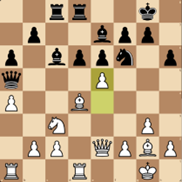
16… dxe5 17. Bxe5 Bxg2 18. Kxg2 Qb4 19. Rxd8+ Rxd8 20. Rb1?!
Having wrought back the initiative, this weak move cedes it to black once more. A far more adventurous defence of the b-pawn follows: 20. Ra3 Qc5 21. Rb3 Nd7 22. Bf4 g5 23. Be3 Qc6+ 24. Qf3 Qxf3+ 25. Kxf3 Ne5+ 26. Ke2 Rd7, when the two forces are finely balanced.
20… Nd7 21. Bf4 Nc5?!
A loose continuation placing the knight in an unenviable position, with next to no squares available to it. Preferable was 21… Rc8 22. Qd3 Nb6 23. Qf3 g5 24. Bd2 Nc4 25. Be1 Qb6, after which black has retained his small but tangible advantage.
- Qf3 Rd7 23. b3 g5
Bold but not necessarily bad. But after this thrust Black must stay vigilant.
- Bc1?
Already an error, as this is the wrong diagonal to control, and the move played restricts her b1-rook from becoming active. For example, White could have preserved parity after, 24. Be5 f6 25. Bb8 g4 26. Qe3 Bf8 27. h3 e5 28. Rh1 gxh3+ 29. Rxh3 Qd4 30. Qxd4 exd4 31. Ne2.
24… g4 25. Qe3 Bg5 26. Qe1 Bf6 27. Bb2
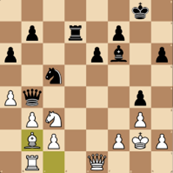
27… Qb6??
A very serious oversight. We have already noted the c5-knight’s mobility dilemma, but that of the queen is even more critical, as we shall see. Necessary was 27… Bd4!
- b4 Qxb4 29. Nd5!
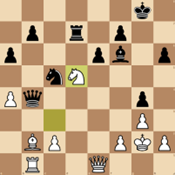
And white’s double-attack becomes painfully clear: not only the attack on the queen, but also that f6 is vulnerable.
29… Qxb2 30. Rxb2 Bxb2 31. Nb6 Rc7 32. Qb4 Bg7 33. Qxg4 Nd7 34. Nc4!?
Adequate, but the critical line comes after 34. Qf4 Ne5 35. c4 Rc6 36. Qd2 Bf8 37. Qd8 a5 38. h4 Kg7 39. Qd4 when white is close to finding the coup de grace.
34… Nf6 35. Qe2 Nd5 36. Nd6 Rd7 37. Ne4 Nc3?
Encouraging the inevitable; instead, 37… Ne7 or …Kf8 put up more resistance.
- Nxc3!?
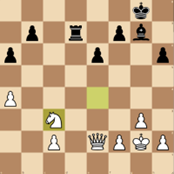
More than sufficient, though the immediate 38. Qc4 Nxe4 39. Qc8+ Bf8 40. Qxd7 is a more clinical finish.
38… Bxc3 39. Qc4 Black resigns 1-0
Ray’s 206th book, “ Chess in the Year of the King ”, written in collaboration with Adam Black, and his 207th, “ Napoleon and Goethe: The Touchstone of Genius ” (which discusses their relationship with chess) can be ordered from both Amazon and Blackwell’s. His 208th, the world record for chess books, written jointly with the late chess playing artist, Barry Martin, Chess through the Looking Glass , is now also available from Amazon.
A Message from TheArticle
We are the only publication that’s committed to covering every angle. We have an important contribution to make, one that’s needed now more than ever, and we need your help to continue publishing throughout these hard economic times. So please, make a donation.


