Gallows humour and the melancholy of anatomy

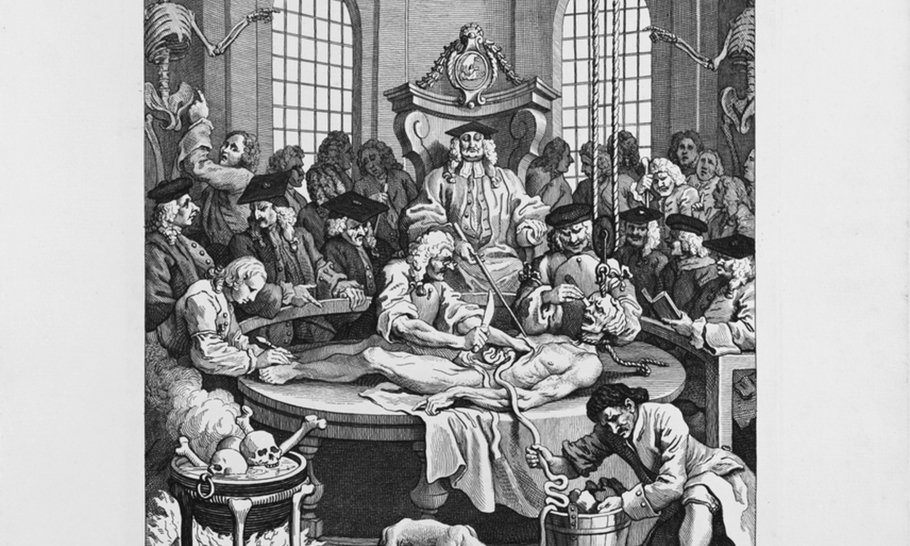
William Hogarth, The Four Stages of Cruelty: Reward of Cruelty
Meredith Gamer’s City of the Gallows: Art and Execution in Eighteenth-Century London (Mellon Centre for British Art, 164pp, 133 illustrations, £40) “is about the spectacle of public executions in eighteenth-century London, the spectators of these events,” and the relation of these two elements to works of art. Common labourers, instead of being hard at work, were given a holiday to watch the public hangings, and the free festive and theatrical entertainment attracted vast crowds carousing in the streets.
Eighteenth-century executions were always surrounded by high drama, and the confrontation with death evoked fascination, fear and sexual excitement. Rivetted witnesses of these morbid spectacles recorded their emotional response to the ghastly details, the victims’ last words and demeanor, the riotous setting, the pulsating crowd, the ritualistic procedure, the dramatic finale and the sudden extinction of life.
In a hanging, the rope was suspended from wooden gallows and the victim was blindfolded. After the noose was tightened, the hanged man, quivering with fear or bravely defiant, was pushed off a high horse-drawn cart or flung off a ladder. A contemporary reported, “he catched the ladder; but soon quitted his hold” and swung from side to side like the pendulum of a clock. One executioner, nervous about hanging a woman, forgot to tie her dress. As she swayed from the gallows her undergarments or sexual parts were exposed to the delighted mob below her.
George Orwell gave a famous grim account of a 1925 hanging in Burma: “There was a clanking noise, and then dead silence. The prisoner had vanished, and the rope was twisting on itself. He was dangling with his toes pointing straight downwards, very slowly revolving, as dead as a stone.” But there was one unexpected pre-extinction orgasm. According to Léon Thionet’s Précis de médicine légale (1913), “erection and true ejaculation take place during a hanging.” James Joyce described this explosive event in the “Cyclops” chapter of Ulysses (1922): “a violent erection of the hanged sends gouts of sperm spouting through his deathclothes on to the cobblestones.”
When hangings failed to proceed according to plan, strangulation was sometimes needed to finish off the victim. A French observer wrote that when the executions were botched, “the Hangman does not give himself the Trouble to put them out of their Pain; but some of their Friends or Relations do it for them. They pull the dying Person by the Legs, and beat his breast, to dispatch him as soon as possible.” Some victims, as late as 1758, were still drawn and quartered for treason: disemboweled while still alive, beheaded and chopped into four pieces. Nazi photographs of mass outdoor hangings of Jews in wartime Ukraine recall the barbarism of the 18th-century. As late as 1957, Arthur Koestler described multiple disasters in modern hangings: “the various forms of mutilation and lacerations, jaws torn off by hitting the edge of the trap, gashes torn in the neck, heads partly or entirely torn off, and people being hanged twice or even three times in succession.”
Executions included hanging, beheading and burning. Between 1680 and 1820 the number of capital offences rose dramatically from 50 to 200 — including “arson, coining, embezzlement, extortion, petty theft, pickpocketing, poaching, robbery and smuggling”. Three thousand people were hanged in the 18th century and thousands more — easy targets for pickpockets — gathered to watch them die. “Capital punishment was conceived as a tool of terror by the rich against the poor.” But executions failed to deter or prevent crime, and even increased it. Images of the gallows were meant to frighten and educate the poor, who failed to learn the menacing lesson.
The dashing and dangerous highwayman Captain Macheath in John Gay’s The Beggar’s Opera (1728) and Jonathan Wild, who ruled a vast criminal empire in London and exited with a swagger, were actually admired as heroes. (Francisco Goya portrayed Macheath’s method of robbery in Highwaymen Attacking a Coach, 1786.) Henry Fielding’s 1743 biography of Wild briefly described his execution: “The Horses pulling the Cart moved on, and with universal Applause our hero swung out of this World.” Jack Sheppard, a successful thief, pickpocket and escape artist, was portrayed in a drawing by James Thornhill with a sweet boyish face and elegant pose. These criminals were admired in the same way that the violent and defiant gangster Al Capone later was in Chicago of the 1920s.
A contemporary described “a poor Wretch, bound in a Cart, just on the Verge of Eternity all pale and trembling with his approaching Fate.” The hangman would prepare their noose, put a cap over their eyes and drive away the cart on which they stood. “Their bodies would sink under the pull of gravity, the noose would tighten around their neck, and they would begin to asphyxiate. As the noose contracted around the neck, an individual’s cries and screams were smothered, replaced by guttural gulps and gasps.” A disillusioned contemporary wrote that “Hanging is nothing at all! only a wry Face, and a pist [sic] pair of Breeches.” Gamer does not discuss the victims who resisted the hangings, and the failure to kill them when the cart jerked out of control and death was delayed.
Two Scottish noblemen, Kilmarnock and Balmerino, were beheaded for treason, but Gamer doesn’t explain their crime. They had played a leading role in the disastrous 1745 Jacobite Rising to restore the Catholic House of Stuart to the English throne. These enemies of King George II were beheaded on Tower Hill in London on August 18, 1746. Three days after the execution, Horace Walpole described the event in a letter to a friend in Italy. He enhanced his account with vivid details, noting that the executioner tactfully hid the axe and the victim’s severed head hung only by a thin shred of skin.
Walpole focused on Balmerino’s bold character. He tested the sharpness of the axe, questioned the axe man and tipped him to make a clean job of it. He wore patriotic Scottish plaid, jumped energetically from one side of the block to another and ordered the start of his own execution. Modern executions, by contrast, are hidden from view, expressing society’s retribution as well as its doubts and shame. Prisons now kill secretly, not publicly, and evoke more sympathy for the executed murderers than for the long-forgotten victims they had brutally killed.
Both Leonardo and Michelangelo dissected and drew cadavers. Eighteenth-century anatomists were granted a fixed number of hanged criminals per year. Their executions ended the chance of a dignified burial, a grave with a pleasant view and the hope of resurrection. Gamer doesn’t mention Thomas Rowlandson’s drawing An Execution Outside Newgate Prison (1805). Two hanged men and a woman dangle from the scaffold next to the forbidding penitentiary. They are surrounded by a few privileged spectators standing on the rooftops and by the Quality enjoying a fine view from the balcony. A mounted horseman vainly tries to keep order while a vast mob surges on the ground, some people riding on the shoulders of others. The crowd chats, shouts, swears and stares as peddlers sell food, drink and printed “Dying Speeches”.
William Hogarth’s The Reward of Cruelty (1751) — an ironic allusion to Samuel Richardson’s Pamela, or Virtue Rewarded (1740) — portrays a horrific stage en route to hell. In Plates 1 to 3, the victim’s “progressive acts of cruelty — torturing a stray dog, beating his own horse and murdering his pregnant mistress — lead to his own fittingly ‘cruel’ end.” In Plate 4, “with the gallows noose still tight around his neck, he lies on a dissection table in an anatomical theatre”: sliced, carved and cut to pieces. He retains in death his last gasping grimace in life.
The surgeon has a wig, spectacles, beak nose, pointed chin, rolled-up sleeves and muscular arms. His left hand plunges deep into the chest cavity of the corpse, and right wields a sharp blade that eviscerates five feet of large intestine. The sausage-like organ shoots off the edge of the anatomy table, whose drooping cloth absorbs the blood, is pulled into a bucket by a crouching assistant and overflows to the ground where a starving dog devours it along with the dead man’s heart.
The well-dressed presiding Lecturer in the demonstration sits on a high throne and directs the procedure with a long stick that touches the corpse. He’s suspended from the ceiling by ropes and pulley attached to a grooved spike that’s drilled into his skull, while a man probes his eye socket with a knife. A third man cuts his foot with a scalpel. In the lower left corner, skulls and bones boil in a cauldron raised on legs, with high flames below it and clouds of smoke floating away.
Seven figures wearing mortar boards or caps, some of them chatting, reading and dozing, surround the circular table. In the background and beneath two high oval windows, eleven men, one open-mouthed and pointing at a skeleton, also witness the ghastly acts. The two skeletons, placed high above the crowd in tall niches on the right and left, point an accusing arm at each other and reveal what the corpse will look like when his flesh is flayed.
The huge, massive chest and powerful head in the Bust incorporating the death mask of Samuel Johnson (1784) seem Johnsonian. But the living Johnson had a narrower nose, rounder cheeks and different lips. Unlike the death masks of William Blake and John Keats, his mask is not recognisable. Agonised rather than acquiescent, it has small closed eyes, ears flat against the skull, large thick nose, furrowed cheeks, strong chin and half-open mouth, as if it were about to speak wisdom or cry for help. Gamer quotes Joseph Baretti’s Guide Through the Royal Academy without noting that the well-known Italian poet, critic and translator was a close friend of Samuel Johnson.
Gamer writes that Hogarth’s “Gin Lane (1751) distills and arrays gin’s ‘evil Consequences’ into a single scene of apocalyptic misery. At the center sits an allegory of Mother Gin, as the liquor was commonly known, whom Hogarth pictures as a dissipated bare-chested sex worker, [with tilted head, disheveled hair and syphilitic cankers on her extended leg], who lets her child fall from her lap as she reaches for a fresh pinch of snuff.” Hogarth’s three fat, long-wigged, red robed hanging judges foreshadow Honoré Daumier’s The Three Judges (1858) and express Alexander Pope’s satiric line in “The Rape of the Lock” (1712): “The hungry judges soon the sentence sign, / And wretches hang that jurymen may dine.”
Meredith Gamer’s City of the Gallows, an exhaustively researched, well-written and excellent elucidation of complex details, is a lively but deeply flawed account of a morbid subject. Some of her comparisons are pointless: “gallows and picture frames share similar materials and rectangular forms.” Others are far-fetched: the calm, seated, naked male model in Johan Zoffany’s The Portraits of the Academicians of the Royal Academy (1772) is nothing like the twisted agonised muscular contrapposto figure of Laocoön wreathed and tortured by gigantic serpents.
Gamer has a good description of Joseph Wright of Derby’s most famous painting, An Experiment on a Bird in an Air Pump (1768):
The painting portrays a group of people gathered in the drawing room of a fine country home to watch a series of “experiments”, or demonstrations, designed to illustrate the laws of pneumatics. Arrayed across the dark, polished surface of the mahogany table before them are an assortment of tools and instruments: a half-hidden candle, two fluid-filled vessels, a pair of brass hemispheres, and most prominently a double-barreled air pump. An experiment with this pump is underway: a luminous white bird—a cockatoo—has been placed in the receiver, which has been sealed and the air pumped out of it. The bird, with its beak open and a wing outstretched, is gasping for breath.
But Gamer’s comparison is again unconvincing. There’s a vast difference between well-dressed people and two tender-hearted children in a handsome claustrophobic laboratory, experimenting in a glass globe on a cockatoo that will be saved from suffocation, and a helpless human being asphyxiated by hanging in front of a vast surging outdoor proletarian mob.
In an absurd “Coda” that has absolutely nothing to do with her subject, Gamer drags in Fons Americanus, a 44-feet-high white sculpture by a Black woman. On a pedestal, a blasted tree stump with an empty noose dangling from one branch, “seems to be suffering”. This work, which belies its title, is supposed to be a “reflection on Britain’s imperial history” and “a time-twisting allegory of the Black Atlantic.”
In his essay on The Sublime and the Beautiful (1757), Edmund Burke provided an unwitting insight into the mob’s attraction to hanging by “ranking public executions, along with fires and earthquakes, as among the greatest sources of the sublime”. This was only two years after the devastating earthquake in Lisbon killed 60,000 people.
James Boswell, a connoisseur of cruelty, was more interested in the effect on himself than on the hanged men, who were sometimes his own unfortunate legal clients. A hanging aficionado with a season ticket to all events, Boswell exclaimed, “I feel an irresistible impulse to be present at every execution, as I there behold the various effects of the near approach of death, and by studying them I learn to quiet and fortify my own mind.” Perhaps the only equally ritualistic public event today, when brave men face death and can suddenly be killed, is the Spanish bullfight.
Jeffrey Meyers has recently published James Salter: Pilot, Screenwriter, Novelist and Parallel
Lives: From Freud and Mann to Arbus and Plath (2024), Forty-Three Ways of Looking at Hemingway (2025) and The Biographer’s Quest (2026).
A Message from TheArticle
We are the only publication that’s committed to covering every angle. We have an important contribution to make, one that’s needed now more than ever, and we need your help to continue publishing throughout these hard economic times. So please, make a donation.


