How I became an engineer


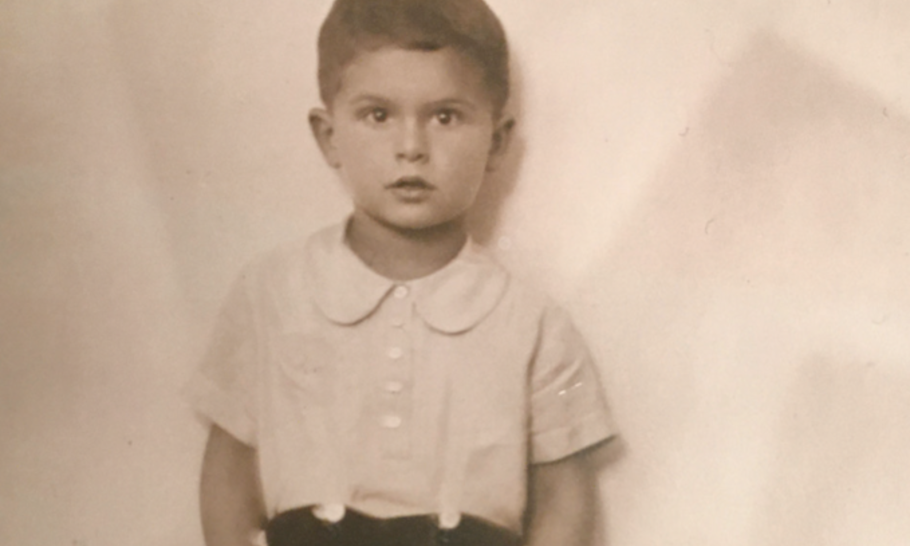
My mother was greatly interested in education, particularly in my education. By the age of one, it was decided that I should go to university. “He will be an engineer,” she would say to anyone who would listen. My mother wanted to impart to me as much knowledge as she possessed herself. Part of that was my musical education. She started to teach me the piano when I was seven years old. I was hopeless. She also wanted to teach me to speak German. She started with the grammar. I had to learn der, die, das and all the cases: Nominativ, Genitiv, Akkusativ, Dativ. I was far too young to appreciate grammar. I made no progress at all.
She was also interested in history. I remember her schoolbook of ancient history, decorated by inkblots. We went through the whole thing. The daily classroom was the kitchen: my grandmother did the washing up, my mother did the drying, and I stood next to them, absorbing the main events of ancient history. I learned then that the ideology of Sparta was laid out by a man called Lykurgos, and that of Athens by Solon. I learned about Mount Taygetos and about all the wars of Athens.
In the final year of secondary school, everyone in the class had to visit a place where tests were conducted to tell the participants what kind of profession to choose in life. The place was called Tehetségvizsgáló Intézet (the Institute for Testing Talent). The test was quite close to what is called here an IQ test. I thought I did quite well. A few days later, each of us had to return for a brief interview.
At the interview, they presented me with a contraption consisting of a metal base with plenty of holes, a few posts, ropes, and wheels. There was one wheel capable of rotating around an axis in one corner, and a similar one further away at the opposite corner. I was told to use the components given to make the distant wheel turn by turning the wheel in the nearer corner. I could not do it.
The interviewer told me, “Never mind, you did very well otherwise.”
“So, which university do you think I should go to?” I asked.
“I am afraid,” came the reply, “we cannot give you any specific advice on what to do in life. You can choose any profession except engineering. But then, you wouldn’t choose engineering, would you?”
I chose engineering. There were several reasons for that:
- I liked mathematics, and I knew that engineering needs mathematics.
- I liked physics too, but back then, a physics degree meant a lifetime of teaching in a secondary school. While I enjoyed private tutoring for extra cash, I lacked the saintly patience required to face a room full of children.
- To study social science meant, at the time, Marxist economics. By then, I knew enough of Marxist economics and could not see how one could run a country on that basis.
- I could have done medicine, as some of my schoolmates did. Unfortunately, I could not bear the sight of blood.
So, I chose engineering.
When the Hungarian Revolution forced us to cross the border in 1956, we did not have any luggage, obviously. But I did put the two most precious things I possessed into my pockets: my two published papers on antennas. They were supposed to prove to everyone in my new country how great an engineer I was. My plan actually worked. Three weeks later, I was working at a company called Standard Telecommunications Laboratories (STL) in London.
This is where I met Eric Ash. He became a role model for me, even though he was only a few years older. He was a seasoned Brit, having emigrated with his family from Germany in 1938. He spoke and wrote beautiful English, was boundlessly curious, energetic, and possessed an infectious enthusiasm. He also always rode a bicycle. These were all traits that I immediately decided to adopt for myself.
STL was a research venue of the International Telephone & Telegraph Corporation — the ITT empire. Eric invented a story he used to tell when introducing me to somebody important. “In engineering research,” he would say, “there had not been a new idea at STL for a while. We have so many different nationalities here, but we had to wait for a revolution in Hungary to get new research ideas.”
I became a Lecturer and eventually a Professor of Engineering Science. But how good an engineer am I? If an engineer is someone who makes useful things, rather than dwells on fundamental ideas about how everything works, then admittedly my highlight as an engineer is building a granny flat in my garden. My research activities have produced many equations, but a much smaller number of useful devices. Some of my colleagues think I am secretly a mere physicist.
I did, it is true, learn from the giants. I had the privilege of being taught by the legendary Károly Simonyi, was introduced to science by a pure genius, Miklós Uzsoki, and I enjoyed my share of encounters with the formidable Dennis Gabor. Yet, my real education into the engineering craft came much later, courtesy of a brilliant succession of research students at Oxford. They possessed that elusive, innate “feel” for the discipline — a quality I lacked, but greedily absorbed by osmosis. In the end, I learned far more from them than they did from me.
Coming back to the definition: at its core, the role of an engineer is to take abstract scientific principles and turn them into practical, real-world solutions that solve human problems. In America, the definition of an engineer is somewhat different: An engineer is a person who can make a device for one dollar which everybody else can make for a dollar and fifty.
By this definition, I am not quite an engineer yet. I am still learning to become one. But I have enormously enjoyed the journey so far.
The moral of the story is probably this: if you have to choose whom to trust, your mother or the talent-scouting firm, trust your mother.
The author is Emeritus Professor of Applied Electromagnetism at the University of Oxford. He was born in Budapest in 1930.
A Message from TheArticle
We are the only publication that’s committed to covering every angle. We have an important contribution to make, one that’s needed now more than ever, and we need your help to continue publishing throughout these hard economic times. So please, make a donation.


