Jimmy Adams: chess polymath



Jimmy Adams: chess polymath
With the death of Jimmy Adams at the age of 79, the chess world has lost one of its most devoted custodians. He was an author, editor, publisher, historian, and lifelong champion of the royal game. Only recently he received an English Chess Federation award in recognition of his outstanding contribution to chess.
Although a FIDÉ Master and a strong player in his own right, Jimmy’s most lasting contribution came not from his performances over the board but from his extraordinary efforts to preserve, translate, publish and illuminate the history of chess. For more than four decades he stood among the leading figures in chess publishing, engaged in the painstaking work of rescuing players, tournaments and ideas from obscurity and presenting them to a wider English-speaking readership.
Yet Jimmy’s most enduring significance lies in the field of chess literature. He wrote numerous chess books, among the earliest being the highly successful K is for Karpov, which he self-published in the early 1970s. This pioneering venture foreshadowed a lifetime dedicated to bringing chess history and culture before a wider audience. New In Chess later published several of his monumental works, many approaching a thousand pages in length, devoted to legendary figures such as Chigorin, Breyer and Zukertort. He also produced four substantial volumes on the great Estonian grandmaster Paul Keres, while his latest work, on Flohr, is due to appear this month. Each represented a genuine labour of love.
Jimmy was also an ardent admirer of Bobby Fischer. Like his hero in the years before he became World Champion in 1972, he was renowned as a workaholic. In 1979, while appearing on television in the Philippines, he discovered a number of previously unpublished Fischer games in newspaper archives. Recognising their importance, he ensured their publication in the British Chess Magazine, thereby adding to the historical record of Fischer’s career.
As a player, Jimmy was no less dedicated. He became London Junior Champion in the 1960s, and I regarded him as one of my principal rivals for distinction when I was selected to compete in the Eastbourne Premier Tournament of 1963. A year later we met again over the board. Conscious of his diligence, erudition and formidable preparation, I abandoned the fashionable Taimanov Sicilian, which I had employed at Eastbourne, in favour of the more solid Caro-Kann. I was well satisfied with the resulting draw and experienced a modest sense of achievement in having neutralised the ambitions of such a dangerous opponent. Eastbourne, incidentally, was organised by the chess entrepreneur B.H. Wood. By one of those curious ironies so common in chess history, Jimmy would later devote many years to editing Wood’s celebrated monthly magazine CHESS.
Over the years he represented several London clubs, including Islington & North London, Bayswater, London Central YMCA and Metropolitan. He took considerable pride in his achievements as a club player and amassed an impressive record against some of the strongest competitors in the country. He often recalled drawing with Jonathan Penrose and defeating Paul Littlewood, among others, during the 1970s and 1980s.
In later life Adams attained the title of FIDÉ Master, awarded in 2014, and continued to compete actively in both American and international events. He regularly encountered master-strength opposition and earned a reputation as a knowledgeable, resourceful and resilient competitor. Yet his interests were never confined solely to tournament success. He neither sought nor required the public prominence accorded to grandmasters, remaining throughout his life a serious student of the game and a respected figure within the international chess community.
Jimmy edited both CHESS and the British Chess Magazine, and at the time of his death served as Deputy Editor of American Chess Magazine. He also contributed regularly to New In Chess and played an important role in the revival of Chess Informant during the 2010s, helping to modernise its appearance and presentation for the digital era while preserving its unique identity.
Through Caissa Editions, the publishing house he founded and directed, Adams became one of the principal custodians of classical chess history. At a time when many important tournament books and historical studies were unavailable, untranslated, or long out of print, he undertook the demanding tasks of translation, editing, annotation and republication. Under his guidance, Caissa Editions produced volumes highly valued by historians, collectors and serious players alike. The imprint acquired a reputation for scholarly rigour, careful sourcing and fidelity to original authors.
Among his most substantial achievements was Gyula Breyer: The Chess Revolutionary, an 880-page biography that restored one of the neglected pioneers of hypermodern chess to his rightful place in history. Drawing upon archival material, translated Hungarian sources and extensive game annotations, the work demonstrated a rare combination of historical scholarship and chess understanding. It was widely recognised as a landmark contribution to chess biography.
His other major studies included Johannes Zukertort: Artist of the Chessboard and Mikhail Chigorin: The Creative Chess Genius, both devoted to influential nineteenth-century masters. In these works Adams combined biography, tournament history and detailed analytical commentary. His expanded edition of the Chigorin study eventually exceeded 700 pages, reflecting the same thoroughness that characterised all his endeavours.
Adams also prepared new editions of classic tournament books. His work on Baden-Baden 1925, often regarded as one of the defining tournaments of the hypermodern era, brought back into circulation an event associated with the ideas of Réti, Nimzowitsch, Tartakower and their contemporaries. In doing so, he helped ensure that pivotal moments in chess history remained accessible to future generations.
Beyond his own writing and publishing, he typeset more than one hundred books for Batsford, many authored by Andy Soltis, with whom he enjoyed a productive and enduring professional relationship.
What distinguished Jimmy Adams was not merely the breadth of his knowledge but his profound sense of responsibility towards the past. He regarded chess not simply as a competitive activity but as a cultural and intellectual inheritance worthy of preservation. Forgotten manuscripts, foreign-language sources, obscure periodicals and ageing tournament bulletins received from him the same attention and care that others reserve for tournament preparation. His books were acts of recovery as much as publications.
Those who knew him describe a man of immense learning, unwavering enthusiasm and remarkable generosity. He was always willing to discuss historical controversies, assist researchers navigating difficult sources, or share new discoveries with fellow historians. For many he became one of the most dependable authorities on the game’s past.
In an age increasingly dominated by engines, databases and instant information, Jimmy Adams represented a different and deeply valuable chess culture, rooted in scholarship, continuity and historical awareness. Through his publishing work he preserved material that might otherwise have vanished from common view.
His death leaves a conspicuous void in the world of chess literature. Yet his legacy endures in the books themselves and in the countless readers who encounter Chigorin, Zukertort, Breyer, Keres and, most recently, Flohr through his efforts, or who study the great tournaments of the past in editions he painstakingly prepared.
Jimmy Adams’s contribution to chess cannot be measured simply by games won or titles earned. It is measured instead by preservation: by what was saved, explained and transmitted to future generations. The benefits of that work will continue to be felt for many years to come.
He will be remembered with gratitude and respect by all who value the history of chess. In the case of the British Chess Magazine, it was Adams’s editorial skill, dedication and personal generosity that helped sustain the publication through some of its most challenging periods.
The two games which follow are furnished with Jimmy’s own comments, reproduced with kind permission from his widow Sharon. Jan Mol is a Dutch entrepreneur, while Andrew Whiteley was a British International Master.
Jan Mol vs. Jimmy Adams
Beverwijk, 1967
- d4 Nf6 2. c4 g6 3. Nc3 d5 4. cxd5 Nxd5 5. e4 Nxc3 6. bxc3 Bg7 7. Bc4 O-O 8. Ne2 Nc6 9. O-O b6 10. Be3 Bb7
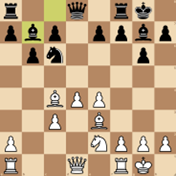
Though Bent Larsen had lost to Boris Spassky in the grandmaster tournament with this development of pieces, I thought it had a lot of potential and so decided to try it out myself.
- f4 e6 12. f5
If I remember correctly, my opponent had stood in as a late replacement when one of the original entrants had pulled out of our all-play-all section of ten players. So I had no idea of his playing strength. On thing was clear, however – he was moving quickly and wasting no time in coming after my king.
12… Na5 13. Bd3 exf5 14. exf5 Re8 15. Qd2 c5
When I was on a trip to Holland in 1979, I took the opportunity to visit another traditional tournament, held in Tilburg in the south of the country. There I was amused to see that a game between Spassky and Hübner had reached the same position as this – over ten years later! Hübner continued instead with 15… Be4, but lost after 16. Bg5. However, why exchange such a fine bishop which bears down on White’s vulnerable g2 square?
- Rac1
- dxc5 bxc5 17. Bxc5 Qd5 threatens mate on g2 as well as the queen’s bishop.
16… Rc8 17. Bh6
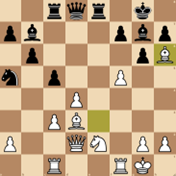
17… Bxh6
Though it looks treacherous, I could have gone for a win of a piece by 17… c4 since after 18. Bxg6 (18. Bb1 Bxh6 19. Qxh6 Rxe2 and if 20. f6 Rxg2+ followed by mate with the queen’s bishop) 18… cxd3 19. fxg6 (19. Qh6 Rxe2 20. Rf4 Qd5 threatening mate on g2; while if 19. Ng3 Kxg7 20. f6+ Kh8 21. Qh6 Rg8 22. Rf4, the threat of 23. Qxh7+! mating can be parried simply by 23… g5) 19… Rxe2 20. gxf7+ Kxg7 21. f8=Q+ Qxf8 22. Qg5+ Kh8 23. Rxf8+ Rxf8, although Black loses his queen, he wins the game. But I’m glad that I played the way I did, as some spectacular tactics now emerge.
- Qxh6 Qe7
Now 18… c4 loses to 19. f6.
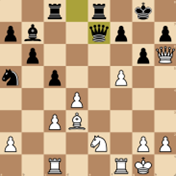
- Rf4
Bravely avoiding an exchange of queens by …Qe3+. If 19. Nf4, with a similar idea, then 19… cxd4 20. f6 Qf8! and not 20… Qxf6 21. Nh5! Qe5 22. Nf6+.
19… Qe3+ 20. Kh1
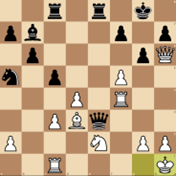
20… Rc6!
A neat way to defend and attack at the same time. Not 20… c4 21. f6 mating. Nor 20… Qxd3 because of 21. f6 Bxg2+ 22. Kg1! Qe3+ 23. Kxg2 Qxe2+ 24. Kh1 winning. And, finally, if 20… Bxg2+ 21. Kxg2 Qxd3 22. f6 Rxe2+ (22… Qxe2+ 23. Kh1) 23. Kh1 Rxh2+ 24. Kxh2 Qe2+ 25. Kg3 Qe3+ 26. Kh4 leaves Black with no more credible checks.
- fxg6
My opponent played this confidently. After 21. Rh4 Qxh6 22. Rxh6 c4 Black wins a piece, while 21. f6 allows 21… Rxf6 exploiting the pin on the rook. However, I also had to anticipate the possibility of 21. Bb5, which would be met by the surprising 21… a6! Then 22. f6 (on 22. Bxc6, I would have continued as in the game) 22… Rxf6 23. Bxe8 (if 23. Rxf6 Bxg2+ 24. Kxg2 Qxh6 25. Bxe8 Qg5+ and 26… Qxf6 wins) 23… Qxe2 24. Rg1 (to stop the mate)
analysis position after 24. Rg1
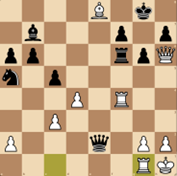
Qe3-e4-e2 – a striking queen manoeuvre!
24… Qe3! 25. Rgf1 (25. Rh4 allows an economical finish: 25… Bxg2+! 26. Rxg2 – 26. Kxg2 Qf3 mate – 26… Rf1+ 27. Rg1 Qf3 mate) and now the prettiest way to win is 25… Qe4!! (threatening mate) 26. R4f3 (26. R1f3 Qe1+ 27. Rf1 Qxf1+! mates; or 26. R4f2 Qxg2+! 27. Rxg2 Rxf1 mate) 26… Qe2! (threatening 27… Qxf1+! again!) 27. Qc1 Bxf3 28. Rxf3 Rxf3 29. gxf3 Qxe8 and wins.
Returning now to the mainline after 21. fxg6
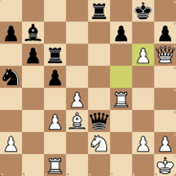
21… Rxg6!!
Shock tactics
- Bxg6
If 22. Qh5 Bxg2 mate — that vulnerable g2 square again…
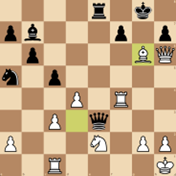
22… Qxc1+!
More shock tactics. White now sees that 23. Nxc1 Re1+ mates. The whole idea of my last two moves was to divert White’s bishop from its defence of the f1 square, thereby preventing an interposition on f1, stopping the back rank mate. Luring that bishop to c6 or g6 amounts to the same thing!
- Ng1
Forced
23… hxg6
Not 23… fxg6? 24. Rf8+! Rxf8 25. Qxc1.
- Qh4 Qe1
24…Re1 could be met by 25.Qf2.
- Qf6 Qe7
Black is now a piece ahead, so simplification is the quickest way to victory.
- Nf3 Qxf6 27. Rxf6 Bxf3 28. gxf3 cxd4 29. cxd4 Rd8 30. Rf4 Nc6 White resigns 0-1
Jimmy Adams vs. Andrew Whiteley
London, 1981
1.e4 e6 2.d4 d5 3.Nc3 Bb4 4.Nge2
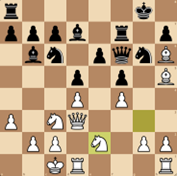
4… Ne7
Mostly I found my opponents played 4… dxe4 here, as happened for example in my game against John Century, Eastman Cup 1974, which I conducted in brutal fashion: 5. a3 Be7 6. Nxe4 Nf6 7. N2g3 Nbd7 8. Bd3 0–0 9. Qe2 e5 (A natural freeing move, but because White has a knight on g3 in this line, as opposed to the more usual f3, I had a strong reply.) 10. Nf5 Re8 11. Bg5 exd4 12. 0–0–0 Nf8 13. Nxe7+ Qxe7 14. Bxf6 gxf6 15. Nxf6+! Qxf6 16. Qxe8 Qxf2 17. Rde1 Qf4+ 18. Kb1 Qd6 19. Rhf1 Qd7 20. Bxh7+! Kg7 (If 20… Kxh7 21. Rxf7+ wins.) 21. Rxf7+! (Anyway!) 21… Qxf7 22. Re7 Be6 23. Rxf7+ Bxf7 24. Qxa8 1-0. I could say that here I sacrificed three pieces – knight, bishop and rook – for three kingside pawns!
- a3 Ba5 6. Qd3 Bd7
This bears some resemblance to the Fort Knox variation, where White’s knight is better placed on f3. Black intends to play 7… dxe4 8. Qxe4 Bc6, gaining time with an attack on the queen, so I continued…
- e5 0–0 8. Bg5 f6
Challenging the centre, but at the cost of weakening his kingside.
- exf6 gxf6 10. Bh6 Rf7 11. Ng3 Nbc6
If 11… e5 12. 0–0–0 e4 13. Qe3 Nf5 14. Nxf5 Bxf5 15. f3 with aggressive intentions.
- Be2 f5
On 12…Ng6 I think I would have proceeded with 13. 0-0-0 rather than 13.f 4 e5.
- Bh5 Ng6 14. f4
Halting any further advance of Black’s f-pawn, and securing control of the e5 and g5 squares.
14… Qf6 15. 0–0–0 Bb6 16. Nge2
16… Kh8
On 16… Qh4 White has 17 .g4! and if 17…f xg4 18.Bxg6 winning.
- h4 Nce7 18. Bg5 Qg7 19. Bf3
Making way for the advance of the h-pawn.
19… h6 20. h5 Nf8
Of course if 20… hxg5 then 21. hxg6+ wins.
- Bh4 Nh7 22. Rh3
This was an easy choice for me as I always used to develop my rooks this way when I was a beginner!
22… Nf6 23. Rg3 Qh7 24. Qe3
Anticipating Black’s next.
24… Ne4
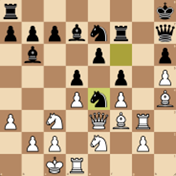
- Bxe4 fxe4
If 25… dxe4, I would have continued 26. Rh1, to meet 26… Rg8 with 27. R1h3, preserving a rook on the g-file and leaving Black constantly on guard against a possible invasion there. Then 26… Nd5 would be bad because of 27. Nxd5 exd5 28. Rg6 (intending 29. Bf6+) and if 28… Raf8 then 29. g4 fxg4 30. f5! threatening Rxh6 winning the queen. In general, my plan after 25… dxe4 and 26. Rh1 would then have been to play Qd2, perhaps followed by Nc3-d1-e3 or d4-d5 at some stage, opening the a1-h8 diagonal leading to the enemy king. Black’s queen remains shut in and his cornered king is vulnerable to attack.
26.Bxe7
But now the time has come for the breakthrough.
26…Rxe7
A study of Chigorin’s games had convinced me that knights were superior to bishops!
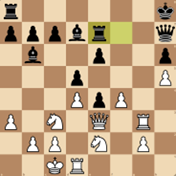
- f5!
Opening a diagonal for the queen. 27. Rg6 Be8 28. f5 Bxg6 29. hxg6 Qg7 29. Rh1 also looked pretty good.
27… Qxf5
Of course, 27… exf5 28. Nf4, intending both 29. Ng6+ and 29. Ncxd5, would lose quickly for Black.
- Rg6!
Cutting off the queen’s diagonal line of retreat as well as hitting the h6 pawn.
28… Rh7 29. Ng3 Qe5
Neatly exploiting the pin on White’s d-pawn, but the queen will soon be a liability on this square. 29… Qf8 30. Rf1 would have allowed White to bring his rook into the attack with gain of time.
- Nce2!
Vacating the c3 square whilst providing new opportunities for the knight on the kingside.
30…Rf8
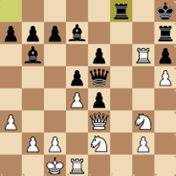
- Qc3!
Attacking the Black queen.
31… Qd6
Though the queen is placed right in the middle of the board, she has only one safe move – and even this is not so safe!
- Nxe4!
An unusual combination. If now 32… dxe4 33. d5+, when the forced reply 33… e5 opens the third rank and loses the queen! Though the game goes on after 34. Rxd6 cxd6 35. Qb4 Bc5 36. Qxe4 White should still win eventually.
32… Qe7 33. Nc5 Be8
So if 34. Rxe6 Qg5+.
- Qe3
The pressure increases move by move. An immediate threat is 35. Qe5+ Rg7 36. Rxh6+ Kg8 37. Nxe6.
34… Rf6
34… Bxg6 35. hxg6 Rg7 36. Qxh6+ Kg8 37. Rh1 decides.
- Nf4
The opening up of the game has exposed many weak squares in Black’s camp.
35… Bxc5
Or 35… Bxg6 36. Nxg6+ Rxg6 37. hxg6 Rg7 38. Qxh6+ Kg8 39. Rh1 mates.
- dxc5 Rg7
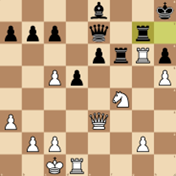
- Nxd5! exd5 38. Qxe7 Rxe7 39. Rxf6
The rest is easy.
39… Kg7 40. Rf5 c6 41. Kd2 Bd7 42. Rf4 Re5 43. Re1 Black resigns 1-0
Ray’s 206th book, “ Chess in the Year of the King ”, written in collaboration with Adam Black, and his 207th, “ Napoleon and Goethe: The Touchstone of Genius ” (which discusses their relationship with chess) can be ordered from both Amazon and Blackwell’s. His 208th, the world record for chess books, written jointly with the late chess playing artist, Barry Martin, Chess through the Looking Glass , is now also available from Amazon.
A Message from TheArticle
We are the only publication that’s committed to covering every angle. We have an important contribution to make, one that’s needed now more than ever, and we need your help to continue publishing throughout these hard economic times. So please, make a donation.


