Olivia Manning’s ‘Levant Trilogy’: the Desert War


Manning, c. 1930s
Anthony Burgess called the novels of the underrated Olivia Manning “the most important long work of fiction written by an English woman novelist since the war”. Like D. H. Lawrence’s Women in Love (1920), The Levant Trilogy (1977-80) shows the effect of war on the emotional and intellectual lives of civilian characters, though Cairo was much closer to the front than Cornwall. An understanding of the military background is crucial to the meaning of the novel.
Like Stephen Crane, who had no battle experience before writing The Red Badge of Courage, Manning had no front-line experience as a soldier or war correspondent. Her main military sources were contemporary conversations with soldiers, and Alan Moorehead’s African Trilogy (1945), Keith Douglas’ Alamein to Zem Zem (1946) and Field Marshal Montgomery’s Memoirs (1958). She lived in Cairo from July 1941 to October 1942, and her Levant Trilogy—written more than 30 years after she left Egypt—brilliantly describes the desert war in North Africa.
John Bierman and Colin Smith’s War Without Hate: The Desert Campaign, 1940-1943 (2002) gives an excellent account of the North African campaign—the essential background of The Levant Trilogy. The burning heat in the desert “plunged below freezing point after dark”. The “open country was ideal for heavy armour, which could maneuvre as freely as warships at sea”. Tank warfare had two principal maneuvres: a frontal assault to break through enemy lines or a hook behind its flank to attack from the rear.
In December 1940, when the Mediterranean island of Malta, crucial for supplies and control of the sea, was being disastrously bombed and troops were fighting in the desert, “upper-crust Cairo was enjoying a life of ease and plenty, as if in denial of the war in its backyard”. In the first British land victory of February 1941, General Richard O’Connor drove the Italian army out of Egypt. The German General Erwin Rommel arrived that month and planned to liberate Egypt from Britain, as Napoleon had hoped to free it from Ottoman rule. Two months later, “Tobruk, the best harbor between Tripoli and Alexandra and one of the best fortified towns in Libya,” was besieged by the Germans: “All British forces, except the besieged garrison, withdrew across the border into Egypt.” After his victory at Tobruk, Rommel advanced to El Alamein, a railway halt just inside the Egyptian border and within 160 miles of Cairo. He threatened to capture the Suez Canal, the rich oil fields in the Middle East and the best route to India.
In July 1941, after the failure to relieve Tobruk, Prime Minister Churchill sacked Archibald Wavell and replaced him with Claude Auchinleck. By doing so, Churchill created a depressing pattern that continued during British defeats when “the Auk” sacked Andrew Cunningham and replaced him with Neil Ritchie. The Auk then sacked Ritchie and Bernard Freyberg, and took command himself. In June 1942 the Germans captured Tobruk and took 33,000 Allied prisoners, the third major British defeat that year after the fall of Singapore and the Japanese victory in Burma.
In July 1942, when Cairo was threatened by the German advance, the British Embassy burned its classified documents. The next month Churchill sacked Auk, and replaced him with William Gott, who died in a plane crash, and was in turn replaced by the ultimately triumphant Bernard Montgomery. In the second battle of Alamein, November 1942, the major British victory stopped Rommel’s advance. This crucial turning point in World War II finally pushed Rommel west for 2,000 miles and drove him out of North Africa.
The Danger Tree (1977), the first novel in The Levant Trilogy, has alternating chapters between Simon Boulderstone’s military life and the civilian life of the perceptive autobiographical heroine Harriet Pringle. The novel begins in April 1941. All British forces, except the garrison in besieged Tobruk, withdraw into Egypt. Simon, aged 20 and naive, has sailed from England, down the west coast of Africa, around the Cape of Good Hope and up the east coast to Suez in Egypt. Separated from his two close friends, he’s lonely and anguished in “the most desolate and arid place on earth,” and in barracks that “suggest evil and death.” In the course of the Trilogy, Simon learns that his older brother Hugo had bled to death in no-man’s-land: “Both legs had been shot away. The sand around him was soaked with blood. He didn’t stand a chance.” Simon serves at the front, is also seriously wounded in the legs, finally recovers and is fit for active service. His bitter experience teaches him to become “wary of affections that seemed always to end in tragedy”.
In July 1942 Rommel’s Afrika Korps is 70 miles from Alexandria, on the Mediterranean coast north of Cairo. An experienced soldier tells Simon, “Things are pretty bad. We’ve lost the whole garrison and we’ll be lucky if we don’t lose the whole Middle East. The whole army is in retreat. We’ll soon be back in Benghazi, Libya. Still, we’re not beaten yet.” The veteran is impressed by General Claude Auchinleck: “Great man, ruddy hero. Big, big chap. You can’t miss ’m.” Despite the fighting spirit, General Archibald Wavell has drawn up plans to evacuate Cairo. Embassy cars are parked and ready for a getaway. Most Egyptians, hostile to British rule, think they’d be better off under Hitler and have become rabidly pro-German.
Poised for disillusion, Simon’s generation “believed that the British empire was the greatest force for good the world had ever known. They expected gratitude from the Egyptians and were pained to find themselves barely tolerated.” An old expatriate quickly undermines his idealism and reasons to fight by declaring, “What have we done here, except make money? I suppose a few rich Egyptians have got richer by supporting us, but the real people of the country, the peasants and the backstreet poor, are just as diseased, underfed and wretched as they ever were.”
About to go into action for the first time, Simon asks a veteran, “What’s it like, being under fire?” and is told about the danger of the imagination:“You don’t feel so much at the time. It’s the thinking about it, is worst.” In Manning’s vivid account of the battle, Simon’s men are strafed by Italian planes but manage to escape. In his second action, he ignores the danger and experiences the delirium of the brave:
Red and yellow tracer bullets, like deadly fireworks, passed overhead and machine-guns kept up their mad, virulent rattle. . . . Seeing a head rise above the hill, a hand lifted to pitch a grenade, Simon fired, and was amazed to see the man leap up and fall backwards. His shot, his first shot with intent to kill, had found its mark. In his excitement, he lost all sense of danger. In an ecstasy of joy, he rushed into a fusillade of machine-gun bullets, thinking he had discovered the thing he had wanted all his life. . . . Finally, coming face to face with a blond, pink-skinned German youth, Simon fired in a fury, saying, “Damn you. Damn the lot of you,” and the pink face opened and spilt out redness, like a pomegranate.
After seeing men in battle, Simon becomes “wary of friendship. His instinct was to avoid any relationship that could again inflict on him the desolation of loss.” After a lucky conversation with an influential officer, Simon is seconded to a safe job as a liaison officer in Cairo headquarters, but decides to return to the front.
The second battle of Alamein in November 1942 was the greatest conflict of the Desert War. During the British advance toward Libya, 17 of their tanks were blown up by the landmines they had planted when retreating from Alamein. The British broke through the German lines and Rommel retreated. Advancing to Matruh, 150 miles west of Alexandria, they recaptured Tobruk. Just as Rommel had boasted he would defeat the British for good, Montgomery “claimed that he had smashed the German and Italian armies. Harriet began to think of the war ending and a normal life beginning again,” but the conflict continues and life remains chaotic.
In a German rearguard action at Gazala, Libya, west of Tobruk, in mid-December 1941, Simon’s driver is killed by booby trap. Like Hugo’s injury, Simon’s legs are severely wounded by shrapnel, and he fears he will be crippled forever: “Part of the booby trap’s metal casing cut across his side and he was flung from the jeep. This, he thought, was death, but it was not his death. Oddly detached from his condition, he put his hand to his side and felt the wet warmth of blood. The action had moved so far forward, he was very likely to bleed to death before help came.” Luckily, a truck rescues him and takes him to the nearest dressing station.
Like the Desert War, the third novel, The Sum of Things (1980), ends triumphantly. In November 1942 the Americans landed at Casablanca on the coast of Morocco and early in 1943 met the British army in Tunisia. The Allies then attacked across the Mediterranean and invaded Sicily. Italy surrendered, joined the Allies and sailed its fleet to a safe base in Malta. By mid-September 1943, Simon has recovered and is ready for active service.
Harriet’s civilian challenges match those of Simon in battle. After fleeing from German victories in Romania and Greece, she lives a precarious existence in Egypt, her third exile. She endures poverty and a tedious clerical job; she’s excluded from high society and is sexually tempted by the dashing Byronic officer Charles Warden. She’s deeply dissatisfied with her husband Guy, a dedicated communist and lecturer in literature at the British Council. Cultured, ebullient, demanding and foolish, he burdens Harriet with boring tasks and unwanted guests. He neglects her, pays attention to other people, rushes away to meet them, is often late for Harriet and even forgets to meet her. Guy flirts with and helps other women, especially the attractive Romanian-Jewish Sophie Oresanu, and arouses Harriet’s jealousy. She leaves him for Luxor, in Upper Egypt, where she’s in great danger from the cholera epidemic that officials try to keep hidden.
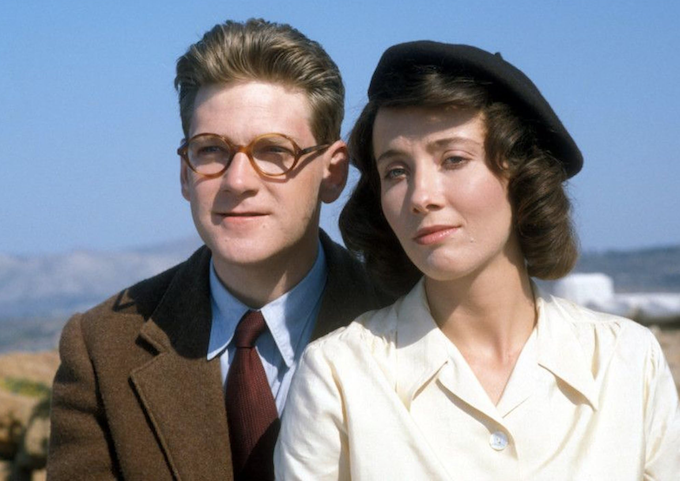
BBC adaptation of Manning’s novels, Fortunes of War, which starred Kenneth Branagh as Guy and Emma Thompson as Harriet.
Harriet, the wife of a humble teacher who’s unable to live a luxurious life, is bitter about the civilian atmosphere in wartime Cairo:
Cairo had become the clearing house of Eastern Europe. Kings and princes, heads of state, their followers and hanger-on, free governments with all their officials, everyone who saw himself committed to the allied cause, had come to live here off the charity of the British government. Hotels, restaurants and cafés were loud with the squabbles, rivalries, scandals, exhibitions of importance and hurt feelings that occupied the refugees while their waited for the war to end and the old order to return.
The war has a fatal effect on domestic life when Harriet’s friend Angela Hooper’s little boy is blown up after he touches a live grenade in the desert—a symbolic re-enactment of Manning’s own wartime miscarriage.
For Harriet, the uncertainty of war is a strong love potion and danger makes her want to seize the day. She twice comes close to a love affair with the handsome Charles Warden, a strong contrast to Guy, who becomes infatuated with her in Athens: “He was a different order of being. His function was not to preserve his own life but to protect the lives of others. She saw him as poetic, transfigured, like one of those sacrificial youths of the last war. He was a romantic figure, marked down for death.”
Harriet is supposed to leave Egypt on a ship to England for women and children, but at the last minute she impulsively decides not to sail. Instead, she joins a truck driven by Miss Mortimer who’s transporting military supplies to Damascus, and then goes south to Jerusalem. When the ship she should have taken is torpedoed, everyone in Cairo thinks she is dead, but the faithful wife returns alive and is miraculously reunited with Guy.
Many chance but convenient meetings in The Levant Trilogy tighten the complex structure, advance the plot and unite the disparate characters. Harriet’s Jewish friend Sasha Drucker, who’d been hiding in Bucharest, suddenly appears just as Harriet is about to have sex with Charles Warden in an Athens hotel. Aiden Pratt, the officer and peacetime actor, meets Guy Pringle in the Cairo bazaar and encounters Harriet in Luxor. Prince Yakimov meets Harriet in Athens and leads her to a clerical job in the British Embassy. Harriet meets Miss Mortimer, who’s driving a truck from Cairo to Damascus. The poet Castlebar meets Harriet in Damascus and drives her back to Cairo. Castlebar’s tough wife Mona suddenly appears and breaks up his liaison with Angela Hooper. Harriet unexpectedly turns up when Guy is teaching in Alexandria and, more dramatically, when she returns from the dead in Cairo.
In The Levant Trilogy the sudden and violent civilian deaths match the military fatalities. Manning’s beloved brother was killed in the war; Simon’s brother is killed in the novel. Simon is hospitalised for leg wounds, Harriet for amebic dysentery. The bold secret agent Foxy Leverett has been murdered in Bucharest. Angela Hooper’s child is blown up. Prince Yakimov is shot by a Greek security guard when lighting a forbidden cigarette during a blackout. Professor Lord Pinkrose is assassinated by an Egyptian revolutionary when he’s about to deliver his long-delayed lecture on Byron. Castlebar dies of a stomach disease. The bisexual Aiden Pratt, frustrated by his love for Harriet and for Guy, mysteriously shoots himself on a train.
Epilogue: Literary allusions that enhance the meaning of the novels.
The Danger Tree (1977)
103- “Yakimov, dead and turned to dust.”—“Imperious Caesar, dead and turned to clay,” Shakespeare, Hamlet, 5.1 (1603).
152- “the enemy will come down on us like the wolf on the fold.”—“The Assyrian came down like the wolf on the fold,” Byron, “The Destruction of Sennacherib” (1815).
The Battle Lost and Won (1978), whose title refers to Alamein.
“When the battle’s lost and won,” Shakespeare, Macbeth, 1.1 (1606) and
“The great result is the battle lost or won,” Wellington after the victory at Waterloo (1815).
Penguin edition 34- “Willing to wound and yet afraid to strike.”—Alexander Pope, “Epistle to Dr. Arbuthnot” (1735).
41- “Religion—the opium of the masses!”—Karl Marx, Critique of Hegel’s Philosophy (1844).
45- He is “one of us!”—“The man has become like one of us, knowing good and evil,” Genesis 3:22. Marlow calls the disgraced Jim “one of us” in Joseph Conrad, Lord Jim (1900).
153- “I wanted to change my life.”—“You must change your life,” Rainer Maria Rilke, “Archaic Torso of Apollo” (1908).
The Sum of Things (1980).
Penguin edition 87- “It has to be over fields. I want that green grass.”— Falstaff “babbled of green fields” in Shakespeare, Henry V, 2.3 (1606).
126- “If he be not kind to me, what care I how kind he be?”—George Wither, “The Shepherd’s Resolution” (1615).
In Cairo, Mr. Liversage, an elderly and eccentric English gentleman who’s collecting money for a wartime charity, pulls a furry wooden dog on wheels with a hole in its back for contributions. –-
In his Letters (1954), W. B. Yeats described the middle-aged Englishman in Nice who “led about a wooden dog on wheels and addressed all his conversation to the dog. Sometimes he took a photograph, then he would explain to the dog why it must stand in the foreground.”
Author’s Note: I knew Olivia’s husband Reggie Smith, who was the exact model for Guy Pringle and seemed to step right out of her novels. On several occasions, I followed Reggie as he raced around London, always late for his crowded schedule and missing several engagements.
A Message from TheArticle
We are the only publication that’s committed to covering every angle. We have an important contribution to make, one that’s needed now more than ever, and we need your help to continue publishing throughout these hard economic times. So please, make a donation.


