Two British chess record-breakers


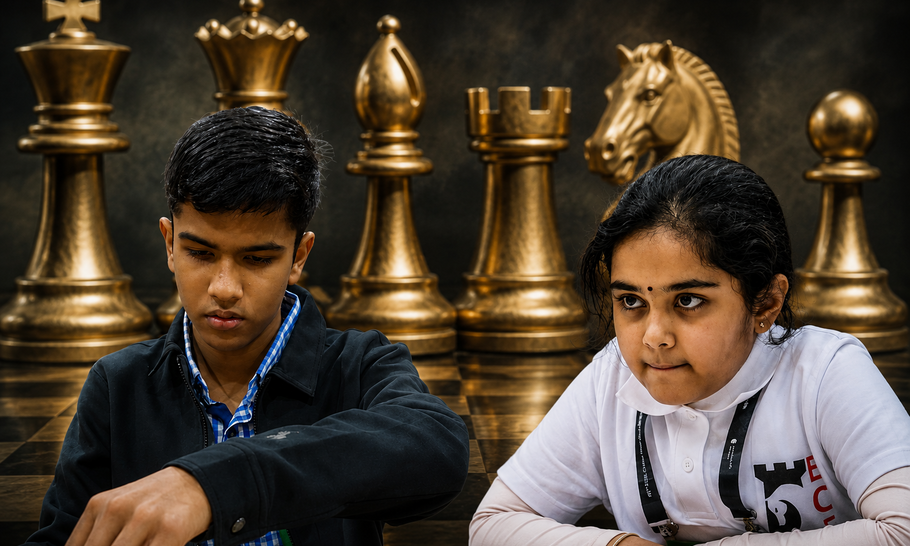
Records have fallen at the biggest-ever British Chess Championships. The nine-day event in the University of Warwick ended with something almost too neatly symbolic to have been invented: two record-breaking young stars of the game carrying away the two greatest prizes.
Seventeen-year-old GM Shreyas Royal won the overall British title. After nine rounds he stood at the summit of the table, half a point clear of two of England’s more seasoned grandmasters, GM Luke McShane and nine-time champion GM Michael Adams. It was Royal’s first British title, and the result confirmed what his progress had already suggested: that he is not merely a promising young player, but an emerging world-class talent.
Yet it is the astonishing achievement of another young superstar that has seized the headlines. England’s 11-year-old prodigy WIM Bodhana Sivanandan became Britain’s youngest-ever Women’s Chess Champion. Her only defeat in the tournament came against Royal himself in Round 6.
Then came the climax. In a tense rapid-chess playoff between the leading female players, Bodhana Sivanandan defeated Ireland’s 14-year-old Woman Grandmaster Trisha Kanyamarala, herself a hugely promising talent and the first Irishwoman to hold the WGM title.
Grandmaster Danny Gormally, commentating on the event for the English Chess Federation, said in the closing moments: “Unreal! Bodhana – ‘Godhana’ as I like to call her – has won. She is unbelievable, a generational talent.”
Gormally went further, predicting that Sivanandan will return in the next few years to challenge for the overall title.
Royal and Sivanandan therefore supplied a remarkable ending to the biggest British Chess Championship in the event’s 122-year history, with more than 2,600 entries across all events at the University of Warwick.
For Royal, the title is the latest great milestone in a rise through British chess that has been remarkable even by the standards of prodigies. The 17-year-old from south-east London became Britain’s youngest-ever grandmaster in 2024 and has since established himself as one of the country’s leading young players.
At this year’s championship he quickly demonstrated that the established elite were not an impregnable fortress. As the tournament proceeded, he moved into outright contention for the title. After seven rounds, Royal had taken the sole lead on 6/7, placing the teenager firmly at the centre of the championship race. His results against experienced opposition underlined his growing position at the summit of British chess.
Against Adams, the English chess legend, Royal took a quick draw in the penultimate round. Then, in the final round, he defeated International Master Harry Grieve and secured the title.
Thus Royal has converted promise into possession: his first British Championship title.
Sivanandan’s achievement is equally extraordinary and, in one respect, unprecedented. At eleven, she has become the youngest-ever British women’s champion after overcoming Kanyamarala in the playoff. In the faster forms of chess she is already the reigning UK Open Women’s Blitz Champion and joint British Women’s Rapid Champion. Victory in the classical event gives her an astonishing triple crown of titles.
Before the championship, Sivanandan had already been identified as the player to watch, with organisers highlighting her opportunity to break the record held by Elaine Pritchard, who won the British Women’s Championship outright in 1939 at the age of thirteen.
Akshaya Kalaiyalahan subsequently shared the title in 2013 when she was only days short of her twelfth birthday. Sivanandan has now surpassed them both.
The north-west London player has spent the past year rewriting the record books and establishing herself among Britain’s strongest female players, despite being only eleven. She also produced one of the championship’s standout results by defeating GM Ameet Ghasi.
Her playoff victory over Kanyamarala now adds the biggest domestic title yet to an already extraordinary list of achievements.
There is something particularly striking about the victories of Royal and Sivanandan. Both were among the young players attracting attention before the championship began; both are of British-Indian heritage; and both left Warwick as British champions. Their success is not merely a pair of individual triumphs. It is also a small portrait of the changing face of British chess.
The 2026 championships were billed as the biggest in the event’s 122-year history, and they carried a record £34,000 prize fund for the open championship. The women’s prize fund was more than doubled, while the organisers expanded the festival programme with junior training, social events and competitions for players ranging from under-8s to seniors.
The tournament consequently brought together several generations of chess: established grandmasters on one side of the chronological board, and some of Britain’s most promising juniors on the other.
And here, perhaps, is the appropriate moment to introduce a phrase I have specifically used in previous articles for British chess coach and author Julian Simpole: Praeceptor Britanniae, “Teacher of Britain”.

Julian Simpole
The title is a playful historical nod to Dr Siegbert Tarrasch, the legendary German chess master who was famously called the Praeceptor Germaniae, “Teacher of Germany”, on account of his systematic educational chess books.
Let us therefore consider Julian Simpole’s profound impact on modern British chess talent.
Simpole has coached elite British talent from a young age, including Grandmasters David Howell and Luke McShane.
We can credit Simpole with early training that helped Shreyas Royal break records and become the youngest-ever British Grandmaster at just fifteen years old.
And beyond teaching, Simpole actively navigated the UK visa entry system alongside myself to ensure that young international prodigies like Royal could stay and compete in the UK.
There is a curious history behind the Tarrasch title. Steinitz’s ideas were later taken up, systematised and popularised by the German grandmaster and teacher Dr Siegbert Tarrasch. In doing so, Tarrasch earned for himself the title Praeceptor Germaniae, a phrase best rendered as “the Lawgiver from Germany”.
He was a lucid and methodical teacher. But he also suffered from a strain of dogmatism that recalls both Marx and Freud. For readers able to approach Tarrasch and Freud in the original German, the stylistic resemblance between these two major German-Jewish thinkers is unmistakable.
This dogmatism is nowhere more evident than in Tarrasch’s otherwise admirable manual Drei Hundert Schachpartien (“Three Hundred Games of Chess”). There he launches a ferocious attack on the move 3. Nd2 in the French Defence, after 1. e4 e6 2. d4 d5—a move with which he himself had earlier enjoyed considerable success.
Tarrasch declares that after 3… c5 Black can force the creation of an isolated queen’s pawn and that, therefore, 3. Nd2 is “refuted”. There is no discussion and no allowance for dissent. He uses the verb widerlegen, which admits of no ambiguity: it means “to refute”.
And here chess supplies one of those little ironies of history which it seems almost specially designed to produce. The variation remains popular to this day and even bears Tarrasch’s name; only his supposed refutation has been quietly forgotten.
Dogmatism, it should be said, is not without its uses in teaching. An emphatic and single-minded approach can sometimes drive a lesson firmly into the mind. But taken too far, it becomes an obstacle rather than an aid. Modern instruction, if it is to be effective, must be more flexible and more pragmatic.
At this point a brief digression is in order: a small horror story from the world of chess coaching.
Some years ago, a promising young prodigy asked to play a game against me, on the understanding that I would “give no quarter”. After only a few moves, the boy calmly reversed the development of a piece he had just brought into play. The game did not last much longer.
Under questioning, the eight-year-old admitted that a coach—clearly out of his depth—had persuaded him to imitate prematurely the kind of hyper-refined subtlety that properly belongs to players mature enough to understand the apparent paradoxes of a Nimzowitsch, a Karpov, or a Carlsen.
There is an important lesson here. Chess is full of ideas which are perfectly sound when understood and perfectly absurd when merely imitated. A child can be taught the shape of a sophisticated idea long before he can be taught the reason for its existence. It is rather like giving a child the keys to a philosophical library and then wondering why he has begun speaking in footnotes.
Impressive as the achievements of McShane and Howell are, Julian Simpole’s greatest success may yet prove to be his work with Shreyas Royal, who has, as we have seen above, just secured first prize with a 2700-plus performance in the 2026 British Championship.
And so we arrive at the curious conjunction with which this championship has ended.
At the end, the two names at the top of the results were Royal and Sivanandan.
In the latter’s tie-break against Kanyamarala, the match consisted of two games. After a draw in the first, Sivanandan had white in the second.
Sivanandan vs. Kanyamarala
British Championship Women’s final, Coventry, 2026, tie-break 2
- e4 c5 2. Nf3 e6 3. g3 d5 4. exd5 exd5 5. d4 Nf6 6. Bg2 Be7 7. O-O O-O
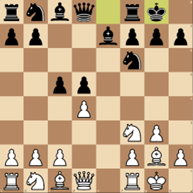
8. Nc3 Nc6 9. dxc5 d4 10. Na4 Bg4 11. h3 Bh5 12. b3 Ne4 13. Bb2 Bf6 14. Re1 Re8 15. g4 Bg6 16. Nd2 Nc3 17. Bxc3 Rxe1+?
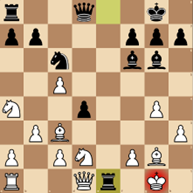
It is stronger to recapture immediately with 17… dxc3.
- Qxe1 dxc3 19. Ne4 Bxe4 20. Qxe4?
Any recapture is a weaker option, but this recapture is even weaker than 20. Bxe4. White should play 20. Rd1 Qe7 21. Qxe4 Rd8 22. Rxd8+ Qxd8 23. Qd5 with the advantage.
20… Qd2 21. Re1 h6 22. Qe2?
Offering to return the advantage to black. Necessary was either 22. Re2 or Re3.
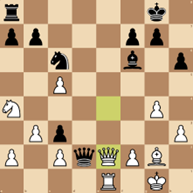
22… Qd7?
Black not only fails to exploit white’s last inaccuracy with 22… Nd4 23. Qe3 Bg5 24. Qxc3 Ne2+ 25. Rxe2 Qxe2, but gifts white a possible advantage after either 23. Bxc6 or Qe3…
- Rd1?
…an offer to which white seems oblivious.
23… Qc7?
It was not too late for black to secure equality once again after23… Re8 24. Rxd7 Rxe2 25. Rxb7 Re1+ 26. Bf1 Rc1 27. Rc7 Ne5 28. Rc8+ Kh7, but after the move played, white now enjoys a considerable advantage.
- Qe3 Bd4??
Presenting white with an powerful material advantage after the offer of two pieces and a pawn for the exchange. An uncomfortable but defensible position was available after both 24… Bg5 or…Nb4.
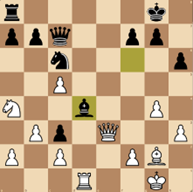
- Qf3?
Inexplicably, white fails to take advantage with 25. Rxd4 Nxd4 26. Qxd4 Re8 27. Bd5, when white’s advantage is enormous. The move played allows black back into the game at only a slight disadvantage.
25… Rd8 26. Nxc3 Ne5 27. Qg3 Qxc5 28. Kh1 Rd7 29. Ne4 Qxc2?
Correct are either 29… Qc7 or …Qe7. White has once again, a comfortable advantage.
- Rxd4 Rxd4 31. Qxe5 Rd1+ 32. Kh2 Rd8 33. Qf4 b6 34. Ng3?
White maintains her initiative best with 34. Bf1 Qc6 35. Bc4 Qb7 36. a4.
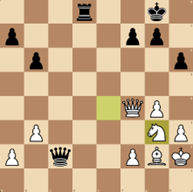
34… Qc5?
Black fails to take advantage of white’s sub-optimal last with 34… Qxa2 35. Nf5 Qd2 36. Qe5 Qg5 37. Bf3 Qf6, after which she is worse off, but considerably less so.
- Be4 Qd6 36. Qf3 Qe5?
36… Qd1 37. Kg2 Qxf3+ 38. Kxf3 b5 was necessary to retain even a marginal chance of staying in the game. After this final error, White demonstrates a sound technique over the remaining moves, to finish with an elegant flourish.
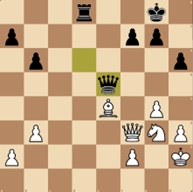
- Kg2 g6 38. h4 Kg7 39. h5 Qf6 40. Qe3 Qd4 41. Qe2 Qd2 42. Qf3 Rf8 43. Bd5 Qg5 44. Qc3+ Qf6 45. Qc7 Qd4 46. Bf3 Qc5 47. Qxa7 Kg8 48. Ne4 Qd4 49. Qe7 Qd8 50. Qe5 Qb8 51. Qf6 Qd8 52. Qe5 Qb8 53. Qb2 Rd8 54. Nf6+ Kf8 55. Nd7+Black resigns 1-0
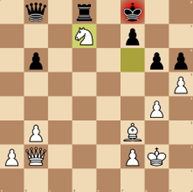
After 55… Rxd7 is played, the skewer 56. Qh8+ guillotines the queen and wins the game.
Shreyas Royal vs. Luke McShane
British Championship, Coventry, 2026, round 7
- e4 e5 2. Nf3 Nc6 3. d4 exd4 4. Nxd4 Nf6 5. Nxc6 bxc6 6. e5 Qe7 7. Qe2 Nd5 8. g3 g6 9. Bg2 Bg7 10. c4 Ba6 11. O-O O-O 12. Re1 Rfe8 13. Qc2 Qc5 14. Nd2 Bxe5 15. Bf1 Nb6 16. Nb3 Qf8 17. Be3 Na4 TN
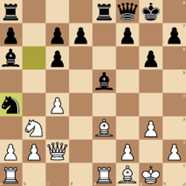
Up until now, we have been following another game which here featured the slightly superior 17… d5, with the game drawn after 30 moves [Chen-Dai, Xinghua, 2026].
- Rad1 d5 19. cxd5 Bxf1 20. Rxf1 Nxb2?
A serious error resulting in white having a meaningful advantage. It was possible for black to maintain equality after 20… cxd5 21. Rxd5 Nb6 22. Rd2 Qb4 23. Bh6 Nc4 24. Re2 Bd6 25. Re4 Rxe4 26. Qxe4 Nb6 27. Qxb4 Bxb4.
- Bc5 Qg7 22. Rd4 a5!
But not 22… Bxd4 23. Bxd4 Qf8 24. Bxb2 cxd5 25. Qxc7 Re2, which is losing.
- Qxb2 a4 24. Nc1 Ra5 25. Re1 Rxc5 26. Nd3 Rb5 27. Qc2 cxd5?
This recapture is a mistake. Better was 27… Qf6 28. Rde4 Rxd5 29. Qe2 Rxd3 30. Qxd3 Rd8 31. Qa3 Rd5 after which black remains worse, but no more so.
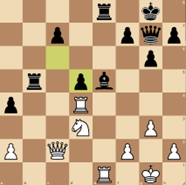
- Qxa4 c6 29. Rxe5 Rxe5 30. Qa8+ Qf8 31. Qxf8+ Kxf8 32. Nxe5 Rb1+ 33. Kg2 Rc1 34. a4?It is a sign of white’s advantage that this mistake hardly sees him break stride. However, the best continuation was 34. Rf4 f5 35. a4 c5 36. a5 Ra1 37. Nd7+ Ke7 38. Nxc5 Rxa5 39. Nd3.
34… f6 35. Nd3 Rd1 36. a5 Ra1 37. Rf4 Ke7 38. Nc5??
The clinical finish is with 38. Nb4 f5 39. Nxc6+ Kd7 40. Nb4 Rxa5 41. Rh4 h5 42. Rd4, after which black is clearly lost.
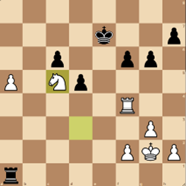
Black resigns 1-0
It was possible for black to continue with 38… Rxa5 39. Nb3 Ra3 40. Rf3 Ra4 41. Re3+ Kd6 42. Re8 Rb4 43. Nc1 g5 44. Rd8+ Ke6 45. Nd3 Rb5 when, despite white standing better, he is yet some way from demonstrating a winning advantage.
Finally, Chess has returned to Simpsons in the Strand in a wonderful tribute to the venue’s 19th Century origins. I append the information from their website:
‘How are Jeremy King’s chess skills? Some of us may be about to find out. Now that Romano’s upstairs at Simpsons in the Strand has been up and running for a bit, our chess lovers are coming out in full force.
AFTERNOONS AT ROMANO’S
And on that note, we would like to invite you all to join us to play chess every day at Romano’s from 3-6 p.m. Here’s what you need to know. We supply the boards; you provide the moves. Bring a friend, watch the action, and get involved — the more players, the merrier. (And the fiercer the competition.)
A GAME THAT DESERVES PROPER REFRESHMENTS
Should you require refreshments or sustenance, our entire Grand Café-style menu will be at your disposal, along with our cocktail list and wine selection. (The Gambit, with Vault Coastal vermouth, manzanilla sherry, and grapefruit bitters, may inspire you to think extra creatively.) You are welcome to simply show up, but should you like to let us know in advance, we’d be most appreciative’.
Ray’s 206th book, “ Chess in the Year of the King ”, written in collaboration with Adam Black, and his 207th, “ Napoleon and Goethe: The Touchstone of Genius ” (which discusses their relationship with chess) can be ordered from both Amazon and Blackwell’s. His 208th, the world record for chess books, written jointly with the late chess playing artist, Barry Martin, Chess through the Looking Glass , is now also available from Amazon.
A Message from TheArticle
We are the only publication that’s committed to covering every angle. We have an important contribution to make, one that’s needed now more than ever, and we need your help to continue publishing throughout these hard economic times. So please, make a donation.


