Eliot in his letters

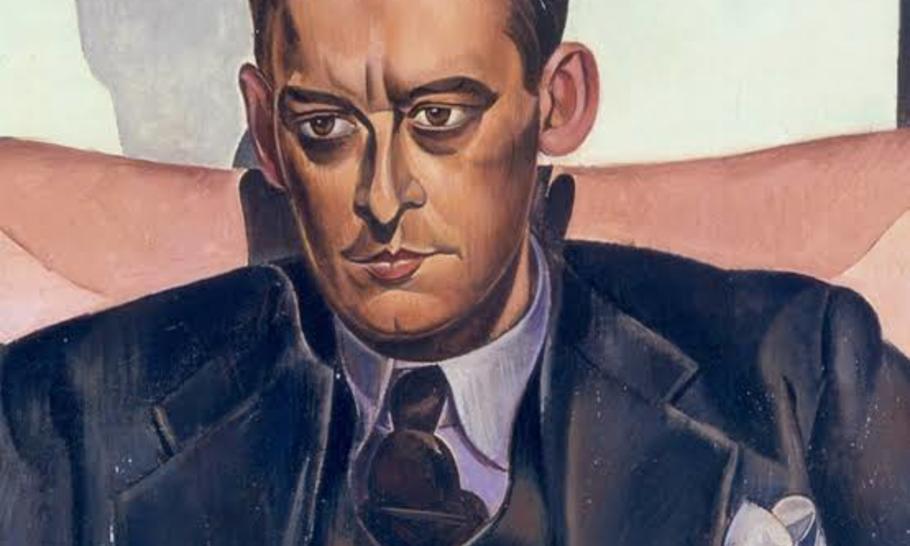
Wyndham Lewis photo by George Charles Beresford 1913
T. S. Eliot, the consummate New England puritan, never exposed the pageant of his bleeding heart. Asked whether he was an American or an English writer, he evasively replied, “That is a very difficult question to decide, and I submit that I am in no better position to answer it than anyone else.” Like his poetical Prufrock, he was “Deferential, glad to be of use, / Politic, cautious and meticulous.” He modestly apologised for delays and errors, and confessed, “I am well aware of grave dramatic effects” (should be “defects”) in Murder in the Cathedral (1935). When struggling with The Family Reunion (1939) he said, “I am trying to write a play, but it is very difficult, irritating when interrupted and tedious when not interrupted,” and admitted: “I am not certain of all of my entrances and exits.”
He was usually formal and correct, and also wrote letters in French, composed humorous cat poems for children, imitated Ezra Pound’s weird backwoods dialect and unleashed obscene parodies. He could be paradoxical: “most of the subjects we discuss are of the kind that are almost too serious to be urgent.” He unintentionally told the Librarian for the Blind that his letter was delayed due to an “oversight”. After a weekend visit, he wittily observed that “everything was civilised except the dachshund”.
A High Church Anglican, extremely respectful to theologians and bishops, Eliot asked one expert, “Do you know a good book on Original Sin?” As Churchwarden he had “to check the week’s cash receipts after church in the evening.” He recommended applicants for teaching positions and helped the needy. He bought a made-to-order wheelchair for his disabled close friend John Hayward. The hospitalised ex-policeman W. L. Janes, who was his manservant, and the promising young poet George Barker were his principal beneficiaries. He noted that Barker had “just put out his brother’s eye with a fencing foil”.
As editor at Faber he told impatient writers, “Any manuscript that is not immediately rejected has to be read by two or three directors,” and “I am very slow in making up my mind about poetry, and like to read poems several times, at considerable intervals.” Since he found it “disagreeable to be disobliging,” his rejections were tactful and accompanied by valuable editorial suggestions. He warned poets not to add words merely for metrical necessity. He advised them to withhold their work until their talent had matured and they could write superior poems. He rather cryptically observed that one book “is good enough not to be published” and “I like the book myself, but I think that now and then there is such a thing as a very good book which there is no point in publishing.” These vatic remarks offered no consolation to aspiring authors.
Instead of ignoring a request from an obtuse schoolmaster, the well-tempered poet lost his temper and replied: “I do not like the idea of people making heartbreaking efforts over poetry, and I think the desire to understand often stands in the way of understanding. Your question whether you have been brazen is irrelevant, and indicates a self-consciousness which is not desirable.” He asked his senior partner Geoffrey Faber to respond to James Joyce’s importunate intermediary Paul Léon: “Will you be dealing with this? You can control your temper better than I can.” But he informed Joyce about his dicey hometown reputation: “I had a pleasant time in your native city, a large part of the population of which seems anxious to erect a monument in your honour, and another part still anxious to forget your existence.”
Eliot spent a lot of time and trouble publishing the difficult lesbian novel of the ungrateful Djuna Barnes. Geoffrey Faber told Eliot and their colleague Frank Morley, “What distresses me is that I should have so completely failed to see what you both see in Nightwood” (1936). Noting the scandalous scenes, Eliot warned Barnes, “It is just possible that the book might be prohibited, in which case we should have a considerable loss.” Mild and coaxing, as if talking to an adolescent, he told the author, “Now then Djuna don’t be a Goose.” He later told his confidant John Hayward, “At any rate, we shall have got Djuna over with, and anything else will seem like child’s play after that.”
Absorbed in his work during the tumultuous 1930s, he wrote nothing significant about Nazi Germany and the Spanish Civil War, and concluded, “Germany is mostly not very interesting.” In May 1937, Eliot toured Hitler’s haunts: “spent a day in Berchtesgaden, and an afternoon in Munich, interesting.” A year later he met and was impressed by the Portuguese dictator António Salazar.
The editing of The Letters of T. S. Eliot, Volume 8, 1936-1938 by the late Valerie Eliot and John Haffenden (Faber & Faber, 2019, 1,100pp, £60) is superb. This volume, covering the
time when Eliot was aged 47 to 50, includes a 23-page chronology and 35 pages identifying the major correspondents. I knew ten of these men and can attest to the accuracy of the descriptions. The witty note on the philosophical critic Kathleen Raine reads: “Briefly married in 1929 to Hugh Sykes Davies, she then married Charles Madge, though that marriage was almost as short-lived.”
The concise note on the cheeky and changeable Denise Levertov, who sent her poems to Eliot when she was 13, reads: “British born poet, critic and political campaigner, daughter of a Russian Hasidic Jew-in-exile who became a serving Anglican priest as well as an editor and leftist activist. In 1955 she became a naturalised American citizen; and in her later years she became a Christian and then converted to Roman Catholicism.”
New information could be added to the notes. Page 533- Angus Davidson died in 1980. 367- “H.M.V.” “not traced” means His Master’s Voice phonograph. 206- Vivien’s “French home” was the Sanatorium de la Malmaison near Paris. 1007- “Shall we ever meet again?” echoes Macbeth (1.1): “When shall we three meet again?” 163- Eliot’s quote “smite once and smite no more” refers to Milton’s “Lycidas” rather than to Genesis. The “two-handed engine at the door” that stands ready to smite no more was a huge two-handed broadsword drawn by Leonardo.
In these letters Eliot’s main subjects were his strange and estranged wife Vivien and his would-be consort Emily Hale, his religion, plays, translations and portrait. He dealt tactfully with the difficult James Joyce, Djuna Barnes and Ezra Pound. He published many serious books at Faber, and edited the conservative quarterly The Criterion, which first paid £1 a page and later £2 per thousand words. He received £500 annual salary for this arduous double employment.
Always generous and helpful, he noted that “a large proportion of my time is spent acting as psychiatrists, labour exchange, school of journalism and authorship, spiritual legal & medical advisers and soup kitchen.” Though always on the lookout for extra cash, he found lecturing, when the agency takes more than half the profits, extremely tiring and not worth the effort: “Unless poverty compels, I have no wish to reappear on the lecture platform.”
Eliot lamented, “I was too much engrossed in the horrors of my private life to notice much outside; and I was suffering from a feeling of guilt in having married a woman whom I detested, and consequently a feeling that I must put up with anything.” Vivien characteristically complained to Geoffrey Faber about what she called “needless acts of rudeness and hostility”: “Tom is good enough to be Director of your Firm, a Godfather to your child. Isn’t he good enough for you to take the trouble to forward a card of invitation to an Exhibition of Pictures?”
She also wrote hysterically to her brother Maurice Haigh-Wood: “I get so sick and nauseated by the sentimental fug and slop of England that I await eagerly the time when I shall be able to leave it for good. And of course it is mad to have to say such a thing.” Writing in the guise of a friend, Vivien told Eliot’s solicitors: “I have been very much upset and shaken by what I told you about Mr. T. S. Eliot, it would un-nerve Mrs. Eliot so much if she knew, that I am only thankful that she is out of the country.” Another letter to Faber was paranoid: “I am OSTENTATIOUSLY FOLLOWED by persons who have no claim on me, & whose acquaintance I deny. They are the enemies & the parasites of my husband and myself & no friends to your household.” Eliot’s secretary, who had to protect him from Vivien’s invasions, called her “a slight, pathetic, worried figure, badly dressed and very unhappy, her hands screwing up her handkerchief as she wept. Meanwhile, Eliot slipped out of the building, and on return would be on edge for the rest of the day.”
In July 1938, Vivien was found wandering in the streets at 5 o’clock in the morning and taken to the Marylebone Police Station. Maurice told Eliot about her fantasy of revenge: “She is full of the most fantastic suspicions & ideas. She asked me if it was true that you had been beheaded. She says she has been in hiding from various mysterious people.” The following month she was “certified of unsound mind” by two doctors and confined to an insane asylum. Her mad Vivisexion hurt Eliot into poetry. Tom and Viv (1994) is a perceptive film about Eliot’s disastrous marriage.
Emily Hale, an American academic and Vivien’s heir apparent, was the absolute antithesis of his mad wife. Eliot portrayed the prissy and repressed Emily as “very much changed, chiefly in the lack of any animation, in a kind of numbness to the external world, a narrowing of her field of awareness, and a tendency to think about her own shortcomings all the time. In a person who ordinarily gives out so much to others, this is very painful.” Emily must have been more guarded when she finally realised that Eliot would never respond to her long-nurtured and painfully repressed feelings. John Hayward felt that Emily was a most unsatisfactory candidate for marriage and dismissed her as “a grim, prim, schoolmamish female who takes a dreadful proprietary interest in poor Tom!” Eliot’s letters to Emily, sealed until 2020 and not published in this volume, are now available and free online.
Eliot was perceptive about his contemporaries. He told the poet John Betjeman, his former pupil: “I am interested that you should think that perhaps you remember me at Highgate [School], if you really do. I didn’t enjoy myself very much there either.” He admired the learned
Edmund Wilson and declared: “I have great respect for him as a writer and like him as a man.” And he exploded the fatuous “E. M. Forster tenet of ‘personal relations’ being the most important thing in life as sentimental heresy—D. H. Lawrence saw much deeper than that.”
Eliot’s old friend Ezra Pound was even more difficult to deal with than Djuna Barnes: “He is such a proud and touchy man that a well-meant intervention may only incense him more.” So he condescended to imitate Pound’s oddball style, alluding to his town in Italy and his interest in Chinese culture: “To the Worshipful Ez Po: Hon. Mayor of Rappaloo in the 2000th year of the Sung Dynasty, a Saloot of 21 Guns and a pinch of Mustard Gaz” to control him. “Goddamb it, I have had a hell of a time lately what with the jobs they give me to do, reading mss and cleaning latrines.”
He vainly tried to tame the enthusiasms of Pound, who was besotted by the crackpot economics of Major Douglas and the politics of Mussolini, by awarding Ez the title of Podestà, a fascist official. Ezra warned Eliot about his interest in Gertrude Stein and called him “a damn fool to fuss over the ‘ole tub of guts.’ ” Eliot admitted, “I wouldn’t ask anybody to break his heart reading” Robert Bridges’ tedious Testament of Beauty (1929), and Pound planned to call his satiric article on the poem “Testicles versus Testament, an embalsamation of the Late Robert’s Britches.” But this Tom-foolery and companionable jesting often prevented any serious discussion. Eliot complained that the meaning of Pound’s chaotic scribbling “is not quite clear to me, even with my intimate knowledge of his style,” and desperately told his pen-pal, “I am trying to decipher your correspondence.”
Later on, in 1957, Eliot declared: “Wyndham Lewis was in my opinion one of the few men of letters of my generation whom I should call, without qualification, men of genius. I had always regarded his genius with admiration, and had always found his conversation stimulating.
Every serious painter and writer in England is as much in debt to his integrity, and to the originality and strength of his vision.” But in April 1938, Lewis’ impressive portrait of Eliot was rejected by the Royal Academy, and unfortunately exiled to Durban, South Africa.
In May 1938, Eliot went to Portugal, an ally of the fascists during the Spanish Civil war, to accept the Camõens Prize. He arrived ten minutes after a railroad accident and saw “the victims being scraped off the locomotive”. He found the Latin hospitality overwhelming and didn’t know how he could survive another week of it. He was fascinated by the mechanical bidet in his bathroom, and explained that he had made a great sacrifice for England by eating a disgusting delicacy: Portuguese pork fed with fish.
As war threatened, 1938 marked a major turning point in Eliot’s life. He had safely confined the dangerous Vivien and ended The Criterion in January 1939, admitting, “It is impossible to run a one-man show like this for fifteen years without feeling that it is going stale.”
Eliot emerges from these letters as a wise and kind man, habitually polite, modest, generous, self-abasing and self-scourging; as a brilliant, congenial, humane, sympathetic and long-suffering poet.
Jeffrey Meyers has recently published James Salter: Pilot, Screenwriter, Novelist and Parallel
Lives: From Freud and Mann to Arbus and Plath (2024), Forty-Three Ways of Looking at Hemingway (2025) and The Biographer’s Quest (2026).
A Message from TheArticle
We are the only publication that’s committed to covering every angle. We have an important contribution to make, one that’s needed now more than ever, and we need your help to continue publishing throughout these hard economic times. So please, make a donation.


