Mozart and the comedy of chess


Having completed last year my annual pilgrimage to Glyndebourne for their new version of Le Nozze di Figaro , I finally realised what this particular opera by Mozart is really about. Figaro himself begins by describing his rivalry with Count Almaviva in the language of a dance:
“ Se vuol ballare, signor contino, il chitarrino le suonerò… ” (Act I, Scene II) Or, in English: “ If you want to dance, my little count, I’ll play the little guitar for you.”
And yet, beneath the dancing, the whole plot is really a game of chess. One player makes a move, the other replies; a thrust is met by a parry, and what appears to be a romantic comedy is conducted with something very like the cold logic of a chessboard. The two principal players are Count Almaviva and Figaro.
The Count’s object is, in effect, to achieve checkmate by restoring his “feudal rights” and seducing Susanna before she can marry Figaro. Figaro’s victory comes when he can reach the secure square of marriage to Susanna, still virgo intacta, and so rescue her from the lascivious attentions of the Count.
The amusing thing is that neither player has sufficient resources of his own, and so both recruit the other characters as pieces in their private game. The Count has Marcellina, Bartolo, Basilio, Don Curzio and Antonio at his disposal. Figaro, on the other hand, has Susanna, the Countess, Cherubino, Barbarina and the chorus of peasants. They are not merely supporting characters; they are the living chessmen through wh om the two men conduct their battle.
One of the clearest examples occurs in the Countess’s private rooms. The Count believes that he has trapped the priapic Cherubino in his wife’s closet. Susanna, with the sort of presence of mind that is almost a separate character in the opera, insinuates herself into the threatened space. Cherubino then escapes by jumping from the Countess’s window.
But the escape has been witnessed by Antonio, the inebriated gardener, who now inconveniently enters the game. Figaro blocks this new attack by claiming that it was he who jumped from the window. The Count counters by producing Cherubino’s papers as evidence that it must have been Cherubino. Figaro parries again, pointing out that Cherubino’s military commission is unstamped and explaining that the young man had asked him to have the omission corrected.
And so it goes on. Move, countermove; thrust, parry; attack, defence. It is chess, but chess played by people who happen to be singing.
There is something particularly appropriate about this resemblance between Mozart and chess. Mozart (1756–1791) and the great French chess master and composer of operas, André Danican Philidor (1726–1795), were contemporaries. They both belonged to those extraordinary pre-revolutionary years when the ancien régime was still capable of combining music, manners, mathematics and absurdity without seeing any contradiction between them. These were also the days of living chess on the lawns of Versailles.
Pierre-Augustin Caron de Beaumarchais (1732–1799), the French dramatist whose Figaro plays provided the basis for both Le Nozze di Figaro and Rossini’s Il Barbiere di Siviglia , was another contemporary of both Philidor and Mozart. Beaumarchais was one of those wonderfully improbable eighteenth-century men who seem to have regarded having one profession as an unnecessarily narrow limitation. At various times he was a diplomat, watchmaker, inventor, musician, spy, publisher, arms dealer and revolutionary, taking part in both the French and American revolutions. Beaumarchais is buried in Paris, Philidor in London and Mozart in Vienna.
The three men therefore ended up in three different cities, but they belonged to the same remarkable age: an age in which a chessboard could be a theatre, a theatre could be a political battlefield, and a political battlefield could occasionally resemble a comedy.
Last month I was in Glyndebourne again, this time for Mozart’s Entführung aus dem Serail , and it struck me that, to a considerable extent, Entführung is a practice run for Mozart’s last opera, Die Zauberflöte .
The resemblance begins with the fact that both libretti are in German. Both Belmonte and Tamino are on a quest, ostensibly to liberate Konstanze and Pamina. Both young men must endure a series of death-defying tests and tribulations. Both operas include comic relief: Pedrillo in Entführung and Papageno in Zauberflöte. Each of these comic figures is supplied with a humorous female counterpart, Blonde and Papagena.
Then there are the villains. The evil functionary Osmin in Entführung finds his counterpart in the lust-driven servant Monostatos in Zauberflöte . And finally there is the most interesting parallel of all: Pasha Selim corresponds, in a rather different form, to Sarastro, the Master of the Zauberflöte brotherhood , modelled on the Freemasons .
Both of these figures initially appear morally ambiguous. Both, however, are eventually revealed as representatives of the Enlightenment, and both are finally surrounded by the kind of operatic praise which leaves no doubt that the composer has decided they are on the right side of history. The Enlightenment may have had its philosophers, but Mozart gave it something much better: an orchestra.
With such a profound commitment to the harmony of music and Enlightenment ideals, one might reasonably have expected Mozart actually to have played chess. Sadly, there is no record of this. There is, however, evidence of chess in the household of Mozart Père.
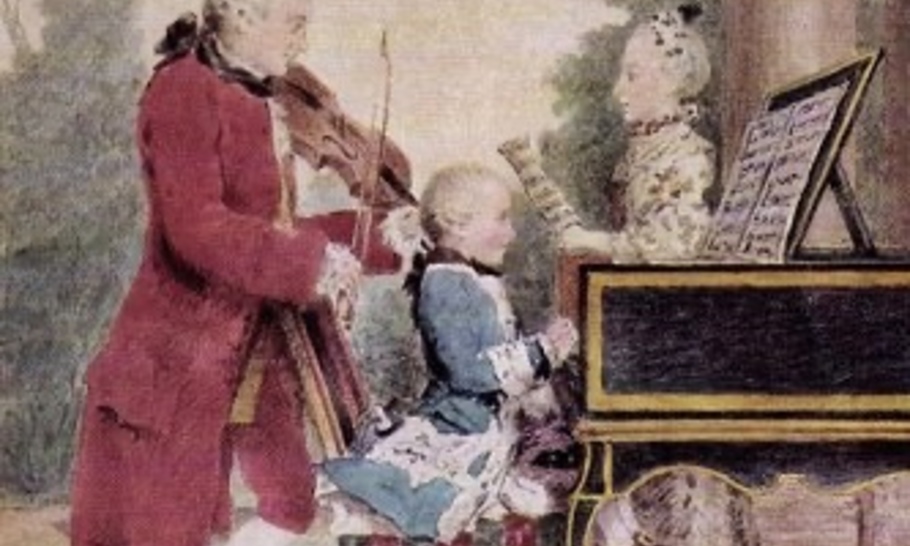
Wolfgang Amadeus Mozart’s sister Maria Anna, known as Nannerl, was the first specifically documented female chess player in their home town of Salzburg. Indeed, chess seems to have had a more substantial presence in the Mozart household than the absence of any record of Wolfgang playing the game might suggest.
I am indebted to Franz Hager of ChessBase for the following information about Nannerl.
Leopold Mozart (1719–1787), Wolfgang’s father and Vice-Kapellmeister, mentioned the matter in 1784 in a letter to Mozart’s patroness, Baroness von Waldstätten. In his later years he spent time with his daughter Nannerl, then thirty-three years old, and played chess with her. This was none other than Wolfgang Amadeus’s much-loved sister Maria Anna, herself a gifted pianist, although, like so many people who happened to be born into the same family as Mozart, she was destined to be overshadowed by her brother.
Leopold wrote:
“Reading, music and a walk are our entertainment, and in bad weather we play Tarock (a card game) and even an occasional game of chess.”
The quotation is modest, but it is rather delightful. Chess is not treated as some grand intellectual pursuit. It is simply something that people do when the weather is bad. There is something very Mozartian about that: music, walking, cards and chess, all gathered together as ordinary parts of domestic life.
Leopold Mozart was born in Augsburg and began studying in Salzburg in 1737. Among his possessions was a chess book Leopold himself had written an influential textbook on violin instruction in 1756. The Mozarts had therefore acquired not merely a passing acquaintance with chess, but at least some theoretical understanding of the game.
The title of the work they owned was Essay on the Game of Chess , in which rules were given for playing well and gaining an advantage through fine moves which might properly be called the secrets of the game. It was written by Philippe Stamma, a native of Aleppo in Syria.
Nannerl’s own life, meanwhile, had little of the neatness of a chess problem. Her desired love match was denied to her and she was obliged instead to make what was considered a financially suitable marriage. She married her older, honest and noble husband, Berchtold zu Sonnenburg (1751–1829), but the two never really understood one another.
As a piano teacher, she later lived in St. Gilgen am Wolfgangsee (the favourite resort of the late German Chancellor, Helmut Kohl) and in Salzburg. She had three children of her own. It is also thanks to Maria Anna that many of her brother’s letters and works survived. There is something rather moving about the fact that the sister who was overshadowed by Mozart should have helped preserve so much of Mozart for posterity.
As to Wolfgang Amadeus Mozart himself , there is still no record of his playing chess. There is, however, abundant evidence that he was fond of puzzles, number games and decipherable language games. He also enjoyed various card games, in which many scholars believe he gambled considerable sums, as well as billiards.
Perhaps chess simply failed to catch his fancy. Or perhaps the evidence has been lost, which is always a danger when dealing wit h the eighteenth century. A man can leave behind hundreds of musical works and still leave us wondering whether he once sat down at a chessboard.
Professor Günther Bauer has intensively researched the games played in Mozart’s lifetime . The Salzburg Institute for Game Research has published books on the subject. Unfortunately, most of the letters from Wolfgang’s time in Vienna have been lost. We know that he liked visiting the premises in Vienna’s Prater and Augarten in the second district, but the question of Wolfgang Amadeus Mozart’s actual ability at chess, and how frequently he played it, remains open.
And perhaps that is just as well. For if Mozart had been a great chess player, we might be tempted to explain his music by reference to chess. We would look for the opening gambit in Figaro , the middle game in Don Giovanni and the endgame in Die Zauberflöte . We would discover elaborate strategies where there were really only melodies, and treat every musical surprise as though it were a concealed move on the board.
The truth is probably more interesting. Mozart may never have played chess at all, yet he understood perfectly the thing that makes chess, comedy and opera resemble one another: the pleasure of seeing one human being make a move and another human being discover, often too late, that there is a reply.
Take a seat and enjoy the music!
Bobby Fischer vs. Boris Spassky
World Championship final, Reykjavik, 1972, game six
1. c4 e6 2. Nf3 d5 3. d4 Nf6 4. Nc3 Be7 5. Bg5 O-O 6. e3 h6
This is the Tartakower Variation, really a modernised version of the old Orthodox Defence to the Queen’s Gambit. According to theory it is playable. Spassky had used it often before and it was a favourite of both Karpov and Kasparov. More recently, it has been deployed by Ding, Vachier-Lagrave and Abdusattorov.
7. Bh4 b6 8. cxd5 Nxd5 9. Bxe7 Qxe7 10. Nxd5 exd5 11. Rc1 Be6
This is the paradoxical point of the Tartakower Variation. One might have expected 11… Bb7 here, but in fact the bishop is better placed on e6.
12. Qa4 c5 13. Qa3 Rc8 14. Bb5 a6?!

An improvement found later is 14… Qb7 15. dxc5 bxc5 16. Rxc5 Rxc5 17. Qxc5 Na6! with good play for the pawn [Timman-Geller, Hilversum, 1977].
15. dxc5 bxc5 16. O-O Ra7 17. Be2 Nd7 18. Nd4
A clever use of the pin to improve the position of his pieces. Fischer is playing with wonderful finesse.
18… Qf8 19. Nxe6 fxe6 20. e4!
A beautifully incisive move which reminds one in a forthright way that White is a player in the great American tradition: in a direct line from Morphy via Pillsbury to Capablanca. Black will now have to yield up command of at least one diagonal.

20… d4?
Black’s response to the incision is an inapposite error when perversely almost all of the available alternatives are superior, for example, 20… dxe4 21. h3 Qf5 22. f4 Kh8 23. Bg4 Qd5 24. Rfd1 Qc6 25. Qb3 Re8 26. Qe3 Rb7 27. b4 c4 28. Rd4; or, 20… c4 21. Qh3 Nc5 22. Bg4 Re8 23. b3 cxb3 24. Qe3 Rc7 25. axb3 d4 26. Qe2 Rb7 27. f4 Rb4 28. e5; from which White derives minimum benefit. The text move blunders into Fischer’s deft strategy.
21. f4!
The only move whereby White can capitalise on Black’s errant misstep.
21… Qe7 22. e5!?
Good, but the engine suggests that 22. Qh3! Kh8 23. e5 Nb6 24. f5 Qg5 25. fxe6 c4 26. Qh5 Qe3+ 27. Kh1 d3 28. Bg4 Re7 29. Qg6 is a slightly stronger continuation.
22… Rb8?!
After the game, at dinner that night, the great Argentinian Grandmaster Miguel Najdorf showed a line that he thought would have given Black a good game, starting with 22… Nb6 with the idea of playing …Nd5. But this is defeated by 23. Qb3 and if 23… Nd5 24. f5, or as ex-World Champion Tal subsequently pointed out, an immediate 23. f5, since 23… exd5 loses the knight after 24. Qb3+.
However, the machine rebuts this analysis with the conclusion that after 22… Nb6, White best proceeds with 23. Qg3!
analysis position after 23. Qg3

Black to play
A) 23. Qb3? Nxd5 24. f5, Black recovers from his disadvantage with 24… Ne3 25. f6 Qd7 26. Bc4 Bxc4 27. f7+ Kf8 28. Qxc4 Qd5 29. Qd3 Rxf7; and if
B) 23. f5?, as suggested by Tal, Black desists from capturing, preferring 23… c4! when White has nothing better than 24. Qxe7 (24. Qg3 exf5 25. Rxf5 d3 26. Bg4 Rd8 27. h3 Qc5+ 28. Kh1 d2) 24… Rxe7 25. fxe6 Rxe5 27. Bxc4 Nxc4 28. Rxc4 Rxe6 29. Rxd4 Re2, when Black has equalised;
23… c4 24. Bg4 Nd5 25. f5 Ne3 26. f6 Qd7 27. Rf2 Nf5 28. Qf4 Qd5 29. Re1 Re8 30. Bf3 Qc5 when White can demonstrate an advantage, but not so great as after the move played.
23. Bc4 Kh8 24. Qh3 Nf8?
In a worse position, Black can scarcely afford this further inaccuracy. Silicon suggests that 24… Rxb2 25. Bxe6 Rc7 26. Bb3 a5 27. Qd3 Rb7 28. Rc2 Rxc2 29. Bxc2 Nf8 was necessary to prevent further deterioration.
25. b3 a5

Now comes the breakthrough on the f-file that enables White to drive a wedge in the Black position.
26. f5 exf5 27. Rxf5 Nh7 28. Rcf1 Qd8 29. Qg3 Re7 30. h4 Rbb7 31. e6 Rbc7 32. Qe5 Qe8 33. a4 Qd8 34. R1f2 Qe8 35. R2f3 Qd8

Black’s position is already hopeless, but prosaically best here was 35… d3 36. Bxd3 Qd8 37. Bc4 Qd1+ 38. Kh2 Qd4 39. Qxd4 cxd4 40. Rxa5 Rc8.
36. Bd3 (36. Rh5 d3 37. Rxd3 Qf8 38. Rxh6 Rc8 39. Rf3 Qd8 40. Bd3 Qd4+ 41. Qxd4 cxd4 42. Rxh7+ Kg8) 36… Qe8 37. Qe4 Nf6 38. Rxf6 gxf6 39. Rxf6 Kg8 40. Bc4 Kh8 41. Qf4 Black resigns 1-0
The gloriously elegant endings are quite splendid. The overt threat is, of course, 42. Rf8!!
a) 41… Qg8 42. Rf8 Rc8 43. Qf6+ Rg7 44. e7 h5 45. Bxg8 Rc6 46. Bc4+ Kh7 47. Bd3+ Rg6 48. Qh8# is the best Black can muster if it is allowed. Other moves fare even worse;
b) 41… h5 42. Rf8+ Kh7 43. Bd3+ Qg6 44. Bxg6+ Kg7 45. Qf6+ Kh6 46. Bd3#; and,
c) 41… Rc6 42. Rf8+ Kh7 43. Bd3+ Qg6 44. Bxg6+ Kxg6 45. Qg4+ Kh7 46. Qg8#.
And if Black tries to evade this terminal manoeuvre, he is similarly stymied:
d) 41… Kg8 42. Rxh6 Rxe6 43. Qf6 Rg7 44. Bxe6+ Qxe6 45. Qxe6+ Kf8 46. Rh8+ Rg8 47. Rxg8#;
e) 41… d3 42. Qxh6+ Kg8 43. Rf3 Rc6 44. Rg3+ Qg6 45. Qxg6+ Kf8 46. Qg8#.
Widely accepted as the best game from the famous match which swept Fischer to the world title, this was described by Najdorf as the chess equivalent of a Mozart symphony, a comment which went round the world at that time.
Ray’s 206th book, “Chess in the Year of the King”, written in collaboration with Adam Black, and his 207th, “Napoleon and Goethe: The Touchstone of Genius” (which discusses their relationship with chess) can be ordered from both Amazon and Blackwell’s. His 208th, the world record for chess books, written jointly with the late chess playing artist, Barry Martin, Chess through the Looking Glass, is now also available from Amazon.


