A Jewish duel


In previous columns I have animadverted upon the rich Jewish tradition in chess. Names which resonate with glory on the 64 squares of the chessboard include such immortals as Zukertort, Steinitz, Mieses, Tarrasch, Lasker, Rubinstein, Spielmann, Nimzowitsch, Botvinnik, Bronstein, Ta l, Korchnoi, Fischer and Kasparov. Indeed, many of the Sternstunden (stellar hours) as Stefan Zweig would have phrased it, of imperishable chess clashes, pitted one Jewish maestro against another.
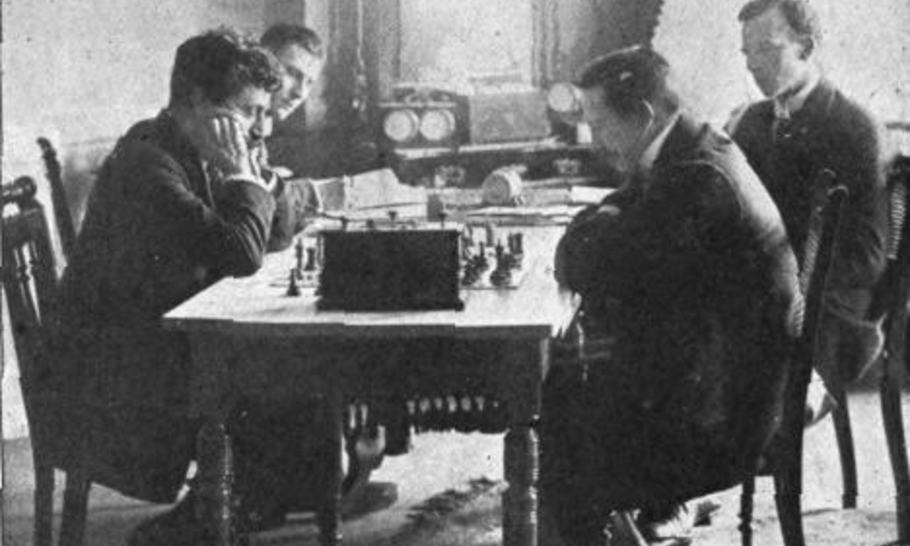
One such was the 1908 world championship match between Emanuel Lasker and Siegbert Tarrasch. This resulted in a classic confrontation between inflexible dogmatism and freewheelingly flexible creativity.
This week’s game is one of the imperishable masterpieces from that titanic duel between the two strongest protagonists of their era . Particularly outstanding was Lasker’s courageous and provocative manoeuvre with his king’s rook. Richard R éti developed an entire speculative theory around Lasker’s psychological approach to chess. This game is powerful evidence in support of R éti’s hypothesis. Tarrasch is lured, by delusional dreams of victory , based on the exposure of Black’s rook, to the edge of precipice, and with one deft stroke Lasker propels his rigidly thinking rival over the cliff and into the abyss .
Siegbert Tarrasch vs. Emanuel Lasker
World Championship Match, Duesseldorf, 1908, game 4
1. e4 e5 2. Nf3 Nc6 3. Bb5 Nf6 4. O-O d6 5. d4 Bd7 6. Nc3 Be7 7. Re1 exd4 8. Nxd4 Nxd4
Lasker knew that Tarrasch had won from this position when his opponent had instead replied 8… O-O [Tarrasch-Steinitz, Vienna, 1898]. Then after 9. Nxc6, Steinitz had responded with 9… bxc6. In game two of this match, Lasker had varied from this with 9… Bxc6, and ultimately won, in spite of suffering for some time with a lost position after his innovation.

9. Qxd4 Bxb5 10. Nxb5 O-O 11. Bg5!?
Despite this proving to be the favourite theoretical continuation, our engine proposed that after 11. h3 (11. Nc3 is as good) 11… c6 12. Nc3 Nd7 13. Be3 Re8 14. Rad1 Qa5 15. Qc4 would lead to positions which, although less aggressive, are calmer than the uncompromising text.
11… h6 12. Bh4 Re8 13. Rad1!?
The two players were , by this time, in unrecorded territory. A year later, 13. c4
led to
a draw [Capablanca-Marshall, New York, 1909]. But in more modern times, 13. Qc4 led to a loss [Fernando-Campora, Santo Antonio, 2001]. This is clearly already an uncomfortable position for White, although our engine suggested that after 13. Qd3 a6 14. Nd4 d5 15. exd5 Nxd5 16. Nf5 Bxh4 17. Rxe8+ Qxe8 18. Qxd5 Bf6 19. Qxb7 Rb8 20. Qxa6 Qe4, Black has no more than equality.

13… Nd7 14. Bxe7 Rxe7 15. Qc3 Re5
The introduction to a bold manoeuvre with this rook. In seeking to exploit Lasker’s risky deployment of this major piece, Tarrasch is tempted into a strategic and tactical overreach.
16. Nd4 Rc5 17. Qb3 Nb6 18. f4 Qf6 19. Qf3 Re8 20. c3 a5 21. b3 a4 22. b4 Rc4 23. g3 Rd8 24. Re3?!
After this inferior move, White loses his slight initiative. Best was, 24. Qe2 Qg6 25. Qd3 Re8 26. Nf5 a3 27. Re3 Rc6 28. Rde1 Nc4 29. Rf3 Nb2 30. Qb5 Qe6 31. Qxb7, with an edge.
24… c5 25. Nb5?!
Another imperceptible misstep. White can retain equality with 25. bxc5 Rxc5 26. Nf5 Nc4 27. Re2 d5 28. g4 dxe4 29. Rxd8+ Qxd8 30. Qxe4, but he has something else in mind…more ambitious but actually fatal to his own prospects.
25… cxb4 26. Rxd6??
White now imagines that he has won a pawn and that after the inevitable 26… Rxd6, the fork 27. e5 will regain the rook
.
As we shall see, White would have done better to rein in his aggression with the more patient and orderly 26. Red3 d5 27. e5 Qc6 28. Nd4 Qc5 29. cxb4 Rxb4 30. Kh1 Nc4 31. a3 Rb6, when Black is hardly better in an effectively level position.
26… Rxd6 27. e5 Rxf4!!

We may rest most assured that this bazooka intermezzo was not considered in Tarrasch’s fantasy dreams of triumph on move 26. Playing his next move must have proved a dispiriting prospect, as he desperately sought some combination that salvaged the position – and saved the game. But there are none. Resignation is a matter of discretion, but it could come now.
28. gxf4
This is actually the best of the only three options worth considering. All of them lose. 28. Qe2?? (28. exf6?? Rxf3 29. Rxf3 Rd5 30. Nd4 bxc3 31. Ne2 c2
. Or:
28. Qxf4?? Qxf4 29. gxf4 Rd1+ 30. Kf2 b3 31. axb3 axb3) 28… Rf2 29. Qxf2 Rd1+ 30. Re1 Rxe1+ 31. Qxe1 Qc6 32. Nd4 Qc4 33. e6 fxe6 34. Nxe6 Qxc3 35. Qxc3 bxc3.
28… Qg6+ 29. Kh1?
Slightly less awful is 29. Kf1 Rd5 30. Nc7 Rd7 31. e6 fxe6 32. Rxe6, but it matters little.
29… Qb1+ 30. Kg2 Rd2+ 31. Re2 Qxa2 32. Rxd2 Qxd2+ 33. Kg3 a3 34. e6 Qe1+ 35. Kg4 Qxe6+ 36. f5 Qc4+ 37. Nd4 a2 38. Qd1 Nd5 39. Qa4 Nxc3 40. Qe8+ Kh7 41. Kh5 a1=Q White resigns 0-1
There is no escape:
a) 42. Qe3 Nd5 43. Qe4 Qaxd4 44. Kg4 Qxe4+ 45. Kg3 Qg4+ 46. Kf2 Qce2#;
b) 42. Qe5 Qg1 43. Qg3 Qgxd4 44. h3 Qe2+ 45. Qg4 Qdxg4+ 46. hxg4 Qh2#.
Ray’s 206th book, “Chess in the Year of the King”, written in collaboration with Adam Black, and his 207th, “Napoleon and Goethe: The Touchstone of Genius” (which discusses their relationship with chess) can be ordered from both Amazon and Blackwell’s. His 208th, the world record for chess books, written jointly with the late chess playing artist, Barry Martin, Chess through the Looking Glass, is now also available from Amazon.
A Message from TheArticle
We are the only publication that’s committed to covering every angle. We have an important contribution to make, one that’s needed now more than ever, and we need your help to continue publishing throughout these hard economic times. So please, make a donation.


