The Budget and the prison of economics

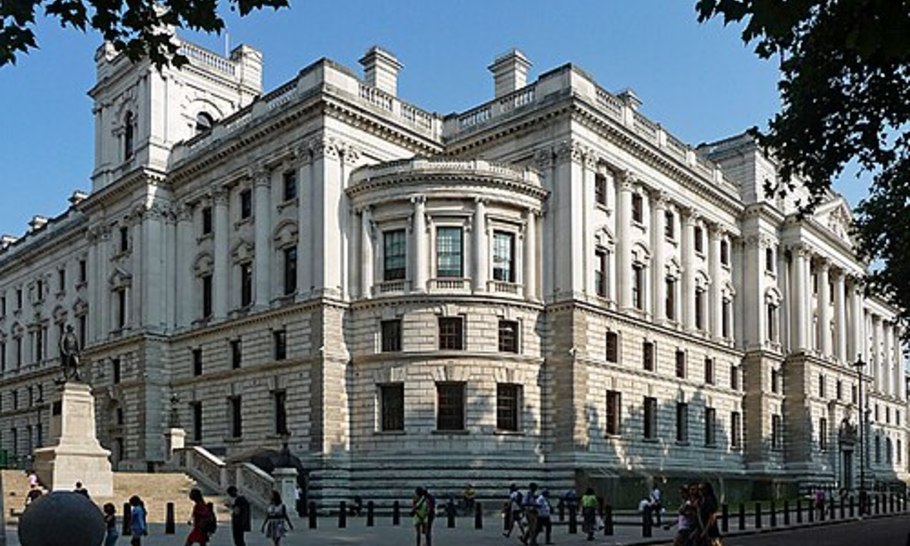
His Majesty's Treasury,1 Horse Guards Road in Westminster, London
Amidst the usual speculation and frenzy about the next Budget on 28th October, one certainty stands out. Our economists, or those with the greatest and loudest influence on policy and the surrounding comment, are not serving us at all well. They have created an economic prison in which our political thinking is confined.
The picture they have built up comes with an absurd and misleading degree of polarity. On one hand the State, facing near impossible choices, is expected to “do something”, such as “cutting ballooning welfare” or “using precious fiscal space”, especially state pensions — a move seen by many as pure political poison. On the other hand, the State is said to be failing dangerously to ramp up new defence projects necessary to survive.
In one of her recent BBC Sunday morning shows, the sharp-as-a-needle Laura Kuenssberg was telling a slightly flustered new Prime Minister that he now had “no choice” but to decide one way or the other between these two imperatives for the State. Escape routes from the prison through higher taxation were exhausted and counterproductive, while bond investors would always wipe out any additional borrowing through still higher debt charges.
This was the no-exit point to which things had come and on which the ranks of economic punditry, from most political angles, had no doubt confidently briefed Ms Kuenssberg. Yet the economic assumptions of her questioning are based on fallacies.
It seems not to have been grasped that no such State structure exists any longer in the digital and super-intelligence age, even though it may once have done so. Instead, we are faced with a new picture that, having been built up over two or three decades, still contains at least two serious fallacies. They are not the most obvious in the whole supply chain of theories and contentions leading to the present apparent dilemmas and deadlocks, but as everyone realizes it is not the most visible links, but the weakest, on which the entire strength of prevailing argumentation, and, it seems, policy, comes to rest. That makes these fallacies all the more dangerous.
The biggest fallacy is the notion that in meeting ever-mounting public spending needs – from potholes to benefits to old-age pensions (still in the UK near the meanest in Europe), to reliable energy (the most expensive), to defence against a million drones, the State must organise, lead and pay — somehow, whether by begging, borrowing or stealing. It is still the widely held assumption, from the PM downwards, that the State must take the lead. The Prime Minister, good communicator though he is, has been heard to reiterate this encrusted belief about the superior virtues of the state machine, which lay at the heart of 20th century politics. What is not perceived, what Treasury eyesight cannot see unless repaired, is that this model is no longer at the heart of the State in the digital age.
Putting the State above the people is simply the modern left-over version of Marxism and his theory of the state as a means of bourgeois oppression. How Marx would have chuckled at its persistence, although it has been shown time and again to have become complete nonsense. How he would have been pleased to see his class-riddled categorisation of society, his depiction of conflicting pockets of social behaviour and interest, to have prevailed right up to now, when in the digital age it has almost all been refuted.
Stale and invalid theories, which neither technology nor reality any longer support, lead of course to the persistence of a stale political battle based on tired and meaningless philosophies and slogans. Parties lose their purpose and way in a new intellectual labyrinth. The debate falls back on traditional lines of partisan political conduct, on the poverty of entrenched dogma, and now complete alienation of the general public, who are rightly sick of “jam tomorrow” rhetoric. A hated political class, a “them”, is thereby conjured into being.
Instead of opening up younger minds to new forms of risk-sharing and state/private co-operation, within a changed (and digitalised) state framework — so badly needed and already being developed in some other advanced economies — the guardians of conventional thinking have stuck to ever narrower models and disciplines.
Instead of providing the political stability which investment must have above all; instead of reinforcing respect for the law and for its institutions and their legitimacy, we are left with the old battlelines. The latter are gaining negligible ground and yet destroying trust and respect in political leadership.
Of course these building blocks of class interest and class conflict never really existed, or at least not in Karl Marx’s parodied and fantasised form. It had to be made up because there was no model. The invention of “the Establishment” — again a journalistic fantasy of the mid-20th century — was the last throw of the empty theory of class oppression and class politics.
This was not how society worked then, whatever Marx or his followers asserted, and that is a hundred times less how it works now, in the digital age and the fast advancing age of political fragmentation.
The impact of this lingering mis-diagnosis is first and foremost on the relationships and surrounding attitudes between State and citizenry – the bundle of bargains between the legal authority to maintain order and citizens’ freedom under the law. It is within the warp and weave of the legal fabric that change has occurred most subtly and deeply. It is the creaking British constitution, the customs, assumptions and practices upholding it over centuries, that have failed to adjust. This is why analysis based on this argumentation, and in turn policy based on that analysis, is so utterly useless today – and of course dangerous. This is the wrong fuel for governance — like feeding diesel into a petrol-engined driven car,
The false persistence of the collectivist Marxian legacy does not get discussed as a top reforming priority in British circles because it is not fully understood how deeply it has infected our fundamental thinking. But you can tell most clearly how it survives in the printed and self-important language of the State, with its avalanche of forms and surveys, criteria and qualifications, instructions as to what is “acceptable” in respectfully communicating with authority.
In the peculiarly British debate, the bond markets have been brought centre stage as the old guard, the praetorians. Their new authority in British politics has been paraded on the (entirely false) presumption that bond markets merely look at recent deficit figures, plus official hopes and pieties. They don’t. They look at the wider, not the narrower scene.
History, habits, political noise, leadership statements, the reliability of the borrowing government — these are the ingredients of price (i.e. interest rate) decisions that Britain has to pay. If British Cabinet ministers, and indeed media pundits, would, for example, take a look at Japan, with a far bigger budget deficit than ours, or the USA (with bigger deficits still), or South Korea, or most of Scandinavia or almost any other advanced society facing very large government debts, as most are after the Covid years, they will hear and see a very different discussion going on from the so-called “conversation” here.
In Japan they will find the government of Sanae Takaichi, rather than chucking in the towel on spending (especially on defence, energy transition and environment), is developing a new range of bridging bonds. These are linked to specific and innovative projects and backed by sustainable and stable sources of funding over carefully measured numbers of fiscal years ahead. They are classified differently from ordinary deficit-financing bonds in separate accounts and not registered as part of the government’s existing outstanding debt.
This is not widely understood and here the vision seems blurred. If the Japanese approach is to work it plainly helps the borrower if as much as possible of outstanding debt is held in domestic hands and as small a proportion as possible in “less understanding” international bond markets. That is still the happy position in Japan, as it used to be once in the UK.
The possibilities of using a similar new approach are being explored now in several other advanced countries. The outstanding example is the USA itself, with a budget deficit – again of trillions — far above British borrowing levels in per capita terms , yet infuriatingly allowing Trump’s America to get away with significantly lower interest charges on debt, existing or new, than Britain. What a verdict on sheer intellectual, financial and economic muddle.
Once Britain was the prince of borrowers, with lenders clamouring to find entry to this sound and lucrative but largely domestic market. But those days are gone. Now it is at the road end where more borrowing is exceeded by the additional cost of borrowing.
Today, in late 2026, government debt overrun is almost universal. The world has reached that stage in the evolution of popular and digitised versions of capitalism that was bound to come: the silicon chip is the true leveller.
Of course, the UK is far from alone in confronting historically high debt levels, exceeded only in the world wars of the 20th century. Delay and failure lead to both benefit cuts AND delayed defence research and development spending too late and too little. Political instability, paralysing uncertainty and internal party division, ripple through the investment scene, as scraps of funding are fought over.
Varieties of what we called the Private Finance Initiative (PFI) have however continued to be used successfully in many jurisdictions including very successfully in the Netherlands and countries such as Ireland, France, Germany, Norway, Sweden, Finland, Canada, Australia and South Africa. Belgium has an active PPP programme as does Czechia. Further afield, Lithuania, Turkey (in particular), among other jurisdictions, use tailored versions of PPP/PFI as a key instrument in procuring to new infrastructure.
The supreme irony in all this is that most PPP programmes can be traced back to the structures and government guidance developed in the UK. Even in the UK there have been some PPP projects developed relatively recently (2024). In Scotland there is a not-for-profit model, while the Welsh have their own mutual investment model.
In England new PPP-financed schemes were finally abandoned, having had a three decade run, in October 2018, although the decline set in after 2010. In the words of practitioner Andrew Petry: “The PR battle for PPPs in the UK, and particularly England, has been comprehensively won so far by the critics and detractors.” There are of course valid criticisms, but they can be countered. The criticism boils down to being politically motivated and born out of a hostility to the private sector having a role in delivering public goods and services and resentment that it seeks to make a profit out of doing so.
This is the really chronic infection that has to be rooted out. It was false and misleading before the onset of the digital age. It is falser still as every day goes by.
II Escaping the prison: how technology is changing economics
If it is true that the current Labour government is developing a new kind of cooperation for the water sector (see links here: water industry), instead of antagonism between public needs and private funds, that must be good news.
Why, should we be interested? Because this could be the start of a new break-out from the economic orthodoxy of our age , which has become not a policy ,or a strategy, but another prison.
Just as it took J.M. Keynes to turn economic orthodoxy on its head in the depression years of the last century, so today there are now substantial numbers of projects, shut away in the “too difficult” box of the public sector. These could be released and tested against cleverer models now available which combine public needs with private funds and skills in entirely new ways. Cumulatively they would have an enormous impact on infrastructure realisation, on reducing funding social tensions on every side (along with rising political instability) and help resolve eye-wateringly expensive decarbonisation of the economy.
A perfect example is the tragedy of the Sizewell C giant nuclear project. This has been chosen as the replica of the massively delayed and over-budget Hinkley C French-designed EPR, the biggest new energy project in Europe (and probably the world). It is a perfect instance of an enormous long-term project which should have (and could have) been kept clear of the public accounts. It would have been still easier to do that if the right modern design (small SMRs) had been chosen instead of a huge and inflexible “white elephant” model from a past age.
New defence technologies are also going to be staggeringly expensive – far more than UK Government spending can possibly bear. Cooperation in both financing and development will have to be from both private and public spheres. Has it been noticed that the United States is growing new companies in profusion to play key roles in the supply chains of modern warfare?
Overseas development is another area where plenty of room exists for small loans to move a scheme from a development project to one that is RTB (ready-to-build), at which point it can be sold or raise construction finance and take out the development loan, again without troubling the Government accounts or disturbing the bond markets – other things of course being equal. This is an area where public sector financial institutions could do far more and cause less bond market alarm in the process.
If all this goes hand-in-hand with tax cuts and with a fresh war on public inefficiencies in every department, as the Conservative Opposition leadership now proposes, sound fiscal credibility in the eyes of the lending world can be restored. This would release the UK from the present apparent fiscal prison in which it has been stuck by current economic advice — without falling again into the booby-trap which ditched the short-lived reign of Liz Truss.
In The Times Fraser Nelson slightly unfairly suggested there was — as yet — no accompanying plan from Mrs Badenoch on the financial side to balance her tax-lowering package. But much of it is there already. Political leaders will find most of the framework of a new style of government to deliver this in the pamphlet A New Style of Government, published by CPC just before the 1970 election – which the Tories won, to much media surprise.
At the time, it had the full initial blessing of the incoming Prime Minister, Ted Heath, although a combination of trades union power and the Treasury knights later defeated him and he became fatally bogged down in the Prices and Income quagmire.
So A New Style of Government remained largely unimplemented and the dozen or so top business leaders recruited to help carry it through soon dispersed as the Conservatives lost their way. But with a few up-datings it remains there ready on the shelf for the real war on ballooning government spending which has got at last to come.
All these issues and opportunities are now being increasingly recognised in the UK (for example in the National Infrastructure Plan). As so often happens, however, the remedies appear to be either half-heartedly implemented or not carried through for long enough, with sufficient momentum and financial backing to have the necessary impact. As those of us involved found in 1970, the preparation and detailed plans for better and less government were and could be very largely achieved – on paper and in dozens of strategic volumes. (The comment was that there has never been a new government so well-prepared.) But the implementation was not. Events, politics and outright resistance won at this stage.
Returning to the charge nine years later, in 1979, under Margaret Thatcher privatisation made more headway in moving from a heavily socialised and nationalised economy, to a better balance. But there were near-fatal moves to cut corners and push ideology which destroyed the momentum and undermined public understanding or support.
All is most definitely not lost. Despite everything the UK, because of its amazingly innovative impulses, has, and continues to develop, some of the most sophisticated solutions to the problems of realising public infrastructure investment without destroying the national finances. Other countries have learned from the UK or developed comparable solutions to attract private sector money, skills and innovations. The UK can now learn from them, but it should hurry up. Inevitably there is much more competition for the kind of money that used to, in the past, readily flow into UK’s projects.
Some quite brave British new initiatives have been tried, as they should have been, considering where new thinking on public/private togetherness really started, but was then clouded over and forgotten. There is, for example, the Regulated Asset Base system, successfully used to create income streams from potential electricity consumers of a new project, years before a single brick is laid at site level, attracting private investment well in advance, such as in the case of the new EPR giant nuclear power project at Sizewell C. There, despite enormous site expenditure, the outcome could yet be decades away, long before which design and technology may anyway have changed from large to small, from one 15-year super-risky site-operation to a set of eight smaller or mid-sized reactors. The RAB system helps but the State still has to pour in borrowed money right away (£14.7 billion) which it has not got.
Another successful use of RAB was deployed with the Thames Tideway, very much smaller but completed on both budget and time. But there are, will be and have been, hundreds more public “needs” projects that could be triggered if absurd doctrinal obstacles between public and private could be removed. The choice is between ten years of half-baked political design risk and a brisk two-and-a half-year investment vehicle return, between an unending road of complex and constantly shifting capital projects and much shorter-term service provision, managed with care – all made infinitely more possible by the managed fragmentation and focus of AI and SI now becoming available.
All these possibilities seem to be stuck permanently in the Treasury’s blind spot. One is left wondering whether we have moved from the realms of economic policy into those of economic ophthalmy. We are waiting for a financial cataract removal operation which is very obviously required and for the staggering skills and precision necessary to perform it. These now have come into being in the real eye world, with many brilliant young women at the forefront in the UK.
There should be no comparison here with going back to Third Way-type attempted escape routes (Blair, Tony Giddens etc) or the Middle Way quagmire (Macmillan and his predecessors), of trying to halve the difference between socialist and market doctrines – and then pushing them together in constant disharmony and mutual rejection. This was the fate in the UK of the last round of PPP/PFI.
We are dealing now, as we plunge ever deeper into the digital/AI/SI unstoppable revolution, with completely new patterns and procedures. We are not travelling on the old socialism-versus-free-market, ideology-paved pathway at all. As Keynes saw, and would see again if he lived now, entirely new conflicts and tensions demand entirely different policy responses, national and international.
A whole new spectrum of alternative possibilities is opening out in a series of economies and societies round the globe. It is now a question, not of “There is no alternative”, but of “Take your pick from the new possibilities”.
Lord Howell was Conservative MP for Guildford (1966-1997), Energy Secretary (1979-81), Transport Secretary (1981-83), Minister of State for International Energy Policy (2010-2012) and chair of the House of Lords International Relations Committee (2016-2019).
A Message from TheArticle
We are the only publication that’s committed to covering every angle. We have an important contribution to make, one that’s needed now more than ever, and we need your help to continue publishing throughout these hard economic times. So please, make a donation.


