Viktor Orban: Budapest to Oxford and back


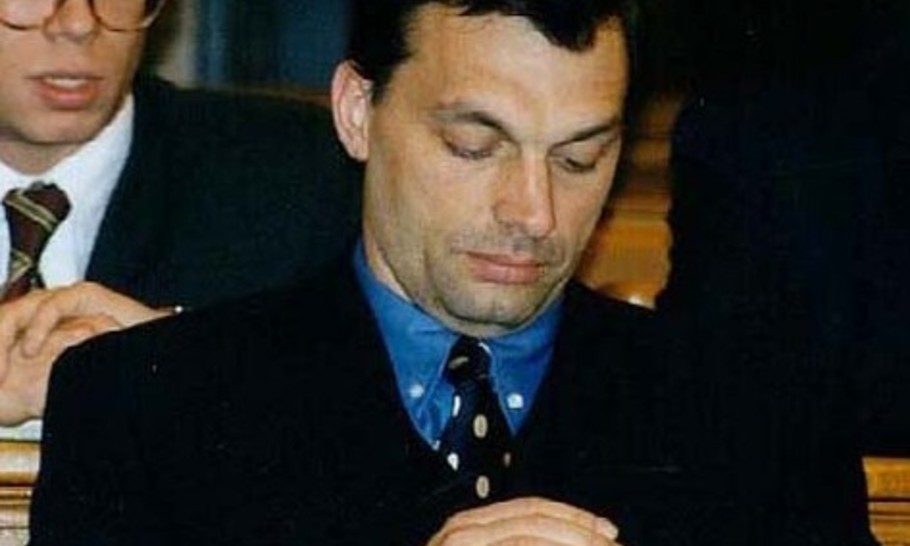
Viktor Orbán in 1997
The recent parliamentary elections in Hungary came as a bolt from the blue. Viktor Orbán had enjoyed a brilliant career — Prime Minister for 16 years, admired by right-wing governments across the world, invited to Washington by an American President perhaps keen to learn how he had so effectively neutralised his opposition.
Orbán’s fall was stunning. Hungary was ready for a change. Nearly 80 per cent of those registered went to the polls, indicating a great interest in the outcome. The results were staggering, hardly believable. Four years ago Fidesz had a two-thirds majority. This time Péter Magyar’s Tisza party had the two-thirds majority — a remarkable reversal. As I watched the election coverage, it sent me back to my memories of the young man I had interviewed in Budapest, more than thirty years ago.
To understand how Orbán came to Oxford, one must first understand George Soros. In the late 1980s, as Communist governments across Eastern Europe began to crumble, the Hungarian-American financier decided to do something characteristically ambitious: to accelerate their collapse. His weapons were money and education. The idea was elegant in theory — identify promising young men and women from Eastern Bloc countries, fund them for a year of study in Oxford, and send them home equipped with the intellectual tools to hasten the end of the regimes they had grown up under.
In practice, the scheme had an obvious flaw. Once a person from a Communist country managed to reach the West, their first instinct was generally to stay there. Many of those selected for a one-year scholarship promptly negotiated themselves onto three-year DPhil programmes. The Soviets, for their part, were surprisingly cooperative — research in the Soviet Union had largely ground to a halt for lack of funds, and they were content to see at least some of their young scientists sponsored abroad. In Hungary, the selection process fell to a small group of Oxford fellows with Eastern European roots: Zbigniew Pełczyński of Pembroke College, Nicholas Kurti of Brasenose, Mary McAuley of St Hilda’s, and myself, also of Brasenose. We interviewed the Hungarian candidates in Budapest.
Viktor Orbán was among the candidates for the 1989 intake, along with several others who had been early figures in Fidesz — the Fiatal Demokraták Szövetsége, or Alliance of Young Democrats — which Orbán had co-founded the previous year alongside Gábor Fodor, László Kövér, and thirty-four other students and activists. It had begun as an avowedly liberal-nationalist movement, a direct challenge to the Hungarian Communist youth organisation. Even its press organ, the university journal Századvég — “End of the Century” — had been funded by George Soros since 1985.
Back to the interview. Orbán’s English was considerably better than my own, which I found a touch embarrassing. He was immaculately dressed — sleek, one might say — and given my own prejudices, that polish aroused a faint suspicion. The interview was in any case brief. Pełczyński had already made up his mind; he wanted Orbán as his own research student, and his enthusiasm rather outpaced my own more cautious assessment. Pełczyński was impressed. I was less so. In retrospect, we both had a point.
Orbán arrived at Pembroke College in September 1989 to work under Pełczyński on the concept of civil society in European political thought — a liberal project for a man who had, at that stage, co-founded a liberal-nationalist party and was known for demanding free elections and the withdrawal of Soviet troops. He was supposed to remain in Oxford for nine months. He stayed for four. The Hungarian parliamentary elections beckoned, and politics, it turned out, was a more urgent calling than scholarship. He returned to Budapest in January 1990, secured the top spot on the Fidesz candidate list — displacing Fodor in the process — and was elected to parliament from Pest County that spring.

Gábor Fodor
In this he was something of an exception. One of the persistent ironies of the Soros scholarship programme was that relatively few of its beneficiaries actually went home. Orbán did. And his Oxford interlude is duly noted in his official biography — a curious decision, given what came next.
Orbán’s subsequent career as Prime Minister brought with it a virulent campaign against George Soros: the antisemitic conspiracy theories, the billboard campaigns, the legislative assault on Soros-funded institutions, including the Central European University. His honorary fellowship at Pembroke — bestowed at Pełczyński’s urging — was eventually withdrawn. The man who had come to Oxford on a Soros scholarship became one of Soros’s most ferocious public enemies. Why? Perhaps Orbán recognised, as an astute political operator, that the Hungarian electorate has long harboured antisemitic currents, and that demonising a Jewish financier would prove electorally useful.
There is a further irony. The man who came to study civil society at Oxford, funded by the Open Society Foundation, later stood before an audience of ethnic Hungarians at Băile Tușnad in Romania and openly and infamously declared that Hungary would become an “illiberal democracy” — one that had abandoned, in his own words, the liberal way of looking at the world.
Somewhere there must be a tale of two Fidesz founders. Gábor Fodor, who stood alongside Orbán at Fidesz’s founding in 1988, refused to follow him rightward. He left the party in 1993, served as Minister of Education under a liberal government, and eventually founded his own Liberal Party. He was a member of the Hungarian parliament from 1990 to 2019, and he is currently the CEO and founder of the Central European Political Transition Institute.
At the age of 96, I thought that I’d seen it all. I did not anticipate the final twist in this story. The fall of Orbán was even more spectacular than his rise. I can even confess to feeling moved when the election results came in.
A Message from TheArticle
We are the only publication that’s committed to covering every angle. We have an important contribution to make, one that’s needed now more than ever, and we need your help to continue publishing throughout these hard economic times. So please, make a donation.


