Who was the Greatest?


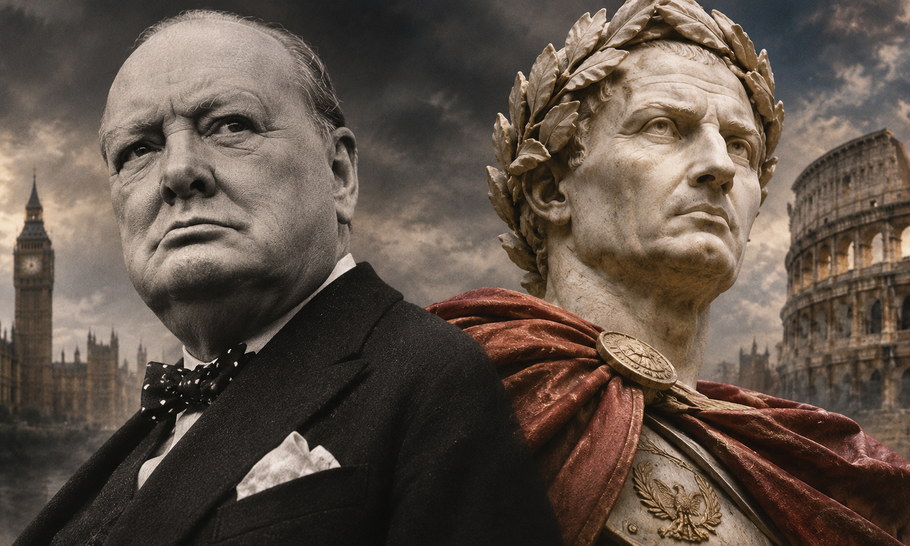
Churchill and Caesar
We have always had a fondness for comparative lists, particularly where sport is concerned. Was W.G. Grace superior to Don Bradman? Was Muhammad Ali superior to Sonny Liston? Well, that second question was hardly an invitation to prolonged philosophical inquiry, was it?
In 2002, the BBC conducted a poll to determine the greatest Britons. One suspects that, were such an undertaking repeated today, the result might contain a few surprises. Indeed, it is a curious feature of national greatness that it becomes considerably more complicated once the nation is invited to vote upon it.
No comparable exercise on such a scale has been conducted since. But in 2002, after six weeks of passionate national debate, the results were finally announced.
Winston Churchill was voted the greatest Briton ever in the much-anticipated conclusion to the BBC poll, a contest which had succeeded in engaging the nation in precisely the sort of passionate argument in which the British excel. The debate reached its climax in a live studio discussion broadcast on BBC2 on Sunday 24 November. By then, more than one and a half million votes had been cast.
The final breakdown was as follows:
Total votes: 1,622,248
- Churchill — 456,498
- Brunel — 398,526
- Diana — 225,584
- Darwin — 112,496
- Shakespeare — 109,919
- Newton — 84,628
- Elizabeth I — 71,928
- Lennon — 68,445
- Nelson — 49,171
- Oliver Cromwell — 45,053
After the result was announced, the late Mo Mowlam, a Labour politician who had championed Churchill, expressed her delight. She regarded his victory as entirely deserved: Churchill, in her view, had demonstrated the determination and courage necessary to protect Britain from invasion, and his inspiring leadership might have made the difference to the eventual outcome of the Second World War. He had, she concluded, been the people’s choice.
There are few things more agreeable than victory, except perhaps the conviction that one has been morally entitled to it. Yet in second place came Brunel, championed by Jeremy Clarkson.
Clarkson accepted defeat with reasonable grace, thanking those who had voted for Brunel and pointing out that the result nevertheless represented a magnificent triumph for engineering. He did, however, suggest that a substantial American vote had helped Churchill to victory, adding that Americans had once again interfered in British affairs.
It is perhaps one of the more charming ironies of greatness that the difference between first and second place was considerable, while the difference between second and third was considerably less so.
In third place, not far behind, came Diana, Princess of Wales, who had died just five years before in 1997. Rosie (now Baroness) Boycott was delighted by Diana’s performance, particularly given the distinguished company in which she had found herself. She saw Diana’s position as an extraordinary triumph of compassion and love over other varieties of greatness. While many people had been surprised to see Diana among the top ten, Boycott observed that this was the choice of the people rather than a ranking assembled by experts.
And there, perhaps, lies the peculiar charm of a public poll. Experts have knowledge; the public has opinions. History has facts; democracy has votes. The two have never been entirely comfortable together.
The series itself was the idea of Jane Root, Controller of BBC2. Root expressed considerable pleasure at the extent to which the series had captured the public imagination and at the extraordinary level of interest and debate it had produced. More than one and a half million votes had been cast, and the subject had become a major talking point everywhere from the pub and the classroom to the House of Commons.
She believed it was wonderful that figures from Britain’s past could still provoke such a passionate response. Television, she argued, had a remarkable role to play in keeping those figures alive for contemporary audiences.
It is a pleasing thought. The dead, after all, are remarkably dependent upon the living for their continued reputations.
Andrew Marr’s natural selection for Great Briton was Charles Darwin, who finished fourth.
Marr took considerable personal amusement from the spectacle of newspaper columnists attacking the concept of Great Britons while repeatedly finding themselves writing about it. To him, this was precisely what the BBC did at its best: educating the country without pomposity, making serious subjects accessible, and doing so in a manner that allowed the public to feel that it had discovered the argument rather than been lectured upon it.
And perhaps that is the real difficulty with deciding who was the greatest. Greatness is a rather likeable word because it means almost everything and therefore, in practice, almost nothing. We can measure votes, achievements, discoveries, victories and monuments. What we cannot so easily measure is the peculiar quality by which one human being continues to fascinate another.
The list, therefore, tells us who won the vote. Whether it tells us who was greatest is another matter entirely.
And, as with most matters of importance, the argument is probably more entertaining than the answer.
A few days ago I noticed an even more backward looking debate on X (formerly Twitter) as to the greatest Roman. The conclusion (in order) was as follows:
- Caesar
- Marcus Aurelius
- Augustus
- Trajan
- Constantine the Great
- Cicero
- Hadrian
- Scipio Africanus
- Diocletian
- Pompey the Great
I regard that as a good try, so, with a few changes, my personal list would be:
- Caesar
- Augustus
- Constantine
- Trajan
- Marcus Aurelius
- Virgil
- Hadrian
- Scipio Africanus
- Quintus Fabius Maximus
- Vespasian
Marcus Vipsanius Agrippa (the right hand man to Augustus) certainly deserves an honourable mention. He is the protagonist of a recent novel by Robert Harris.
If we venture into the Byzantine period after the fall of the western empire, then Justinian, his general Belisarius and the chessplaying emperor Alexius Comnenus all swim into purview.
I recently read a fascinating book comparing Caesar and Alexander the Great as military commanders. Interestingly, Caesar came out on top, not least because he had to create an army from scratch, whereas Alexander inherited a fully active and highly formidable military force from his father.
Amongst chess champions, a compendium of the greatest would run something like this:
- Kasparov
- Carlsen
- Fischer
- Karpov
- Capablanca
- Lasker
- Alekhine
- Botvinnik
- Morphy
- Steinitz
Why is Kasparov ahead of Carlsen? The answer is in the strength of opposition he faced, in his numerous epic struggles against Karpov. Carlsen’s opposition simply does not match up to this exceptional level of antagonist. And Bobby Fischer in third? A great challenger, potentially the greatest ever champion, but a total disappointment as world champion, when he stopped playing for twenty years after 1972. And the inclusion of Steinitz. He was champion from 1866 to 1894 according to his own estimation and during that period he despatched every conceivable rival, Anderssen, Blackburne, Zukertort, Gunsberg, Tchigorin….until, almost 60 years old, he ran up against the almost infallible Lasker.
And now for something completely different: my personal list of those grandest of grandmasters, not necessarily world champions, whose style , writings and games I find most instructive and infinitely enjoyable.
These were my role models at various stages of my own career, chesstitans whose games and writings I studied and whom I either admired, tried to emulate or both. In some cases I was even fortunate enough to watch them in action, while in three cases I actually faced them in person across the chessboard, scoring two losses and two wins.
- Nimzowitsch
- Petrosian
- Staunton
- Botvinnik
- Réti
- Spielmann
- Tal
- Alekhine
- Kasparov
- Fischer
This week, three representative games plucked from the opulent treasury of the jewels of the mind fashioned by the above illuminati.
Akiba Rubinstein vs. Rudolf Spielmann
San Sebastian, 1912, round 10
- d4 e6 2. c4 f5
Spielmann was noted for his penchant for aggression. Indeed his book, The Art of Sacrifice, was one of the seminal texts I studied in my youth, along with Nimzowitsch’s My System. Together they formed the Bibles for both Strategy and Tactics on the chessboard. Add Réti’s Masters of the Chessboard, and you had a complete chess education in one package for a 1960’s teenager.
- Nc3 Bb4 4. Bd2 Nf6 5. g3 O-O 6. Bg2 d6 7. a3 Bxc3 8. Bxc3 Nbd7 9. Qc2 c5 10. dxc5 Nxc5
Black has willingly conceded the Bishop pair to his mighty opponent, but Spielmann’s hyperactive squadrons of cavalry more than compensate.
- Nf3 Nce4 12. O-O Bd7 13. Rfd1 Rc8 14. Bxf6 Qxf6 15. Qb3 Rc7 16. Ne1 Nc5 17. Qb4 f4 18. Nd3?
White should deploy this knight elsewhere: 18. Nf3! (18. Qc3 is almost as good, 18… fxg3 19. Qxf6 gxh2+ 20. Kxh2 Rxf6) 18… e5 19. Qc3 Ba4 20. Rf1 Ne6 21. b3 Bc6 22. Rad1, and White continues with full equality. 18. Rxd6 would be a serious error after 18… fxg3, when Black’s accumulated energy in the f file becomes manifest.
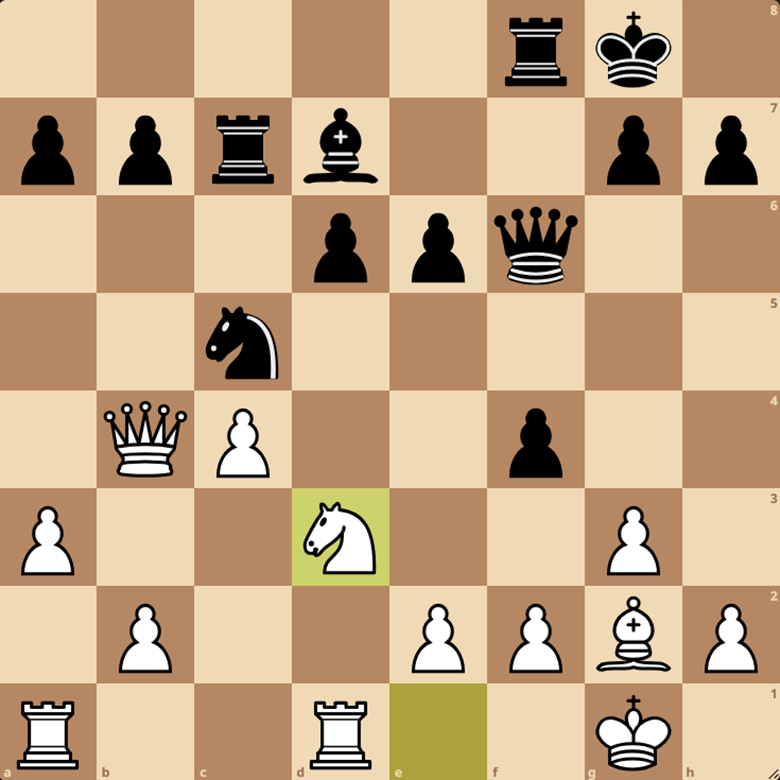
18… fxg3 19. fxg3 Nxd3?
This continuation is inferior to 19… Bc6 20. Qc3 Nb3 21. Qxf6 Rxf6 22. Rab1 Bxg2 23. Kxg2 Rxc4, after which Black has a persistent advantage.
- Rxd3 Qf2+ 21. Kh1 Bc6?!
Black errs again with this inaccuracy and should prefer 21… Qxe2 22. Rd2 Qxc4 23. Qxc4 Rxc4 24. Rxd6 with some tangible advantage.
- e4 Rcf7 23. Re1
But obviously not 23. Rxd6?? Bxe4 24. Bxe4 Qe2 25. Bxh7+ Kxh7 26. Qc5 Rf1+ 27. Rxf1 Rxf1+ 28. Qg1 Qf3#
23… a5 24. Qc3 Qc5 25. b4
In spite of minor inaccuracies on both sides, but only revealed after merciless subjection to modern engine analysis, Spielmann now unleashes one of the most geometrically bold and complex sacrificial sequences ever devised on the chessboard.
25… Bxe4!!
A bolt from the blue.
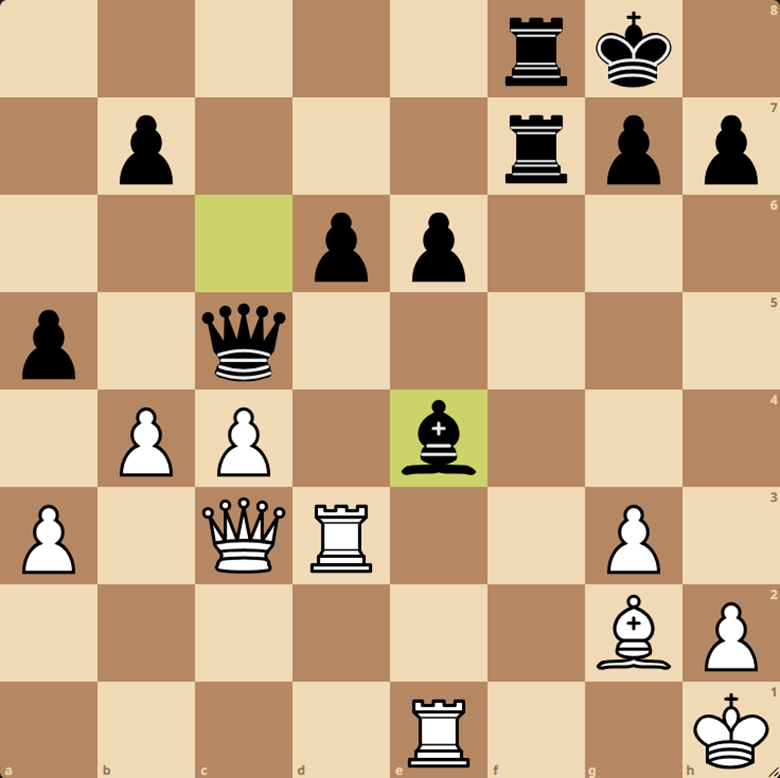
- Rxe4?
Understandably poleaxed by Spielmann’s blast of sacrificial wizardry, the normally imperturbable Rubinstein, in fact the winner of the San Sebastián tournament, loses his footing.
Plausible though it seems….This capture amounts to a losing blunder, but the correct line is not immediately apparent. After 26. Rf3? Rxf3 (26… Qc6?! is not quite as strong: 27. b5 Rxf3 28. Qxf3 Bxf3 29. bxc6 Bxc6 30. Bxc6 bxc6 31. Rxe6) 27. Qxf3 Rxf3 28. bxc5, Black enjoys a substantial advantage.And now we will explain why capturing the queen is taboo: 26. bxc5?? Rf1+ 27. Rxf1 Rxf1#.
The best line is actually 26. Bxe4 Rf1+ 27. Rxf1 Rxf1+ 28. Kg2 Rg1+ 29. Kf3 Qh5+ and now 30. Kf4! (but not the dreadful 30. Ke3? Qxh2 with advantage to Black) 30… Rf1+31. Rf3 Rc1 32. Qd3 and incredibly, White has managed to keep the position on an even keel.
26… Rf1+ 27. Bxf1 Rxf1+ 28. Kg2 Qf2+ 29. Kh3 Rh1 30. Rf3
- Rf4?? Qxh2+ 31. Kg4 Qh5#.
30… Qxh2+ 31 . Kg4 Qh5+ 32. Kf4 Qh6+ 33. Kg4 g5 34. Rxe6 Qxe6+ 35. Rf5 h6
Giving check is cruder but even more effective: 35… Qe4+ 36. Rf4 gxf4 37. Qf6 fxg3+ 38. Qf4 Qg6+ 39. Qg5 h5+ 40. Kf4 Rf1+ 41. Ke3 Qxg5+ 42. Kd3 Qf5+ 43. Kc3 Qf3+ 44. Kb2 Rf2+ 45. Ka1 Qd1#.
- Qd3 Kg7 37. Kf3 Rf1+ 38. Qxf1 Qxf5+ 39. Kg2 Qxf1+ 40. Kxf1 axb4 41. axb4 Kf6 42. Kf2 h5 White resigns 0-1
New York International, NYC,1924 round 6
1.Nf3 d5 2. c4 e6 3. g3 Nf6 4. Bg2 Bd6 5. b3 O-O 6. O-O Re8 7. Bb2 Nbd7 Réti introduced his famously revolutionary double fianchetto opening during 1923 and 1924. His victims included Rubinstein, Capablanca, Janowski, Ed Lasker, Bogolyubov and here the British champion Yates.
8. d3 c6 9. Nbd2 e5 10. cxd5 cxd5 11. Rc1 Nf8 12. Rc2 Bd7 13. Qa1 Ng6 14. Rfc1 Bc6 15. Nf1 Qd7 16. Ne3 h6?
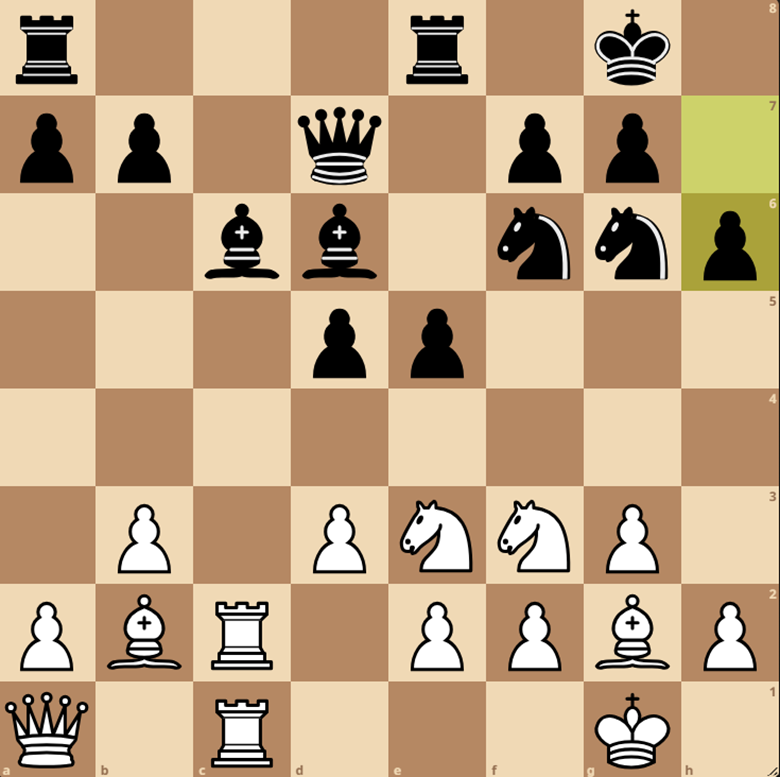
Réti’s conduct of the opening has involved the most extreme form of flank pressure against the centre. I first saw this position in Nimzowitsch’s My System , and as a young player reared on the Giuoco Piano, it came as a huge shock to me. I immediately wanted to emulate it. Objectively, Réti’s concept is not totally convincing, but aesthetically and creatively his configuration is astounding.
Black should now seize the opportunity to deny his opponent the freeing move d4 by playing it himself, leading to a long but forcing line: 16… d4 (also good is 16… Qe6) 17. Nc4 Bc7 18. e4 dxe3 19. Nxe3 Ng4 20. d4 Nxe3 21. fxe3 Bb6 22. Re1 Qg4 23. Nxe5 Nxe5 24. dxe5 Bxg2 25. Rxg2 Red8 26. Kh1 Bxe3, when Black emerges with his slight advantage intact.
- d4 e4 18. Ne5 Bxe5 19. dxe5 Nh7 20. f4 exf3 21. exf3 Ng5?!
Black should contest the a1-h8 diagonal, here with 21… f6 22. f4 fxe5 23. f5 Ne7 24. Bxe5 d4, when equality is maintained.
- f4 Nh3+?!
As with the previous move, challenging the dark squares with 22… d4 23. Bxd4 Bxg2 24. Kxg2 Qh3+ 25. Kh1 Ne6, enables Black to retain a level position.
- Kh1 d4 24. Bxd4 Rad8?
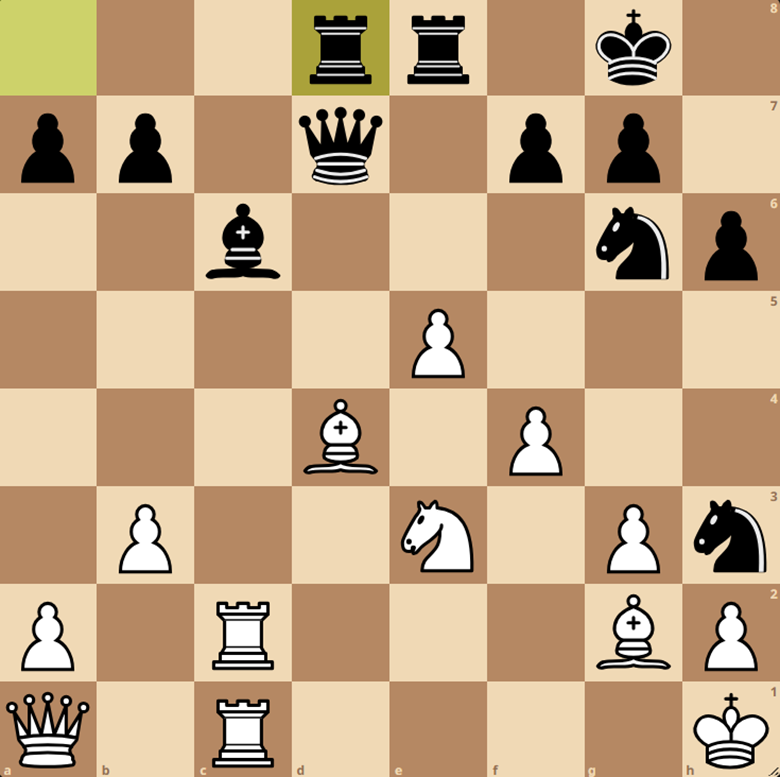
Allowing White a finesse. After 24… Bxg2+ 25. Kxg2 Rad8 26. f5 Ne7, White can no longer take advantage of the c6-exchange.
- Rxc6 bxc6
No better is 25… Nf2+ 26. Kg1 bxc6 27. Bxc6 (but not 27. Kxf2? Qxd4) 27… Nh3+ 28. Kf1 Qc8 29. Bxe8, when White remains within touching distance of the finishing line.
- Bxc6 Nf2+ 27. Kg2 Qxd4 28. Qxd4 Rxd4 29. Bxe8 Ne4 30. e6 Rd2+ 31. Kf3 Black resigns 1-0
Mikhail Botvinnik vs. Lajos Portisch
Monte Carlo, 1968, Monaco, round 7
- c4 e5 2. Nc3 Nf6 3. g3 d5 4. cxd5 Nxd5 5. Bg2 Be6 6. Nf3 Nc6 7. O-O Nb6
A reversed colour Sicilian Dragon, a favourite of Botvinnik from his early years up until 1958.
- d3 Be7 9. a3 a5 10. Be3 O-O 11. Na4 Nxa4 12. Qxa4 Bd5 13. Rfc1 Re8 14. Rc2 Bf8 15. Rac1 Nb8?
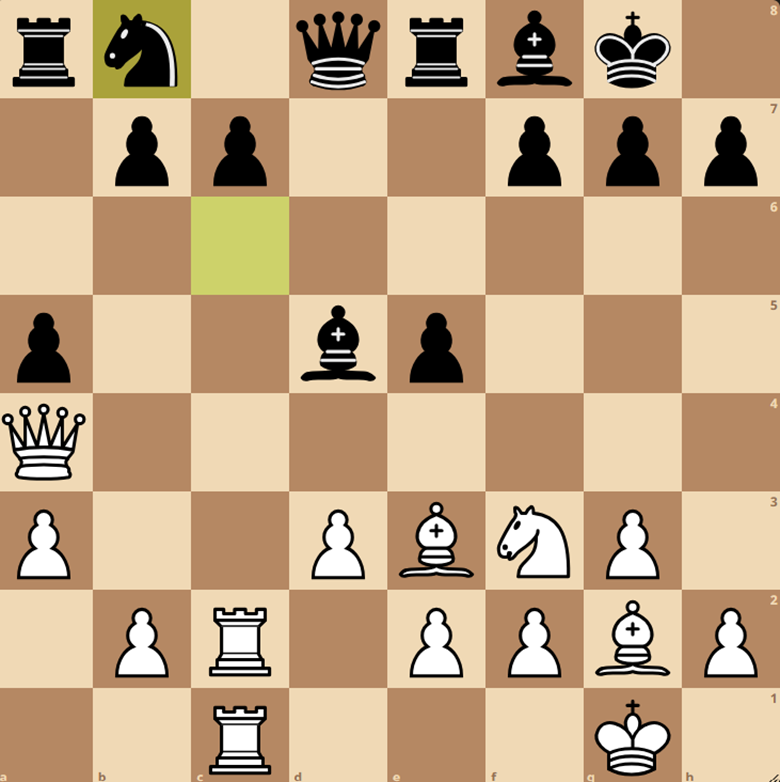
Clever but fatal, but only because of Botvinnik ‘s inspired refutation. Black discounts the weakness of his kingside with a move far too slow to sufficiently reinforce it. Best here is 15… Ne7 (15… h6 is also good) 16. Rxc7 Bc6 17. R7xc6 Nxc6 18. Rc4 h6 when White can find no conclusive breakthrough. The Soviet Patriarch, the Red Czar of the USSR chess Imperium, now seemingly falls into the trap of losing his intrusive rook
- Rxc7 Bc6 17. R1xc6 bxc6
Now Botvinnik unleashed his godlike thunderbolt.
- Rxf7!! h6
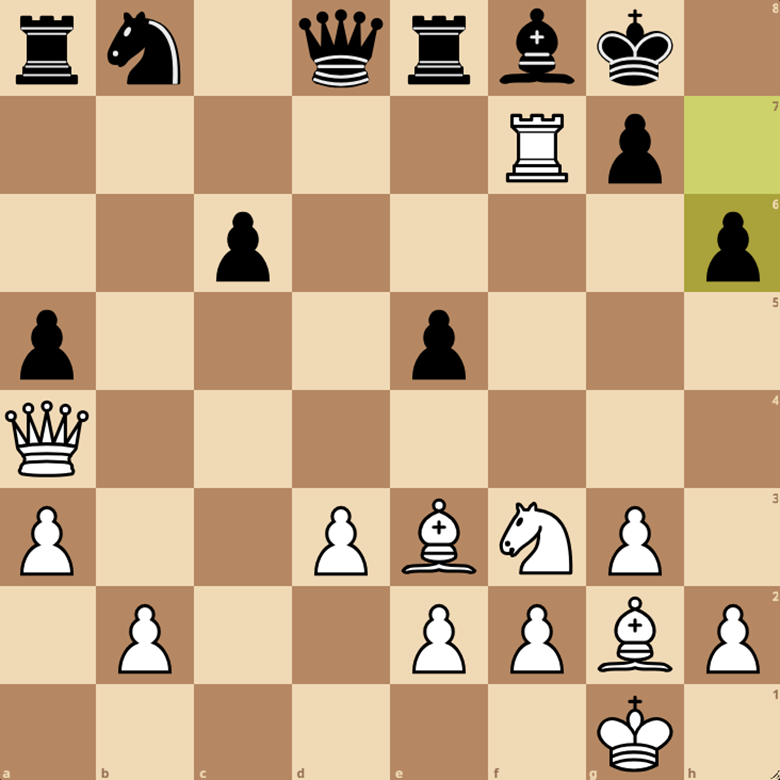
Unfortunately the recapture is simply not tenable, as after 18… Kxf7? 19. Qc4+ Kg6 (19… Ke7 20. Bg5+; and 19… Qd5 20. Ng5+ are disastrous) 20. Qg4+ Kf7 21. Ng5+ Qxg5 (21… Kg6?? 22. Be4+ Kf6 23. Qf5+ Ke7 24. Qe6#; 21… Kg8?? 22. Qc4+ Qd5 23. Bxd5+ Kh8 24. Nf7+ Kg8 25. Bxc6 Re6 26. Qxe6 h5 27. Nh6+ Kh7 28. Be4+ g6 29. Qg8#) 22. Bxg5,White is winning easily.
- Rb7 Qc8 20. Qc4+ Kh8 Botvinnik now hurls a second thunderbolt from Olympus. 21. Nh4!! Qxb7 22. Ng6+ Kh7 23. Be4 Bd6 24. Nxe5+ g6 25. Bxg6+ Kg7 26. Bxh6+ Kxh6 27. Qh4+ Kg7 28. Qh7+ Kf8 29. Qxb7 Black resigns 1-0
Some critics regard this as the greatest game of chess ever played. It certainly aspires to be on a par with Botvinnik’s other main contender for that accolade, his immortal victory over Capablanca at AVRO 1938. Interestingly, neither game was played during his long period as world champion, from 1948 to 1963, with two brief interruptions for Smyslov and Tal.
Ray’s 206th book, “Chess in the Year of the King”, written in collaboration with Adam Black, and his 207th, “Napoleon and Goethe: The Touchstone of Genius” (which discusses their relationship with chess) can be ordered from both Amazon and Blackwell’s. His 208th, the world record for chess books, written jointly with the late chess playing artist, Barry Martin, Chess through the Looking Glass, is now also available from Amazon.
A Message from TheArticle
We are the only publication that’s committed to covering every angle. We have an important contribution to make, one that’s needed now more than ever, and we need your help to continue publishing throughout these hard economic times. So please, make a donation.


