In Fischer’s footsteps


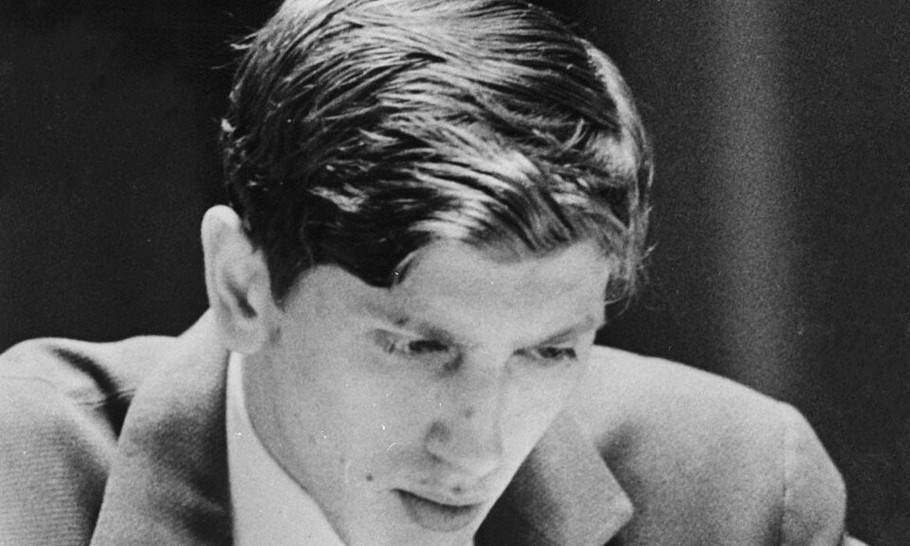
Fischer in 1971
One of the most celebrated victories of the legend that was Bobby Fischer, arose during that USA championship where the mercurial Grandmaestro notched a 100% score against a field comprising master and Grandmaster opposition. The game I have in mind was a stunning demolition of two times world championship candidate Pal Benkö and featured the. sensational blockading sacrificial strike, seemingly a thunderbolt from the blue, Rf6!!
One might be excused for thinking that this sacrifice was a unique occurrence in the annals of chess sacrificial onslaughts. However, that would be a mistaken assumption. Having overlooked a tactical opportunity to win myself, I personally suffered as the victim of a similar sacrificial concept, against my fellow student from Dulwich College, the talented and ingenious John Sugden. This was before the Fischer masterpiece even saw the light of day. John went on to twice win the Major Open section of the annual British championship, following in the illustrious footsteps of the immortal Alexander Alekhine.
United States Championship, New York, 1963/64, round 10
- e4 g6 2. d4 Bg7 3. Nc3 d6 4. f4 Nf6 5. Nf3 O-O 6. Bd3 Bg4?!
Stronger is 6… Nc6 7. O-O e5 8. d5 Nd4 9. f5 c6 10. Bg5 h6.
- h3 Bxf3 8. Qxf3 Nc6 9. Be3 e5 10. dxe5 dxe5 11. f5 gxf5?!
A small oversight with long-term implications, as Black allowing the g-file to open has deadly consequences. Preferable is the long but mostly forced variation, well within Benko’s ability to calculate: 11… Nd4 12. Qf2 c5 13. g4 b5 14. g5 b4 15. gxf6 Bxf6 16. O-O (16. Ne2? {16. Nd4?? Bh4!} 16… c4 17. O-O-O cxd3 18. Rxd3 Bh4) 16… bxc3 17. bxc3 c4 18. fxg6 cxd3 19. gxh7+ Kxh7 20. cxd4 Rg8+ 21. Kh1 exd4 22. Bd2 Rg6 23. cxd3 Rc8 though White still has an edge.
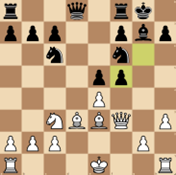
- Qxf5 Nd4 13. Qf2 Ne8 14. O-O Nd6 15. Qg3 Kh8 16. Qg4 c6 17. Qh5 Qe8??
The hope of exchanging queens after the f-pawn moves is a wishful deceit and loses. Better for Black is to continue with 17… Ne6 18. Ne2 Rg8 19. Nd4 Nxd4 20. Bxd4 f5 21. exf5 Ne4 22. Bc3 Nxc3 23. bxc3 e4 24. Bxe4 Bxc3, when he is slightly worse but certainly not yet losing.
- Bxd4 exd4 19. Rf6!!
The only move — and what a move! The rook is immune from capture as after 19… Bxf6?? 20. e5 Ne4 21. Bxe4 h6 22. Qxh6+ Kg8 23. Qh7 is checkmate. This stunning coup has been picturesquely likened to hurling a boulder in front of Black’s f pawn.
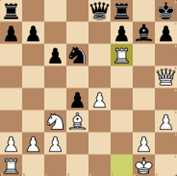
19… Kg8 20. e5 h6 21. Ne2 Black resigns 1-0
Thematic Match, Dulwich, 1963, round 2
- d4 Nf6 2. c4 Nc6 3. Nf3 g6
This principled development is rarely played, although a recent win for Black was notable [Makarian-Carlsen, T/Tue chess.com R7, 2023].
- d5 Na5
An uncommon continuation in an uncommon variation; the quieter line is with 4… Nb8, and the more energetic, with 4… Nb4.
- Qc2 c5!?
Superior is 5… b6! 6. e4 Bg7 7. Nc3 (or 5… Bg7! 6. Nc3 b6 7. e4) when after either a) 7… d6 8. Bg5 h6 9. Bd2 Bd7 10. Be2 e5 11. b4 Nb7 12. O-O; or, b) 7… O-O 8. Be2 d6 9. h3 e6 10. O-O e5 11. b4 Nb7 12. Bg5, Black is slightly worse. But the text is an improvement over 5… a6?
- e4 d6 7. Be2 Bg7 8. Nc3 O-O 9. O-O a6 10. Bd2 Bd7
10… Bg4 11. b3 Nd7 12. Rab1 Rb8 13. a4 b6 14. h3 Bxf3 15. Bxf3 e5 16. Bg4 has also been played.
- Rae1 Rb8 12. Nh4?!
This move loses considerable momentum, when 12. h3 b5 13. b3 e5 14. Nh2 Qe7 15. Bd3 b4 16. Ne2 Nb7 17. Qc1 keeps the initiative alive.
12… b5 13. b3 bxc4 14. bxc4 Qb6?
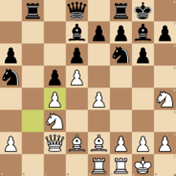
A misjudged placement for the queen, when it is better utilized supporting the central break, for example, after 14… e6 15. Nd1 exd5 16. exd5 Rb4 (an astonishing sacrifice proposed by the engine, which in fact counsels refusal as the optimal response!) 17. Nf3 Bf5 18. Qc1 Ra4 19. Ne3 Be4 20. Bc3 Bxf3 21. Bxf3 Rxa2 with an additional passed flank pawn.
- f4
The reason behind White’s twelth move, yet dogmatic since it helps vindicate Black’s dubious queen foray. More energetic is 15. Nd1 e6 16. Ne3 exd5 17. exd5 Rbe8 18. Bc3 Qd8 19. Qb2, when White has a firm grip on the game.
15… Qb2 16. Qd3 Nh5?
Placing a second knight on the rim in a slow and self-damaging manoeuvre. Black best inhibits White’s better position with 16… Bg4! (the sacrifice 16… Nxc4!? is also playable) 17. Rb1 Bxe2 18. Qxe2 Qa3 19. e5 Nd7 20. Rxb8 Rxb8, or some transposition thereof.
- Bxh5?
An excruciating mistake, both failing to exploit Black’s last error and also bestowing upon him a powerful advantage. Necessary is 17. Rb1!, and if Black continues: a) 17… Nxf4 18. Rxf4 Qa3 19. Rxb8 Rxb8 20. Rf1 Rb2 21. Nf3 Rxd2 22. Nxd2 Bd4+ 23. Kh1 Qxc3; or b) 17… Qa3 18. Rxb8 Rxb8 19. e5 Rb4 20. Bc1 Nxf4 21. Bxa3 Nxd3 22. Bxd3 Rxc4 23. Bxc4 Nxc4, White’s material advantage is a telling force which leaves Black fighting for survival.
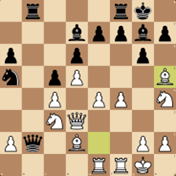
17… gxh5?
Black carelessly returns White the advantage, demonstrating that what seems natural isn’t necessarly best. Black can completely turn the tables with 17… Nxc4! and whether White attempts either, a) 18. Rf2 Bd4 19. Nf3 Bxf2+ 20. Kxf2 Rb4 21. Re2 gxh5; or b) 18. Bc1 Qxc3 19. Be2 Bd4+ 20. Kh1 Qxd3 21. Bxd3 Nb2 22. Bxa6 Rb6 23. Bxb2 Bxb2, his goose is cooked.
- e5 dxe5 19. fxe5 Nxc4 20. Bc1?
This move is a miscalculation and loses a considerable part of White’s advantage. He was better advised to continue with 20. Bf4! (20. Qxc4? Qxd2!) 20… Nb6 21. Qg3 Kh8 22. Rb1 Qa3 23. e6 Qxc3 24. Bxb8 Bb5 25. Rxf7 Rxf7 26. exf7, with good winning chances.
20… Qb4 21. Re4?
Another weak move returns the position to equality. White maintains a serious advantage after 21. Qg3 Kh8 22. Bf4 Rg8 23. Rb1 Nb2 24. Rf2 Bf6 25. Rfxb2 Qxb2 26. Rxb2 Rxb2 27. exf6 Rxg3 28. Bxg3 exf6 thus preserving his good winning chances.
21… Nb2?
Losing. White would keep his meagre lead after the more circumspect 21… Nxe5 22. Qg3 Nc4 23. Ne2 Bg4 24. Nf4 f5 25. Rxe7 Qc3 26. Rxg7+ Qxg7. It is interesting to note that here, the engine approved 22. Qg3 Qb6 23 d6 Kh8 24. dxe7 Rg8. But there is more to this than it has seen!
- Qg3 Qb6 23. Rf6!!
A brilliant conception that even took our engine by surprise, with it initially recommending either 23. d6 or Rf2. After the text move, the game is effectively over.
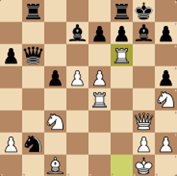
23… exf6 24. Bh6 c4+
And it is mate in 8 moves: 24… Bg4 25. Rxg4 c4+ 26. Kh1 Rfd8 27. Rxg7+ Kf8 28. Nf5 Ke8 29. e6 Qxe6 30. dxe6 Rd1+ 31. Nxd1 Nxd1 32. Qxb8# or Rg8#.
- Kh1 Bg4 26. Rxg4 Rfc8 27. Rxg7+ Kf8 28. Rxf7+ Kxf7 29. e6+ Ke7 30. Nf5+ Kd8 31. Qg8+ Kc7 32. Qf7+ Black resigns 1-0
As 32… Kd8 33. Qd7 checkmate must follow.
Ray’s 206th book, “ Chess in the Year of the King ”, written in collaboration with Adam Black, and his 207th, “ Napoleon and Goethe: The Touchstone of Genius ” (which discusses their relationship with chess) can be ordered from both Amazon and Blackwell’s. His 208th, the world record for chess books, written jointly with the late chess playing artist, Barry Martin, Chess through the Looking Glass , is now also available from Amazon.
A Message from TheArticle
We are the only publication that’s committed to covering every angle. We have an important contribution to make, one that’s needed now more than ever, and we need your help to continue publishing throughout these hard economic times. So please, make a donation.


