The Great Tibetan Lama Hoax: 'The Third Eye'

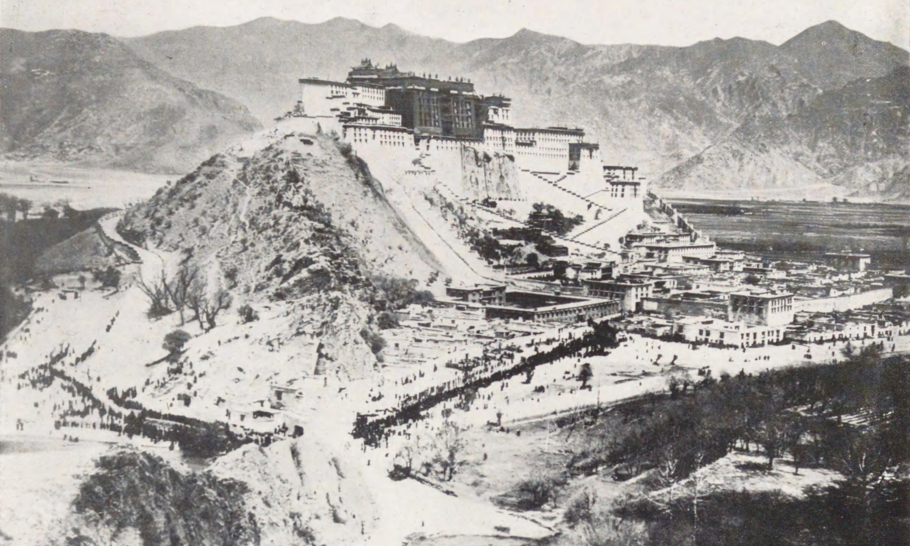
Historical image of Potala Lhasa 1932
Published in November 1956, T. Lobsang Rampa’s The Third Eye was the first ever autobiography of a Tibetan lama. The “T” stood for Tuesday, the day of the author’s birth. The book became an instant bestseller. It was translated into more than a dozen languages and made its mysterious author an extremely wealthy man. More than four million copies, mostly in paperback, have been sold since – the exact figures unknown. The last edition was published in 1991.
The Third Eye revealed secret mystic practices unheard of in the West. It took its title from an operation, undergone when the author was eight, to open “the third eye”: “A strong looking lama sat behind me and took my head between his knees. The second lama opened a box and removed an instrument made of shining steel … He pressed the instrument to the centre of my forehead, and rotated the handle … There was no particular pain as it penetrated the skin and flesh … Suddenly there was a little ‘scrunch’ and the instrument penetrated the bone.”
A sliver of wood, which had been treated with fire and herbs, was then inserted into the incision. “Suddenly there was a blinding flash … like a searing white flame. It diminished, died, and was replaced by spirals of colour, and globules of incandescent smoke.” The third eye had been opened. “The lama Mingyar Dondup turned to me and said ‘You are now one of us, Lobsang. For the rest of your life you will see people as they are and not as they pretend to be.’”
The book began life two years earlier, in London. Visits to the offices of literary agents by Tibetan lamas have always been rare, and so when one turned at the office of Cyrus Brooks of the A. M. Heath Agency, despite not having an appointment, he was shown straight in. Dr Ku’an-suo, according to one account, was hoping to interest Brooks in a book he had in mind on do-it-yourself surgical corset-making – a practical guide. Brooks told him that in his judgment, such a work would prove hard to place with a publisher. (Another version of the initial encounter suggests that he was seeking freelance work writing advertising copy for this same species of medical supplies.) Brooks’ visitor intrigued him. For Dr Ku’an-suo was, it seemed, no ordinary lama.
Having studied at the sacred monastery of Potala, in Lhasa, the Forbidden City, he had, he said, gained degrees in both Medicine and Surgery from the University of Chungking (now Chongqing), in southwestern China. Alas these qualificators were not recognised in the United Kingdon; hence his foray into the surgical goods trade. While serving as a medical officer in the Chinese army during the War, he’d been captured – and horribly tortured – by the Japanese. Having managed to escape, he had made his way, in a small fishing boat, to Korea, and then progressed, via the Soviet Union and the USA, to England. He had, he said, picked up a little English in the Japanese prisoner of war camp. Brooks couldn’t contain his excitement. Why don’t you, he asked, write your own story? At first, the lama expressed extreme reluctance to embark on a book; he came round.
A few weeks later, the first chapters arrived. They told of the author’s early life as the son of a highborn family in Lhasa. Here he had intimate conversations with the Thirteenth Dalai Lama (who died in 1933). The young Lobsang was taught the secrets of clairvoyance, levitation, astral projection, the divination of auras. Much of this was familiar currency amongst Theosophists, and other western students of mysticism. But then came astonishing revelations that no other writer on Tibet had previously reported. Kites in which grown men could fly, an encounter with an Abominable Snowman, or Yeti, golden images of Lobsang’s previous incarnations – and of course the operation to expose the “third eye” itself. While the concept was an ancient one, generally taken as a metaphor for enhanced perception, or arcane wisdom of one form or another, a surgical procedure to unlock its clairvoyant powers, was, hitherto, undreamt of in the West.
In April 1955 the book was accepted for publication by the distinguished firm of Secker & Warburg. This we know, as with much of what follows, from the waspish and engaging autobiography of Fredric Warburg, published in 1973, All Authors Are Equal. Under his leadership, along with the founder Martin Secker, the firm were the publishers of Animal Farm and Nineteen Eighty-Four, as well as the English translations of Thomas Mann – and Franz Kafka.
Warburg read the first chapters over a weekend. He was hooked. “From the beginning there emanated from Dr Ku’an’s masterpiece a magical aroma of enchantment. The book, even in its partial and provisional form, was literally bewitching. It cast a spell over me.” Immediately he knew in his bones that he had a lulu of a best seller on his hands.
But only if it were authentic. If it was a work of imagination, and had to be consigned to the Fiction shelves, it would be nothing like as profitable. But this was surely the real McCoy. “I told my directors with a profusion of superlatives what I thought of Dr K.’s book. One after the other, with one exception, they read it and were bowled over by its mysterious appeal… within a bare ten days terms had been agreed.”
An advance of £800 – then a large sum – was negotiated, to be paid in stages; an in-house editor was appointed to oversee the book, schedules were drawn up, work proceeded. Shortly afterwards came the first storm cloud. A “rather discouraging” letter arrived from A. M. Heath. Three publishers, it turned out, had already passed on the book. One, Mark Bonham-Carter, of William Collins, had expressed what Brooks described as “an unimaginative scepticism for the author’s credentials.” But Warburg was not deterred: “It is not uncommon in my experience for another publisher to reject a work which I have subsequently published with success. So I was not unduly impressed by these rather tepid reactions.” And he was heartened when Elliott Macrea, President of the highly respected American publishing house of E. P. Dutton, picked up the U.S. rights.
This was doubly significant, because Dutton had brought out works on Tibet by four writers, two of whom were still alive. One was Heinrich Harrer, the Austrian author of the famous Seven Years in Tibet, published in 1954. A member of the first party successfully to climb the forbidding North Face of the Eiger – the “Murder Wall” – he had been travelling back from the Himalayas in September 1939 when he was captured and imprisoned in India by the British authorities. Having escaped, the blond, blue-eyed Harrer and a fellow mountaineer, disguised as Indian workmen, had entered Tibet and made it, after 21 months of suffering the hardships and privations endured by all such travellers, to Lhasa, where Harrer tutored the Fourteenth, and present, Dalai Lama – in English. The second living author was André Migot, a Frenchman whose Tibetan Marches, published by Dutton in 1955, charted his travels, in the guise of a mendicant lama, around the eastern part of the country over nine months during 1947.
Dr Ku’an was duly invited to meet the publishing team. Though they had been a little nervous as to how their auras would appear to the savant, they were impressed. Their visitor proved to be a self-possessed, if rather blunt and reticent individual. His appearance, fully-robed, was reassuring. What’s more, “Between the eyes, slightly to the left of centre’ Warburg reported, ‘a small purplish-red mark could be seen, almost the size of a collar button, the scar no doubt of that remarkable incision.”
Warburg’s belief, at this stage, was that “The account given by Dr K. of his adventures and wanderings … were so odd that it was hard not to accept it. An impersonator could have invented a vastly more believable story in five minutes.” He was further persuaded as to Dr Ku’an’s bona fides because, while Bonham-Carter had not accepted them, others who had read the MS, “and there must have been over a dozen by this time – believed it was what it purported to be.” None of these readers were specialists on Tibet. But the fact that E. P. Dutton had on its list four books by people who were, “strengthened my feeling that we had the experts on our side.”
Work progressed. Warburg’s confidence in it was only slightly shaken by a letter from Elliott Macrae, saying that, since it was “important to establish beyond a shadow of a doubt Dr Ku’an’s background,” his editors had asked him to provide references, at least for his time in China. This request was sarcastically dismissed. Warburg sent back a somewhat ambiguous credo: “We have no doubts about the author’s authenticity, and even if the book were a fake, which it is not, it would be one of the greatest fakes of our time.”
Warburg now took his author out to lunch. He was pleased to see that scampi and rice was on the menu, which he assumed would suit an Oriental palate. Instead, Dr Ku’an ordered fish and chips, and tucked in enthusiastically. Noticing Warburg’s surprise, he told him “I can’t stand rice. I had too much of the horrible stuff in Japanese prison camps.” Uneasy – “in my heart was alarm” – Warburg returned to his office.
By early August, 1955, the MS had been delivered, the greater part of the advance handed over, the first publicity notes for the trade written. Interest had been piqued and orders from booksellers were already coming in. “There could hardly be any going back now. The die was cast.”
Warburg had by now decided there were five possibilities. 1. The work was genuine but embroidered here and there, as with so much autobiography. 2. The work was authentic, but the person he knew as Dr Ku’an was a front for the real Tibetan author, whose identity was unknown. 3. The work was partly true, partly made up. The author had either lived in Tibet or its neighbour, Sikkim. Dr Ku’an had experienced the events he describes or learned of them from genuine Tibetans. 4. “The manuscript was the work of a brilliant psychopath who had thought himself thoroughly into the mind of a lama, after studying the history of Tibet and the theory and practice of lamaism.” 5: “The manuscript was a fake, written to deceive.”
A month later came sight of the first iceberg. While Warburg seems to have relied on colleagues and perhaps acquaintances for their appraisals, Macrae at Dutton had send out copies of the completed MS to expert “readers” who would report on the book’s accuracy, or otherwise. “All three readers agree that there are many inaccuracies in the manuscript … serious questions have been raised as to the author’s knowledge of Lhasa – both in the geographical sense and from the standpoint of customs, traditions and monasteries, as well as his knowledge of Buddhist and Tibetan religious belief.”
One reader thought it possible that the author was Tibetan, but from an outlying province (some of which had long before come under Chinese control), who may have visited Lhasa. It seemed certain that the author had taken much of his material from already published books. Not altogether accurately.
In 1974 one of Dutton’s readers declared himself. This was Agehananda Bharati, a German-born convert to Hinduism and recognised authority on Tibetan Buddhism, who for thirty years was a Professor of Anthropology at Syracuse University. He recalled his first reaction: “I was suspicious before I opened the wrapper: the ‘third eye’ smacked of Blavatskyan and post-Blavatskyan hogwash. The first two pages convinced me the writer was not a Tibetan, the next ten that he had never been either in Tibet or India, and that he knew absolutely nothing about Buddhism of any form, Tibetan or other. The cat was out of the bag very soon, when the ‘Lama’ … mused ‘for we know there is a God.’ Every page bespeaks the utter ignorance of the author of anything that has to do with Buddhism practiced and Buddhism as a belief system in Tibet or elsewhere.” This is, presumably, the gist of what Bharati reported back to Dutton.
Most disturbing of all: the readers concurred that Dr Ku’an didn’t seem to be fluent in the Tibetan language. Warburg – even his radiant confidence was now dimmed – stopped all payments, and summoned his author for a showdown.
“’You are not a Tibetan lama.’ I told him grimly, ‘and you have no real knowledge of the Tibetan language. Our reports demonstrate that elementary mistakes have been made in the Tibetan script, most if not all of which has been copied, sometimes very clumsily, from readily available sources.’”
Dr Ku’an shuddered, and passed a weary hand across his face. “’Part of what you say is true. When I left Tibet I served, as you know, as a medical aide with the Chinese armies fighting the Japanese invaders. The Nipponese captured and tortured me. … They had seized Tibetan documents and plans: now they wanted me to translate and explain them!’
‘“Yes, but what has this got to do with your mistakes in Tibetan?’
“’Do you think I would reveal important secrets to the bloodthirsty Japanese? … I imposed a hypnotic block on my knowledge of the Tibetan language. After that I could no longer read or write or understand Tibetan. The secrets were safe. Even today, trying to read or write Tibetan brings on a fearful migraine.’”
Explaining that for the last six years he had been suffering from an incurable disease, had less than two years to live, and wished he’d never started the wretched book in the first place, Dr Ku’an gathered up his robes and left Fredric Warburg to ponder his doubts. Which were only to deepen.
After receiving the disturbing news from Dutton, Warburg had decided to seek the advice of an accredited authority on Tibet himself. He asked Dr David Snellgrove, then a Lecturer in Tibetan at the School of Oriental and African Studies in London, to give his assessment. It came through shortly after the unsatisfactory meeting with Dr Ku’an.
“The book is a complete fantasy, culled from the work of others,” Snellgrove reported. “The fellow is a complete impostor and has probably never been to Tibet. He should be properly unmasked, as such men are dangerous.” The book contained, at best, “half truths”. Snellgrove also questioned why Rampa had the Dalai Lama, of all people, referring to the “soul”. He also provided his own list of Dr Ku’an’s mistakes in Tibetan.
Warburg wrote to Macrae, “In my opinion, we and you have been the victims of one the most remarkable and interesting fakes of modern times.” He now slipped through the gears of the familiar cycle of grievous loss: denial, anger, despair, pain, and finally a sorrowful resigned acceptance that an important part of one’s life was now gone forever. But then appeared the faintest ray of sunlight. “Could we not publish it after all,” he asked himself, “while warning the reader that we had been unable to authenticate it?”
Rolling the dice again, Warburg decided to approach another reader. This was John Morris, “a fine Orientalist … who had travelled widely in the East.” Morris, later a Controller of the BBC Radio Third Programme, had indeed spent time in India and Chinese Turkistan and later taught in Japan. But he had never set foot in Tibet.
Warburg’s perseverance was rewarded. “This is a curious mix of fact and fantasy,” Morris told him. “The descriptions of Lhasa and Tibetan life are completely authentic. There is not the slightest doubt that he was brought up in Tibet from an early age.” Of the mystical elements, Morris was less convinced, finding them “very hard to swallow … My own opinion is that the author is some sort of psychopath living in a private world of his own. It is even likely that he has persuaded himself that all this occult nonsense is true.”
Ignoring the second judgement, Warburg took the first as his imprimatur: “I would reject the other experts whose views contradicted each other. We should publish The Third Eye with a ‘beware’ notice, but without suggesting that it was a complete fabrication. It would, I felt certain, become a best seller. As a publisher, I could not reject it. The decision was made. Publish! At least then, I thought, the truth will somehow emerge.” He didn’t quite say, publish and be damned.
In November 1956 The Third Eye hit the bookshops.
“I am a Tibetan,” the author’s preface began, “one of the few who have reached this strange western world. … Some of my statements, I am told, may not be believed. That is your privilege, but Tibet is a country unknown to the rest of the world. The man who wrote of ‘the people who rode on turtles in the sea’ was laughed to scorn. So were those who had seen ‘living fossil fish.’ But these men were eventually proved to be truthful and accurate. So will I be.”
In a carefully worded Publisher’s Foreword, Secker & Warburg admitted that they did not share the author’s confidence. Instead they invited their readers, more or less, to make up their own minds as to whether the book was genuine or not: take it or leave it.
“The author must bear – and willingly bears – a sole responsibility for the statements made in this book. We may feel that here and there he exceeds the bounds of Western credulity … None the less the publishers believe that The Third Eye is in its essence an authentic account of a Tibetan boy in his family and lamasery … Anyone who differs from us will, we believe, at least agree that the author is endowed to an exceptional degree with narrative skill and the power to evoke scenes and characters of absorbing and unique interest.”
So is it true or not? Of course the publishers had not placed the book on the shelves without the most careful examination of its credentials. “In an attempt to obtain confirmation of the author’s statements the Publishers submitted the MS to nearly twenty readers, all persons of intelligence and experience, some with special knowledge of the subject. Their opinions were so contradictory that no positive result emerged. Some questioned the accuracy of one section, some of another; what was doubted by one expert was accepted unquestioningly by another.” (Mysteriously this caveat lector – a masterpiece of sustained equivocation – was only included in the first two editions; after that it disappeared.)
“Some with special knowledge of the subject … [My emphasis.] As far as I can see there were only three readers who matched that description. And two of them were Dutton’s. Warburg’s sole expert on Tibet was David Snellgrove – and he hadn’t visited Tibet, nor claimed to.
It’s true that since the late eighteenth century Tibet had been a country forbidden to foreigners, with rare exceptions. And yet … by my reckoning, in 1955 there were at least nineteen westerners alive who had visited Lhasa, and in some cases lived there. Several others had travelled in outlying regions.
It is a truism of Tibet that practically every western European visitor who spends any amount time in the country, going back to Francis Younghusband, who invaded it in 1904 as a late move in “The Great Game”, writes a book about it. One was Peter Aufschnaiter, the man who had, with Heinrich Harrer, escaped from the British POW camp and entered Tibet illegally. The pair only left Lhasa after the Chinese invasion in 1950. Aufschnaiter’s own account was called Eight Years in Tibet. Eight more former residents were British officials and their families, who had been stationed in the capital in the 1930s and 1940s. By 1955 three of them had written memoirs about their time there. (A fourth, written by the widow of one of these British diplomats, followed in 1987.)
Two more were travellers – the adjective “intrepid” for once is fully justified – who, many years before Harrer, Aufschnaiter and Migot, slipped into Tibet, having been refused official permission. They travelled to Lhasa, in disguise, under very real threat of being killed by brigands, or by angry mobs whipped up into murderous frenzy by the xenophobic Tibetan monks. One was William Montogomery McGovern – said, entirely plausibly, to be one of the models for Indiana Jones – who spent several weeks in Lhasa in 1923 and published To Lhasa in Disguise later that year. In 1955 he was a Professor of Political Philosophy at Northwestern University, twelve miles from Chicago. Dutton don’t seem to have contacted him.
The other was Alexandra David-Néel, a quite extraordinary sans pareille, who managed to reach Lhasa in 1924, at age of 55, after surviving many hair-raising spills and chills journeying across the country disguised as a beggar. Which included dangling from a broken rope bridge above a raging torrent that would have made a great scene in an Indiana Jones movie. With her was her adopted son – a Buddhist monk. Her book of the journey – Voyage d’une Parisienne à Lhassa – came out in 1927. It was translated into English the same year. By 1955 she was living in Provence. Both of these adventurers were experts in Tibetan Buddhism who spoke and read the language fluently; having studied both, in great depth, before their travels through the country.
David-Néel in particular wrote about the esoteric elements of Tibetan Buddhism: the influence of the earlier, shamanistic Bôn religion on the one hand; the esoteric Vajrayana Tantric Buddhism on the other. These recondite aspects had long been of fascination to westerners, especially the Theosophists: David-Néel had been such; indeed, she knew Madame Blavatsky personally. A later book was called Mystiques et Magiciens du Tibet. If Rampa had read the English translation – he had no French – no coherent version of its subject matter appears in The Third Eye. She was not asked to give a verdict.
Two other notable visitors were Americans – Lowell Thomas, the journalist mainly responsible for propagating the myth of Lawrence of Arabia; and his son. They been invited to Lhasa in 1947 to help draw the world’s attention to the looming threat of Chinese invasion. They spent more than a year in the country and made a film. As far as we know, they were not approached by Dutton.
A 1930s visitor to the Tibetan side of the Himalayas was Marco Pallis, a wealthy Anglo-Greek polymath; as well as being a celebrated climber he was also an accomplished musician, a pioneer in the revival of Early Music. At this time he converted to Buddhism. His book Peaks and Lamas, published in 1939, is still regarded a classic of mountaineering literature. In 1947 he and his partner, Richard Nicholson, spent several months in Lhasa, at the government’s invitation.
Of the writers who travelled to outlying regions of Tibet, but not Lhasa, one whose account may well have been used as a source for The Third Eye was the English newspaper reporter Edwin J. Dingle. His 1952 book, My Life in Tibet, told of nine months of advanced spiritual training he claimed to have undertaken in a lamasery in 1910.
The most significant member of this group of people who had got to know Tibetans, their language, customs and religion well was Hugh E. Richardson, a Scottish diplomat. He was our last ‘Man in Lhasa’, serving as Officer-in-Charge of the British Mission for nearly nine years; from 1936 to 1940, and again from 1946 to 1950. He wrote several scholarly works on Tibet, starting in 1940, when he co-authored a Tibetan Word Book with his former chief. On his return to Lhasa in 1946, Hugh Richardson and Heinrich Harrer became close friends. Marco Pallis, Harrer and Richardson would go on to play notable parts, indeed starring roles, in the later stages of the Rampa story.
Though Warburg doesn’t say so, and probably didn’t know, Hugh Richardson was one of the three readers consulted by Elliot Macrae at E. P Dutton. Not one of the other accredited travellers to Tibet mentioned above was consulted by any of the three publishers involved. (Doubleday, having taken over from Dutton as the American publisher when the latter dropped out, don’t seem to have consulted anyone.) Apart from Aufschnaiter, whose book was published in German in 1983 (in English in 2002), all of them could have been contacted though their publishers. Or, failing that, the 1950s version of Linked-in, Who’s Who – which, with the possible exception of Alexandra David- Néel, would have listed their London clubs, if not their addresses.
But I don’t believe that, apart from the moment of weakness in which he approached Snellgrove, Warburg wanted expert opinion. It was likely to be inconvenient.
*******
The great majority of reviews were extremely positive. The Times Literary Supplement described the book as “almost a masterpiece … though it would be a matter of extraordinary difficulty to say whether it is a work of truth, it comes near to being a work of art.” The Observer pronounced it “extraordinary and exciting.” The New Statesman warmly congratulated the author “for having written a book in a language not his own.”
This same thought had puzzled some of the people who were willing to believe that the book was, broadly, authentic. Just how, in a few short months in a Japanese POW camp had the author managed to acquire such a grasp, not just of correct English – in marked contrast to his Tibetan – but of the kind of schoolboy banter familiar to devotees of the “Fat Owl” Billy Bunter and his chums in the Greyfriars Remove?
“A stunning crash – I thought my head had split – and the sound of voices. ‘New boy. One of the high born. Come on, let’s scrag him!’ … There was a sudden loud bellow. ‘What’s going on here?’ A frightened whisper: ‘Oh! It’s old Rattlebones on the prowl.’ … The Master of the Acolytes reached down and dragged me to my feet by my pigtail… ‘You one of the future leaders? Bah! Take that, and that!’”
One of Dutton’s readers – almost certainly Richardson – had written in his report, “I can say that the English construction, grammar, idiom and vocabulary are most unlikely to have been achieved by any Tibetan.” And what of the traces some observers – including a BBC television producer – claimed to have noticed, in Dr Ku’an’s speech, of a west country accent?
Not all the reviews were favourable. Hugh Richardson’s, in the Daily Telegraph, titled “Imaginary Tibet,” is worth quoting at length. “A book which plays up to public eagerness to hear about ’mysterious’ Tibet has the advantage that few people have the experience to refute it. But anyone who has lived in Tibet will feel after reading a few pages of The Third Eye that its author T. Lobsang Rampa is certainly not a Tibetan.
“Local colour has apparently been borrowed from standard works, but is applied as inappropriately as the decoration of a magpie’s nest. There are innumerable inaccuracies about Tibetan life and manners which give the impression of Western suburbia playing charades … Moreover, the turn of phrase in the slick colloquial English is quite unconvincing when attributed to a Tibetan writer.
“Given that this is the work of a non-Asian mind – and if I am mistaken, I should be happy to make amends to the author in person and in Tibetan – one can regard only as indifferent juvenile fiction the catchpenny accoutrements of magic and mystery: the surgical opening of the ‘third eye’; the man-lifting kites; the Abominable Snowman; the Shangri-la valley and eerie going so on in caverns below the Potala.”
The other nay-sayer in the British press was, hardly surprisingly, David Snellgrove. His verdict, in the academic journal Oriental Art, was: ‘This is a shameless book.’ Heinrich Harrer’s review of the German translation was so hostile that the publisher threatened to sue him.
None of these caveats weighed the book down. The Third Eye was a huge success. Reprint after reprint followed. By the end of 1957 Secker & Warburg had sold more than 45,000 copies, in hardback. Corgi soon issued a paperback, which too became a best-seller. As Fredric Warburg remembered thinking at the time, “Another gamble had succeeded. Or had it?”
Not entirely.
*********
On the morning of January 31st, 1958, some fourteen months after the publication of The Third Eye, Fredric Warburg took an unexpected call from Hugh Medlicott, a reporter for the Daily Mail. “Would it surprise you to know”’ he asked, “that your Tibetan lama is a hoaxer?” Warburg’s heart, he tells us, skipped a beat. But he rose magnificently to the challenge: “It’s no surprise to me at all.”
Just as well. Because he woke up the next morning to a headline emblazoned across the front page of the Mail that read “THIRD EYE LAMA EXPOSED AS FAKE.”
The basis of the Daily Mail’s scoop was the evidence gathered by a private detective from Liverpool, Clifford Burgess. “In three weeks,” reported the Mail, he “and his pretty 19-year-old assistant, Miss Sheila Briant, of Hoylake, Cheshire, have travelled more than 3,000 miles. They have interviewed scores of people and taken statements running into thousands of words about ‘Dr Ku’an’.”
Who, it turned out, was born Cyril Henry Hoskin, in 1910, the son of a plumber from Plympton, Devon. By the time the exposé was published he had relocated to Howth, the hill overlooking Dublin Bay. Irish police confirmed to Burgess that the man who called himself Dr Ku’an had no British passport. He could travel freely between Ireland and Britain; nowhere else.
In the Mail’s article Warburg pronounced himself “very surprised. I thought he was Chinese. [Not Tibetan?] We were not sure ourselves about the book and sent it to twenty people who all have different opinions.”(Eighteen of them had more or less the same, erroneous opinion.)
A spokesman for Doubleday, the American publishers, issued an evasive statement too: “We expected that people would think it was good reading, but not necessarily true.” This was, of course, essentially Warburg’s position all along, as the Publisher’s Foreword makes clear.
Marco Pallis, Hugh Richardson and David Snellgrove were all quoted to the effect that the book was an egregious fake. John Irwin, the television producer who had interviewed Rampa was also on record: “No normally intelligent person could meet him and believe he was Tibetan or Chinese. He was thoroughly Western.” Irwin was the man who thought he’d heard traces of a west country accent.
Burgess’s researches had turned up that Hoskin had indeed worked in a surgical goods factory – hence the nature of the book, or literary services, he had first proposed to Cyrus Brooks. In the War he moved to Thames Ditton, having got a job as the clerk of a correspondence school in nearby Weybridge. Here the man who became Rampa began to emerge. In 1947, neighbours testified to Burgess, Dr Ku’an-suo, as Hoskin now styled himself, shaved his head, grew a beard, adopted eastern dress, and was occasionally to be seen taking his cat for a walk on a lead. He had cards printed bearing the name of Dr Carl Ku’an-Suo. At this stage of his cosplay career, he purported to be Chinese. Angry if this pose went unacknowledged, he wrote to his managing director at the school: “You may wonder why I go on so. But will you please remember I am Ku-an Suo.”
Now under siege by the world’s press – this was a big story – things were getting to the “bogus lama”, as the Mail had gleefully styled him, to Hoskin’s fury. Medlicott had already reported that Mrs Hoskin had “asked me not to call on her or her husband again as my aura was penetrating the house and making him ill. He has coronary thrombosis and his doctor has signed a letter saying he is too ill to see visitors.” By this stage reporters and photographers had made a habit of sneaking into the house.
Finally, after a day of stalemate, Mrs Ku’an herself came out to break the deadlock. She read from a prepared statement. “About the middle of 1949, my husband had a slight accident. For some weeks he seemed to be very vague about many things, and when I discussed an event of the past with him he had no recollection of it. Instead, he spoke of life in a lamasery, of experiences in the war, prison camp life and Japanese torture. He was no longer the same man.”
What on earth could have happened? But before the assembled hacks could draw breath, came another twist. Mrs Sheelagh Rouse, Hoskin’s secretary and helpmeet, announced that, “We were prepared for snoopers to come and pry out the facts. I have seen the real Dr Ku’an but I will not tell you where he is.” So now there were two of them. This was backed up in a communiqué issued by Hoskin himself. He had, the press were now told, merely adopted the name of Dr Ku’an so as to shield the real personage behind the book; “The story is true, but for very good reasons the identity of the Tibetan author cannot be revealed.” It later emerged that the real author was in hiding, living under the daily threat of Chinese Communist reprisals.
The day after the Daily Mail broke the story, Fredric Warburg wrote an article for the Daily Express – for a then hefty fee of £250; “a price beyond my wildest dreams.” (Hoskin later joshed him for this, understandably.) While acknowledging that this new intelligence was an unwelcome development, he asked, “But is the truth, the whole truth out? How could the man alleged to be Cyril Henry Hoskin, known to me as Dr Ku’an, write a book which thrilled the world? … Why did he choose this subject? How did he gain the material? …. Was he perhaps the mouthpiece of a true lama, as some have alleged?”
Warburg now sent one of his employees, Eric Newby, to Howth. The talented Newby would later the same year publish his own account of an Asiatic experience – A Short Walk in the Hindu Kush. A book in which exaggeration for comic effect is deliberate. His under-rated first work, The Last Grain Race, had already been published by the firm. He took the ferry to Ireland and installed himself with a tape recorder at the now critically ailing author’s bedside. As always when he was presented with awkward facts, Hoskin had found himself at death’s door, with days, if not hours to live.
Nevertheless Newby was treated to an astonishing revelation that finally unlocked the troubling mystery of how a man who had never left the United Kingdom had such detailed, if faulty knowledge of Tibet and its mystic traditions: “I, a Tibetan lama, now occupy what was originally the body of a Western man, and I occupy it to the permanent and total exclusion of the former occupant. He gave his willing consent, being glad to escape from life on this earth in view of my urgent need. In the East, it is acknowledged that the stronger mind can take possession of another body.” (There is a complex Buddhism concept called grong ‘jug, whereby consciousness can be transferred from one body to another; but this is generally understood to take place after death. Not the result of one living person taking possession of another through some sort of superior willpower.)
A more detailed account of this simultaneous transmigration was later confided by Hoskin, and appeared in the press under the title, “How I Became A Tibetan.” While climbing a tree in his garden at Thames Ditton, on the 13th of June, 1949, in order to photograph a young owl, he had, it appears, overreached himself – not for the last time – and fallen heavily to the ground.
“There was a blinding pain, and a flash, as if of coloured lightning, and all went black. I do not know how long I lay a crumpled inert mass beneath the tree but quite suddenly I became aware that I was disengaging myself from the physical body … … I nearly screamed, or should have screamed if I had had a voice. Approaching me across the grass was the figure of a Tibetan lama dressed in the saffron robe of the High Order … For a moment it seemed as if Time itself stood still. The lama grasped my astral form, severed the silver cord and entered my earthly body.”
In contemporary New Age parlance, such a visitation is known as a “walk in”. Cyril Henry Hoskin had now become T. Lobsang Rampa. Or perhaps it was the other way round. A Cartesian conundrum.
Rampa had come to make good on a telepathically-negotiated bargain that had already been agreed by both parties, after a certain amount of karmic horse-trading. The exchange was necessary to the lama because by the late 1940s, worn out and frail, he desperately required a new body. He had, we will remember, been mercilessly tortured by the Japanese. This took place in a POW camp near Hiroshima. Rampa tells us he was still there when the first Atomic bomb was dropped in 1945; and claims to have witnessed ‘clouds of dust’ falling out of the sky. Most likely, then, he was suffering from radiation sickness too.
(Could Hoskin possibly have been mistaken? An account of levitation which Alexandra David- Néel claimed to have witnessed in Tibet was put down by some of her supporters to the hallucinatory effects of altitude sickness. This arboreal episode may perhaps have been another case in point.)
*****
Hoskin might have avoided being found out to be a fake had not he, or his alter ego, acquired a disciple, in early 1957, shortly after the publication of The Third Eye. This was the young woman who became his secretary, Sheelagh Rouse, described in the press coverage as a ‘socialite’ – given as an occupation – and ‘a well-known Mayfair party-goer’. She had, at the age of 27, fallen under Dr Ku’an’s spell, and left her husband and three young children in order to sit at his feet, and drink freely from the cup of Oriental wisdom.
According to Medlicott in the Daily Mail, Clifford Burgess had been hired by “a group of Tibetan scholars to make the investigation.” This was true. They were Henrich Harrer, Marco Pallis and Hugh Richardson. But there was more to it than that, as Hugh Richardson himself later explained to me. I met him in 1992, while working on an abortive television documentary about the Rampa Affair. A spry, charming, patrician presence, then in his late 80s, he was living only a fairway or two’s distance from the Royal and Ancient golf course at St Andrews, the place of his birth. He had, he told me, introduced the game to Tibet in the 1940s, albeit with mixed results. Still sharp as a tack and blessed with extremely good recall, still wryly despairing of the fact that The Third Eye had been published at all, he kindly provided me with copies of his own files on the affair.
He also told me that Sheelagh Rouse’s estranged parents, fearing their daughter was being kept under psychological duress, had approached Scotland Yard. An interview with Dr Ku’an, presumably under caution, had been conducted. The police confirmed that he had no passport, and was thus a fraud. But as no crime had been committed – there was nothing in the Constable’s Powers of Arrest that covered impersonating a Tibetan lama, and Mrs Rouse was over twenty one – the police took no further action.
Richardson further indicated to me that, though they strongly denied this in the press, it was Sheelagh Rouse’s parents, not the devotees of Tibet, who had paid for Clifford Burgess to investigate Dr Ku’an. Presumably in the hope that were he exposed as a charlatan their daughter might come to her senses. The Rouses had got in touch with one or other of the anti-Rampa faction, asking for help.
Marco Pallis had got to know Burgess, then a police officer, when the two served together as ARP wardens during the war. Pallis now asked him to act, while keeping the parents’ involvement a secret. Sheelagh Rouse herself was aware of this: she told the Mail, “someone employed a private detective to discredit the lama and win me back.” It didn’t work. Sheelagh Rouse only left Lobsang Rampa, as she clearly believed him to be, in 1980, after a falling out, shortly before he died. Up to this point she had lived in his household, along with his wife, as his adopted daughter as well as his secretary.
Though they were sympathetic to the anxieties of the parents of Mrs Rouse, the motivation that animated the Pallis, Harrer and Richardson triumvirate was their disgust at Hoskin’s pantomime version of the country they loved – though not uncritically. They were even more disgusted by the Chinese invasion in 1950, and its aftermath; a book that made the Tibetans look like children hardly helped.
They had swapped notes way before the Daily Mail’s scoop. Hugh Richardson’s documents included two of the three pages of the closely typed list of errors sent to him by the exasperated Heinrich Harrer after the publication of the book – the first page was lost. His annotations are damning. “Ignorance as he shows on the last two pages,” Harrer writes, referring to pages 89 and 90, “make me doubt that the author is even a Tibetan.” Between pages 76 and 255, which his surviving notes cover, he identifies some 45 mistakes in Tibetan geography, language, life and manners. Mistakes, not fabrications.
There are plenty to choose from. Buildings appearing on the wrong side of the city. (Though Rampa may have of course hypnotically suppressed his knowledge of Tibetan topography as well as language.) Golden candlesticks, never seen before by accredited visitors. A single ear-ring worn by the mystic’s mother – only men of high rank did this; women wore them in pairs. A tableland so high in altitude that one would have required oxygen to cross it. People wandering about on stilts. And on and on and on.
Some are fantastical inventions; others just the sort of trivial mistakes anyone might easily make in writing about a country they have never been to. At school in Tibet, for example, small children didn’t write on slates. Though they might have done in Plympton in the 1910s.
Hoskin did get a few things right, culled from other books. Monk-police, girls playing shuttlecock, women using wooden structures to support elaborate hair-dos. But relatively few of his observations are on the correct side of the truth or dare ledger. Most are casually invented, and then he moves on to the next piece of nonsense.
*****
While he never quite re-captured his early glittering success, T. Lobsang Rampa went on to write a further eighteen books. None was published by Secker & Warburg. One of them – Living with the Lama – was “telepathically dictated” by one of his cats, Mrs Fifi Greywhiskers. It is not an improvement on the others.
These further instalments are even more carelessly written and preposterous than the first offering. (In one, he tells us he takes a tube to work, and then, just eighty words later, that he rides a bike to his employ.)
In his Daily Telegraph review of the first follow up, Doctor from Lhasa, published by the Souvenir Press in 1959, Hugh Richardson writes: “It is surprising that his present publishers should claim that experts were unable to disprove the ‘fact’ of ‘The Third Eye.’ No one of my acquaintance who has lived in Tibet – including a genuine Tibetan lama to whom I read the manuscript – has any doubt that it was an impudent fake. [The exact same phrase he used to me when we met in 1992.]
“So far as Tibet is concerned the most realistic part is the picture on the dust-jacket: and we see in the photograph of the author that he does not know on which side the cross-over of a Tibetan’s robes should come.”
The many absurdities in subsequent dispatches from the mystical front include: a time capsule of greatly advanced technology left by the inhabitants of Atlantis; motion picture holograms of earth’s early history; evidence of the prior existence of a race of giants, whose lives came to an end after another planet collided with our own. (This was perhaps suggested by Velikovsky’s Worlds in Collision, a classic of pseudo-science.)
There is also, of course, a ride on a spaceship. This latter excursion was related in My Visit To Venus, written, it seems, in 1957 but only published, by other hands, nine years later. Hoskin allowed this after insisting on some changes. This work, however, is a matter of controversy among keepers of the Rampa flame, some of whom find it far-fetched.
What comes across in reading the subsequent books – at least to me, though I confess I gave up after the sixth – is that Hoskin, really, had very little curiosity about non-fictitious Tibet at all; never mind its unique form of Buddhism, or its people, or customs. After the hastily compiled Third Eye he had plenty of time for solid research. But his interest, as far as I can see, was just in making things up – a pulp writer manqué – and indulging his own lurid fantasies. As any writer of fiction does.
*******
In The Great Lama Mystery, Fredric Warburg asks us, “Why should Dr K., who had declared himself Chinese, pose to us as Tibetan? Simply that too much was known about China and so little about Tibet.” That certainly explains a great part of the book’s initial appeal. Tibet was a place of abiding mystery and fascination. The Land of Snows; The Roof of The World; Lhasa, The Forbidden City. Access to the country was hard if not impossible because of the mountains, and the extreme disinclination of the Tibetan authorities to allow it, unless forced to at the mouth of a cannon. Lost Horizon, James Hilton’s extremely successful novel, published in 1933, with its valley of near-eternal youth, Shangri-La, later a hit film directed by Frank Capra, stamped on the western consciousness the romance and mystique of Tibet.
Agehananda Bharati, in his 1974 essay Fictitious Tibet, concludes of The Third Eye: “the book also shows a shrewd intuition into what millions of people want to hear.” Credulity, as well as nature, abhors a vacuum and so in 1956 a western public was eager to believe breathless reports of all manner of marvellous and wondrous goings on in a determinedly hidden part of the world. Not least, perhaps, in mid 1950s Britain, where life, as well as our home-grown movies, seemed, at least as received wisdom has it, to play out in monochrome. Rationing of food ended in 1954; rationing of the imagination continued.
This longing for glamour and exoticism, and a new, racy and exciting form of recreational religious belief is what The Third Eye exploited, deliberately – or otherwise.
*******
Personally, I don’t follow Fredric Warburg in supposing that the gestation of The Third Eye was begun in the late 1940s, all part of a carefully worked out publishing heist. Certainly, it’s not clear when exactly Hoskin decided to change from posing as a Chinese to impersonating a Tibetan, and why – and this may be seen as a sign of nefarious intent. Although, to me it’s more likely that Hoskin came to see being taken for a Tibetan lama as a promotion in terms of rarity value and social cachet.
In the immediate aftermath of her husband’s unmasking in February 1958, according to Medlicott in his Daily Mail scoop, Mrs Hoskin had told him, “The book is fiction. He had tried to get a number of jobs without success. We had to have money to live. So he was persuaded to write the book.” (She later went back on this and followed her husband – or his successor’s – party line.) But this is, I would say, the truth of the matter – in a field where, to say the least, it is in short supply.
Certainly it accords with what Cyrus Brooks told Warburg: that he had to persuade his guest – who expressed initial strong reluctance – to write a book. This could have been a cunning pose, but – though I have no hard evidence – there is no reason to disbelieve it. I think it was opportunism. Matched up with some considerable ability at impersonation.
I think Warburg’s possibility No 4. sums the matter up: “The manuscript was the work of a brilliant psychopath who had thought himself thoroughly into the mind of a lama, after studying the history of Tibet and the theory and practice of lamaism.” Though I would of course question the use of the word “thoroughly”.
In The Rampa Story, published in 1960, the eponymous character and a fellow lama observe Hoskin over previous years of his life by consulting the “Akashic Records”, a kind of supernatural archive in which visions of the past can be conjured up and consulted by adepts. It is a concept unknown in Buddhism, and unmentioned by Hoskin up to this point; it is one drawn from Theosophy, always his go-to source. Perhaps he was doing some research.
Here we read that Lobsang Rampa and his fellow lama have divined that a certain man in England is tired of life in Thames Ditton and may perhaps be willing to offer the physically ailing Rampa a new lease of life by means of a bodily transfusion. Through the lamas’ eyes, we see that Hoskin is unemployed, and frantically and hopelessly in search of a job. (This seems entirely to have been the case in real, real life. In a later book we learn that Hoskin has been unhappy and frustrated since at least the outbreak of war). Approached telepathically by Rampa, he admits the lama’s information about his current state of mind is accurate.
“’So you want to leave your body?’ [Rampa] asked. ‘I do, I hate it here!’ he exclaimed vehemently … ‘the unfairness [of life in England], the favouritism.’”
Rampa plays his ace: “What have you to look forward to? Unemployment, illness, unhappiness, a mediocre life in mediocre surroundings … Have you achieved anything in life? Have you done anything to be proud of?” Hoskin does not argue back; he accepts the proposition and is told to prepare. The exchange will be made in a month.
This is in essence a portrait of a man contemplating suicide. No wonder Hoskin retreated, or advanced, into a life of fantasy and escape from what passed for his real life.
*********
“The damage to the reputation of Secker & Warburg might have been considerable, had we not refused to authenticate The Third Eye,” Warburg writes at the end of his chapter on The Great Lama Mystery, reflecting on the fact that his star author had been exposed as a hoaxer. This is a remarkable statement. To call it disingenuous would be in itself to be disingenuous, and then some. Certainly Secker & Warburg did indeed refuse to authenticate The Third Eye. Who could have done? But they also refused to de-authenticate it, simply by seeking the judgements of dilettanti and ‘Orientalists’ of various stripes as opposed to the genuinely knowledgeable. Excepting Snellgrove.
Many readers, pro and con, and I am one, are happy to believe that Cyril Hoskin believed all this stuff himself. Warburg seems to concur. But that is no justification for publishing an account he knew, in his bones, to be bogus. I would say it is impossible to read his reminiscence of the affair without coming to this conclusion.
People believe all kinds of things. One famously believed as many as six impossible things before breakfast. But no one has taken Alice in Wonderland to be a documentary record. The damage to Secker & Warburg was considerable, if judged by any reasonable standard.
But no damage was done to the firm’s balance sheets. Warburg remarks in his 1973 memoir, “The rate of sale of The Third Eye increased enormously for months after the exposure, and we sold nearly 10,000 copies before the end of 1959. Even today, so many years later, we continue to sell it remarkably well.” At this point Corgi had sold 250,000 paperback copies.
Secker & Warburg received letters from several readers who claimed to be in possession of fully-functioning third eyes themselves. The “gamble”, ultimately, did succeed.
The Third Eye went on to become an Ur-text of the burgeoning hippy movement of the 1960s – along with Aldous Huxley’s The Doors of Perception, Jack Kerouac’s The Dharma Bums (the “Beats” were influenced by the books of Alexandra David- Néel), and Timothy Leary’s The Psychedelic Experience – a riff on The Tibetan Book of The Dead. By this time, though, partly thanks to Dr Leary, LSD had established itself as a psychotropic version of the ‘third eye’ surgery, with its short cut to instant satori. Another piece of essential reading was Carlos Castaneda’s The Teachings of Don Juan: A Yaqui Way of Knowledge – about a Mexican brujo, or sorcerer, published in 1968, which turned out to be another hoax. Albeit a more sophisticated one: Castaneda had studied anthropology.
The Third Eye went on to become a sacred scripture all over again come the dawning of the mystic-friendly New Age. And Rampa to this day is still a titan in this field. A current website describes him, quite rightly, as ‘a New Age trailblazer’. A comment I found at random on the web sums up the view of the completely convinced: “T. Lobsang Rampa is a legendary spiritual leader whose gifts to humanity have continued to offer his readers a true and trustworthy vision of the wondrous worlds that lie just within reach of our own.” A Facebook page devoted to the protean holy man has more than six thousand adherents.
Despite his coronary thrombosis and non-specific cancer, Cyril Hoskin managed to live on for a further 23 years after the press frenzy at Howth, before dying, in Calgary, at the age of 70, in 1981. (He must finally have acquired a passport; presumably in the name of Hoskin.)
The final irony: the present Dalai Lama, one assumes through gritted teeth, has admitted that, while he is fully aware that The Third Eye is a fraud, it did nonetheless inspire many readers to take an interest in Tibet for the first time – and be sympathetic to its plight. And to be fair to Cyril Hoskin, he was very much on the right side of principle as regards the invasion of Tibet in 1950 and the ongoing Chinese suzerainty. It’s also true that many readers were introduced to Buddhism itself for the first time by The Third Eye.
So all in all it can be judged a success in more, if also less, ways than one. And as Fredric Warburg observed: “It was one of the most profitable books we ever published.”
A Message from TheArticle
We are the only publication that’s committed to covering every angle. We have an important contribution to make, one that’s needed now more than ever, and we need your help to continue publishing throughout these hard economic times. So please, make a donation.


