Compare and contrast ‘Macbeth’ and ‘House of Cards’

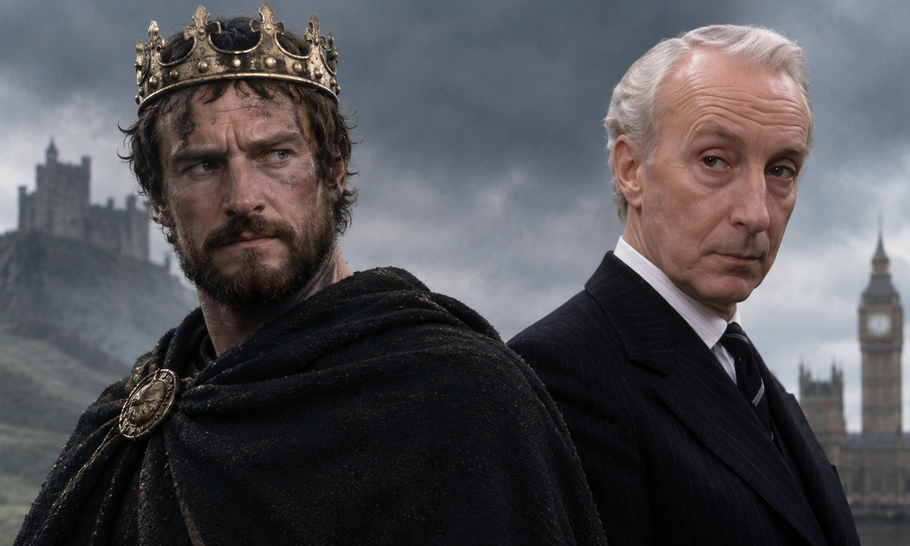
Macbeth and Ian Richardson as Francis Urquhart from the original BBC House of Cards.
Not in the legions
Of horrid hell can come a devil more damned
In evil to top Macbeth.
Shakespeare
The BBC drama series—House of Cards (1990), To Play the King (1993) and The Final Cut (1995)—with a screenplay by Andrew Davies, is set in London in the 1980s. This political film brilliantly transforms the plot, characters, speech and themes of Shakespeare’s Macbeth, with additional hints from Richard III and other plays. The main parallels between the play and the film are the villain Macbeth and the politician Francis Urquhart, Lady Macbeth and Urquhart’s wife Elizabeth, the Thane of Cawdor and the brutal bodyguard Corder, as well as the effective soliloquies, the themes of trust and betrayal, the murder of rivals and the guilty conscience that follows.
In Macbeth, the treacherous Cawdor joins the Norwegian king’s rebellion against King Duncan of Scotland:
Norway himself, with terrible numbers,
Assisted by that most disloyal traitor
The Thane of Cawdor, began a dismal conflict.
Deeply disappointed by Cawdor, Duncan says: “He was a gentleman on whom I built / An absolute trust,” a major theme in the film. After Cawdor is captured and executed, Malcolm the king’s son, reports his poignant death: “nothing in his life / Became him like the leaving it.” The nobleman Ross then commends Macbeth’s bravery and success in battle: “and every one did bear / Thy praises in his kingdom’s great defense.” Macbeth is then rewarded with Cawdor’s title of Thane:
No more that Thane of Cawdor shall deceive
Our bosom interest: go pronounce his present death,
And with his former title greet Macbeth.
The three Witches now prophesy that greater honours will come at Duncan’s expense: “All hail, Macbeth! Hail to thee, Thane of Cawdor! All hail, Macbeth, that shall be King hereafter!”
But Macbeth, like Francis Urquart in House of Cards, is not satisfied with the role of Thane. He wants to be king and intends to conceal his dark intentions: “Stars, hide your fires; / Let not light see my black and deep desires.” Lady Macbeth, the domestic demon, fires up her husband and pleads to increase her own manly strength to carry out her evil plans: “unsex me here, / And fill me, from the crown to the toe, top-full / Of direst cruelty!” She urges Macbeth: “But screw your courage to the sticking place, / And we’ll not fail.” Bucked up by his wife, Macbeth confesses his “Vaulting ambition, which o’erleaps itself / And falls on th’other. . . . I am settled, and bend up / Each corporal agent to this terrible feat.” Macbeth stabs Duncan in his sleep, kills the king’s guards and blames other men for the murders. Tormented by guilt and insomnia, he laments: “Yet I do repent me of my fury, / That I did kill them. . . . Macbeth does murder sleep.” With Duncan now dead, “The sovereignty will fall upon Macbeth. / He is already named.”
But Macbeth must also eliminate all his closest rivals to the throne. He confesses that poisonous insects have penetrated his brain: “O, full of scorpions is my mind, dear wife! . . . Thou know’st that Banquo and his Fleance lives.” He hires assassins to murder them, but the son Fleance escapes. Macduff, the next victim, is horrifically informed: “Your castle is surprised; your wife and babes / Savagely slaughtered,” and he tragically exclaims: “What, all my pretty chickens and their dam / At one fell swoop?” Lady Macbeth, though evil, still has the remnant of conscience and she too feels agonizing guilt: “Here’s the smell of blood still. All the perfumes of Arabia will not sweeten this little hand.”
When the remaining nobles hear that Duncan’s son Malcolm and the nobleman Macduff, who’d fled the country, have returned to Scotland to claim the rightful crown, they state: “Revenges burn in them for their dear causes.” Before Macbeth dispatches him, Young Siward, son of an English general, shouts: “The devil himself could not pronounce a title / More hateful to mine ear.” Cutting a blood-soaked path, Macbeth has killed King Duncan, Duncan’s two Guards and Young Siward; and has also ordered the murders of Banquo, Lady Macduff, her son and her household. At the end of the play, Macbeth is slain. The triumphant Macduff, to avenge the deaths of his family, holds up his severed head and rejoices in the just extinction of “this dead butcher and his fiendlike queen,” who has in agonized repentance just killed herself.
The House of Cards stars the Shakespearean actor Ian Richardson, who plays Francis Urquhart. Like Macbeth, Urquhart is a Scot, born in the barren Highlands, has been a soldier, has no children, and is a usurper and a murderer. Both Macbeth and House portray ruthless ambition and a tragic struggle for power. One character quotes Lord Acton’s famous aphorism: “Power corrupts, and absolute power corrupts absolutely.” Francis Urquhart, abbreviated to FU (which suggests Fuck You), begins as the Machiavellian Chief Whip, whose very title suggests brutal punishment. Corrupted and destroyed by his quest for high office, he becomes Prime Minister but is finally killed by the two people he trusted most.
King Duncan had trusted both Thanes, Cawdor and Macbeth, and both betray him. Throughout House almost all the characters—especially the vulnerable women, Mattie Storin, Sarah Harding and Claire Carlsen—fear betrayal, reveal their insecurity and seek reassurance by repeatedly asking (in close-ups), “Do you trust me?” FU repeatedly asks this crucial question before destroying his political rivals and colleagues who know his damaging secrets and could destroy him. In the end, trust is doubtful, betrayal is certain.
As in Macbeth and other Shakespearean plays, FU speaks directly to his audience in many intimate soliloquies with cinematic close-ups. He confides in his listeners, tells them what he’s going to do, prepares them for the worst and then does it. He often conveys his mood by slyly smiling and raising his eyebrows. He’s unscrupulous and evil, but has admirable wit, cunning and intelligence. He emphasises his fierce and elusive character by repeating his favorite phrases: the menacing “I’ll put a bit of stick about,” and with silent assent: “You might say that, I couldn’t possibly comment.”
The amusing names of the characters, as in an 18th-century novel, are significant. Urquhart, or Irk-Hard, is easily angered and retaliates with punishment. Lady Macbeth is echoed in his wife’s name, Elizabeth. The homonym Corder echoes the Thane of Cawdor. Tim Stamper is not timid and stamps on his enemies. Mattie Storin puts her story-in the press. Staines is stigmatized by homosexual relations with boys. Roger O’Neill, a stereotyped drunken Irishman as well as a cocaine addict, has a sexually suggestive first name. Penny Guy, his exploited Black lover, suggests “a penny for the guy,” a coin for the effigy of Guy Fawkes who tried to blow up the Houses of Parliament and is burned on a bonfire every November 5th. Sarah Harding is hardening and hard enough to leave FU. Tom Makepeace, who has Thackeray’s middle name, makes peace between the Greeks and Turks in Cyprus. The scandalous and foppish Geoffrey Boozer-Pitt suggests boozing and the immoral pits. Two men have animal names: the minister Polecutt (polecat) and the persistently aggressive Labour MP Badger. The crude American newspaper proprietor Landless lacks a country estate and is not a gentleman.
The Prime Minister’s refusal to give FU the cabinet post he’s been promised sets the recurrent pattern for all the characters whose ambitions are severely thwarted, feel betrayed and plan to take revenge. Early in House of Cards, FU quotes the witches’ prophecy: “Glamis and Cawdor and King hereafter” (1.3), and adds with a quote from Shakespeare’s Henry IV, Part 1: “Our fortunes prosper well” (4.4).
In this savage satire of parliamentary politics the ministers are vicious and corrupt, and FU makes it his business to discover all their dirty little secrets. He destroys each of his political rivals on the way to seize power: the Prime Minister (the equivalent of Duncan), the Press Secretary and PR man Roger O’Neill, the Foreign Secretary Patrick Woolston, the Environmental Secretary Peter Mackenzie. He also blackmails lesser colleagues with explicit photos of flashing, homosexuality, adultery, and sexual relations with a vulgar and money-grubbing royal princess.
FU asks who would be a leader in this wicked world and modestly pretends that he doesn’t want to be Prime Minister. He keeps repeating, “Oh, no, no, no. I’m just a backroom boy,” encouraging his colleagues to court and persuade him to accept that high office. At one point he crouches like a hunchback with a bent arm in Richard III, and quotes that play: “I have set my life upon a cast / and will stand the hazard of the die” (5.5). After FU denies that he has political ambitions, Elizabeth recalls the scene in Richard III at Baynard’s Castle (a riverside fortress in London). When Richard, then Duke of Gloucester, is offered the Crown, he hesitates, feigns modesty and claims unworthiness before graciously accepting it.
Alas, why would you heap these cares on me?
I am unfit for state and majesty;
I do beseech you, take it not amiss;
I cannot nor I will not yield to you. (3.7)
FU often asks and relies on the advice of his wife. Like Lady Macbeth, Elizabeth helps him make crucial decisions, blesses his cursed deeds, urges him to destroy his personal and political enemies. She loves to play tapes of Richard Wagner’s thunderous and ominous Ride of the Valkyries (music also used in the movies Apocalypse Now and Star Wars). In the garden of their country house, she lights a flickering bonfire that suggests her affinity to the three prophetic witches in Macbeth.
The name of the huge bodyguard, violent fixer and hit man, Commander Corder, suggests his closeness to the dead rebel Cawdor in Macbeth. The giant holds a naval or police rank; he is 6 feet, 4 inches tall, has black hair combed high on his head and must bend down to walk through doorways. Dark and tough, a good man to have in your corner, he first stands silently in the background and waits for orders to act. He can immediately arrange an accident, riot or explosion. and blame it on the IRA. When road-rage hoodlums deliberately crash into FU’s limousine on the highway and injure his head, Corder kills all three of them and claims they were armed. Corder shares Elizabeth’s enthusiasm for Wagner’s Götterdämmerung, and she tells FU that she and Corder are going to have dinner in her country house and listen to Wagner’s Siegfried. The treacherous Corder, like his Shakespearean namesake, eventually betrays FU’s trust, arranges his assassination and takes his place with his lady.
FU has incriminating evidence on everyone and ruins all his rivals. After involving the innocent Prime Minister in a financial scandal, destroying the character and career, and forcing him to resign, FU washes the metaphorical blood off his hands and links the Scottish King and English PM by quoting: “Duncan is in his grave; / After life’s fitful fever, he sleeps well” Macbeth (3.2). FU matches Macbeth’s bloodthirsty progress by killing all his dangerous intimates who know too much: Roger O’Neill, the journalist Mattie Storin, the Junior Whip Tim Stamper and FU’s political advisor Sarah Harding. Repeating the pattern of his own thwarted ambitions, he denies promotion to the ambitious Roger O’Neill and Tim Stamper. He also forces O’Neill to lend his beautiful and witty lover, Penny Guy, to Patrick Woolton. He then makes a tape recording of their sexual encounter that ruins Woolton’s marriage and damages his career. He sends the tape by mail and Woolton, unaware of its contents, plays it at breakfast in front of his wife, who bitterly asks, “will I need an HIV test?”
Between scenes, real rats suggest the filthy political atmosphere by crawling greedily around Westminster. FU kills Roger O’Neill, who knows too much, by mixing rat poison with Roger’s plentyful supply of cocaine. He then ironically assures O’Neill that he’ll have nothing more to worry about (because he’ll soon be dead). In a semi-comic scene, Peter Mackenzie, the Health Minister, is threatened by a prearranged mob when he arrives to make a soothing speech. He tries to escape by furiously ordering the driver to back up his car and runs over a crippled man in a wheelchair.
A portrait of FU’s conquering hero Napoleon by Emile Vernet (1815) appears on the wall behind him in his study and seems to inspire him when he’s talking first to Mattie Storin and then to Sarah Harding. Like many other women drawn to power, the ambitious journalist Mattie Storin is madly attracted to FU. He forces Roger to terrify Mattie by wrecking her car and breaking the windows of her flat. While praising his political shrewdness, Mattie also suggests she’s eager to have sex with him and becomes his lover. FU throws Mattie off the roof garden of the House of Commons and claims she committed suicide. Mattie lands on top of a parked car, face up with her legs alluringly spread apart. Her position suggests that she was pushed backwards and did not jump forward, but no one questions her suicide.
FU always needs scapegoats, and roughs up his own ministers when he becomes PM.
Tim Stamper, FU’s close friend and a hard Right Conservative, takes over his old job as Chief Whip. A loyal devotee and accomplice, he follows the same path and for the same reasons as FU, turns against his master and seeks revenge when he’s not given the promised job of Home Secretary. He recovers Mattie’s secret tape recordings that reveal FU’s role in the murders of Roger O’Neill and Mattie Storin. Stamper gives a copy of Mattie’s tapes to Sarah Harding as insurance, but both are killed in car explosions engineered by the always efficient Corder. FU ironically quotes Macduff’s “all my pretty chickens / At one fell swoop” (4.3).
FU has killed Mattie, but not the memories of her death. He experiences four recurrent guilty-conscience flashbacks of throwing Mattie from the roof, which recall another Shakespearean motif, the appearance of Banquo’s ghost in the play. Macbeth confesses: “I am in blood / Stepped in so far” (3.4), and is tormented by guilt which, like Macbeth’s insomnia, “does murder sleep” (2.2). Like Macbeth, who covered-up his murder of Duncan and his Guards, FU always managed to persuade colleagues that other men had committed his crimes.
Mattie Storin is youthful, sensual, vulnerable and single. By contrast, Sarah Harding is experienced, stylish, shrewd and married. Very thin, Sarah wears loose baggy clothes like Diane Keaton’s in Annie Hall. Sarah follows Mattie’s pattern. She agrees to become FU’s slave, is eager to learn everything she can from him, flatters her master and falls in love with him. FU, who’d terrified Mattie, frightens Sarah who’s mugged in the street. He then seduces her and kills her as he killed Mattie.
In The Final Cut, FU wants to obliterate the memory of his predecessor Margaret Thatcher to prove he’s been the greatest British PM. Elizabeth quotes Coriolanus (3.3), ironically hints at his dark fate and tells FU “There is a world elsewhere” if he decides to leave politics. Praising Elizabeth, he says, “I owe so much to you, my lovely,” and the action is propelled forward with three quotes from King Lear. She asks about the ever-changing fortunes of the leading figures, “Who’s in, who’s out?” (5.3) and forcefully insists that FU must act or “Nothing will come of nothing” (1.1). Condemning ingratitude, as he often does when his ministers disobey him, FU declares, “How sharper than a serpent’s tooth it is to have a thankless child” (1.4). Mattie, Sarah and his third recruit, Claire Carlsen, vaguely hint at Lear’s three daughters.
Claire follows the pattern of Mattie and Sarah. He doubts her loyalty and asks Claire if he can trust her. The portrait of Napoleon again appears in the background when FU talks to Claire. She’s in her forties, married to a Swedish millionaire, has a luxurious Scandinavian modern flat in London where she has an affair with the Foreign Secretary Tom Makepeace. Politically ambitious and a clever schemer—she’s compared to Shakespeare’s Cressida who moves between the Trojan and the Greek camps—Claire angles for the job and becomes Parliamentary Private Secretary to FU. The younger Mattie and Sarah are not shown in bed with FU. Claire, older and more experienced, fulsomely praises Tom’s sexual performance and her full breasts swing when she’s on top of him.
In 1956, during the Greek insurgency against British colonial rule in Cyprus, FU was a 19-year-old lieutenant in the Scots Guards. Like his memories of Mattie whom he pushed from the roof, he has guilty flashbacks about the two Greek men he murdered in Cyprus, like the hoodlums murdered by Corder. FU defends himself by telling Elizabeth, “I killed them in a military operation. They were terrorists.” Maria Passolides tells Tom Makepeace that she knows FU had killed her uncles and he agrees to help her in order to bring down FU. The files in the Ministry of Defence must by law remain secret for 50 years. Makepeace, having resigned and is no longer Foreign Secretary, asks Claire as PPS to get the secret document. But Corder, always well informed, is told about her theft, humiliates her and grabs the document. Instead of giving it to FU, he plans (like Stamper with Mattie’s tapes) to use it against him.
FU thinks no one knows about his guilt except Elizabeth and Corder. Elizabeth treacherously tells FU, “Trust Corder,” but they finally conspire to destroy him. When the English king and high government officials are present at the unveiling of Thatcher’s statue, Maria’s father pushes through the crowd and shoots the man who killed his brothers. He’s immediately shot by sniper on the nearby roof, whom Corder had made ready to kill FU.
Maria helps to reveal the secret document that incriminates FU, but loses her father. FU loses his life, his wife and his bodyguard, but is assassinated, dies a martyr and strengthens his reputation. Corder wins Elizabeth and continues to do his dirty work for Makepeace, who’ll become the next Prime Minister. In Shakespeare’s tragedy of the rise, fall and death of the villain, Macbeth takes Cawdor’s title and Macduff kills Macbeth. In the film, Corder takes Urquhart’s place with Elizabeth and Passolides kills Urquhart. The Elizabethan speech, and the soliloquies from Macbeth that narrate the action and structure House of Cards, emphasise the universal themes of trust and betrayal, and the tragic consequences of the ruthless quest for power.
Jeffrey Meyers has recently published James Salter: Pilot, Screenwriter, Novelist (2024),
Parallel Lives (2024) and Forty-Three Ways of Looking at Hemingway (2025) with LSU Press. The Biographer’s Quest (2026) appeared with Mercer University Press.
A Message from TheArticle
We are the only publication that’s committed to covering every angle. We have an important contribution to make, one that’s needed now more than ever, and we need your help to continue publishing throughout these hard economic times. So please, make a donation.


