Reincarnation: Anglo-Indian chess



In the mid 19th century the strong English master John Cochrane took up a post in India. In earlier years he had proved a worthy sparring partner for Howard Staunton, whose formative period was undoubtedly heavily influenced by his duels with Cochrane. In India Cochrane encountered the Brahmin Moheschunder Banerjee, whose playing style anticipated that of the Hypermoderns Grunfeld and Reti, not to mention the great Soviets, including Botvinnik and Bronstein. Here is a sample of the play of this visionary player from the distant subcontinental frontiers of the British Empire:
Moheschunder Bannerjee vs. John Cochrane
Casual game, Calcutta, 1853
- Nf3 d5 2. g3 c5 3. Bg2 Nc6 4. O-O e5 5. d3 f5 6. e4 fxe4 7. dxe4 d4 8. Ng5 Nf6 9. f4 h6 10. fxe5 Nxe5 11. Nf3 Bd6 12. Nxe5 Bxe5 13. Bf4 Qe7 14. Nd2 O-O 15. Bxe5 Qxe5 16. Nc4 Qe6?
The eqilibrium is disrupted by this inaccuracy. It was important for Back to keep congtrol of the dark squares with either 16… Qg5 or …Qc7.
- e5 Qxc4??
Coupled with his previous inaccuracy, this successive error exposes White to extreme jeopardy. as the e-pawn very quickly becomes a source of imminent danger.
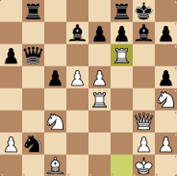
Best was 17… Nh7 18. Rxf8+ Nxf8 19. Qe2 Qa6 20. b3 Be6 21. Qe4 Qc6 22. Nd6 Qxe4 23. Bxe4 Nd7 24. Bxb7 Rd8, when White’s passed e-pawn can be blockaded.
- exf6 Rxf6?
After this premature recapture, White’s superior development guarantees the demolition of Black’s kingside. Best is 18… Bd7 19. Qh5 Qf7 20. Qxc5 gxf6 21. Rae1 Rfe8 22. Bxb7 Rad8 23. Rxe8+ Rxe8 24. Qxd4, but even so, Black is uniquivocally second best in this position.
- Rxf6 gxf6 20. Qh5 Kg7?
If the game was most likely already a lost cause, this move emphatically ensures this. Black could struggle on for a little longer after 20… Qf7 21. Bd5 Be6 22. Bxe6 Qxe6 23. Qg6+ Kh8 24. Qxh6+ Kg8 25. Qg6+ Kh8 26. Rf1, but eventually, White’s passed connected g- and h-pawns will bring the game to an inevitable conclusion.
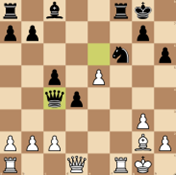
- Bd5 Black resigns 1-0
Moheschunder Banerjee was born c. 1800 near Calcutta. He belonged to an age in which a man might acquire a formidable reputation without the inconvenience of travelling far enough to discover that the world was larger than his village. Philip Walsingham Sergeant described him as having been, as of 1848, “a Brahmin in the Mofussil-up country, as we might say — who had never been beaten at chess!” Hundreds of his games survive through the writings of John Cochrane, who regularly played him between 1848 and 1860, during Cochrane’s tenure at the Calcutta bar. Few reputations could have been subjected to a more sustained examination, and fewer still have left so substantial a record of their encounters with a man determined to test them.
Moheschunder originally played traditional Indian chess, in which pawns could not advance two squares from their starting row and promoted to the piece corresponding to the square they reached. He probably learned Western rules after coming into contact with Cochrane and other Europeans. The encounter between two traditions was not merely a meeting of rules, but of habits of thought; and, as often happens when cultures meet over a chessboard, neither side could afford to assume that familiarity was the same thing as mastery.
Cochrane is quoted in a letter written by a member of the Calcutta Chess Club, which appeared in the Chess Player’s Chronicle in 1850:
‘The only player here who has any chance whatever with Mr Cochrane, upon even terms, is a Brahmin of the name of Moheschunder Banerjee. Of this worthy, Mr Cochrane has himself remarked that he possesses as great a natural talent for chess as any player he ever met with, without one single exception’.
A member of the Calcutta Chess Club, during a Mofussil pilgrimage in the autumn of 1848, heard of the fame of this local Philidor, and learning further that the Mofussil champion “had never been beaten”, he rejoiced exceedingly in the prospect of beating him soundly. This expectation was not destined to be fulfilled, for our Brahmin triumphed. The discomfited clubman thereupon brought him down to Calcutta, and introduced him to the aforementioned Cochrane.
Moheschunder favoured defences that were unusual in the West, employing fianchettoed bishops in ways that reflected the traditions of Indian chess. The Indian Defences, including the King’s Indian and Queen’s Indian, now bear the name of Moheschunder and his countrymen. Both involve advancing pawns one square, as in Indian chess, rather than adopting more traditional defences such as 1. e4 e5 and 1. d4 d5.
The significance of these openings lies in their demonstration that a method unfamiliar to one school of thought may be entirely natural to another. In chess, as in society, convention has a curious habit of presenting itself as necessity, until someone with sufficient skill demonstrates otherwise.
Another contemporary assessment offered a qualification to the notion that Moheschunder adhered rigidly to the methods of his countrymen:
“This eminent player, unlike his countrymen generally, does not rigidly adopt a system of close tactics. Many of his games in the collection before us are begun in the European rather than in the Oriental style, and he appears to be as much home in the one as in the other.”
His versatility, then, was as noteworthy as his originality. He was not simply a practitioner of an unfamiliar tradition, but a player capable of moving between traditions without becoming wholly confined by either. Such independence is rare enough in chess, where a man may spend a lifetime defending a system merely because he has mistaken habit for principle.
Among other innovations, Moheschunder played the first known Gruenfeld Defence in Cochrane vs. Moheschunder, 1855, 67 years before it was “introduced” in Alekhine vs. Gruenfeld, 1922. The chronology is a reminder that an idea may exist long before the world is prepared to recognise it. Moheschunder’s place in chess history rests not merely upon his ability to challenge formidable opponents, but upon his contribution to a tradition whose influence extended well beyond the circumstances in which he first learned the game. He played according to principles that Western chess would later come to appreciate, demonstrating that originality does not always announce itself as such, and that the future occasionally borrows from a past it has been slow to understand.
Now a namesake of the brilliant Brahmin has risen to the fore in the UK in the person of Supratit Banerjee, now an International Master. Supratit’s achievement received its formal ratification at a meeting of the FIDÉ Council in Samarkand, Uzbekistan, on September 27, the decision itself being announced on October 7. The distinction was earned by a youngster who represents England internationally, having secured the three International Master norms required of him and surpassed the 2400 rating threshold. In chess, as in life, distinction is rarely bestowed upon those who have not first mastered the rules.
On the international circuit, Supratit has distinguished himself in encounters with experienced grandmasters and international masters. He secured an IM norm at the 2025 British Chess Championships and has continued to advance with remarkable speed, all while balancing the demands of competitive chess with those of his school commitments. It is a considerable achievement to pursue excellence in two such exacting arenas, though youth has occasionally been known to make light of the burdens that would weary its elders.
The English Chess Federation congratulated Supratit, his family, coaches and everyone who has supported him on this outstanding achievement. A spokesperson for the federation said: “Supratit’s skill and hard work are paying off with the honour of this title. He has a wonderful future ahead of him in the game. We wish him well and hope he continues to power up the rankings.”
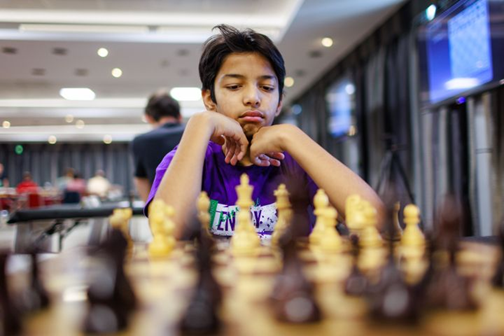
Supratit Banerjee
This is another milestone for a formidable generation of young English players including Britain’s youngest WGM and also now IM, 11-year-old Bodhana Sivanandan.
Supratit’s achievement also surpasses the new British champion GM Shreyas Royal’s mark of 13 years seven months. Supratit’s mother Pooja described his journey:
“Starting in Glasgow with limited coaching, guidance, resources and opportunities, Supratit’s journey to becoming the UK’s youngest International Master has been one of perseverance, hard work and family sacrifice.” With parents who had little knowledge of chess or its competitive pathways, much of the journey after moving to London was experimental — navigating an unfamiliar chess world and finding the right direction with little guidance.
“Balancing chess training and tournaments with 11+ exams, homework, academics and catching up on missed classes has been a constant challenge. Over time, well-wishers from the chess fraternity, supportive clubs, dedicated coaches, the ECF and Chess Trusts joined the journey, generously offering encouragement and support that made a real difference.
“Through it all, Supratit’s determination, clear goals and positivity have kept him moving forward with a smile. We are immensely proud of how far he has come — and this is just the beginning”.
In 2026, Supratit was invited to attend training camps organised by the Kasparov Chess Foundation and later he said “That was an amazing experience, especially getting the opportunity to talk to one of the greatest players in chess history”.

left: Garry Kasparov; right: Supratit Banerjee
In reflecting on these two extraordinary talents, one cannot but help observe the shadow of the famous Netflix series, The Queen’s Gambit.
The relationship between the records of Supratit Banerjee and Bodhana Sivanandan illustrate a radical departure from the historical pattern of the open game. Banerjee’s International Master title was ratified by FIDE on 27 September 2026, making him the youngest player in British chess history to attain this title.
Under ordinary circumstances such a record would also stand as the national benchmark overall, since the youngest achievers of titles have almost invariably been boys.
Yet less than a month later, on 23 October 2026, Sivanandan surpassed his mark by completing the requirements for the International Master title at the age of just 11 years, 7 months and 16 days.
Thus, while Banerjee remains Britain’s youngest male International Master, it was Sivanandan who succeeded him to became the youngest ever British International Master.
This week’s games are respective wins by our two outstanding prodigies, first the amazing Bodhana defeats Supratit, then Supratit strikes back.
Bodhana Sivanandan vs. Supratit Banerjee
Cambridge International Open, 2024, round 3
- e4 e6 2. d4 d5 3. Nd2 dxe4 4. Nxe4 Nd7 5. Nf3 Ngf6 6. Nxf6+ Nxf6 7. c3 c5 8. Ne5 a6 9. Be3 Qc7 10. Qa4+ Bd7 11. Nxd7 Nxd7 12. O-O-O O-O-O 13. Be2 Nb6 14. Qc2 Nd5 15. Kb1 c4 16. g3 Qc6 17. Bc1 Be7 18. f4 g6 19. Bf3 h5 20. h3 Qc7 21. Rhf1 b5 22. Be2 Kb8 23. Bd2 Ka7 24. Bf3 a5 25. Rfe1 Bf6 26. a3 Rd7 27. Bg2 Qc6 28. Re2 Rhd8 29. g4 hxg4 30. hxg4 b4 31. cxb4 Bxd4??
After a well-contested opening, featuring near-perfect play from both protagonists, parity is sacrificed on the altar of pawn voracity. And there is no turning back.
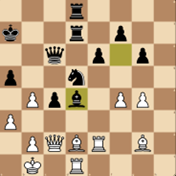
Had Black instead have played the normal 31… axb4, then after 32. Bxd5 Rxd5 33. Bxb4 Rxd4 34. Rf1 Rd3 35. Rc1 c3 36. bxc3 Qb5, the game would have continued becalmed.
- Re4 Bg7 33. Rxc4 Qb5 34. Rc5 Qb6 35. Rxa5+ Kb8 36. Bxd5 Rxd5 37. Rxd5 Rxd5 38. Bc1 Rxd1 39. Qxd1 Bd4 40. Qb3 Qc6 41. Qd3 Qd5 42. a4 e5 43. fxe5 Qxe5 44. Qf3 Qe7 45. Bd2 Bg7 46. a5 Qe6 47. b5 g5 48. Qd3 Bf6 49. a6 Be7 50. Qd4 Qg6+ 51. Kc1 Qe6 52. b6 Qc6+ 53. Bc3 Qh1+ 54. Kc2 Qg2+ 55. Kb3 Qh1 56. Qe5+ Ka8 57. b7+ Qxb7+ 58. axb7+ Kxb7 59. Qxe7+ Kc6 60. Kc4 f5 61. b4 f4 62. b5+ Kb6 63. Bd4+ Ka5 64. Qa7#
No quarter asked, no quarter given.
Supratit Banerjee vs. Bodhana Sivanandan
London Classic Masters, 2024, round 5
- e4 c6 2. d4 d5 3. Nd2 dxe4 4. Nxe4 Nf6 5. Nxf6+ exf6 6. c3 Bd6 7. Bd3 O-O 8. Ne2 Re8 9. O-O Nd7 10. Bf4 Nf8 11. Bxd6 Qxd6 12. Ng3 g6 13. Ne4 Qd8 14. Re1 Be6 15. Nc5 Qc7 16. Qf3 Kg7 17. Qg3 Qxg3 18. hxg3 Re7 19. Re3 Rae8 20. Rae1 f5 21. b4 Kf6 22. c4 Bc8 23. a4 Ne6 24. g4 h6 25. gxf5 gxf5 26. Bxf5 Nxc5 27. Bxc8 Nxa4??
This miscalculation leaves the previously level position tilted dramatically in favour of White.
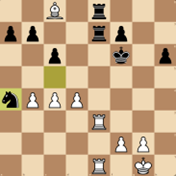
Black should have continued with 27… Rxe3 28. Rxe3 Rxc8 29. bxc5 Rd8 30. Rd3 b6 31. cxb6 axb6 32. d5 cxd5 33. cxd5, when the equilibrium is undisturbed and full equality maintained.
- Bxb7 Rxe3 29. fxe3 Re6 30. e4 Nb6 31. c5 Na4 32. d5 cxd5 33. Rf1+ Kg7 34. exd5 Re4 35. d6 Rd4 36. Ra1 Nc3 37. c6 Nb5 38. d7 Kf8 39. Ra5 Nc7 40. Rxa7 Ke7 41. Ba6 Kd8 42. b5 Rb4 43. Rb7 Rd4 44. Rb8+ Ke7 45. Rc8 Ne6 46. Re8+ Kf6 47. Rxe6+ fxe6 48. c7 Rxd7 49. c8=Q Rd6 50. b6 Rxb6 51. Qd8+ Kg7 52. Qxb6 Kf7 53. Bc4 Ke7 54. Qxe6+ Kd8 55. Qd6+ Ke8 56. Be6 h5 57. Qd7+ Kf8 58. Qf7#
Savage play by both young Masters.
Ray’s 206th book, “ Chess in the Year of the King ”, written in collaboration with Adam Black, and his 207th, “ Napoleon and Goethe: The Touchstone of Genius ” (which discusses their relationship with chess) can be ordered from both Amazon and Blackwell’s. His 208th, the world record for chess books, written jointly with the late chess playing artist, Barry Martin, Chess through the Looking Glass , is now also available from Amazon.
A Message from TheArticle
We are the only publication that’s committed to covering every angle. We have an important contribution to make, one that’s needed now more than ever, and we need your help to continue publishing throughout these hard economic times. So please, make a donation.


