The next UN boss: Secretary or General?
 by
Guy Gabriel
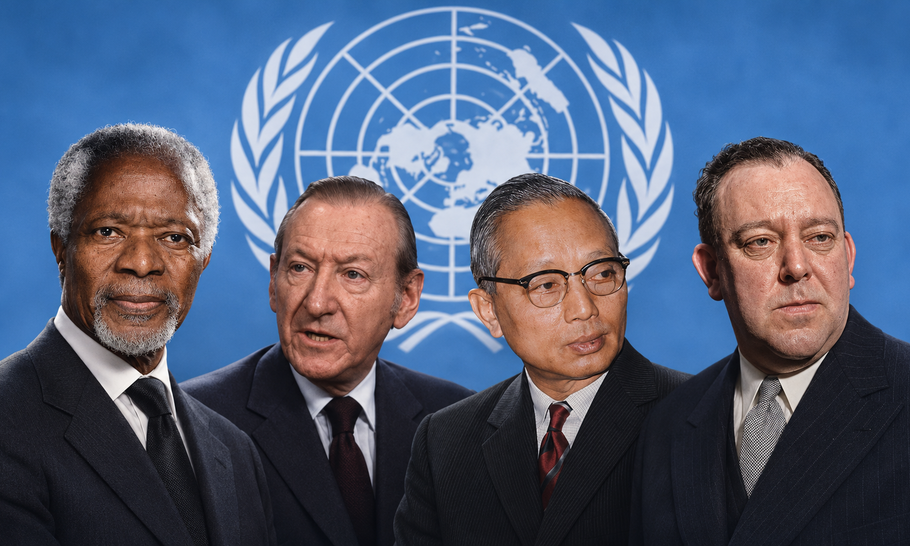
Kofi Annan, Kurt Waldheim, U Thant and Trygve Lie
“Who do you think you are, a country?” US Secretary of State Dean Rusk is said to have shouted at the United Nations Secretary-General, U Thant (1961-71) who, in defiance of the powerful flow of US policy on the Vietnam war in 1965, attempted diplomatic overtures to the North Vietnamese. Though the UN itself describes the post as the organisation’s “chief administrative officer”, in reality, the Secretary General occupies an office whose place is quite difficult to characterise in the international system. A world leader? For sure. A world decision-maker? Up to a point. This captures the ambivalent essence of the UN’s top job – should you be more “Secretary” than “General”? Kofi Annan (1997-2006) complained that “SG” stood for “scapegoat”
In reality, the UN’s autonomy or biddability depends in large part on the initiative of the occupant of the Secretary-General’s office and the perceptions of those against whom it buffets – most noticeably, the US and its unilateralism. First Secretary-General Tyrgve Lie (1946-1952) is reported to have handed the baton on to his successor with the words: “Welcome to the most impossible job on this earth.”
But now, that baton is being handed over again. The next UN Secretary-General will take up his or her appointment on 1 January 2027. The short list of eight contains five women – so far, a woman has never led the UN. According to the UN Charter, the person “shall be appointed by the General Assembly upon the recommendation of the Security Council,” and the outcome is expected shortly.
There has been an informal system of regional rotation regarding appointments to the top job, and the region of Latin America and the Caribbean is next in line. In fact, in the latest (eighth) straw poll (an informal system consisting of the Security Council members expressing a non-binding opinion), Rebeca Grynspan of Costa Rica is leading, with Rafael Grossi of Argentina in second.
It is not easy to settle on an appointment, as it requires the agreement – and usually compromise – of some big players. Tyrgve Lie himself was a safe bet, a compromise candidate which established the preference for safe bets to come, though that’s not what always resulted. Over the years, the Secretaries-General have varied in nature from the bold and independent to the politic and cautious to the urbane and charismatic – and back to mild and moral administrator again. To this must be added one scarcely believable outlier, the Austrian former Wehrmacht officer and member of Nazi organisations, Kurt Waldheim (1972-81) – “a living lie”, in the words of Brian Urquhart, a diplomat who spent four decades working in the UN.
A Secretary-General demonstrating too little initiative will get him or her ignored, and perhaps some candidates have been preferred for possessing these qualities. A biddable Secretary-General can help advance national foreign policy objectives, as the UN’s platform brings with it much legitimacy. If you’re the dominant power in the world, having the UN around can help you manage it; your geo-strategic Venn diagram is likely to find common cause with the UN from time to time, which can make it a convenient executor of objectives lower on your agenda, if you are not prepared to take the issue on yourself directly.
On the other hand, a Secretary-General needs sufficient chops to undertake a peace-making initiative, on the proviso that his or her innate diplomatic instinct will ensure the initiative does not upset the powerful member states – again, read above others, the US. Then, there are times when Secretaries-General can and do have the grit to go further than merely try to apply the will of member states, which is often much watered-down by the time it reaches the doing something stage anyway.
Article 99 of the UN Charter gives the S-G some freedom to influence the agenda: “The Secretary-General may bring to the attention of the Security Council any matter which in his opinion may threaten the maintenance of international peace and security.” However, too much initiative, backed up by stubbornness, at the wrong time and on the wrong issues will get you stood down for a second term, as was the case with Boutros Boutros Ghali (1992-96). The US vetoed his reappointment for a second term, harbouring deep mistrust over his handling of Rwanda and Somalia, among other issues.
Kofi Annan was already into his second term when the Security Council declined to authorise the 2003 US invasion of Iraq, much to the fury of the US. The Administration of President George W. Bush saw this as an impertinent attempt to constrain American power. For this refusal to authorise the invasion of Iraq, Annan would not have served a second term, had he been in his first.
What will the next incumbent do? Climate change, AI, persistent humanitarian need and dwindling budgets will be major cross cutting issues, certainly. In terms of conflict, Ukraine and Iran are both being prosecuted by members of the P5, so it is difficult to see how the UN could play an independent role as a peacemaker there. Just as important as what the next top global diplomat will do, however, is the question: how will he or she do it? More as a Secretary, or as a General?
A Message from TheArticle
We are the only publication that’s committed to covering every angle. We have an important contribution to make, one that’s needed now more than ever, and we need your help to continue publishing throughout these hard economic times. So please, make a donation.


