Anita Brookner: suffering and success

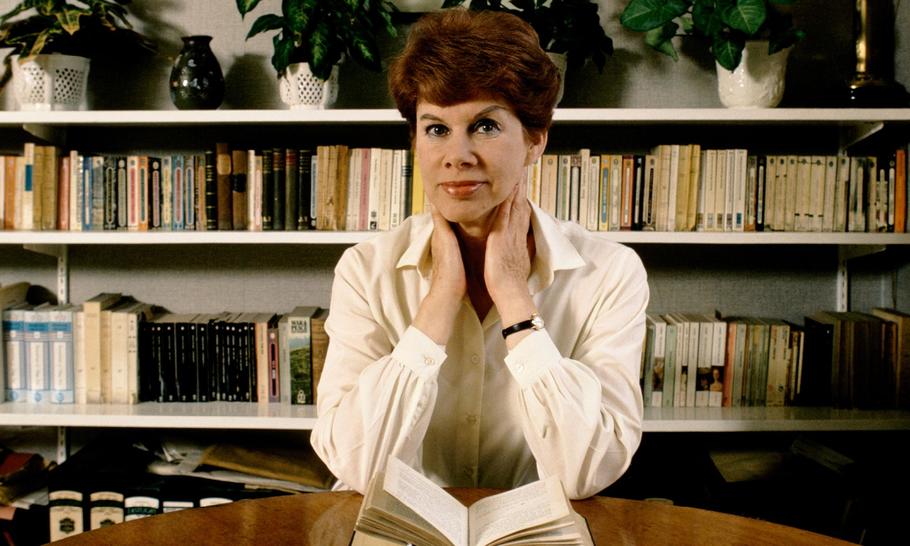
Anita Brookner
I have heard the mermaids singing, each to each.
I do not think that they will sing to me.
S. Eliot, “The Love Song of J. Alfred Prufrock”
The novels of Anita Brookner (1928-2016) are fine examples of a characteristic feminine style: precious, fanciful, sentimental, delicate and intuitive. (I’ve read all her books and admire her style.) Traditional female novels include descriptions of clothes and furnishing, emphasis on children and domestic details, sensitivity to nature, fine writing, narrow focus, and absence of serious social and political content. The recent work of radical feminists—which Brookner disliked—has been tainted by whining, self-pity and hostility to men.
To put Brookner in perspective: of twelve leading 20th-century British women novelists (Virginia Woolf, Ivy Compton-Burnett, Jean Rhys, Rebecca West, Elizabeth Bowen, Stevie Smith, Olivia Manning, Elizabeth Taylor, Muriel Spark, Iris Murdoch, Doris Lessing and Edna O’Brien) only Compton-Burnett and Murdoch went to university. Only Spark, Lessing and O’Brien had children, though Spark and Lessing quarreled bitterly with their offspring. None of these writers both went to university and had children. Brookner was a university lecturer, like Murdoch, and also had a Ph.D. in art history. It’s worth remarking that many British and American women writers had notably nasty temperaments: Gertrude Stein, Virginia Woolf, Compton-Burnett, Edith Sitwell, Muriel Spark, Lillian Hellman and Susan Sontag. Brookner, by contrast, was nice.
I
The maiden name of Brookner’s mother was the Polish-Jewish Schishkas, which sounds like the Yiddish shiksa, a gentile woman, and kishkas, guts. In her new biography (Anita Brookner: Art and Life, Chatto & Windus/Knopf, 528pp, £28/$45) Hermione Lee writes that Brookner had a domineering grandmother, bullying uncle and mocking aunts, as well as a timid father and disappointed, unloving, needy mother, who provoked agonizing feelings of guilt, pity and protectiveness in their daughter. Brookner was born in London, and by the time she was fourteen her mother had become a permanent invalid. Anita had no religious beliefs, but kept her Jewish identity. She always followed the prohibition of shellfish in Leviticus (11:9-12) and dramatically exclaimed, “I will die if I even look at a prawn.”
Brookner was an outstanding student and could have gone to Oxford or Cambridge, but her family wanted her to live at home and take care of them, so she went to King’s College, London. Her dissertation on the unfashionable 18th-century French painter Jean-Baptiste Greuze at the Courtauld Institute of Art was directed by the homosexual scholar and Soviet spy Anthony Blunt, and she took 20 years to turn that work into a book. Neither Brookner nor Lee, who spends 10 pages on Greuze, mention Tomasi di Lampedusa’s satiric interpretation of Greuze’s Le Fils Puni (1778) in his novel The Leopard (1958): “The man was expiring on his bed, amid welters of clean linen, surrounded by afflicted grandsons and granddaughters raising arms toward the ceiling. The girls were pretty, provoking, and the disorder of their clothes suggested sex more than sorrow; they, it was obvious at once, were the real subject of the picture.”
In 1950, instead of finding the longed-for freedom in Paris, an idealised city of joy, color and style, Brookner lived on a graduate fellowship and led a drab existence. This included the Bibliotheque Nationale, daily walks, scholarly work, early nights and solitary museum visits on rainy Sundays. She felt like a prisoner in a cell, “living a reduced life, speaking to no one.” But she didn’t literally “starve” in Paris. She had her student grant and money from her family, lived modestly and bussed all around France looking at pictures. It’s not clear why Brookner had a powerful lifelong attraction to Paris, apart from the great museums. She travelled there alone and remained solitary, had no close French friends, wasn’t keen on French food, and didn’t know or like French wines. (When she needed the names of wines for her novel, she went to a wine shop and copied them down.) She seemed to spend a lot of time watching couples kissing in the street and people enjoying life in crowded, smoke-filled cafés.
Though highly strung and terrified of trains, Brookner taught briefly at Reading University and commuted from London. She joined the faculty at the Courtauld in 1964, and “felt ill and trembling with fear” before each lecture. Lee repeatedly calls her a “legendary” teacher, but doesn’t define the legend. Lee also calls her a brilliant linguist, but mentions no foreign language but French.
Brookner adopted Stendhal’s belief in his History of Painting in Italy (1817) that “art is essentially a system of moral values made visible”. She gave the Slade Lectures in Fine Arts at Cambridge University in 1967-68, which she published, with an allusion to Freud, as Romanticism and Its Discontents (2000). When asked what was so special about one of her favorite paintings, Giovanni Morini’s The Tailor (1567), she exclaimed, “The eyes, the eyes,” though his left eye is obscured by a shadow and only one eye is visible. Brookner had no interest in Lord Byron, the most famous and influential Romantic poet in England. She wrote a novel called Lewis Percy, but was not interested in Percy Wyndham Lewis or any other contemporary English painter. In 1987 she was unceremoniously pushed out of the Courtauld when the director gave her position to a young scholar.
Her eminent colleague Anthony Blunt, healing the fissure in his own subversive character, was deceptive both in life and in his books on art, where he distorted the facts and denied the evidence that disproved his thesis. He identified with his various alter-egos, and exalted the qualities he often lacked and most admired: Nicolas Poussin’s idealistic stoicism and resignation in the face of adversity, Francesco Borromini’s ruthless logic and intellectual control, William Blake’s defiance of authority and support of the French Revolution, Pablo Picasso’s imaginative transformations and political commitment to the Spanish Loyalists. Brookner was astonished and shocked when Blunt’s double life was revealed. Though she had read his books, she never suspected his formidable powers of deception.
Brookner was no oil painting, not even an etching. Short and skinny, she had bushy reddish hair and a pale face. A friend noted that “when she was young, she looked old”. Her unattractive features were cruelly caricatured by David Levine and other satirists: high-sculpted hairdo, wide nostrils, large teeth, bulbous pendulous lips and flat chest, with a curious outsized head sometimes twisted at an odd angle to her body. Lee hopelessly attempts to transform her into a “handsome” woman with “big, round eyes and full, sensual lips.” Lee’s own witchy photo matches Brookner’s and is not destined to attract readers.
In a notable non-sequitur, Lee states, “The melancholy image of relentless pathos, gloom and solitariness won’t do. She was dandyish, witty, controlled and stylish.” Though her clothes did not dispel her melancholy, Lee calls her idol a “non-pareil stylist and extraordinary human being” with perfect hair, discreet jewelry, “impeccable maquillage, hair and outfit.” Flamboyant and dramatic, she was perfectly tuned to Paris: petite, chic, elegant, soigné, classical, bon ton.” Lee describes Brookner’s appearance with a string of French words to provide bogus authenticity and make her seem like an haute couture model.
In fact, the photos in this book destroy the false image of the stylish frenchified Anita. She often wears her usual white blouse with a pointed collar peeping over a wool sweater, and a schoolgirl’s plaid pleated skirt. Her grey dress, plain raincoat and tan wool overcoat are quite ordinary, and clearly lack a “flawless, stylish French look.” All dressed up to receive the Booker Prize for Hotel du Lac, she wore a severely striped dress with girlish frilly collar and cuffs. Frederic Raphael called her “a sad little handbag-carrying lady.” Lee’s fanciful, fashionable image just won’t do.
Brookner yearned for love and a family of her own, and said she wrote because she had no children. She created her annual 200-page novel in her Courtauld office during the summer holidays. “When she started writing her first novel in 1981, she was experiencing sadness, desperation and boredom. She was unhappy and alone, and wanted to know why she had deserved such a fate. She was wracked by demons and full of anxiety, inner torments and despair.” She invented the novel in her head while walking, then returned home and wrote it down without revising it.
Wounded by harsh reviews, she called her publication process “my annual humiliation”. Lee labels all criticism of Brookner by men, no matter how valid, sexist and misogynist. In 1984 Hotel du Lac won the Booker Prize of £15,000 (some £62,000 in today’s money), which made her famous and wealthy, but subjected her to unwelcome publicity and interviews. She could now afford to stay at the Hotel Crillon in Paris. She left an estate worth an astonishing £2.4 million, most of it donated to Médicins sans Frontières.
Jane Austen never married but her heroines always got their husbands; Brookner’s heroines lose their hopeful prospects. In her best novel, Hotel du Lac, Philip Neville denigrates Edith Hope’s grey-cardigan life to make his unusual marriage proposal seem more attractive. But she’s also had a promising earlier offer, rejects both men, remains with her elusive married lover and keeps her precious solitary freedom. Brookner had a Jamesian unlived life, and all her emotions went into her books. She led the life of the brain and craved the life of the body, and needed to suffer in order to write. Her dominant themes are “the cost of passion, the lessons of suffering and disappointment,” sublimated longings and repressed emotions, courage and failure, hope and despair, desire and loss. Her fictional women are lonely, passive and forlorn, and she confessed, “a solitary life is not for the faint hearted”. The novelist Claire Messud observes, “her novels are almost unbearable in their unflinching examination of isolation and disappointment.”
A woman of strict habits, Brookner began her day by buying bread and newspapers in the nearby shops. She rarely entertained at home, and usually met friends in local Italian restaurants. She always ordered fish, drank water (not wine), had an espresso, smoked three cigarettes and left early. But as her health deteriorated, she gradually withdrew from old friends, such as the novelist Julian Barnes and the publisher Carmen Callil.
Plagued by poor health throughout her life, Brookner suffered from migraines, insomnia, depression and dental problems. In 2010 she crashed into a plate-glass window and broke some bones. Two years later, “she was found in the bath, unable to move, and not sure where she was. She had been there for hours; she seemed to have forgotten how to get out” and was finally rescued by a neighbour. From then on, she couldn’t concentrate, stopped reading, and was often forgetful and irritable. In 2016 she accidentally set her bed on fire and was rescued again, but suffered from burns, smoke inhalation and shock. When diagnosed with kidney cancer, she refused treatment and was ready to die.
II
Brookner gave personal and biographical interpretations of the artists she studied, but carefully hid her own life. Like Henry James, T. S. Eliot and W. H. Auden, she hoped in vain to prevent her biography. She firmly declared, “I have no private papers. I shall leave no trace. That’s the ideal.” But Lee overruled the woman and writer whom she idealises, and when there’s no available information about her subject, she pads her book with excessive background material.
Hermione Lee’s highly praised biography is false and deeply dishonest. Brookner’s stylish clothes, witty conversation, and successful careers as art historian and novelist did not give her an emotionally fulfilled love life. The most interesting aspects of Brookner’s biography, her lovers and sex life, remain secret. Brookner’s self-lacerating interviews with John Haffenden in the Literary Review and Shusha Guppy in the Paris Review completely destroy Lee’s image of the dandyish, witty and jolly Anita.
Instead of rejecting her sad and depressing public image, Brookner constantly emphasised and confirmed it. At various times she sounds like Kafka and said:
My parents’ lives were blighted and mine is too. I inherited my parents’ sadness. Life is an ultimately saddening business. My own life is disappointing. I find myself deeply exasperating. I’m absolutely passive, like blotting paper. I really feel invisible. I feel alone, abandoned, excluded. I am one of the loneliest women in London. I have the same high hopes, the same momentary failure of nerve and belief that everything will go wrong from the start. People say that I am always serious and depressing. I wrote my first novel in a moment of sadness and desperation. Writing frees me from the despair of living. My novels are penitential. I feel impelled by irritation with circumstances and life. I’m now doubly a victim, in life and in fiction.
She also made an amusing but perhaps unintentionally sexual pronouncement: “It is more difficult for a woman to get inside a man than for a man to get inside a woman.”
Lacking specific information about Brookner’s carefully concealed life-story, Lee ignores her own warning—“The problem with this negative image is that it confuses the author with her characters”—and constantly treats Brookner’s fictional heroines as self-portraits. Jumping around from novel to novel to extract possible tidbits, she says it’s tempting to see “overlaps between her personal feelings and her fiction” and “Ruth Weiss, in A Sort of Life, gives some strong clues for Brookner as a young woman.” Lee gets her knickers in a twist when frustrated by her elusive prey, who obliterated her past as carefully as a French collaborator or a Nazi spy. Lee regretfully admits that Brookner’s “possibly imaginary boyfriends have long been obliterated by time and secrecy.”
Unable to nail down even one definite love affair, Lee quotes meaningless contradictory gossip and reconstructs a putative affair with the art historian Michael Jaffé that never took place. The art scholar Francis Haskell and publisher Christopher MacLehose were also supposed contenders for Brookner’s final favor. But she confessed, “I chose the wrong people, and the wrong people chose me. So it never came about,” which certainly caused great sadness. She told her cousin that one lover “fucked like a navvy,” which sounds like a pure fantasy since she had no sexual relations with unskilled labor.
Lee includes everything she’s found, not what interests the reader, and includes at least two dozen boring lists. Unconscionably padding her book with tedious facts, she offers these torture-to-read sentences:
Their family names were Cynstang, Mitelberg (or Mittelberg), Gelbendorf, Shine, Fineman, Salamon, Seletsky, Joslovitch, Feldman, Singer, Younger, Samuel, Karpenkopf, Schwartzkopf, Perkowics, Schishka (or Schiska) and Brukner (or Bruckner).
The curators whom she thanks in her thesis acknowledgments were: the Canon-archivist of Autun, Mlle Prévost of the Museum of Orléans, Mme Legaisse of Lyon, Mme Dubuisson of Troyes, Mlle Cornillot of Besançon [the legendary Marie-Lucie Cornillot, known as ‘la grande mademoiselle’], M. [Hans] Haugh of Strasbourg, M. Malbos of [the Musée Granat] at Aix-en-Provence, M. [Pierre] Quarré of Dijon, M. [Denis] Rouart of Nancy, M. Labrouche of Bayonne, and M. [Louis] Armand-Calliat of Chalon-sur-Saône; and to M. Claparède of Montpellier, who allowed me use of his unpublished material.
A number of errors appear in Lee’s book. The title of Samuel Richardson’s novel is Clarissa (1748), not Clarissa Harlowe. Paris is closed up in August, not for the entire summer. Brookner’s collected criticism would run into hundreds of pages, not thousands of words. Philip Neville in Hotel du Lac owns a prosperous electronics company and is not a salesman. Lee writes that Jews in Warsaw “could only do farming and gardening”, though most Jews were merchants and shopkeepers.
Lee’s biography reveals a disastrous mismatch of author and subject. Brookner’s life was uneventful, her novels short. Brookner is concise, sensitive, witty and intelligent; Lee’s 528-page tome is long-winded, heavy-handed, humourless and obtuse. She subjects the reader to 24 boring plot summaries of Brookner’s lively 24 novels and offers banal comments like these: “On the fiction-writing side, two more ‘solitary lady’ novels came out in quick succession”; “There’s even more unease in A Friend from England”; “Rachel is outraged by Heather’s defection”; “Mrs. May (neé Dorothea, or Thea, Jackson), is the widow of the urbane Henry May, originally Mayer, who died fifteen years ago.”
Brookner sent me two super-polite letters. The first, with my surname misspelled and signed “Yours very sincerely,” thanked me for my essay “Robert Lowell: The Paintings in the Poems”. On August 5, 1987 she tactfully wrote from the Courtauld Institute without giving her opinion: “I am more than flattered that you should send me your paper on Robert Lowell. I shall read it with the greatest interest.” The second letter spelled my name correctly and was signed “Yours sincerely.” On May 5, 2002, when I was writing my life of Maugham, she sent her response from 68 Elm Park Gardens, London SW10: “I haven’t read Somerset Maugham since I was a very young woman. He impressed me at the time as being very sophisticated, i.e. knowing what went on between men and women. Stylistically I thought him competent but a bit mechanical.” Our mutual friend Francis King tried to introduce us but, characteristically shy, she demurred.
CODA:
Brookner was as allusive, though not as erudite, as T. S. Eliot. Lee, hopelessly unaware of Brookner’s intellectual brilliance that gave depth and meaning to her speech and fiction, misses most of her, often ironic, literary allusions.
218- “an angel with a flaming sword.” – Genesis 3:24: The Archangel Michael who drove Adam and Eve out of Paradise.
247- “Nothing fails like failure.” – Proverb: “Nothing succeeds like success.”
155- “when she was bad, she was dreadful” – Nursery rhyme: “when she was bad, she was horrid.”
48- “To thine own self be true” – Shakespeare, Hamlet (1600): “To thine own self be true.”
167- “sicklied o’er with a pale cast of good cheer” – Hamlet: “sicklied o’er with the pale cast of thought.”
6- “Brightness went out of the air” – Thomas Nashe, “A Litany in Time of Plague” (1600): “Brightness falls from the air.”
221- “hostages to fortune” – Francis Bacon, “Of Marriage and Single Life” (1625): “He that hath wife and children hath given hostages to fortune.”
176- “The happy few” – John Milton, Paradise Lost (1667): “A fit audience though few” as well as Stendhal, The Charterhouse of Parma (1839).
270- “the world well lost.” – John Dryden, All for Love; or, the World Well Lost (1677).
274- “vindication of the rights of tortoises.” – Mary Wollstonecraft, A Vindication of the Rights of Women (1792).
392- “would sigh and usually obey.” – Edward Gibbon, Memoirs (1796): “I sighed as a lover, I obeyed as a son.”
54- “Ancestral voices” – Coleridge, “Kubla Khan” (1816): “ancestral voices prophesying war.”
401- “from here to eternity.” – Kipling, “Gentlemen-Rankers” (1892): “from here to eternity.”
335- “he has seen twenty ways of dying and none of them was any good.” – Kipling, “In the Neolithic Age” (1892): “There are nine and sixty ways of constructing tribal lays, / And every single one of them is right!”
260- “Through the silent garden.” – Frances Hodgson Burnett, The Secret Garden (1911).
249- “Black Dog” – Winston Churchill, Letter of July1911, stating his name for depression.
369- Falling Slowly – James Joyce, “The Dead” (1914): “It was falling softly . . . softly falling
. . . falling too.”
262- “Silence, secrecy and muteness” – James Joyce, Portrait of the Artist (1916): “silence, exile and cunning.”
89- “Parma violets” – appear in Proust’s The Guermantes Way (1920) as symbols of memory, refinement and social prestige.
434- “She believed there was no hope. Not for herself, but universally and philosophically.” –
Franz Kafka, conversation with Max Brod, 1920: “There is plenty of hope, an infinite amount of hope – but not for us.”
250- “On some things it is better to keep silent.” – Ludwig Wittgenstein, Tractatus (1921): “Whereof one cannot speak, thereof one must be silent.”
378- “You can do all the voices.” – T. S. Eliot, the original title of The Waste Land (1922): “He do the police in different voices.”
264- “the crowd began to straggle down the steps, reminding her of a sequence in some early masterpiece of the cinema.” –The Odessa Steps in Eisenstein’s Battleship Potemkin (1925).
428- “the kindness of strangers.” – Tennessee Williams, A Streetcar Named Desire (1947): “the kindness of strangers.”
377 – “downhill all the way.” – Leonard Woolf, Downhill All the Way (1967).
233- “Intended to inspire fear and loathing.” – Hunter Thompson, Fear and Loathing in Las Vegas (1998).
Jeffrey Meyers has recently published James Salter: Pilot, Screenwriter, Novelist and Parallel Lives: From Freud and Mann to Arbus and Plath (2024), Forty-Three Ways of Looking at Hemingway (2025) and The Biographer’s Quest (2026).
A Message from TheArticle
We are the only publication that’s committed to covering every angle. We have an important contribution to make, one that’s needed now more than ever, and we need your help to continue publishing throughout these hard economic times. So please, make a donation.


