A bad bet: 10 years of Brexit


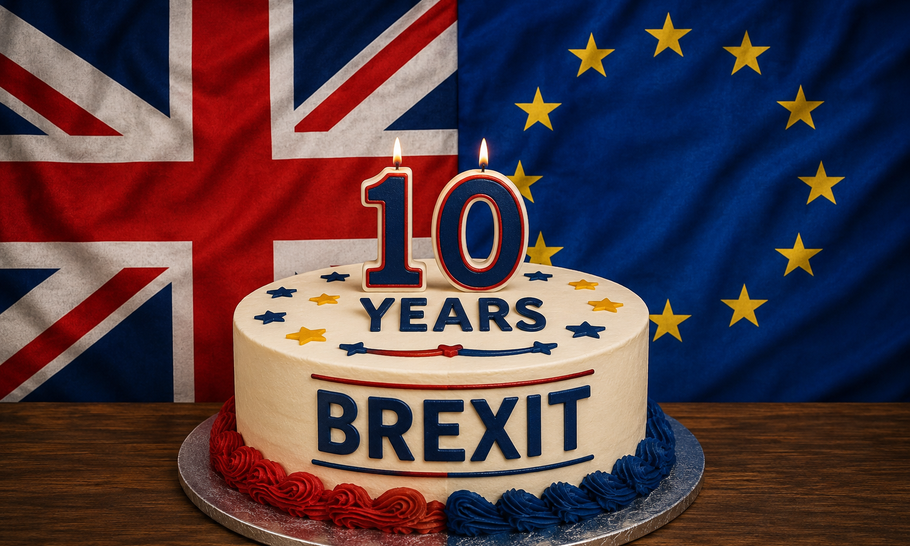
Today, exactly ten years ago, I was having a coffee in the Café Nero integrated into the entrance to Broadcasting House, the London HQ of the BBC.
I had just come out of doing an interview for French TV using the BBC suite of interview studios there. It was Brexit day and the international media interest was sky high. The BBC Café Nero was full of UK EU pundits, politicians and foreign correspondents.
There are many claims to be the Number 1 EU pundit in the British media but Professor Anand Menon must be close to the top of the list. Now aged 60, he has written 16 books on EU matters over a career at St Anthony’s Oxford University, the specialist college on global politics. For the last decade, at his other base at Kings College, London, he has run the respected think tank UK In A Changing Europe which, together with Charles Grant’s Centre for European Research, are the two premier intellectual hubs for EU affairs in London.
Anand, UK-born of Indian heritage, is an engaging, witty, super-brainy interlocutor on all aspects of EU policy and its interface with Britain. So when I saw him in Café Nero, I asked him; “Anand, you know everything there is to be known about Britain and Europe. Who will win today?”
Without pausing he replied: “I know the English, Denis. They will bottle it. They won’t dare vote Leave.”
I was astonished. I came back from working on the Continent to be a Labour MP in 1994. Almost the first thing I heard as I knocked on doors in the South Yorkshire constituency I was hoping to represent for Labour was: “You’ve let them all in, Mr MacShane – the foreigners. You can’t hear English spoken any more in the town centre.”
Often the P words, Poles and the short pejorative racist insult for Pakistani immigrants, were used. I spent the next two decades as Britain descended into a xenophobic hostility to foreigners, immigrants, and all things European.
In the House of Commons, the new Prime Minister Tony Blair faced William Hague, the young Oxford Union-formed Tory leader whose family come from the town where I was an MP. Hague mocked and sneered at the EU every week at Prime Minister’s Questions.
From the 1950s to the 1980s, the Conservatives were the pro-European party. Margaret Thatcher’s premiership promoted the fullest economic integration with Europe, including her Single European Act, which represented the biggest sharing of sovereign economic power with a foreign government in British history. But by the 1990s the Tories had done a full U-turn.
William Hague at the Despatch Box sounded just like Tony Benn or Arthur Scargill and assorted Communists and Trotskyists in the trade unions, as they denounced the secret power of Brussels to take over Britain.
After 2001, the Tory leadership passed to Iain Duncan Smith and Michael Howard. The first lacked William Hague’s brains, the second lacked his Oxford Union wit, but both parroted Hague’s hostility to anything European.
Rupert Murdoch ensured The Times and the Sun did daily propaganda against Europe. The Federation of Poles of Great Britain published a dossier of 100 anti-Polish hate headlines in just one paper, the Daily Mail, ranting about Polish “rapists” or Polish “thugs” or Polish “fraudsters” as part of the Mail’s campaign to turn Britain anti-European.
Even the Guardian’s economics editor was hostile to the EU and Labour under Neil Kinnock, a lifelong anti-European along with Robin Cook, Barbara Castle and Jack Straw. In 2015 Labour’s election manifesto included a pledge to hold an In/Out referendum with the promise that Labour would support the Leave side.
In 2011 inspired by the Greek crisis and the brutal treatment of the Greeks by Angela Merkel, I along with many others began using the term “Grexit” – the idea that Greece should exit the EU to solve its economic difficulties. I also mused on the idea of a “Brexit” as a possible development in Britain.
The ideas came together in my 2015 book Brexit: How Britain Will Leave Europe. I took it to friends in the Foreign Office, the CBI, and as an ex-president of the National Union of Journalists to media friends. They all patted me on the head and said there was no chance of a Leave vote. I thought they were all wrong, but I was out of politics by then and no-one listened.
So when Anand Menon assured me in the Café Nero a decade ago that Leave would lose, I just went to the nearest Paddy Power and put £100 on Leave. Winning was a consolation prize for me, but Brexit was a bad bet for Britain.
Today the nation is poorer as a result. The anti-EU movement has taken a sharp turn towards ethnonationalism, even open racism, and calls for “remigration” – the expulsion of people in Britain on the basis of colour.
Brexit has devoured six prime ministers in a decade. The latest is Sir Keir Starmer, who repeated Theresa May’s mantra when addressing the Labour Movement for Europe in 2022. He, like Mrs May, believed he would “Make Brexit Work”.
That oxymoron is still repeated on the BBC and in the press and by the Tories under Kemi Badenoch. Far from the populist plebiscite of 10 years ago answering the Europe question for Britain, politicians still cower in fear of talking about Europe rationally and with purpose.
I have known, liked respected Andy Burnham for more than 20 years. Married to a Dutch woman, he has always repudiated the Europobia of many Conservatives, many in Labour and now the ethnonationalists in Reform and Restore. But hostility to Europe is deeply rooted in British politics. I fear we will have to get a lot poorer and lose even more influence in world affairs before the penny (or euro cent) drops.
A Message from TheArticle
We are the only publication that’s committed to covering every angle. We have an important contribution to make, one that’s needed now more than ever, and we need your help to continue publishing throughout these hard economic times. So please, make a donation.


