Whatever happened to intelligent TV?


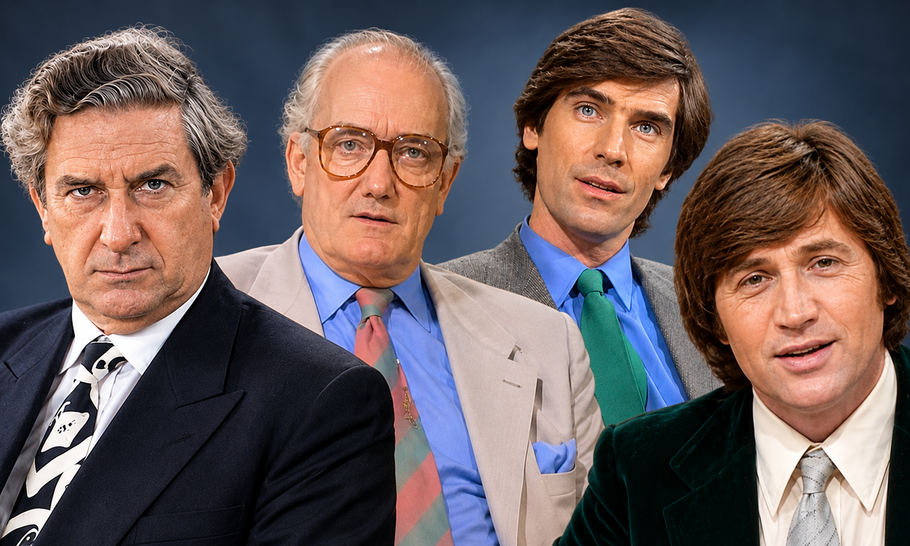
Jeremy Isaacs, Bryan Magee, Michael Ignatieff and Melvyn Bragg
I was recently contacted by Sebastian Cody, the creative figure behind After Dark, one of Channel 4’s most interesting and original discussion programmes that emerged in the 1980s. He is interested in a programme I made with the late Udi Eichler for Voices, another Channel 4 late-night discussion show in the 1980s. The programme featured the American philosopher John Searle and Geoffrey Hinton — a British-Canadian computer scientist, cognitive psychologist and Nobel Prize laureate. Both Voices and After Dark were short-lived. That kind of TV discussion programme moved over to BBC2 — in particular, The Late Show (1989-95) — and ITV’s The South Bank Show (1978-2010) with Melvyn Bragg.
During the 1970s, 1980s and 1990s, there was a golden age of intellectual discussion on British television and radio, especially on BBC2, Channel 4 and Radio 4. The reasons for this are a mixture of the quality of the presenters, the interviewees and the producers.
First, the presenters included Bryan Magee, Melvyn Bragg and Michael Ignatieff. Magee presented series such as Conversations with Philosophers (Radio 3, 1970-71). The series began with an introductory conversation between Magee and Anthony Quinton, followed by discussions on Bertrand Russell, G. E. Moore and J. L. Austin, Ludwig Wittgenstein, and the relationship between philosophy and religion, among others. Extracts of each of the conversations were printed in The Listener (the BBC’s equally highbrow weekly magazine) shortly after the programmes were broadcast.
In 1978 Magee presented a series of interviews with leading British and American philosophers, called Men [sic] of Ideas. This was a series that according to The Daily Telegraph, “achieved the near-impossible feat of presenting to a mass audience recondite issues of philosophy without compromising intellectual integrity or losing ratings” and “attracted a steady one million viewers per show”. Magee interviewed distinguished philosophers such as Sir Isaiah Berlin on “An Introduction to Philosophy”, Charles Taylor on “Marxist Philosophy”, Herbert Marcuse on “The Frankfurt School”, William Barrett on Existentialism, AJ Ayer on Logical Positivism, Bernard Williams on “The Spell of Linguistic Philosophy” and John Searle on “The Philosophy of Language”. Except for Iris Murdoch all the interviewees were men who taught at British or North American Universities, half of them from Oxford and Cambridge.
Magee followed this with another series of interviews on BBC2, The Great Philosophers (1987), a series of interviews with leading philosophers about great thinkers from Plato and Aristotle to Nietzsche, Existentialism and Wittgenstein. Again, the interviewees were leading male philosophers (again there was only one woman) from major British and American universities.
The new Channel 4 commissioned their own intellectual discussion programme, Voices, produced by Udi Eichler with a number of different presenters, the best known being the Canadian writer and intellectual, Michael Ignatieff.
There were several differences between Voices and Magee’s series for BBC2. First, Voices was more topical, rather than academic discussions about the history of ideas. Second, there were more women on Voices, including Margaret Boden, the literary critic Gayatri Spivak, writers such as Nadine Gordimer and Susan Sontag, the economist Emma Rothschild and psychoanalysts such as Hanna Segal, Elizabeth Spillius, Janine Chasseguet-Smirgel and Juliet Mitchell and the academic Sherry Turkle.
But perhaps the most significant difference was that instead of British and American academic philosophers, Voices featured psychoanalysts, writers such as Saul Bellow, Martin Amis, Günter Grass and Josef Brodsky, literary critics and social thinkers, from Ralf Dahrendorf and Anthony Giddens to George Steiner and Alain Touraine.
Another crucial difference was how many of the writers and intellectuals Voices featured were foreign, not British or American – Cornelius Castoriadis, Leszek Kolakowski, Octavio Paz. This was not just in contrast with Magee’s guests but the presenters and guests on today’s more intellectual programmes, such as Simon Schama, Mary Beard, David Olusoga, who are nearly all British. That is a significant difference.
Ignatieff went on to become one of the founding presenters of The Late Show on BBC2 from 1989-1995. Again, these discussions and interviews were more topical, starting with the Fall of the Wall, broadcast live from Berlin, and a programme on the fatwa against Salman Rushdie.There was also the familiar mix of writers, intellectuals and scientists, including William Styron, Rushdie and Ian McEwan, Mario Vargas Llosa, Susan Sontag, Margaret Atwood and Czeslaw Milosz, thinkers such as Isaiah Berlin and EJ Hobsbawm, scientists like Steve Jones and Lewis Wolpert and filmmakers like Marcel Ophuls, Wim Wenders and Volker Schlöndorff.
Another significant difference is the kinds of intellectuals and thinkers who appear on British TV and radio compared with thirty-fifty years ago. Today many of the media intellectuals are historians, whether ancient, like Beard, or modern like Schama and Olusoga, rather than Magee’s philosophers or the kinds of people Ignatieff interviewed which included psychoanalysts, social thinkers like Christopher Lasch, Giddens, Daniel Bell and Touraine, literary critics like Steiner, writers like Bellow, Amis and Ian McEwan. That is a significant change.
Finally, think of the kinds of issues Ignatieff discussed with these people or that Melvyn Bragg discussed on Start the Week and on Radio 4 in the 1990s or on In Our Time more recently: Modernity, Psychoanalysis, the fall of Communism, the nature of modern warfare, nationalism, science, filming the Holocaust, or the extraordinary number of subjects featured on In Our Time with Bragg and now Misha Glenny.
These kinds of programmes have almost entirely disappeared from British television. In Our Time, the annual Reith Lectures and The Life Scientific, all still on Radio 4, are almost the last vestiges of intellectual discussion on British radio.
Why has this happened? Firstly, think of the people who run British television. Executives in the 1980s and 1990s like Jeremy Isaacs and Michael Kustow at Channel 4, Alan Yentob and Michael Jackson at BBC2, were highly cultured and hugely ambitious, with a wide range of interests. With one or two notable exceptions, their successors are not. Channel 4 has long ceased to be a creative channel and may soon disappear. ITV will not long outlast The South Bank Show. BBC2 has lost the ambition that made it such a distinctive powerhouse in the late 20th century. That leaves Radio 3 and Radio 4.
A second problem is the disappearance from our screens of presenters like Bryan Magee and Michael Ignatieff. On Radio 4, Melvyn Bragg was until recently still going strong on In Our Time, Professor Jim Al-Khalili has now presented over 300 episodes of The Life Scientific and The Reith Lectures still survives almost eighty years after it started in 1948.
A third problem is the disappearance of The Listener, which used to publish edited transcripts of The Reith Lectures, Men of Ideas and Voices, and publishers who produced books based on three series of Voices and the decision of OUP to no longer publish transcripts of series like Men of Ideas and The Great Philosophers in the 1970s and 1980s.
Perhaps the biggest difference of all is the disappearance of the golden age of public intellectuals such as Sir Isaiah Berlin, EJ Hobsbawm, EP Thompson and Bernard Williams. There are a few successors: the philosopher John Gray, the classicist Mary Beard, the historian Sir Simon Schama. But crucially they no longer draw the same audiences. This is no fault of their own. It is a product of a larger cultural change. The audiences who used to follow programmes like Men of Ideas, Voices, and The Late Show, who read The Listener and watched intellectual discussion programmes and interviews late into the evening on BBC2 and Channel 4 seem to have abandoned terrestrial TV and intellectual weekly magazines. Perhaps podcasts are the only future for such broadcasts but the most successful podcasts rarely feature European or Central and South American writers and intellectuals and certainly not central and east European figures of the stature of Leszek Kolakowski, Czeslaw Milosz and György Konrád.
It would be easy to call this dumbing down. But it’s the specific nature of the changes that is more interesting. Some of these changes are definitely for the better. More women, more people of colour. But other changes are not positive and I wonder how many young viewers are being attracted to new kinds of ideas which might change their lives.
A Message from TheArticle
We are the only publication that’s committed to covering every angle. We have an important contribution to make, one that’s needed now more than ever, and we need your help to continue publishing throughout these hard economic times. So please, make a donation.


