Amadeus ex machina: chess, AI and music


The name of André Danican Philidor still stands at the threshold of modern chess. He was the first to see the game as more than an affair of isolated brilliance — he saw it as a structure of ideas. Yet his chief musical work, the opera Tom Jones, contains no trace of chess. The two worlds he inhabited — the cold precision of strategy and the warmth of melody — never quite met. It is left to later generations to bridge them.
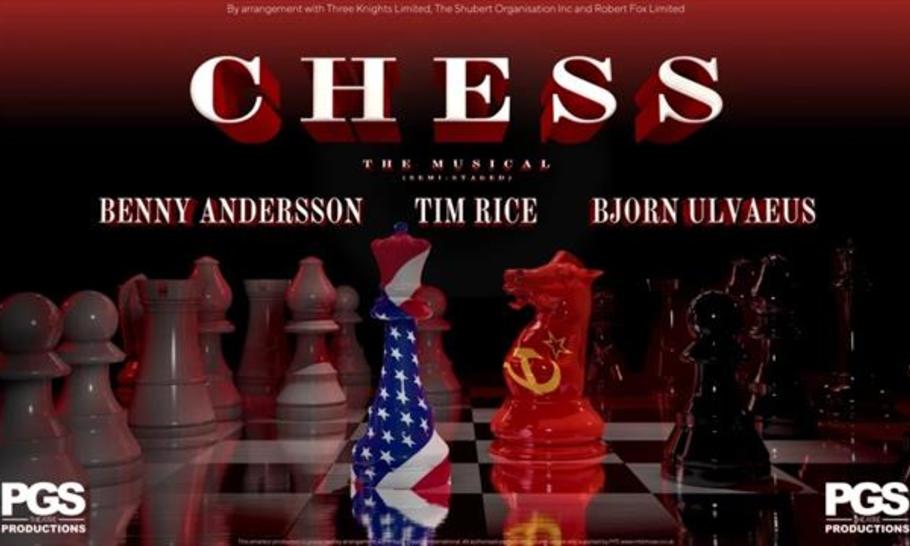
In our own time, the curious marriage of chess and music found a new form in CHESS: The Musical. Sir Tim Rice, whose words had already enlivened Evita and The Lion King, joined forces with Benny Andersson and Björn Ulvaeus, the architects of ABBA. Together they produced something both brilliant and absurd: a pop opera about the Cold War, the game of kings, and the treacheries of the human heart.
Behind the lights and choruses lay the world championship itself — a stage no less theatrical, and far more cruel. Those who dismissed Rice’s tangled plot as implausible — defections, betrayals, and improbable affairs — had not watched real chess. The truth, as so often, had outstripped invention.
Consider Elena Akhmilovskaya, a leading light of Soviet women’s chess, who fled during the Olympiad with an American captain, only to abandon him soon after her arrival. It was as if she had stepped out of Rice’s script, obedient to the logic of passion and exile rather than reason.
The game has seen stranger scenes still. I was present at the 1978 World Championship in Baguio City, in the Philippines — a match whose bitterness exceeded even the Cold War it mirrored. Anatoly Karpov, the dutiful champion of the Soviet state, faced Viktor Korchnoi, its defiant exile. Around them gathered a retinue of bureaucrats, informers, and fanatics. The air itself seemed under surveillance.
The Soviets sent a full delegation, including the formidable Viktor Baturinsky, once a Stalinist prosecutor, now Karpov’s guardian and strategist. Korchnoi’s camp was no less strange. Among his supporters were orange-clad members of the Ananda Marga sect — men out on bail for attempted assassination. It was a contest not only between two minds but between two moral worlds, each convinced of its own virtue.
Then came the matter of the yoghurt.
During the second game, a pot of yoghurt was brought to Karpov. At first, we laughed. But when a second appeared, Korchnoi’s companion, Petra Leeuwerik — once a prisoner in the Soviet camps — demanded a protest. To her, the yoghurt was not innocent. It was a signal, a code, a whisper from Moscow. She imagined that the flavour or colour might dictate Karpov’s next move, like an order passed in the open under the eyes of the enemy.
Absurd as it seemed, the controversy grew until it consumed the match itself. The arbiter, Lothar Schmid, issued a ruling worthy of Kafka: Karpov might have yoghurt, but only violet yoghurt, served by a single designated waiter at a fixed time. In this way, the world championship was preserved — by decree of yoghurt colour.
The press rejoiced. Reporters filled columns with mock solemnity, as though chronicling a new kind of warfare. “The implications remain frightening,” one wrote, “if Herr Schmid is ever forced to distinguish between mauve and violet.”
Such was the world we had made: a place where men capable of calculating fifty moves ahead could be undone by the suspicion of dairy espionage.
Years later, CHESS: The Musical would echo those events, capturing in song the uneasy marriage of intellect and power. The Arbiter’s song — half threat, half confession — remains the truest summation of the bureaucratic soul:
As you settle down behind your pawns
Power passes to me
You may play like
Fischer, Alekhine, Capablanca, Tal combined
I don’t mind
Please feel free.
You may think you’re the big fromage
But you don’t have my clout
I start the match
I control it
I can call it off
Kasparov found that out.
‘The Arbiter’s Song’, CHESS: The Musical
Concert pianist and chess player, Jason Kouchak performed this song https://www.youtube.com/watch?v=CAgJyrOt_Tk at the at 45th Chess Olympiad-Budapest 2024 Olympiad opening inspired by the special 100 year anniversary of the foundation of FIDÉ in Paris on July 20, 1924, also by St Stephen’s 1,000 year anniversary and Stefan Zweig’s novella Schachnovelle, written in 1941. It encompasses the idea of shadows of the past haunting our present actions and movements.
A new chess/music talent is on the horizon: chess grandmaster Jonathan Levitt has also produced over 50 new songs created on his computer, collaborating with an AI program called Suno. There are no singers or musicians involved. He goes by the name “GM Jon”. A video of one of his chess songs is here:
https://www.youtube.com/watch?v=WGRfa-E66u4
……… performed by a link to a song about Fischer, performed by Tara Toner, Jon’s AI female singing creation:
In the short time Jon has been involved in creating music, he has already come across incredible prejudice against AI music, especially from those with musical skills themselves. This is an instance where I can safely plead “ not guilty”.
Jon believes it is already the case that machines have played a big role in the music we consume, and they have done so for some years now. AI has made enormous strides in recent months and the direction of travel is clear. Soon, if not already, real musicians will not be able to compete on equal terms.
Jon notes that chess players came to terms with the superiority of the machine some 30 years ago when the great Kasparov lost a match to IBM’s Deep Blue. Human chess is still vibrantly active , and so it will be with music. The future may no doubt see the best work being done with man/machine collaboration. Why not start now? Amadeus ex Machina, as it were!
For those that question the morality of AI music, claiming that machines steal or borrow the ideas of human musicians, Jon asks one question: why is it okay for other humans to do that, but not for machines? As far as he is concerned, what matters is the quality of the music, not how it is produced. If great music can be produced with the help of technology and bring pleasure to billions of people, then he is all in favour. He would regard it as “immoral” – or at the very least misguided – to try to prevent that from happening.
Of course, he works with what interests him – among other things, humour, politics, chess, dogs, and satire.
Jon is working towards creating YouTube videos for these songs and getting them on Spotify and other platforms. Actually, he does not use AI to write lyrics, but he does rely on it for the music. For now, he thinks many humans can still write better lyrics than machines, but only a handful of top musicians are still better at creating and performing the music.
Jon would be delighted if human musicians wanted to perform any of his songs and would happily collaborate with someone with the appropriate qualifications
Another link to his songs:
https://www.youtube.com/@JonathanLevittGMJON
Our game this week maintains the theme of English chess-playing musicians who also occupy prominent YouTube channels. Back to the 1980s…
Brixton & Streatham chess club competition, 1982, London
Notes by Raymond Keene
- Nf3 Nf6 2. g3 d5 3. Bg2 c6 4. d3 Bg4
The development to f5 with Black’s queen’s bishop is also possible, but the text is more flexible. White is often tempted to chase the black bishop, which is a double-edged weapon. White’s kingside pawns may become a bludgeon or a weakness.
- Nbd2 Nbd7 6. O-O e5 7. e4 Bd6 8. Re1 O-O 9. h3 Bh5
There is no obligation to trade. Black prefers to maintain the tension. White’s next manoeuvre seeks also to mobilise his queen’s bishop in fianchetto, but it is rather time consuming and Black seizes the opportunity to expand in the centre and on the queen’s flank.
- b3 Re8 11. Bb2 d4
Locks the white queen’s bishop out of play for some time to come.
- a3 c5 13. Nf1 b5
Black has won the queenside skirmish, so White turns his attention to the other wing. He seeks to regain the initiative by hounding the black queen’s bishop.
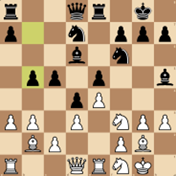
- g4 Bg6 15. Ng3 Nf8 16. Bc1 Ne6
Black prepares to fasten onto the debility of f4 in the wake of White’s bold advance.
- Nf5 Bc7 18. Bd2 Nd7 19. h4 h5
A key defensive stroke. White’s pawns must not be allowed to become a mobile juggernaut.
- Bh3 hxg4 21. Bxg4 Nf4 22. Ng5 Nf8
It appears that White is massing his forces for a direct attack against the black king, while Black is hoping to block the enemy efforts there, whilst expanding on the queenside. Now, though, a sudden switch of fronts takes place.
- a4 N8e6
White lunges at Black’s queenside, but Black ignores it.
- axb5 Nxg5 25. hxg5 Qxg5 26. Ng3 Qh4 27. Bd7
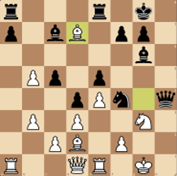
27… Re6 28. Bxe6
The key move in Black’s counter-attack. By sacrificing rook for bishop, Black gains control of the f-file as a future avenue of aggression and simultaneously annihilates White’s command of the kingside light squares, which derives solely from the existence of his light squared bishop.
28… fxe6 29. Bxf4
White now tries to reduce Black’s attacking force – shooting down one of the vultures hovering ominously around his king.
29… exf4 30. Nh1 Bh5 31. f3 Rf8 32. Rf1 Rf6 33. Rf2
However, the concentration of Black’s energy now proves too powerful. White’s defences crumble.
33… Rh6 34. Qe2
Lining up for the sacrificial kill. White overlooks the finish, but by now there was little he could do.
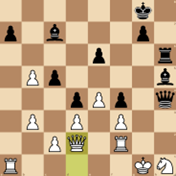
34…Qxh1+
And Black announced mate in three.
- Kxh1 Bxf3+ 36. Kg1 Rh1 checkmate.
Ray’s 206th book, “ Chess in the Year of the King ”, written in collaboration with Adam Black, and his 207th, “ Napoleon and Goethe: The Touchstone of Genius ” (which discusses their relationship with chess) can be ordered from both Amazon and Blackwells. His 208th, the world record for chess books, written jointly with chess playing artist Barry Martin, Chess through the Looking Glass , is now also available from Amazon.
A Message from TheArticle
We are the only publication that’s committed to covering every angle. We have an important contribution to make, one that’s needed now more than ever, and we need your help to continue publishing throughout these hard economic times. So please, make a donation.


