Blockading the world, by the world blockaded


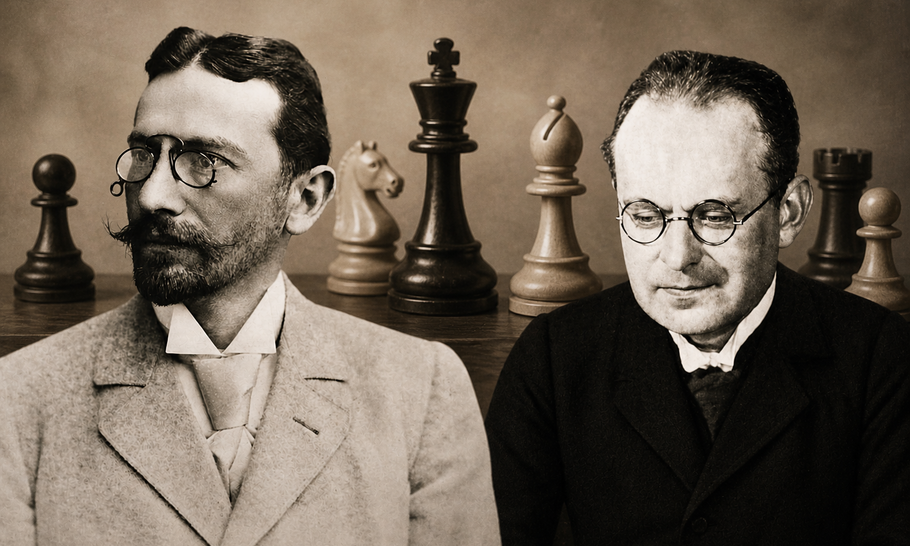
Siegbert Tarrasch and Aron Nimzowitsch
The reciprocally blockaded Straits of Hormuz are in the news, probably receiving more attention now than they have done since John Milton enlisted the place to embellish his description of Satan’s throne in the devilish palace of Pandemonium, from Book II of Paradise Lost. To mention Blockade on the chessboard is to evoke the spirit of Aron Nimzowitsch, whose strategic mantra — first restrain, then blockade, finally destroy — echoes down the decades since that genius of both planning and paradox first wrote of the Blockade in the aftermath of the First World War.
I therefore commence this week with a curious relic of my own early existence—a game I won at the age of 13, when the world was at once simpler and, in retrospect, vastly more forgiving. At that time I had fallen under the potent intellectual spell of Aron Nimzowitsch and his remarkable treatise My System, a work which impressed itself upon my youthful imagination with something approaching doctrinal authority. Today, of course, the prodigy who has not attained the rank of grandmaster by such an age is already deemed a lost cause; but in that more distant, almost geological epoch—what I have whimsically termed the Cretaceous Period—mere competence at thirteen was enough to provoke murmurs of precocity.
Bhuyia vs. Raymond Keene
Clapham Common CC, 1961, London
- d4 Nf6 2. c4 e6 3. Nc3 Bb4 4. e3 c5 5. Bd3 Nc6 6. Nf3 Bxc3+ 7. bxc3 d6 8. O-O b6 9. e4 e5
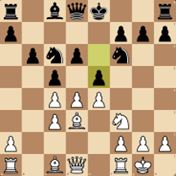
Here, in embryo as it were, I venture upon what would later be recognised as the Hübner variation of the Nimzo-Indian—introduced, I note with some private satisfaction, seven years before its formal christening by the German Grandmaster Hübner, whose name it now bears.
- d5 Ne7 11. a4?! TN
An uncertain gesture, almost an experimental twitch of the hand. Later practice records a game, Kirk–Collas, Naujac sur Mer, 2012, proceeding instead with 11. Ne1, while the cold, impersonal engines of our modern age incline toward 11. Nh4.
11… Bg4 12. a5 Ng6 13. Qa4+ Bd7 14. Qa2 O-O 15. h3
A modest move, yet inferior to the more deliberate 15. Ne1.
15… Qc8 16. Bg5
Again, a certain lack of precision; 16. Kh2 or 16. Re1 would have harmonised more fully with the position’s latent energies.
16… Nh5 17. Qc2
More consistent, perhaps, would have been 17. Rfb1.
17… f6
The engines—those tireless mechanical oracles—suggest instead 17… h6 18. Be3 Nhf4 19. Rfb1 Nxd3 20. Qxd3 bxa5 21. Rxa5 f5.
- Bd2 Bxh3
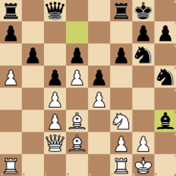
Here, the game acquires a sudden and almost theatrical vitality. The sacrifice does not merely suggest itself—it insists, clamours, demands existence.
- axb6?
A grave misjudgement, what ought to have been a terminal blunder. The modern evaluation plunges White into the abyss at -8.1. The proper course lay in 19. Nh2 Ngf4 20. gxh3 Qxh3 21. Bxf4 Nxf4.
19… Bxg2
Yet even here, amid the smoke of battle, I failed to perceive the most incisive continuation: 19… Qg4! 20. Ne1 Bxg2 21. f3 Bxf3+, when the attack becomes irresistible.
- b7 Qg4?
What was powerful a moment before now falters; the tempo slips, and with it some measure of clarity. The crushing line was 20… Qh3! 21. Nh2 Nh4 22. Qd1 Nf3+ 23. Qxf3 Bxf3 24. Nxf3 Qg4+ 25. Kh2 Qxf3.
- Nh2 Qh3 22. bxa8=Q Nh4
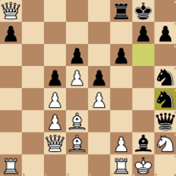
- Qxf8+?
A gesture of premature alarm. After Black’s inaccuracies, salvation still lingered in 23. f4 Rxa8 24. Be1 Qe3+ 25. Qf2.
23… Kxf8 24. Be2?
The final misstep—one that permits a swift and almost inevitable conclusion. Resistance might have persisted after 24. Qd1 Bh1 25. Qg4 Nf3+ 26. Qxf3 Bxf3 27. Nxf3 Qxf3 28. Be3 Ng3 29. Kh2 Nxf1+ 30. Bxf1 Qxe4 31. Rxa7 Qh4+, where the struggle, though grim, is not yet extinguished.
24… Bh1 White resigns 0-1
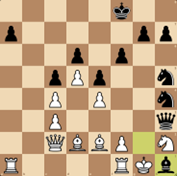
A picturesque denouement: the black forces massed ominously along the h-file, converging with mechanical certainty. The mate follows inexorably: 25. Bf3 (25. Bc1 Qg2#) 25… Nxf3+ 26. Nxf3 Qg2#.
Seated once at a window table in a restaurant in Lonon’s St. Martin’s Lane, I found myself, quite unexpectedly, at the epicentre of an Extinction Rebellion demonstration. It unfolded with a peculiar theatricality: ageing hippies affixed to a white van , like barnacles to a stranded vessel, surrounded by yellow-clad police, while sombre figures in black clambered atop the vehicle, delicately applying solvents and cutters to disentangle man from machine.
Dinner and a show indeed. Yet as I watched, my mind wandered—not idly, but with a certain uneasy gravity—toward the broader question of rationality in our age.
There seems, I reflected, a diminishing coherence in Western thought: a tendency toward the hysterical and the contradictory. One encounters proclamations from figures such as Greta Thunberg, Ed Miliband, or Gordon Brown—who once declared we had fewer than fifty days to save the planet—utterances which, whatever their intent, often betray a curious detachment from proportion.
The catalogue of unreason grows: the abandonment of lithium-rich Afghanistan while clamouring for green technologies dependent upon that very resource; assaults upon cultural inheritance by those it sustains; perplexing debates over identity amidst geopolitical realities of far greater immediacy. And yet, now and again, a corrective emerges—as in the recent judgement of the UK Supreme Court, which offered, at least momentarily, a restoration of clarity.
One might well ask, with Shakespeare: “Is chaos come again?” Or has it, in truth, always been with us?
From Nicolaus Copernicus to Charles Darwin, humanity has endured successive dethronements of its own centrality. Friedrich Nietzsche answered this void with his concept of Eternal Recurrence—a universe repeating endlessly, devoid of ultimate purpose. Only the “superhuman,” he proposed, could endure such knowledge without despair.
In the realm of chess, a similar struggle against chaos unfolds. Siegbert Tarrasch sought to impose order upon the near-infinite possibilities of the game, while Nimzowitsch rebelled, embracing complexity and paradox. Between them lies a dialectic as profound, in its way, as any philosophical dispute.
Chess, like the universe, contains more possibilities than atoms—10^120 positions, dwarfing even the vastness of cosmological estimation. And yet, through systems, language, and metaphor, we strive to comprehend it.
Nimzowitsch’s genius lay not merely in innovation, but in articulation: “the passed pawn’s lust to expand,” “prophylaxis,” “the mysterious rook move.” Such phrases do more than describe—they illuminate.
And so, whether in the ordered violence of a chessboard or the disordered theatre of modern life, we remain engaged in the same ancient endeavour: to wrest meaning from multiplicity, to impose form upon flux, and—however fleetingly—to glimpse order within the vast and restless machinery of existence.
In his authoritative book, Chess and Chessmasters, magisterially translated by Harry Golombek from the original Swedish, Grandmaster Gideon Stahlberg concurs that at the beginning of the 20th century, Tarrasch occupied a unique place in the chess pantheon. His great tournament successes had granted him a richly deserved reputation as a player, while his widespread literary activities energetically publicised his theories, so that it was not long before he had built up a significant school of followers. “Thus he became the great teacher, whose every word was listened to with hushed attention. To Tarrasch, chess was above all a science. The game followed strict laws and woe to him who broke one of them!”
Suddenly, though, there arose a tempest of contradicting opinion, particularly from one of the younger, less experienced masters: Aron Nimzowitsch. The Balt rapidly made his mark by original, apparently irrational, play, and fought his way into the leading group of the world‘s Masters. After achieving this entry into the “Magic Circle”, he astonished the chess world by a vehement attack against the ancien régime — that is, against the precepts of Tarrasch. At the same time, Nimzowitsch embarked on a fierce campaign on behalf of his own theories.
Nimzowitsch accused Tarrasch of routine dogmatism, and, to a 21st century observer, such an accusation does indeed seem justified. Nimzowitsch also opposed Tarrasch’s conception of the openings, and in substitution propounded a theory of development which welcomed constricted yet resilient positions that were rich in potentialities, just such positions as Tarrasch normally condemned on principle. In my own games, I have frequently followed the Nimzowitschian precepts, heading for seemingly cramped structures which were, however, packed with possibilities for decisive breakouts.
Aron Nimzowitsch, like Tarrasch himself, holds an honoured position amongst those outstanding personalities of chess history who have narrowly failed in their ambition to become world champion. Nimzowitsch was perhaps the most colourful, making his impressive mark not only with his successful play but also with his profound writings and his eccentric behaviour away from the chessboard.
Born in Riga into the Jewish family of Niemzowitsch, he learnt the moves at an early age from his father (an accomplished master in his own right) but it was not until 1904, while in Germany (ostensibly to study mathematics) that Nimzowitsch began to concentrate on chess. Unlike Tarrasch, Nimzowitsch was never seduced by the temptations of an alternative professional career, away from the chessboard.
At the start of his learning trajectory, Nimzowitsch’s talent seemed to lie in the purely tactical and combinational field, but several failures led him to undertake a complete revision of his chess ideas, placing greater emphasis on positional play, blockading strategy and consolidation. With his changed outlook, Nimzowitsch achieved significant successes, including equal second, behind Rubinstein, at San Sebastian 1912 and equal first with Alekhine at the All-Russian Championship in St Petersburg 1913.
The Great War, combined with the Russian Revolution, brought an abrupt halt to Nimzowitsch’s activities. In 1920 he left Latvia for Scandinavia, changing his name in the process from Niemzowitsch to Nimzowitsch. At first he took refuge in Sweden but eventually settled in Denmark. Nimzowitsch’s return to tournament competition in the early 1920’s was disastrous but gradually he played himself into form, securing a number of notable successes in the mid-1920’s, including equal first with Rubinstein at Marienbad 1925, first at Dresden 1926 (scoring 8½ out of nine, ahead of Alekhine and Rubinstein) and first at Hannover 1926. He also garnered two first prizes in strong tournaments in London during 1927. It was during this rich period that Nimzowitsch’s most influential work appeared: Mein System (My System). Published in 1925, it underwent several revisions until 1928 and is still a bestseller in many translations over the entire chess-playing world.
Nevertheless, the World Title still eluded him. Nimzowitsch took third place in the prestigious New York tournament of 1927, behind Capablanca and Alekhine; his brilliant first prize at Carlsbad 1929 was achieved ahead of Capablanca, Spielmann, Rubinstein, Euwe, Vidmar and Bogoljubow, yet Alekhine was not competing. His performance at Carlsbad possibly justified Nimzowitsch in adopting the title “Crown Prince of the chess world“ which he then assumed — somewhat pompously, given that he never managed to beat Capablanca. Yet Alexander Alekhine, the reigning monarch, refused to give way and the crown prince never managed to secure the funds for a world championship match. Nimzowitsch’s best results in major tournaments from 1929 onwards (2nd at San Remo 1930, 3rd at Bled 1931) were achieved in the shadow of the mighty Alekhine, against whom he won three games, lost nine and drew nine. Ill-health caused Nimzowitsch’s sudden decline in the mid-1930s and he died, just 48 years old, at the Hareskov Sanatorium, Copenhagen, in 1935.
In his playing style Nimzowitsch belonged to the so-called Hypermodern School, which held (inter alia) that control of the centre did not necessarily imply occupation by pawns. Adherence to these views, combined with a decided mutual incompatibility, brought him into frequent opposition with the great exponent of the classical school, Tarrasch. Neither master was averse to self-adulation and the bitterness emanating from their first meeting in 1904 was never entirely eradicated. In fact, hostility towards Tarrasch and his works was a recurring theme of Nimzowitsch’s literary endeavours.
However, Nimzowitsch’s major contribution to chess literature consisted not in his ridicule of Tarrasch, nor yet in the discovery of a novel method of play, but in his elaboration of a new chess vocabulary which made intelligible the hitherto but vaguely articulated strategy of master-strength players. Nimzowitsch possessed an unrivalled facility for capturing the essence of an already known operation or structure with a memorable and meaningful word or phrase, which thereby increased speed of comprehension and assisted clarity of thought. Nimzowitsch introduced into chess terminology such phrases as “the passed pawn’s lust to expand”, “the mysterious rook move”, “prophylaxis”, “7th rank absolute” and “hanging pawns”. It is an established phenomenon that rapid advances in performance are often immediately preceded by advances in modes of expression, and we may indeed detect an upsurge in the general level of chess after the publication of My System.
Nimzowitsch’s writings were penned with such enthusiastic and allusive wit, that only the most hardened could resist the appeal of his message. Consider the following passage on Tarrasch’s favourite hobby horse, the isolated queen’s pawn: “… we no longer consider it necessary to render the enemy isolani absolutely immobile; on the contrary, we like to give him the illusion of freedom, rather than shut him up in a cage (the principle of the large zoo applied to the small beast of prey).”
I have frequently maintained that chess as a game of war, mirrors battlefield strategy of the day. Thus chess originally reflected the chariots, foot soldiers, cavalry and war elephants of the ancient Indian army. During the Renaissance the chess queen acquired her rampant new powers, a metaphor for the new distance weapon, the cannon. Most strikingly, given that the prime modus operandi of warfare in 1914-1918 consisted of trench and blockade operations, both on land in Flanders and at sea, after the Naval Battle of Jutland, the blockade in chess came to the fore.
What, moreover, one might ask, can modern chess games tell us about contemporary warfare? I enter here the realms of further extreme speculation, but Bongcloud openings (1. e4 e5 2. Ke2) early queen sorties based on Qh5 and deliberate tempo loss (1. c3 followed swiftly by c4) all practised by the elite, including the current first ranked player and former World Champion, Magnus Carlsen, indicate to me that the direction of conflict is towards asymmetric warfare, involving terrorism, surprise, psychological combat and guerilla tactics, rather than the stately orchestration of grand strategy, as might have appealed to a Capablanca, a Botvinnik, a Karpov or indeed, Tarrasch and Nimzowitsch themselves.
Meanwhile, within the confines of the chessboard, Nimzowitsch’s words still ring true: “Ridicule can do much, for example, it can embitter the existence of young talents; but one thing is not given to it, to put a stop permanently to the incursion of new and powerful ideas.”
Most strikingly of all, at a time when antisemitism is once again rearing its hideous head, it is worthwhile recalling that both Aron Nimzowitsch and Siegbert Tarrasch (not to mention Sigmund Freud) were great Jewish teachers and thinkers. Grandmaster and writer, Nimzowitsch introduced such memorable phrases as : ‘the passed pawn’s lust to expand’, ‘first restrain, then blockade, finally destroy’ and ‘the mysterious rook move’. Brilliant phraseology often aids comprehension, and Nimzowitsch was a master of the telling epithet.
Nimzowitsch elevated the interpretation of blockading strategy (also a Tarrasch trademark) to new heights, as in his celebrated win with the black pieces against Johner from Dresden 1926. This was notably the forerunner of the so called Hübner system in the Nimzo-Indian, with which I introduced this column and which Bobby Fischer deployed to such devastating effect in game five of his celebrated match victory in 1972, against the incumbent champion, Boris Spassky in 1972.
Nimzowitsch, is regarded by many as the author of what might be termed the chess players’ strategic Bible, My System, but excoriated by others as irrelevant or at times even incomprehensible.
First of all, let me establish Nimzowitsch’s credentials as a role model.
In terms of opening theory, his most enduring contributions have been the Nimzo-Indian Defence and the complex of systems starting with 1. b3 or 1. Nf3 followed by b3. As a player he defeated Alekhine, Lasker and Euwe in individual games and won, or shared first prize, in such powerful events as Marienbad 1925 (11/15), Dresden 1926 (8½/9), London 1927 (8/11) and above all Carlsbad 1929 (15/21) where he triumphed ahead of Capablanca, Spielmann, Rubinstein and Euwe.
So, why have some critics denigrated the Jewish Grand Maestro’s contribution to chess knowledge, science and practice?
Let us take four pillars of his thinking, the blockade, prophylaxis, centralisation and over-protection. Those in the anti-Nimzo brigade have pointed out that the blockade existed before Nimzowitsch, notably and ironically in the games of his arch enemy Dr Siegbert Tarrasch. Nevertheless, Nimzowitsch elevated the interpretation of blockading strategy to new heights, as we have seen from the links above.
Centralisation, too, was known and practised well before Nimzowitsch came on the scene. To be fair, I do not think that Nimzowitsch claimed to have invented either centralisation or the blockade, merely to have observed such mechanisms and refined them. However, with chess being a game which simulates warfare, I do believe that the prime battle modes of the First World War, trench combat and naval strangulation, did influence Nimzowitsch’s blockade-oriented writings of the early 1920s.
This brings us to prophylaxis, the anticipation, restriction and prevention of the opponents’ potential for attack. Again, I think that Nimzowitsch observed this methodology in the games of contemporary masters, and his chief contribution was to identify and name it. Certainly, world champion Tigran Petrosian ( 1963-1969) made it completely clear that prophylaxis, as taught by Nimzowitsch through Petrosian’s trainer Ebralidze, was highly influential in forming his own chess style.
Now we come to the more opaque concept of over-protection. Even ex-world champion Magnus Carlsen has confessed to a certain bafflement where this is concerned and – make no mistake – over-protection was very much Nimzowitsch’s primary strategic insight and was exceedingly close to his heart. Overprotection is to Nimzowitsch as E=mc2 is to Einstein or Mind Mapping to Tony Buzan.
Prophylaxis and the mysterious rook move are far simpler to grasp, even in the extreme mode of Garry Kasparov’s doubling of his rooks on e7 and e8 in the closed e-file in game 24 of the 1985 world championship match against Karpov, the game which crowned Kasparov as the youngest ever world champion.
Over-protection is less clear, both in terms of its relevance and its usefulness. What I think has been overlooked is that the concept of over-protection (concentrating force on a key point in order to maximise energy) has morphed into specific opening variations, where it is just second nature and disguised from its original function as a discrete strategic device.
As is well known, Nimzowitsch favoured 3. e5 against both the French and Caro-Kann defences. The latter is now more in vogue than the former, though Nimzowitsch himself predicated the rationale for both as being over-protection of e5. A clearer instance of over-protection evolving into a popular opening variation is White’s control over d5 in most lines of the highly fashionable Sveshnikov variation of the Sicilian.
Perhaps the clearest manifestation, though, is White’s concentration of force behind his e5 pawn in many variations of the King’s Indian attack.
To conclude: amongst those prominent individuals who fail to appreciate Nimzowitsch, I would, among others, include Yasser Seirawan, Jan Gustafsson and World Champion Max Euwe (1935-1937), with Magnus Carlsen somewhat ambivalent. Some, it must be said, exude more than a whiff of antisemitism, but on the basis of ‘if the cap fits, wear it’, I am advised by Messrs Sue, Grabit and Runne, that I best leave it there.
In the Nimzowitsch camp I would firmly place Bent Larsen, Tigran Petrosian, Mikhail Botvinnik (who loved the Nimzowitschian e4/c4 pawn structure in the English opening and who was also a staunch upholder of Nimzowitsch’s favourite response 3… Bb4 in the Winawer French. Not to overlook the Icelandic former world title candidate, Johann Hjartarson, who gave ample recognition to Nimzowitsch in a keynote lecture in 2019 at the Gibraltar Masters.
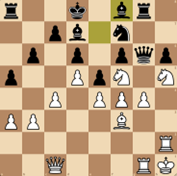
This week’s game, played in the final round, was decisive in securing Nimzowitsch’s famous victory in the elite tournament of Carlsbad 1929. It reveals in clear form the four pillars of quintessential Nimzowitschiana: prophylaxis, centralisation, overprotection and above all The Blockade.
Aron Nimzowitsch vs. Savielly Tartakower
Karlsbad (1929), Karlsbad, 1929, round 21
- d4 Nf6 2. c4 g6 3. f3 Bg7 4. e4 d6 5. Nc3 O-O 6. Be3 Nbd7
A rather passive move in the Saemisch variation (by transposition) which allows an interesting reply for white. At the time the game was played, attention centred on more lively lines such as 6… e5 7. d5 c6 or …Nh5. Even 6… Nc6 (which had been played as early as 1927 at the London International Tournament by Yates against Vidmar) has turned out to be playable).
- Nh3 e5 8. d5 a5
8… Nh5 was a more reliable continuation
- Nf2 b6
9… Nh5 was correctly recommended by Nimzowitsch.
- Qd2 Nc5
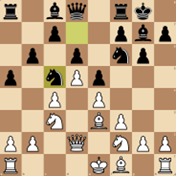
Again, Nimzowitsch suggests 10… Nh5. The unimaginative text move allows Nimzowitsch to create just the kind of position he must have been longing for in this crucial last round game: a blockade position where white alone has winning chances (in view of black’s lack of pawn breaks) and black has no active counterplay at all.
- Bg5 Bd7 12. g4 Qc8 13. h4 Kh8?
This is a mistake which grants white a tangible edge. Better was 13… h5! 14. Be2 hxg4 15. Rg1 g3 16. Nh1 g2 17. Rxg2 Nh5 18. O-O-O f5, and white’s advantage is negligible.
- h5 gxh5 15. Bxf6 Bxf6 16. Rxh5 Bg7 17. Nh1 f6 18. Qh2 h6 19. Ng3 Kh7 20. Be2 Rg8 21. Kf2 Rh8 22. Rh4 Qe8 23. Rg1 Bf8 24. Kg2 Nb7 25. Nh5 Qg6 26. f4 Nd8??
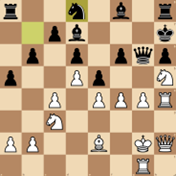
A potentially game losing continuation which invites white to continue with 27. g5 fxg5 28. fxg5 Nf7 29. Nf6+ Kg7 30. Nxd7 winning. The correct continuation was with either 26… Kg8 or …Bg7.
- Bf3?!
Nimzowitsch misses the decisive tactic just examined, instead building steady pressure.
27… Nf7 28. Ne2 Be7 29. Kh1 Kg8 30. Neg3 Kf8 31. Nf5 Rg8 32. Qd2 Rc8 33. Rh2 Ke8 34. b3 Kd8 35. a3 Ra8 36. Qc1 Bf8??
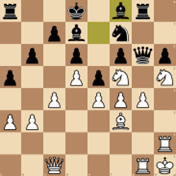
Losing! Black has four alternatives
- A) 36… Rc8 37. b4 axb4 38. axb4 Ra8 Qc3!;
- B) .. Qh737. Qc3 Qh8 38. b4 Ra7 39. Re1 Bf8 40. Rb1 Ke8 41. Qb3 a4 42. Qc3 Ra8 43. Rd1 Rg6 44. Nh4;
- C) 36… Ra6 37. b4 Ra8 38. Rd1 a4 39. Rg1 Rc8 40. Qc3 Rb8 41. Be2 Qh7 42. Rd1 Ke8 43. Rf1 Qg6 44. Qc2;
- D) 36… Rh8 37. b4 Rh7 38. Rf1 Rh8 39. Qb2 Rg8 40. Qc3 Ke8 41. Qc1 axb4 42. axb4 Bd8 43. Qb2 Qh7 44. c5.
All these are better than the losing move played, but none sufficient to reverse fortunes. Black now falls into rapid decline, and white’s clinical technique is instructive.
- Nh4 Qh7 38. Nxf6 Qh8 39. Nxg8 Qxg8 40. g5 exf4 41. gxh6 Qh7 42. Qxf4 Bxh6 43. Qf6+ Kc8 44. Nf5 Bxf5 45. exf5 Kb7 46. Qg6 Rh8 47. Qxh7 Rxh7 48. Rg6 Kc8 49. f6 Rh8 50. Bg4+ Kd8 51. Be6 Ke8 52. Bxf7+ Kxf7 53. Rhxh6 Black resigns 1-0
On chessgames.com, one kibitzer and chess historian, ‘Calli’, helpfully quoted the following extract, “I watched the final stages of his last game at Carlsbad last year. when Dr. Tartakower had plainly got out of his depth, and as I walked away with Senor Capablanca, who had also been watching the game that meant much to himself, Senor Capablanca said: ” One man knows what he is up to in playing that crazy sort of stuff, and the other man does not.” – The Times, August 18, 1930
Ray’s 206th book, “ Chess in the Year of the King ”, written in collaboration with Adam Black, and his 207th, “ Napoleon and Goethe: The Touchstone of Genius ” (which discusses their relationship with chess) can be ordered from both Amazon and Blackwell’s. His 208th, the world record for chess books, written jointly with the late chess playing artist, Barry Martin, Chess through the Looking Glass , is now also available from Amazon.
A Message from TheArticle
We are the only publication that’s committed to covering every angle. We have an important contribution to make, one that’s needed now more than ever, and we need your help to continue publishing throughout these hard economic times. So please, make a donation.


