Chess and the Eurovision Song Contest



Felicia in May 2026
I have generally entertained the notion that this column ought to preserve some breadth of cultural horizon, and not be confined within the narrow hedgerows of chess alone. It was in this spirit, indeed, that I recently proposed the newly crowned World Snooker champion, Wu, be known as Wedgwood Wu, in respectful acknowledgment of his remarkable gifts as a potter.
Conceive, then, my astonishment when, following last Saturday’s Eurovision finals, I observed that the Swedish entry bore the title My System—precisely the same as the celebrated strategic scripture of chess, My System, authored by Aron Nimzowitsch. Coincidence is often the mask worn by stranger forces.
Eurovision Song Contest 2026, Vienna
Felicia: My System
Cause now you’re in my head
My heart
My body parts
You’re always coming back on the weekends
You’re in every touch
And thought
And every shot
No I can’t get you out of my system
(My system)
No I can’t get you out of my system
There was a period in the history of chess (approximately 1900–1912) when philosophical thought upon the game had approached a dangerous stagnation after the death of Wilhelm Steinitz, and when the malady of sterile draws appeared to menace chess far more gravely than in our own age. At such a moment there emerged a man who discerned what enduring truths survived within Steinitz’s somewhat exaggerated theories, and who elucidated them for the chess world in a succession of notable articles (Wiener Schachzeitung, 1912–1913).
What, then, was this new and permanent truth concerning the structure of a chess masterpiece? Something singularly simple—indeed obvious—yet never before expressed by any predecessor of Aron Nimzowitsch. Namely, that not merely throughout the game as a whole, but especially in the opening contest for the centre, it is of far greater importance to control squares than to occupy them.
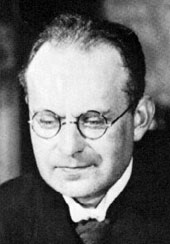
Aron Nimzowitsch
The development of this conception, pursued by Nimzowitsch in his two didactic works, My System and Chess Praxis, bestowed upon the chess world an armoury of fresh ideas and formulations: blockade, overprotection, the rule of two weaknesses, and others besides.
To paraphrase the great Alexander Alekhine: As a fighter and practical player, Nimzowitsch lacked nothing, in my opinion. If he did not ascend to the utmost summit—that is, to become world champion—it was owing only to an artistic hypersensitivity. Yet even in practical play he created values of lasting permanence.
The great figures of former times grow fewer with each passing year, and every new loss is felt more sharply. We stand in need of fresh genius, and doubtless it shall come.
Honour be to the memory of the great artist and the often passionate, but always upright and noble-minded man Aron Nimzowitsch.
It is worthy of note that Bobby Fischer held Aron Nimzowitsch in very high esteem for his contributions to chess theory. Fischer, though a far more aggressive and uncompromising combatant, possessed a profound respect for Nimzowitsch’s writings and employed his concepts in practical tournament play.
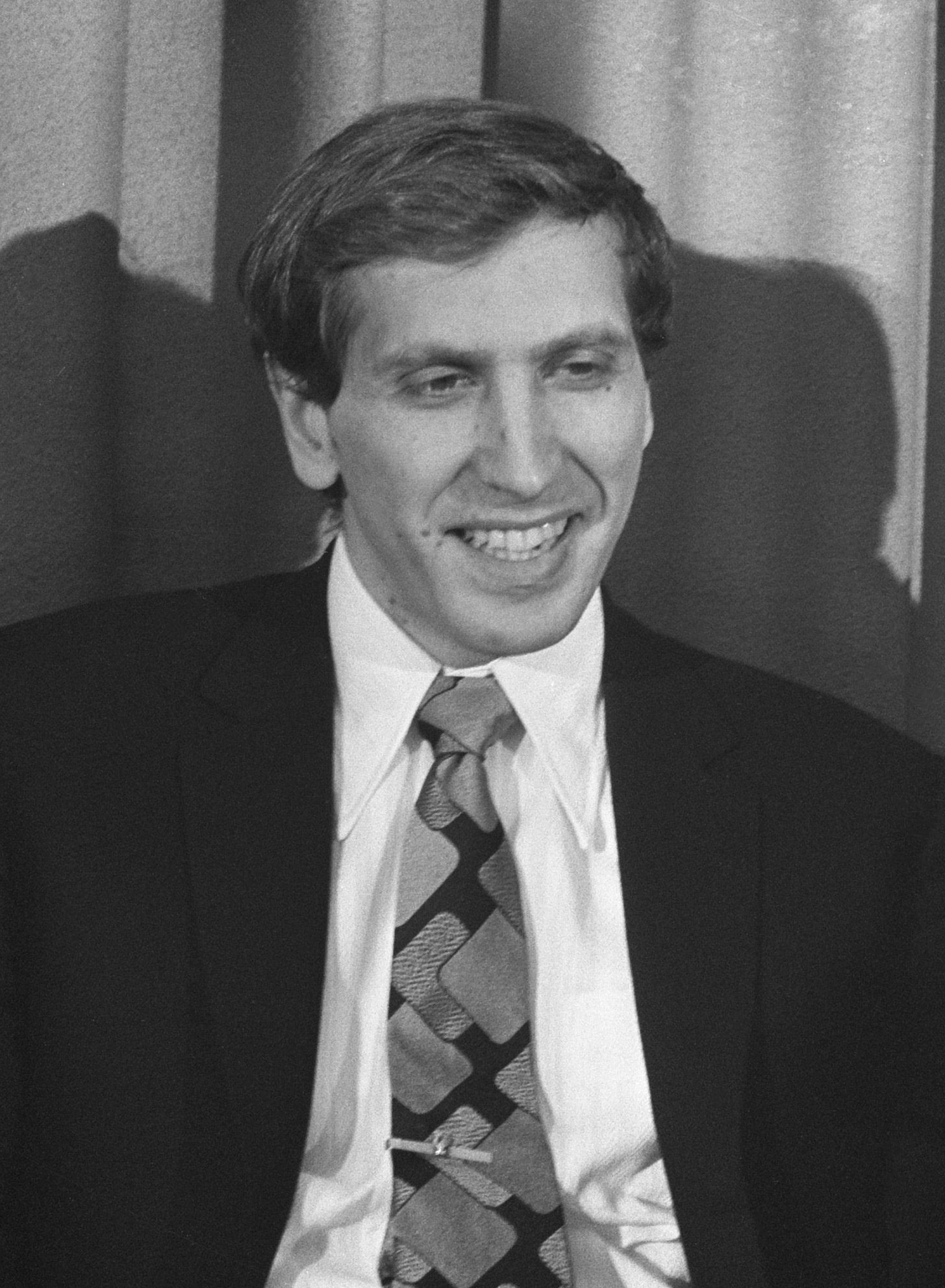
Bobby Fischer
Praise for Nimzowitsch’s Work
Fischer regarded Nimzowitsch’s seminal text, My System, as an indispensable masterpiece. He believed firmly that study of Nimzowitsch’s hypermodern ideas was compulsory for any serious chess player seeking comprehension of the deeper principles of strategy and positional play.
Practical Application
Fischer did not merely study Nimzowitsch; he incorporated those teachings into his own competitive practice. In the crucial fifth game of the 1972 World Championship match against Boris Spassky, Fischer adopted the Hübner system in the Nimzo-Indian Defence. That strategy, founded upon blockade and restraint, is generally considered a direct forerunner of Nimzowitsch’s concepts. Fischer won decisively, and the game formed a cornerstone in his path to becoming World Champion.
The argument for Nimzowitsch scarcely rests upon theory alone. Here is a summary of Nimzowitsch’s best tournament results, together with victories against notable contemporaries. These facts should suffice to silence any ill-judged derogatory disrespect toward Nimzowitsch and his theories, surprisingly voiced by such contemporary commentators as Seirawan and Gustafsson. It is encouraging that among the defenders of Nimzowitsch we find authorities of unquestioned standing, including Grandmasters and Champions such as Petrosian, Larsen and Hjartarson.
I have compiled a couple of lists which demonstrate abundantly the prowess of Nimzowitsch across three decades. The first records tournaments in which he secured first prize:
Munich tournament, 1906
Russian championship, Petrograd, 1914
Copenhagen tournament, 1923
Marienbad tournament, 1925
Dresden tournament, 1926 (ahead of Alekhine and Rubinstein)
Hanover tournament, 1926
Bad Niendorf tournament, 1927
London international tournament, 1927 (ahead of Marshall and Bogoljubov)
London 1927 (UK opponents only)
Berlin BSG tournament, 1928 (ahead of Bogoljubov, Tartakower and Reti)
Carlsbad tournament, 1929 (ahead of Capablanca, Spielmann, Rubinstein, Euwe and Bogoljubov)
Frankfurt tournament, 1930
Winterthur Swiss championship, 1931
Plus principally Scandinavian tournaments in Copenhagen: 1922, 1924, 1928 (twice) 1933 and 1934.
Against his Elite opponents, Nimzowitsch could claim some striking overall plus scores:
Euwe: one win no losses
Flohr: two wins no losses
Janowski: three wins no losses
Lasker: one win no losses
Maroczy: one win no losses
Tchigorin: one win no losses
Tarrasch: five wins two losses
Tartakower: five wins three losses
Réti: five wins one loss
Sultan Khan: one win no losses
Spielmann: eighteen wins fifteen losses
Marshall: six wins five losses.
The record is not that of an eccentric theorist secluded among abstractions, but of a formidable practical master. The figures remain, austere and stubborn things, and they make their own reply.
One would not necessarily regard Bobby Fischer as a disciple of Nimzowitsch. Indeed, when I wrote my chessography of Nimzowitsch back in 1973, I assessed our new World Champion (none other than Fischer himself) as an anti Nimzowitschian in his chess style. A recent closer examination has revealed that I was mistaken. Some of Fischer’s games are pure Nimzowitsch!
I give following several links to games that amply demonstrate our theme, and finish with a couple of outstanding demonstrations where style met substance to form a masterpiece.
Fischer vs. Mecking (Palma de Mallorca, 1970)
Nimzowitsch vs. Spielmann (New York, 1927)
Virtually a carbon copy of the Nimzo masterpiece, even down to the rook and pawn endgame.
Spassky vs. Fischer (Reykjavik, 1972)
Johner vs. Nimzowitsch (Dresden, 1926)
The blockade in action, combined with the taming of white’s bishop pair. First restrain, the blockade, final destroy, was Nimzowitsch’s resounding tricolon for such achievements.
In the following game, we witness a perfect example of Nimzowitsch’s postulate of overprotection, revolving around the strongpoint on e5.
Robert J. Fischer vs. Lhamsuren Myagmarsuren
World Championship Interzonal, Sousse, 1967, round 3
- e4 e6 2. d3 d5 3. Nd2 Nf6 4. g3 c5 5. Bg2 Nc6 6. Ngf3 Be7 7. O-O O-O 8. e5 Nd7 9. Re1 b5 10. Nf1 b4 11. h4 a5 12. Bf4 a4 13. a3 bxa3 14. bxa3 Na5?!
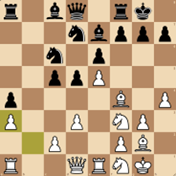
A persistent theme in this and future variations is the vulnerability of the a8-rook. Instead of the text, it is preferable to play 14… Rb8 with, for example, 15. c4 Nb6 16. cxd5 Nxd5 17. Qxa4 Nxf4 18. Qxf4 Qxd3 19. red1 Qf5 20. Qxf5 exf5, maintaining near equality.
- Ne3 Ba6?!
This piece is misplaced and now white is better. Once again, it is best to move the rook with 15… Rb8 16. Ng5 Nc6 17. Qh5 h6 18. Nh3 Qe8 19. c4 Rb3 20 cxd5, keeping the status quo.
- Bh3?
White relinquishes his momentum with this inaccuracy. The best continuation is after, 16. Ng5 Nc6 17. Qh5 Bxg5 18. hxg5 Ncxe5 19. Nxd5 exd5 20. Bxe5 Nxe5 21. Rxe5 Bb7 22. Rae1.
16… d4 17. Nf1 Nb6 18. Ng5 Nd5?!
Better is 18… Bb7, contesting the h1-a8 diagonal while white’s bishop is misplaced on h3.
- Bd2?!
The engine suggest the following line: 19. Qh5! Bxg5 20. Bxg5 Qe8 21. Qg4 Kh8 22. Nd2 Nc3 23. Bg2 Bb7 24. Bxb7 Nxb7 25. Ne4 Nxe4 26. Qxe4, which it regards as better for white.
19… Bxg5 20. Bxg5 Qd7 21. Qh5 Rfc8?
This is a significant error, as after 21… Bb7 22. Nh2 Qe8 23. Qg4 Kh8 24. Rab1 Bc6 25. Rb2 Nc3 26. Bd2 Qd8 27. Bg2 Qc7 28. Bxc6 Nxc6, white develops significant kingside pressure while only Black’s queen is available for defensive purposes. White is now much better.
- Nd2?
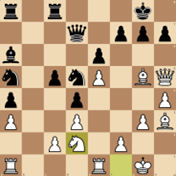
White misjudges the optimum development for his kingside attack, and black achieves a wholly undeserved equality. Correct was 22. Bg2, when after 22… Qe8 23. Bf6 Bb7 24. Nh2 Qf8 25. Be4 Nxf6 26. exf6 g6 27. Qf3 Bxe4 28. Rxe4 c4, white retains a powerful advantage.
22… Nc3?
A hopeful continuation, but one which is inferior. Best is 22… c4 23. Bf6 Qe8 24. dxc4 Bxc4 25. Ne4 Qf8 26. Bg5, when black is able to initially counter white’s first attack wave.
- Bf6 Qe8 24. Ne4 g6 25. Qg5 Nxe4 26. Rxe4 c4?
This acceleration to reduce and simplify the queenside, compounds black’s problems, as his primary attention in such a difficult position, is the defence of his king. Of the many variations available, black selects the worst.
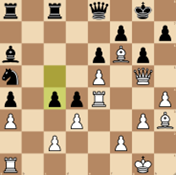
Comparatively better, although still insufficient, are:
- a) 26… Bb7! 27. Rg4 Qf8 28. h5 Bd5 29. Bg2 Bc6 30. Bxc6 Nxc6 31. Rh4;
- b) 26… Nb3 27. Rg4 Qf8 28. Re1 c4 29. h5 cxd3 30. hxg6 fxg6 31. cxb3 axb3 32. Rxd4;
- c) 26… Rc7 27. h5 Bc8 28. Rh4 Rb8 29. Rf1 Nb3 30. cxb3 axb3.
- h5 cxd3 28. Rh4!?
A slightly stronger continuation is 28. Bxe6 fxe6 29. Rg4 Ra7 30. hxg6 Qxg6 31. Qh4 Qxg4 32. Qxg4+ Kf8, after which white’s victory is marginally delayed.
28… Ra7 29. Bg2 dxc2??
After this move, mate must follow. The best available is 29… Qf8 30. Be4 dxc2 31. hxg6 fxg6 32. Bxg6 hxg6 33. Rh8+ Kf7, after which, white’s attack is nearly fully-formed, and black’s army sits uncoordinated on the side most distant from his ever-vulnerable king.
- Qh6 Qf8 31. Qxh7+ Black resigns 1-0
Black does not wait for, 31… Kxh7 32. hxg6+ Kg8 33. Rh8#.
And finally a game with Fischer’s own commentary, where his …Nh8 not only introduces a winning attack but also functions as an homage to Nimzowitsch’s celebrated Nh1 in the game: Nimzowitsch vs. Rubinstein (Dresden,1926).
Viktor Korchnoi vs. Robert J. Fischer
Herceg Novi (blitz), Herceg Novi, 1970, round 10
Notes by Fischer
- d4 Nf6 2. c4 g6 3. Nc3 Bg7 4. e4 d6 5. Be2 O-O 6. Nf3 e5 7. O-O Nc6 8. d5 Ne7 9. Nd2
This move is apparently considered best by the Russians. In the “Turner Mira” 1970, Petrosian played 9. b4 Nh5 10. Nd2!? Nf4 11. a4, but without great success against Gligoric.
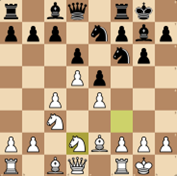
9… c5
I think this is a logical move. Black takes a tempo from his King side play to slow down White’s Queen side initiative which usually comes quite quickly with b4, c5, etc.
- a3 Ne8 11. b4 b6 12. Rb1 f5!
Having made all the necessary precautions on the Queen’s side Black is now ready to attack on the King’s flank.
- f3
Maybe better is 13. Nb3 as in the game Gligoric-Tringov, Belgrade, 1969.
13… f4 14. a4 g5 15. a5 Rf6! 16. bxc5?
This is, as Korchnoi pointed out afterwards, a “terrible mistake” because now it is impossible for White to get any initiative on the Queen side.
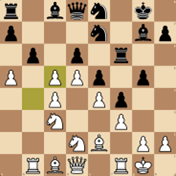
16… bxc5 17. Nb3 Rg6 18. Bd2 Nf6
Or …h5!
- Kh1 g4
Maybe more exact was 19… h5.
- fxg4
Forced because of the threat of 20… g3 and then white cannot play 21. h3 because of 21… Bxh3 etc.
20… Nxg4 21. Rf3?
- Bf3! was better, with a more tenacious defence..
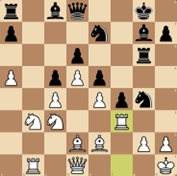
21… Rh6 22. h3 Ng6 23. Kg1 Nf6 24. Be1 Nh8!!
This attacking manouver is decisive.
- Rd3 Nf7 26. Bf3
- h4!? held out a little longer.
26… Ng5 27. Qe2 Rg6 28. Kf1
Or 28. Kh2 Qd7 threatens 29… Nxh3 etc.
28… Nxh3 29. gxh3 Bxh3+ 30. Kf2
At this moment my hand hovered over White’s Pawn on e4, but at the last second I realized that 30… Nxe4 is answered by 31. Qxe4 and White wins.
30… Ng4+ 31. Bxg4 Bxg4
And here Korchnoi thought for about a minute and a half and not seeing a defence to the double threat of 31… Bxe2 and 32… Qh4+
White resigned 0-1
Ray’s 206th book, “ Chess in the Year of the King ”, written in collaboration with Adam Black, and his 207th, “ Napoleon and Goethe: The Touchstone of Genius ” (which discusses their relationship with chess) can be ordered from both Amazon and Blackwell’s. His 208th, the world record for chess books, written jointly with the late chess playing artist, Barry Martin, Chess through the Looking Glass , is now also available from Amazon.
A Message from TheArticle
We are the only publication that’s committed to covering every angle. We have an important contribution to make, one that’s needed now more than ever, and we need your help to continue publishing throughout these hard economic times. So please, make a donation.


