Front-line leadership


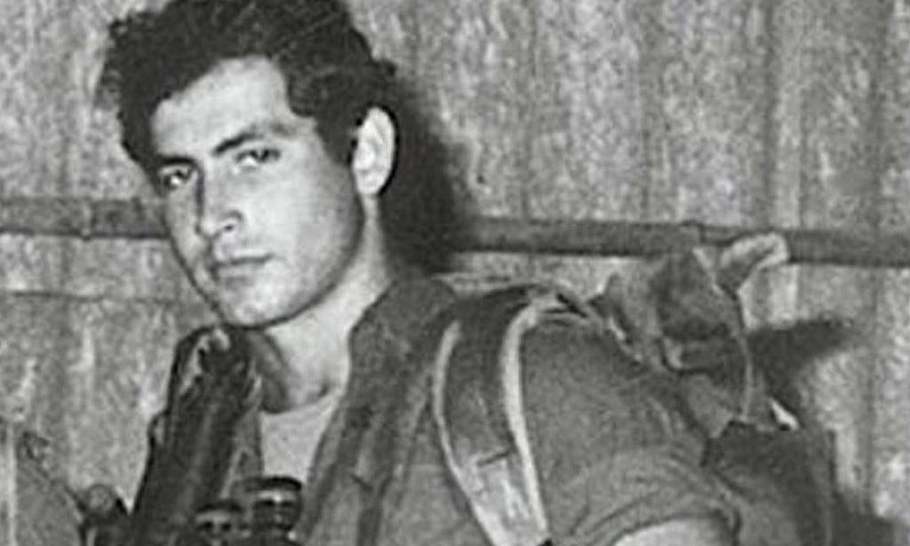
Benjamin Netanyahu as a soldier (Shutterstock)
The imbroglio over Sir Keir Starmer’s wobbly support for US actions in Iran raises the question of how important personal military experience is for a leader. Of the three men involved — Donald Trump, Keir Starmer and Binyamin Netanyahu — only one, the Israeli Prime Minister, has served in his country’s armed forces.
Netanyahu spent five years in the Sayeret Matkal, the IDF’s principal special forces unit, saw combat on several occasions and was wounded more than once. His brother Yonatan commanded Sayeret Matkal and was killed leading the 1976 Entebbe raid to rescue hostages from a hijacked plane.
Starmer of course was a “human rights lawyer” during the era when some of his colleagues were pursuing — often vexatious — claims against British soldiers who had served in Iraq, Kosovo and Northern Ireland. Donald Trump was a rich kid from New York who evaded the draft and possible service in Vietnam by claiming medical immunity on the dubious grounds of bone spurs in his feet.
Political and military leadership have been closely intertwined for millennia. A leader’s first duty is to protect his people, whether formed by a tribe, kingdom, republic or empire. Until about 1500, English kings and the nobles around them were trained as warriors, and were expected to take the field with their armies when the occasion arose. One thinks of Edward the Black Prince, aged 16, commanding a wing of the army at Crécy in 1346; when the French were pressing him hard, his father King Edward III merely said: “Let the boy earn his spurs.” And Henry V, who trounced the French at Agincourt in1415, was a fearsome warrior who, also then 16, had survived an arrow in his left cheekbone at the battle of Shrewsbury.
Of course not all England’s medieval kings survived their military experiences. Harold was slaughtered at the climax of the battle of Hastings in 1066. And in 1485 King Richard III died at Bosworth Field “fighting manfully in the thickest press of his enemies”, as a Tudor partisan admiringly wrote. When his skeleton was discovered in 2013, it was found to have suffered more than a dozen severe wounds, including a devastating blow from a pole-axe which split his skull open.
The last monarch to appear on a battlefield with his army was King George II at Dettingen in 1743, during the War of Austrian Succession. He was present less as King of England than as Elector of Hanover. George nominally commanded the army, and ignored the advice of an experienced officer, the Earl of Stair, which gave some advantage to the French, though luckily not a decisive one. But he did not skulk in the rear. As the National Army Museum records: “Frightened by the initial crackle of musketry, King George’s horse dashed off, carrying him to the rear to his great embarrassment. The King returned to the right of the line on foot, shouting encouragement to his troops. When the Duke of Ahremberg rode up to him and begged him not to expose himself to the enemy, he declined saying: ‘What do you think I am here for — to be a poltroon?’”
By this time there was no likelihood of a king actually wielding a weapon in anger. Battles were no longer won by aristocratic skill at arms but by artillery and massed musketry. Professional soldiers now commanded armies and directed the conduct of the fighting. Success in war gave some generals political opportunities. Napoleon Bonaparte is probably the most significant example. The Duke of Wellington, who ended Napoleon’s career at Waterloo, was later twice prime minister of Great Britain. He detested politics, complaining after his first cabinet meeting that though he had given his ministers their orders, they immediately began discussing them. General Ulysses S. Grant led the Union armies to victory in the American Civil War, and later had two (notably unsuccessful) terms as President.
Winston Churchill was descended from one of Britain’s greatest soldiers, John Churchill, first Duke of Marlborough. Young Winston had been a cavalry officer on the Northwest Frontier, and participated in the British army’s last major cavalry charge at Omdurman. Though he went on to have a stellar political career, he always found it hard to resist the bugle’s call. In 1916 he tried to atone for the disaster of Gallipoli by commanding a Royal Scots Fusiliers battalion in the trenches. Although he could easily have spent all the time at his HQ farmhouse behind the line, he visited the trenches three times a day, and often led night-time patrols into no-man’s-land. He joked with the men, reduced the harshness of their discipline and advised his officers that there was no point in ducking when they heard a gunshot because by the time they heard it, the bullet was long past them.
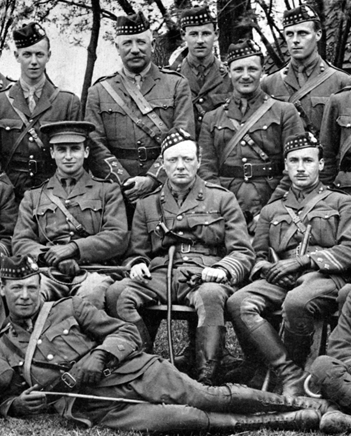
Figure 1 Churchill with officers of 6th Royal Scots Fusiliers
In World War Two, he hoped to land in Normandy beaches on D-Day, but was ordered not to by George VI. The King had been tipped off by the Supreme Allied Commander, General Dwight D Eisenhower (who himself went on to serve two terms as US president).
But while Churchill was kept away from the invasion of Normandy, he would not be prevented from crossing the Rhine in March 1945, on the very day of the British army’s assault. There is an extraordinary photograph of Churchill standing triumphantly in a jeep driven by Field Marshal Montgomery, passing a long column of astonished commandos waiting to cross the river themselves. The Prime Minister’s triumphant look says it all.
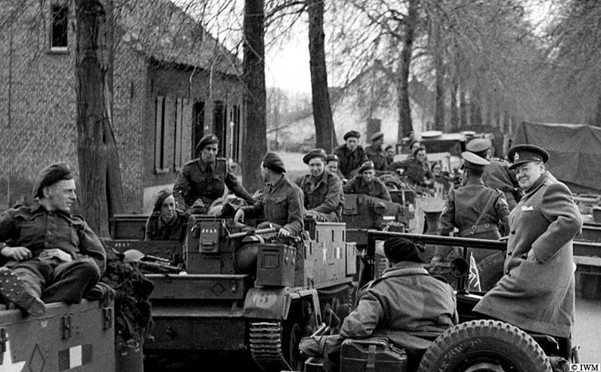
Figure 2 Heading for the Rhine, March 1945
Shortly afterwards Churchill was photographed, cigar in mouth, stepping out of a landing craft onto the east bank of the Rhine. Fighting was continuing nearby, but final victory was close, and he was determined to savour the moment.
Churchill’s successor as PM, Clement Attlee, had been an infantry officer at Gallipoli, and was the second to last man to be evacuated from Suvla Bay at the end of the campaign. He also fought in Mesopotamia, where he was twice wounded, and on the western front.
The increasingly grotesque and capricious administration of President Donald Trump, with its deliberate betrayal of Ukraine, invites no doubt invidious comparison with his more notable predecessors. One wonders whether Trump would have toyed with people in such dire straits if he had himself any experience of armed conflict. In 2020 he was reported to have called the 1,800 US Marines killed at Belleau Wood in WW1 “suckers and losers”. In 2015 he said on the record that his opponent Senator John McCain, a combat pilot whose plane had been shot down over North Vietnam, was not a hero because he had been a prisoner of war: “I don’t like people who are taken prisoner.” The President was also unforgivably dismissive of the record of allied forces in Afghanistan; he offered a grudging apology only after protests.
I grew up in Washington, arriving there in 1961 just as John F Kennedy was inaugurated, and leaving in 1970 during Richard M Nixon’s first term. As a schoolboy naturally I had no dealings with any of them, though I heard a lot about all of them at home because my father Louis was the Times’ Washington correspondent, and influential people – what the media like to call “insiders” – were always dropping round for a drink and gossip. The Secretary of State Dean Rusk was a near neighbour and an Anglophile, so we saw a lot of him.
I once saw JFK up close on 13th November 1963, when the pipes and band of the Black Watch played for the President’s family on the White House lawn. Anyone not familiar with the story should go on YouTube and search Black Watch White House 1963 which will lead to a remarkable 15 minute film of the tattoo made by the US Navy.
I had the great good fortune to attend this extraordinary event, one of the highlights of my childhood. I had turned eleven a few days earlier. Several hundred guests were invited to the tattoo, including many disabled children from institutions in the DC area. As I walked on sticks, the result of a bout of polio on Times service in Delhi some years earlier, my father applied for tickets for us as well.
I remember the day not just for the tattoo but also for the very relaxed security at the White House. That afternoon we climbed into our battered old Ford Country Squire station wagon, and drove down Massachusetts Avenue to the White House. Pulling up at the front gate, my father explained to a genial White House policeman that I was, as he put it, “lame”.
“Mr. Heren,” replied the guard, who evidently knew him well, “you just drive right up to the House.”
We were met by a functionary in plain clothes, perhaps a secret service agent, with whom I waited while my father took the car down to the underground staff car park. He knew the way, and was not accompanied. On Dad’s return, we were led through a number of grand rooms, and emerged through French windows onto the south terrace.
As we passed through the windows, I became aware of a crowd of photographers facing the building. Glancing to my left, I saw gliding through the next set of windows the poised, queenly figure of Jackie Kennedy — an impressive lesson in how a celebrity faces her public.
We were a little late and there was a scramble to find me a seat, from which I had an excellent view (see picture). My father disappeared for a gossip with Kennedy’s press secretary. I had never before seen a kilt, or heard the bagpipes, and I found the whole thing exhilaratingly exotic. I appear in the film at 10 seconds and at 2 minutes, looking rather cold. I recall being struck by the colour of the President’s hair, reddish-auburn in the autumn sunshine.
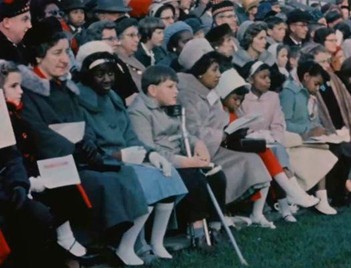
The writer watching the Tattoo
The contrast between the principal figures at the White House that day in November 1963 and the present incumbent is striking. The men of 1963 had both experienced combat, whereas President Trump managed to evade service in Vietnam by claiming a dubious medical condition.
JFK had been a naval lieutenant and served as a motor torpedo boat commander in the Pacific. He was decorated for saving the life of one of his sailors after PT 109 was sliced in half by a Japanese destroyer. Extraordinarily Kennedy had towed the man two miles to safety by clamping a string in his teeth. Many years later, asked about how he had become a “hero”, he merely said: “It was involuntary. They sank my boat.”
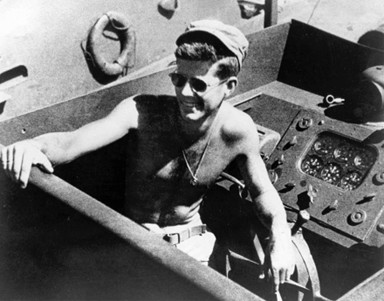
JFK aboard PT109
The Black Watch were commanded at the White House by a “soldier’s soldier”, Major Mike Wingate-Gray, MC and bar: the first medal was for charging with a bren gun and taking out a German machine gun post on Sicily in 1943; the second, in October 1944, was awarded for personally negotiating a 60-hour truce with the German garrison of Dunkirk to allow 20,000 French civilians and a number of severely wounded Germans to escape an imminent British bombardment of the town. All soldiers hate it when civilians are caught up in fighting, and I suspect Wingate-Gray was prouder of the second honour. Later in his career he commanded 22 SAS with distinction in Borneo, Radfan and Aden before retiring in the rank of brigadier in the early seventies.
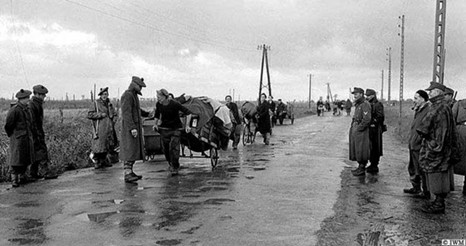
Ceasefire checkpoint outside Dunkirk, 4 October 1944: French civilians departing for safety, Black Watch to the left, Germans to the right., Officer in middle of road may be Wingate-Gray
In the film, Kennedy’s gracious off the cuff speech of welcome is well worth watching as an antidote to President Trump’s recent ignorant calumny about British troops in Afghanistan. JFK remarks that the Black Watch is particularly welcome because in its long history it has often fought on the Americans’ side – WW1, WW2, and Korea – though “once against us, in the War of Independence” – before he waxes sentimental about Scotland, “that green and misty country,” whose romantic history had grabbed him early on.
Wingate-Gray, another man who knew how to behave, responded with thanks on behalf of Queen Elizabeth the Queen Mother, the regiment’s colonel-in-chief. He then presented Kennedy with a sgean dubh – an officer’s dirk – engraved with the regiment’s motto: Nemo Me Impune Lacessit, “no one wounds me with impunity.” Kennedy remarked it was an excellent motto that we all could adopt. Later in the afternoon the Kennedys are sitting on the White House balcony with Wingate-Gray who is quick to take the sgean dubh away from little John Jr, then not quite three years old, but clearly very interested in daggers.
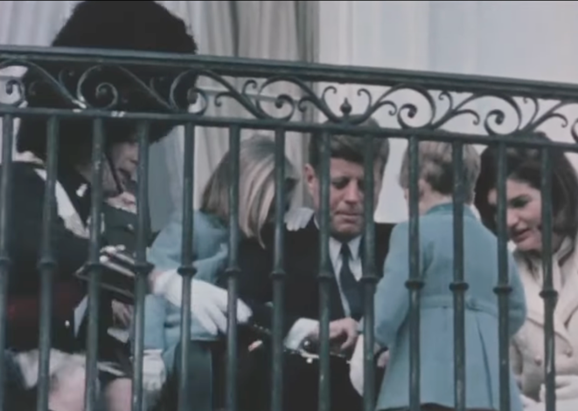
Major Wingate Gray with JFK and family and dirk
The White House archive shows that the tattoo was the Kennedys’ only engagement on 13th November. Jackie said later that it was their family’s “last happy day”. She asked that pipers of the Black Watch should march in her husband’s funeral procession. Nine were chosen, playing “The Brown Haired Maiden,” “The Badge of Scotland,” “The 51st Highland Division,” and “The Barren Rocks of Aden” on the way to the Requiem Mass at St Matthew’s Cathedral. Later at Arlington Cemetery they played “Mist Covered Mountains”, perhaps an allusion to the President’s earlier romantic description of Scotland.
To invite a British army regiment to take part in the funeral was an extraordinary honour: after all, we, the old enemy, had burned the White House down in 1814. The only Scottish regiment involved in that escapade was the Royal Scots Fusiliers. Other units were the Essex Regiment and the Duke of Lancaster’s Regiment, plus some Royal Marines and Royal Engineers.
Does this have anything to do with the attack on Iran, and Starmer’s equivocation? Just this: that leaders who have seen war at first hand may have a better idea of how these things pan out once the solids start flying. Whether that leads to better decision making is another matter. It was Kennedy who rather surreptitiously committed US combat troops to Vietnam, from which they were eventually extricated by the distinctly unwarlike Richard M Nixon.
But I would contend that in extremis it helps a leader make crucial decisions when his country is in peril. Bibi Netanyahu’s country has been threatened with annihilation almost since its inception, not least by the fanatics of Tehran since 1979. Here, as with Hamas and Hezbollah, Israel under Netanyahu has seized the opportunity to weaken or even eliminate, a deadly enemy – which seems to fulfil the traditional role of leadership.
A Message from TheArticle
We are the only publication that’s committed to covering every angle. We have an important contribution to make, one that’s needed now more than ever, and we need your help to continue publishing throughout these hard economic times. So please, make a donation.


