Google takes over at the BBC


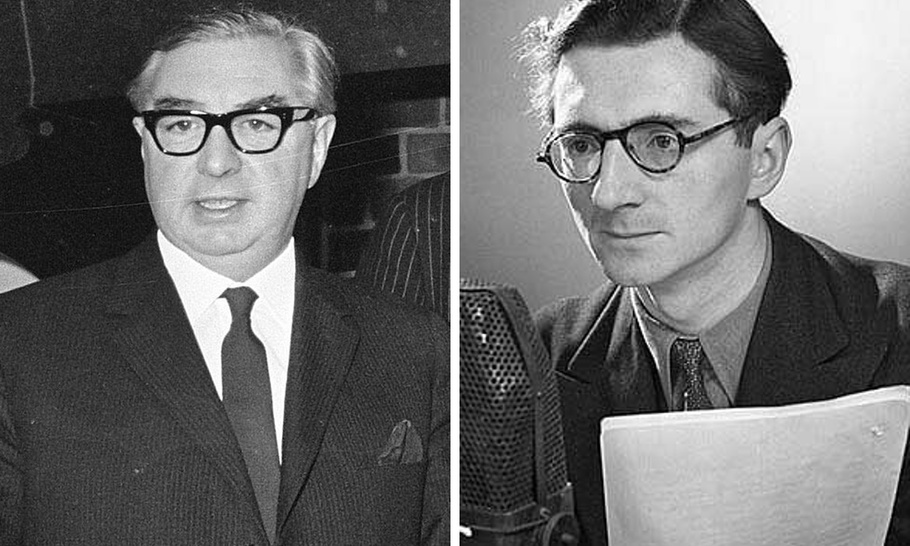
George Brown, the Labour politician and Douglas Stuart, the former BBC correspondent
How long before Google takes over the BBC? The first act of the new Director-General of the BBC, Mat Brittin — who is the former boss of Google Europe — has been to close down Britain’s finest current affairs programme: Radio 4’s The World Tonight.
The 45 minute programme, going out at 10 pm every evening, is a beacon of serious broadcast journalism without any of the tabloid tweaks or personality presenters of the rest of Radio 4 journalism. In the years running up to the Brexit plebiscite the former President of the Oxford University Conservatives Federation, Nick Robinson, together with Daily Telegraph reading personality presenters, especially John Humphries, turned Today into Radio Spectator. 13 hours later, at 10 p.m. the World Tonight restored the BBC’s hard-won reputation since its founding in the 1920s as a creator of high quality journalism and tough partisan debate, but always on the basis that in politics as in life there is more than one point of view.
I found myself a World Tonight producer after 1974. I had been a graduate trainee after Oxford sent to the BBC Midlands news room in Birmingham to learn about industrial, manufacturing, working-class Britain of which I knew nothing. I grew up and went to school in sheltered middle-class Ealing, where the only workers we met were council employees mowing Ealing Common as we lay about smoking dope.
I stood for Parliament for Labour in 1974 in the then safe Tory seat of Solihull and the BBC decided that I could not continue to work in Birmingham as I had nailed my colours to the Labour mast. The same rules were not applied to Tory or Liberal BBC journalist employees, who were trusted to obey the rules of the “good chaps” and keep their politics out of their journalism. But I was told I could no longer work as a BBC news journalist in Birmingham. So I was transferred to work on London-based BBC output, including The World Tonight based at Broadcasting House and the BBC World Service at Bush House.
There I discovered a rigour and obsession with reporting the truth. At Bush House, where I wrote news bulletins about the great uprisings in black Africa, the movements against apartheid rule in South Africa or in left-over European colonies like Mozambique and Rhodesia. I was taught that no line could go into a World Service bulletin unless it had two sources. It was a pain, scrabbling around various global sources, but it ensured that when the BBC said something had happened the BBC (and Britain) was believed.
Today Google and the BBC are a perfect fit. Everything on Google is free and, like Wikipedia, the two US giants of news information do not have time or staff to ensure the truthful balanced journalism that was once the BBC’s gold standard of world reporting. That in turn enhanced Britain’s global reputation as a producer of truthful news.
I learnt a lot about broadcast journalism from The World Tonight, then presented by the BBC foreign correspondent, Douglas Stuart. A Scots-born Oxford educated journalist, who fought as an officer in Italy in World War 2 and spent 2 years in a PoW camp, Stuart worked as a BBC foreign correspondent in Italy, Germany and Washington. By the time he launched The World Tonight as its presenter in 1970, Stuart knew Europe, North America and the former British Empire.
Since Brexit a decade ago, the BBC has given up serious journalism about Europe, though it still has great reporters like Sarah Smith in Washington or Steve Rosenberg in Moscow. The World Tonight has for 56 years been the best radio news programme in the English-speaking world.
Not any longer. The man from Google is firing more than 50 BBC current affairs journalists. From the Kremlin to the board-rooms of the City, where journalism of any sort is seen as enemy action, Matt Brittin’s Googleisation of the BBC will be warmly welcomed.
One evening on The World Tonight my task was bringing in George Brown, formerly Harold Wilson’s deputy and Foreign Secretary, to be interviewed by Douglas Stuart. Brown arrived so drunk he fell off the studio chair and lay vomiting in front of Stuart on the studio floor. We got him up and poured water down his throat so he just about managed to stutter out an interview.
I learnt then what I learnt in more detail as an MP and minister that in the high reaches of politics, alcoholism is the unspoken secret that binds together many household names in Parliament and government.
Having poured George Brown into a taxi outside Broadcasting House, I went back to the production office. The BBC complaints team put a woman through to me. “I just heard a senior British former cabinet minister completely drunk on The World Tonight. I have no views on Mr Brown’s politics, but it was outrageous and unforgivable for the BBC to put him live on air when he was so obviously completely drunk.”
Her middle-class outrage would be unknown to the world of Google. There was once a bond between the British people and the BBC. Letting the norms and values of Google take over will seriously damage the BBC, but maybe that is just the new Britain we have to learn to live in
Denis MacShane was President of the National Union of Journalists 1978-79. He later became a Labour MP.
A Message from TheArticle
We are the only publication that’s committed to covering every angle. We have an important contribution to make, one that’s needed now more than ever, and we need your help to continue publishing throughout these hard economic times. So please, make a donation.


