Happy Fourth of July: the US at 250

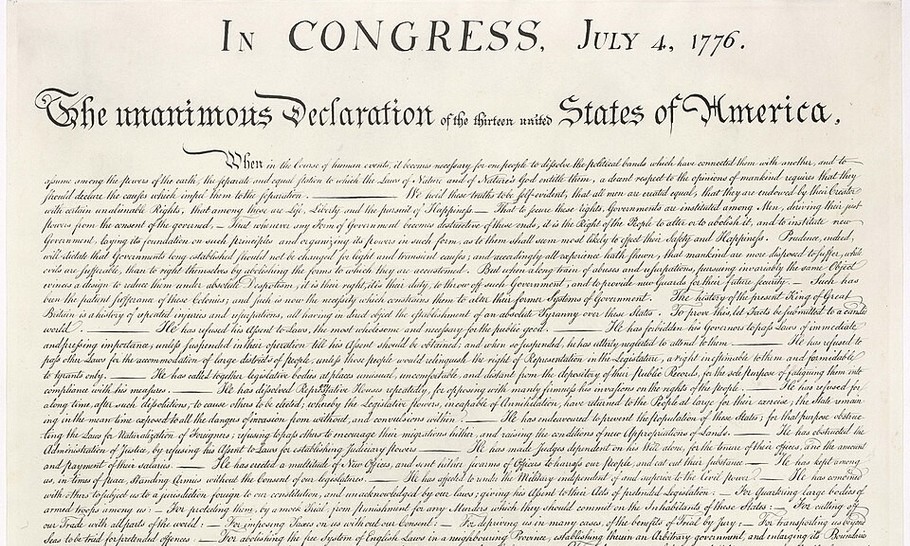
stone.tif
This Saturday, the United States turns 250. In the grand sweep of history, 250 years is barely a moment: Rome lasted a millennium, China’s dynasties ran across thousands of years. Yet in that blink, a ragged collection of colonies became the largest and most consequential economy the world has ever seen, outpacing its competitors by miles. It wrote the rules, built the institutions and invited the world in, profiting from the architecture itself. At 250, it is worth pausing to marvel.
The scoreboard is extraordinary: the world’s largest economy at around $29 trillion, roughly a quarter of global output; the dollar still the planet’s reserve currency, on one side of nearly nine in ten foreign-exchange transactions; more than a third of the world’s biggest public companies flying the American flag. But the numbers only tell you what America became. The more interesting question is why.
As an American who does business all over the world, I’d argue that the success is underpinned by a central ethos: money and investment go where they are treated best. Nowhere has treated them better than the US, and I have identified five forces which have defined American approaches to business over the past 250 years.
- An abundance of energy: The US is a continental landmass: fertile soil, navigable rivers, resources in the ground. Take the Shale revolution, which rewrote the global energy order. In barely a decade America went from energy importer to the world’s largest producer of oil and gas, and it has set new energy-production records four years running. Cheap, secure energy keeps industry at home, and surging demand from data centres will only deepen the advantage.
- An entrepreneurial hunger: America’s backing of private enterprise and entrepreneurial spirit has propelled its success from day one. Failure has rarely been fatal: bankruptcy laws, second chances, the celebration of the pivot. Immigration has been a structural advantage, drawing exceptional talent for generations, from Einstein to the engineers who built Silicon Valley, and nearly half of Fortune 500 firms were founded by immigrants or their children. Indeed, the hunger shows up in cultural exports: US brands and formats have set the template for global consumer life, with stories of relentless reinvention across continents.
- Appetite for risk. US capital markets are the deepest and most liquid on earth, worth well over $100 trillion. The roots of the New York Stock Exchange are found in an agreement made between twenty-four brokers in 1792. Beneath a buttonwood tree outside 68 Wall Street, they pledged to trade only with each other, and to fix their commissions. This modest pact laid the foundation for American exceptionalism, and two centuries on, Wall Street still sets the price of risk and the cost of borrowing for governments and companies everywhere. America has turned its instinct towards risk into an industry – venture capital – whose early bets seeded Apple, Google, and Amazon. In 2025, global VC investment reached upwards of $425 billion, with the US accounting for the lion’s share. The underlying rule has been a constant: ideas could always find money, and money could always find ideas.
- Technology. The internet, GPS and the foundations of modern AI all began in the US, and American companies turned each into a world-reshaping product. Though the name Silicon Valley wasn’t coined until 1971, its roots can be traced to the 1930s, when professors at Stanford urged graduates to build at home rather than head east. Today eight of the ten largest technology companies on earth are American, and the next wave is already cresting: the largest stock-market debuts in history are lining up, with SpaceX, OpenAI and Anthropic all preparing to go public within months of one another. With the rapid evolution of AI, robotics, life-saving medicines, and infrastructure, we are witnessing an industrial revolution around intelligence, and the pipeline is arguably fuller than ever.
- Innovation. Plenty of nations invent, but America’s distinctive genius is commercialisation: turning a discovery into a product, a product into a company, and a company into a global standard faster than anyone else. The motor car was a German invention, but it was Henry Ford who put the world on wheels. The web was invented in a European physics lab; American firms made it how the planet shops, talks and works. Time and again, regardless of where the breakthrough was made, the business gets built in the US.
No other economy in history has combined all of these advantages at the same moment and on the same scale. That is why, 250 years on, America remains the most consequential economic power the world has ever seen. Its infrastructure is continuous yet evolving: the ships of centuries past may have been replaced by data, technology and global investment flows, but the machinery of capital formation has never been broken. Underlying its dominance is a constitution built to protect freedom and private property, a rule of law that makes contracts hold, and a military strong enough to defend the stability the whole system depends on.
The next chapter is already being written – in the AI labs of San Francisco, the biotech campuses of Boston, the defence startups of Austin. And notice who is doing the building: not governments, but private enterprise and private risk, exactly as it has been from the start. The same compounding advantages that built the last 250 years are now being directed towards what may be the most consequential technological moment in human history.
One of the things I love most about the US is its optimism. On the evidence of the last 250 years, the next 250 look set to be even better.
Adam Harrington is co-founder and president of Intellectual Digital Global.
A Message from TheArticle
We are the only publication that’s committed to covering every angle. We have an important contribution to make, one that’s needed now more than ever, and we need your help to continue publishing throughout these hard economic times. So please, make a donation.


