Hungary and football: tales from a golden era


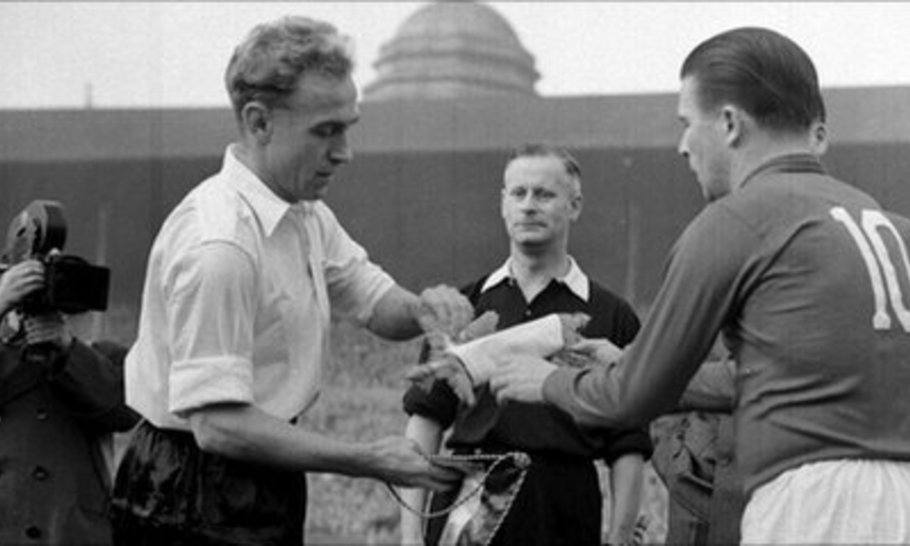
England vs Hungary, 1953: 'The invention of modern football'
To tell football stories in England is a brave endeavour. England and football are synonymous across the globe; the English invented the game and remain its most famous practitioners. However, back in the 1930s, Hungary’s national football team was a major European powerhouse and, as a child, I lived through what is now celebrated as the golden era of Hungarian football. I want to share a few stories, memories of unusual and wondrous things I witnessed.
1934: A Home-and-Away Reversal of Fortunes
This seems to be my very first football memory altogether, remembered because it contradicted the usual way of things, where one typically wins at home and loses away. In the semi-finals of the 1934 Central European Cup, Ferencváros played the top Italian side Bologna. In the first leg in Budapest, in front of a highly expectant home crowd, Ferencváros suffered a shock 1-4 loss at home. Travelling to Italy for the second leg, the Hungarians stunned the hostile local crowd by pulling off a miraculous 5-2 victory. It was a legendary triumph that folks in Budapest discussed for decades, conveniently omitting that we lost the subsequent tie-breaker replay 2-1.
1937: Seven into the Net of the Prague Lion
My father was a shop assistant, a role that demanded his presence all week long, with Sunday being his only day off. This made our Sunday afternoons a sacred ritual. A commentator on the radio, the legendary István Pluhár (the pioneer sports radio reporter in Hungary) would be reporting live on the matches. I was listening with my father, perched on his knees. Whenever there was a goal, I would run to the kitchen to tell my mother. She was not interested, but I felt an absolute duty to report each goal to her.
The match that stands out was a friendly international in September 1937 against Czechoslovakia, which Hungary won 8-3. Seven goals were by the forward György Sárosi. I still vividly remember what was written in the newspapers at the time, triumphantly declaring that Sárosi had scored seven times straight into the net of the Prague Lion, Plánička. František Plánička was a giant of the game, a formidable Czech goalkeeper and one of the greatest shot-stoppers in history. To score seven times against a man of his stature was nothing short of miraculous.
1937: The Miracle Against Piola
I would also like to include a memory from the Central European Cup final that everyone talked about that same year. The Hungarian goalkeeper, József Háda, was famously able to save a penalty from the Italian star, Silvio Piola, during the final between Ferencváros and S.S. Lazio, ultimately resulting in Hungary capturing the 1937 trophy. Years later in Italy, when I asked about Háda, they still knew all about him. Curiously not many in Hungary remembered, perhaps illustrating that no man is a prophet in his own land.
Sneaking In
(1930s Budapest Local Derbies)
As a schoolboy, I liked to go to football matches, but this was a luxury that cost more money than I could afford. Luckily there was one boy in my class whose father was an official at Ferencváros, working at the stadium. He stood at the gate and sneaked us in. Usually, we would find out during the week that he could let us watch a match on the following Sunday. That was not possible for international matches, but for local matches between two Hungarian teams, he did manage to get several interested classmates inside.
Once, he could not get us in as it was a match against a foreign team. We foolishly thought we could manage without his help, tried to sneak through a revolving turnstile, but were swiftly intercepted, and sent away in disgrace.
Then came 1 September 1939 and the 1940s. Normal life was abruptly swallowed whole by the Second World War and the bleak, fractured years that followed. My memory of that decade contains zero football.
1953: The Match of the Century
During the early 1950s, Hungary featured the legendary Aranycsapat (Golden Team) or “Mighty Magyars” led by Ferenc Puskás. They played 69 matches with 58 wins between 1950 and 1956, dominating world football and winning the 1952 Olympic gold.
Before this historic game at Wembley Stadium in November 1953, England had never been defeated on home soil by a team from outside the British Isles. Hungary proved the 6-3 win was no fluke by thrashing England even worse (7-1 in Budapest) a few months later in May 1954. To this day, it remains England’s heaviest international defeat.
Even our grim dictator, Mátyás Rákosi, felt compelled to praise the feat. Far from hostile, the defeated English merely applauded our aesthetic genius. In Budapest, the crushing rematch sparked a popular, wry pun: „Az angolok egy hétre jöttek és hét-eggyel mentek”: the English came for a week and left with a 7-1.
It is a fitting tribute to Puskás’s dazzling style that FIFA later established the global Puskás Award for the most beautiful goal in world football each year.
1954: Taming the Undefeated
During the 1954 FIFA World Cup semi-final in Switzerland, the Hungarian national team played against the Uruguay national team. Uruguay were the undefeated reigning world champions after winning the 1950 World Cup, and they had never lost a single World Cup match in history up to that point. Our legendary team went to Switzerland and beat them 4-2 in extra time.
1954: The Miracle of Bern
My story would not be complete without the heartbreak of the Hungarians never winning the World Cup, especially the memorable final in 1954. Entering the final in Berne, Hungary was on a 31-game unbeaten streak and was considered completely unstoppable. They had even crushed their final opponents, West Germany, 8-3 in the group stage earlier in the tournament.
Hungary looked poised to lift the trophy, storming into a 2-0 lead within just 8 minutes, only to then see the Germans fight back to 2-2, with West Germany scoring the winning goal in the 84th minute. For Germans, it was a symbolic moment of post-WWII rebirth known as Das Wunder von Bern. For Hungary, it was sadly a missed opportunity to win the World Cup.
An Academic Epilogue in Madrid
(1993 Sabbatical)
Decades later, long after the Golden Era had faded into the history books, I experienced a curious aftershock of our nation’s footballing diaspora. In 1993, I arrived in Spain for a sabbatical at the Universidad Autónoma de Madrid. To my absolute astonishment, everyone I encountered: academics, administrative staff, and locals alike, knew exactly how to spell my first name, László.
The mystery was quickly solved: the legendary László Kubala had spent over a decade (1969–1980) as the manager of the Spanish national football team, leaving an indelible mark on the country’s collective consciousness.
A Final Changing of the Guard
The dry facts show that Hungary would go on to find success again, becoming Olympic Champions a further two times, in Tokyo in 1964 and Mexico City in 1968. However by then my own footballing allegiance had shifted entirely. Living across the North Sea, I had gradually transformed into an avid fan of The Three Lions, while the golden remnants of my childhood memories quietly became the stuff of legend.
A Message from TheArticle
We are the only publication that’s committed to covering every angle. We have an important contribution to make, one that’s needed now more than ever, and we need your help to continue publishing throughout these hard economic times. So please, make a donation.


