Inquisitive outsider: Paul Theroux

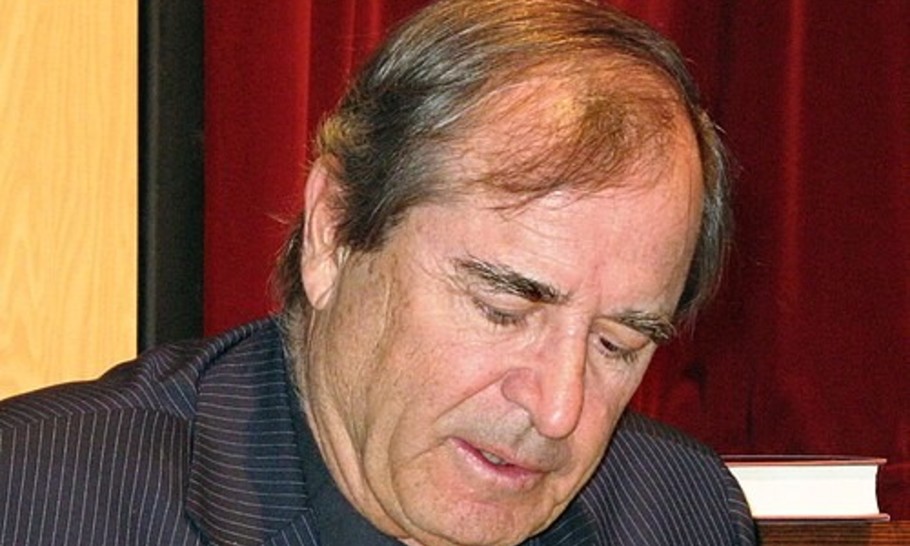
Paul Theroux in 2008
I can recall the glory days when I was a traveller, not a tourist. In 1969 I bought an open-ended, round-the-world, Boston to Boston plane ticket. In Kuala Lumpur, Malaysia, I called to reserve a seat on the next flight and the airline said they’d hold the nearly empty plane for me. My taxi sped through the rubber plantations, drove onto the airport runway and I walked up the metal ladder. They plane door closed and we took off. From 1971 to 1975 I was the only foreigner living in a traditional Spanish village above the Mediterranean coast. It now has a disco in the main square, an amusement park below and monstrous cruise ships disgorging streams of passengers at the dock.
Paul Theroux’s 12th travel book, True North (Penguin/Mariner, 423pp, £22/$32), a fascinating account of his drive around Canada, completes his North-American trilogy of road trips in Mexico and the Deep South. Like D. H. Lawrence in Sea and Sardinia, Theroux “feels an absolute necessity to move,” and explains his restless disappearing acts by having grown up in a big family, his hatred of confinement and scrutiny, and his need for the excitement of vanishing.
Theroux’s sharp tongue enlivens the book and makes readers long for the old days when few people went abroad. He begins with a satiric blast against mass tourism, though his own alluring books have encouraged foreign travel. He regrets that it’s now impossible to venture into “traumatized Afghanistan, corrupt Angola, lawless New Guinea and fractious Albania”. Bali is frenetic and traffic-jammed; Hawaii has 11 million tourists a year. Pattaya in Thailand, a town of 120,000, has 27,000 prostitutes and 12 million visitors; Machu Pichu in the Peruvian Andes attracts 4,500 tourists each day; and every day 20,000 people crowd into a room in the Louvre to see the Mona Lisa. Most of them take a few photos and skip the rest of the museum. After energetically encouraging tourism for 60 years, the inhabitants of Spain, Italy and Greece have now become hostile to visitors and urge the oppressive invaders to “Go Home”. Where can you now go? An adventurous explorer can still follow Evelyn Waugh’s remote footsteps to Spitsbergen in Norway and to British Guiana in South America.
Though Samuel Johnson had never been to Canada, in 1756 he denounced the country as “a cold uncomfortable uninviting region of desolate sterility”. Theroux compares its frozen wastelands to “the trackless emptiness of eastern Siberia.” But he follows the promising lead of Edmund Wilson, who wrote in O Canada: An American’s Notes on Canadian Culture (1965), “for the first time in history Canada is beginning to become interesting, and people ought to be instructed about what is going on up there.”
Theroux successfully meets the challenge, has done extensive research and mastered the history and culture of the country. He drives up from his home on Cape Cod and crosses the northern border in all four seasons of the year. Once lost, he pleads, “I’m looking for the Trans-Canada highway,” and is told, “You’re on it.” He discovers that “the Trans-Canada was in many places a narrow country road with cyclists and people walking their dogs.”
After early chapters on his ancestral French village in Yamaska, Quebec, an hour southeast of Montreal, the book kicks into high gear as he drives to the Atlantic Maritime Provinces on the east coast and then west to Vancouver on the Pacific coast. Larger in area than the United States, Canada has a population of 41 million, about the same as California or Tokyo, and eight million people live in Toronto. Though Canadians are notably polite and restrained, they release their aggression in the vicarious violence of ice hockey.
Theroux vividly describes the landscape and weather, has revealing encounters with many people, notes their distinctive appearance and the local setting. Counting on their patience and candour, the inquisitive outsider coaxes interesting answers out of his often-taciturn informants, takes notes on their conversation and writes them up in the evening.
A young woman in Nova Scotia is “small and finely made, with the luminous pallor of someone who lives on a cloudy island”. A fisherman informs him that “the vibration of the windmills’ electric cable bothers the sensitive lobsters and thunderstorms scare them”. Hunters tell him that in the rutting season “moose lower their heavily antlered heads to the ground and charge any creature large enough to appear to be a sexual rival. Hunters take advantage of this blind haste by imitating a bull’s call, luring a maddened animal to attack: “Black bear’s good eatin’ too.”
Theroux praises Canada for its strong gun laws and absence of capital punishment, its free health insurance and superior public education. But he also reports their history of injustice and cruelty. He merely mentions the Canadian realist “genius” Alex Colville, whose painting The Tree at Horton’s Landing (1956) has historical as well as aesthetic interest. The tree marks the spot where 10,000 French Catholics were forcibly deported between 1755 and 1764 from the English provinces to France, the Caribbean and Louisiana.
In an attempt to purify the country and misguided belief that “if you leave Indians with their families, they will remain savages”, the government forcibly kidnapped and confined them. For a century between 1896 until the mid-1990s, Catholic “priests and nuns were responsible for some of the cruelest and most inhumane abuses in the Indian residential schools—whippings, canings, sexual assaults, intimidation, isolation and vicious deracination—that stripped children of their cultural identity. All for the purposes of destroying the Indigenous identity and creating Christians.” A First Nation (Indian) laments, “When I was at school, the textbooks referred to us as ‘savages.’ That’s hard to hear. Am I a savage? That’s a hardship.”
But modern Canada encourages and tolerates Asian and African immigrants—who’ve been driven out of their own countries by natural disasters, poverty, war, danger and fear—and lured to Canada by free health care and even by an offer of marriage. Yet Theroux notes the misery of Somali refugees “lost, traumatized, stunned and shivering in the cold, utterly out of their element, without any notion of a future except as captives and dependents.”
Throughout his journeys, Theroux also reveals a lot about himself. He’s descended from French-Canadians; is the third of seven children; grew up outside of Boston; graduated from the University of Massachusetts; taught in Malawi, Uganda and Singapore before moving to England; took a yachting trip in British Columbia; speaks Swahili to African immigrants; phones his two sons in London every week; is claustrophobic; dislikes being a houseguest; and delights in Indian food.
Theroux’s account of Canadian authors who are connected to English and American writers is the strongest part of the book. The popular Canadian poet Robert Service was born in England. The best Canadian novel, Wyndham Lewis’ satiric Self Condemned (1955), was written by an Englishman who was born on a yacht near Amherst, Nova Scotia. Lewis lived an impoverished life in Toronto during World War Two and called it a “sanctimonious ice-box”. Two leading Canadian writers were born abroad: Brian Moore in Northern Ireland and Michael Ondaatje, author of The English Patient, in Ceylon.
The Englishman Malcolm Lowry wrote his best novel, Under the Volcano, about Mexico, while living in Canada. The Canadian poet, Paul Strand, lived in America. The Canadian academics, Leon Edel, Donald Greene and Hugh Kenner, had brilliant careers in America. Saul Bellow, American’s greatest modern novelist, was born in Canada. The major American poet Elizabeth Bishop grew up in Great Village, Nova Scotia. The American novelist John Irving lives in Toronto. Canada will surely remain a vital literary center.
Jeffrey Meyers, FRSL, had thirty-four books translated into fourteen languages and seven alphabets, and published on six continents. Forty-Three Ways of Looking at Hemingway came out with LSU Press in November 2025. The Biographer’s Quest appeared with Mercer University Press in April 2026.
A Message from TheArticle
We are the only publication that’s committed to covering every angle. We have an important contribution to make, one that’s needed now more than ever, and we need your help to continue publishing throughout these hard economic times. So please, make a donation.


