Meister Mieses


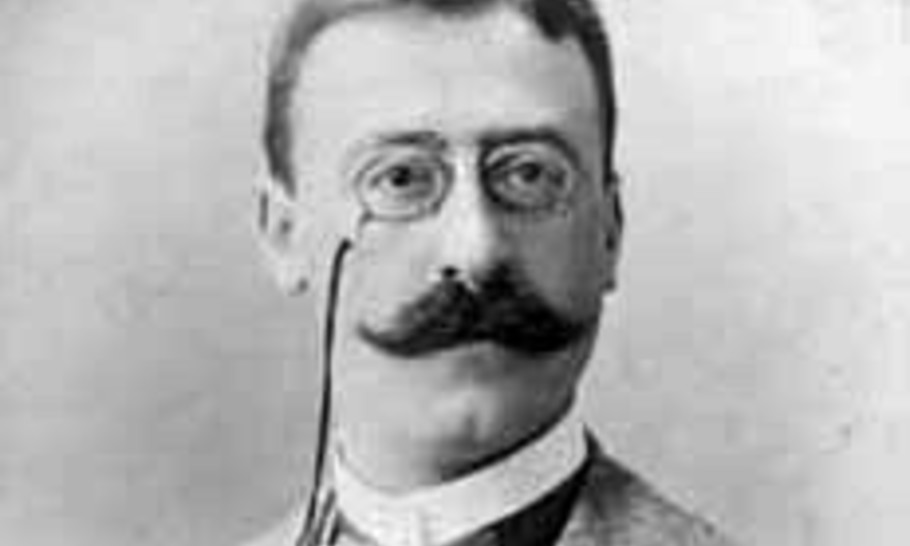
Jacques Mieses, 1900
In my column Prelude to Armageddon, I dwelt on the abundance of Jewish chess masters from the second half of the 19th century, an abundance which continued well into the 20th century. Famous names proliferate, as names sometimes do when they are carrying not merely the identity of a man but the weight of a rich cultural heritage: Johannes Zukertort, Wilhelm Steinitz, Emanuel Lasker, Siegbert Tarrasch, Akiba Rubinstein, Aron Nimzowitsch, Rudolf Spielmann, and the prime topic of this week’s column, Jacques Mieses.
Many of these men played chess actively well into the 1930s, which was a time when the German language, not to mention German politics, was entering an intense period of flux. There is something almost comical in the spectacle of a government attempting to regulate a language as though words were soldiers on parade. Foreign words, the so-called “Fremdwörter”, were phased out by the Nazis. Thus “Telefon” (telephone) was replaced by “Fernsprecher”, while the easily comprehensible “Kandidatenturnier”, or qualification tournament, gave way to the more clumsy, if purely Teutonic, “Anwärtertreffen”.
But words have a troublesome habit of becoming actions. And so, as the language was purified, the chessboard was purified too.
The German chess writer and official Max Blümich was entrusted by the Nazis with revising the celebrated chess primer, Kleines Lehrbuch des Schachs. This concise chess manual had been co-authored by the aforementioned Jacques Mieses: an ingenious but erratic player, yet a most lucid and reliable author, whose writings had nurtured generations of pre-Nazi German chess enthusiasts.
There was, however, one small difficulty for the Gauleiters of grammar, spelling and the written word in general. Mieses was Jewish.
Blümich’s solution was brutal, and perhaps brutal solutions are always distinguished by their simplicity. He simply eliminated the original author’s name from the book. Then, for good measure, in the editions of 1941 and 1943, Blümich went on to cancel the names of such Jewish chess Titans as Dr Siegbert Tarrasch, the famed Praeceptor Germaniae, and even Dr Emanuel Lasker himself, the World Chess Champion from 1894–1921.
Thus a government which had begun by correcting vocabulary ended by correcting history. The chessboard, at least, has one advantage over politics: it remembers who made the move.
Mieses himself was fortunate. For many years a resident of Leipzig, Mieses escaped to England, where he continued to create the ingenious tactical masterpieces which had made his name on the battlefields of European chess.
My title alludes to a famous anecdote, recorded by the great chess writer Assiac (Heinrich Fraenkel), who knew Mieses well. On a visit to the US, the grandmaster was addressed by a chess fan ignorant of German pronunciation: “Sie sind Mister Meises?” (“You are Mister Meises?”) He replied: “ich bin Meister Mieses.” (“I am Master Mieses.”)
Mieses was a fascinating character, the topic of a recent lengthy tribute on the British Chess News X (formerly Twitter) site. Although he could make no dent at all in the armour of the Titans Lasker, Capablanca and Alekhine, losing around twenty games without even a single draw, Mieses did score numerous wins against other immortals of the game. His victims included such luminaries as Rubinstein, Janowski, Spielmann, Tarrasch, Vidmar, Marshall, Bogoljubov and Schlechter.
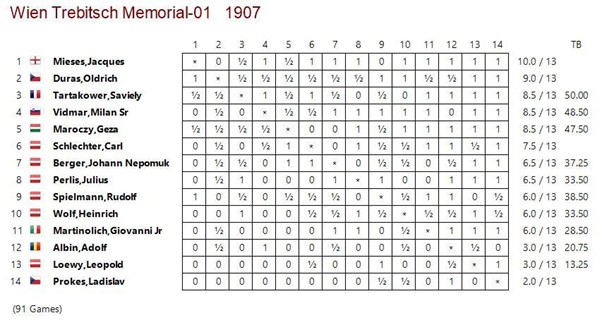
One of the greatest performances of his career was when he came first at Vienna 1907, ahead of Duras, Maróczy, Tartakower, Vidmar, Schlechter and Spielmann.
(Wien is of course Vienna.)
Mieses was one of the first players to be awarded the Grandmaster title by FIDÉ, though only near the end of his career in 1950. Perhaps his greatest victory came against Nimzowitsch at Gothenburg 1920. Alekhine once accused Nimzowitsch of exaggerated voracity on the chessboard, and this foible proved the undoing of that great author of chess players’ strategic Bible, My System, in the following tactical masterpiece.
Aron Nimzowitsch vs. Jacques Mieses
Gothenburg International tournament, 1920, round 2
- c4 f5 2. b3 e5 3. Nc3 Nf6 4. Bb2 d5 5. cxd5 Nxd5 6. g3?
This errant continuation was unfortunately indicative of one of Nimzowitsch’s poorest ever tournament results. After this the pendulum of initiative swings in Black’s favour. White keeps the momentum after 6. Nxd5 Qxd5 7. e3 Be7 8. Nf3 Nc6 9. Bc4 Qd6 10. O-O.
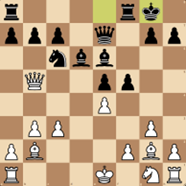
6… Nxc3 7. dxc3 Bd6 8. Bg2 Nc6 9. Qd5?!
An inaccuracy: White should instead try either 9. Qc2 or Bd5.
9… Qe7 10. e4?!
After this further inaccuracy, Black enjoys a concrete advantage. White’s best limit of this was after 10. Qd2 Bd7 11. O-O-O a5 12. Kb1.
10… Be6 11. Qb5 O-O?
Black robs himself of a powerful initiative available after the more aggressive 11… O-O-O 12. exf5 a6 13. Qd3 Bc5 14. Qc2 Rhf8 15. Be4 (but not 15. fxe6 Bxf2+ 16. Qxf2 Rxf2 17. Kxf2 Rd2+ 18. Ne2 Qc5+ 19. Kf1 Qe3) 15… Bd5 16. Rd1 Bxe4 17. Qxe4 Rxd1+ 18. Kxd1 Qd7+, when he has established a solid advantage.
- Qxb7 Bd7 13. Qa6 Rab8 14. Nf3??
This lackadaisical continuation fails to address the joint threats Black potentially wields against both White’s king and queen. The best means of addressing these is with:
a) 14. O-O-O f4 15. Nf3 Kh8 16. Rd5 Qe8 17. Kb1 Be6 18. Rd2 Rb6 19. Qa4 Bd7 20. gxf4 Rxf4 21. Ne1; or,
b) 14. Qd3 Nd4 15. cxd4 Bb5 16. Qc2 Bb4+ 17. Bc3 Bxc3+ 18. Qxc3 exd4 19. Qb2 fxe4 20. O-O-O; respectively, after either of which White is hardly worse.
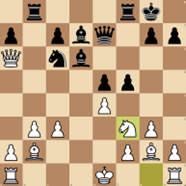
14… Nb4!
Black’s knight sacrifice clinically exposes White’s frailties.
- cxb4 Bxb4+ 16. Nd2 Bb5 17. Qxa7 Bxd2+ 18. Kxd2 Qd6+ 19. Kc2 Bd3+ 20. Kc3 Rb6 21. Qa5 Qd4+!?
Stronger still is 21… Bxe4 22. Bxe4 fxe4 23. Kc2 Rc6+ 24. Qc5 Qxc5+ 25. Kd1 Qc2+ 26. Ke1 Rxf2 27. Bxe5 Qe2#.
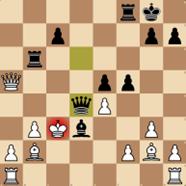
- Kd2 Qxf2+
Again Black misses a mating sequence, but has such a stranglehold, that this is of no consequence: 22… Qxb2+ 23. Kxd3 fxe4+ 24. Bxe4 Qd4+ 25. Ke2 Rxf2+ 26. Ke1 Qe3+ 27. Kd1 Qe2+ 28. Kc1 Qb2+ 29. Kd1 Qxa1+ 30. Bb1 Qxb1#.
- Kxd3 Rd8+ 24. Qd5+ Rxd5+ 25. exd5 e4+ 26. Kc3 Qe3+ 27. Kc2 Qd3+ 28. Kc1 Rb5 29. Ba3 Rxd5 30. Bf1 Qe3+
Another mating path is with 30… Qc3+ 31. Kb1 Rd1+ 32. Bc1 Rxc1#.
- Kc2 Rd2+ 32. Kb1 Rd1+ White resigns 0-1
Black will mated next move.
Ray’s 206th book, “ Chess in the Year of the King ”, written in collaboration with Adam Black, and his 207th, “ Napoleon and Goethe: The Touchstone of Genius ” (which discusses their relationship with chess) can be ordered from both Amazon and Blackwell’s. His 208th, the world record for chess books, written jointly with the late chess playing artist, Barry Martin, Chess through the Looking Glass , is now also available from Amazon.
A Message from TheArticle
We are the only publication that’s committed to covering every angle. We have an important contribution to make, one that’s needed now more than ever, and we need your help to continue publishing throughout these hard economic times. So please, make a donation.


