Popski’s Private Army: a very little platoon


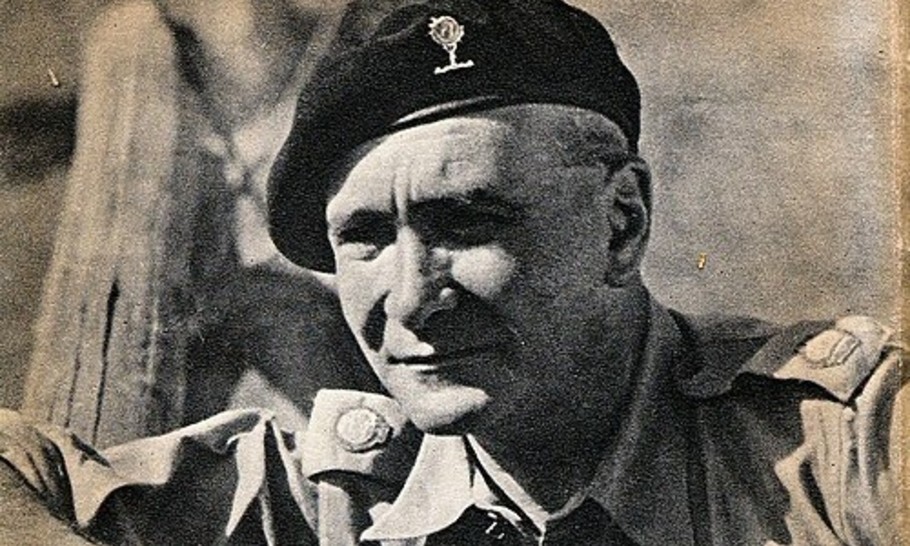
Vladimir "Popski" Peniakoff
You will doubtless have heard of 22 SAS, the British Army’s premier special forces unit, which in 1980 famously ended the Iranian Embassy siege on prime time TV. From the number of books and overwrought television programmes (“SAS Rogue Heroes” leading the pack) the nation, or at least that section of the population equipped with one X and one Y chromosome, is absolutely obsessed with the SAS. You may well also be familiar with the Royal Marines’ equivalent, the Special Boat Service (SBS), who for some reason are able to keep a lower profile than the heroes of Hereford – “we have better manners and much more common sense”, an SBS veteran once told me.
Edmund Burke in his Reflections on the Late Revolution in France spoke of the “little platoons” which engage men’s loyalties. We English, as is our habit, have adopted his idea as embodying our native genius, though Burke, I think, was speaking of humans generally. Little platoons were certainly to the fore during the Second World War, from which SAS and SBS both emerged. That makes it somewhat surprising that another small irregular formation, Popski’s Private Army (PPA), has not achieved similar dizzying heights of fame and literary fortune.
PPA, like the SAS and the Long Range Desert Group, emerged eccentrically during the desert campaign of 1940-42. It was founded by Vladimir Peniakoff, a Belgia- Jewish Nile Valley cotton planter of Russian extraction, who before the war had spent much of his spare time exploring the western desert as far as the Libyan border. When war came he placed his expertise at the service of the British Eighth Army, as it fought first the Italians and then the German Afrika Korps under Field Marshal Erwin Rommel. Although he was a 41-year-old foreigner, Peniakoff was accepted by the army because of his fluent colloquial Arabic and First World War military experience. He was commissioned as a major in the Libyan Arab Force (LAF), five infantry battalions recruited by the British from anti-Italian Libyans living in Egypt.
Peniakoff knew the desert routes, the oases and the best ambush spots and sought permission to use the LAF to attack the Axis forces in the rear. He took one LAF battalion and renamed it the 1st LAF Commando, recruiting several British soldiers as well. The LAFC harassed the Axis communications in the Jebel Akhdar mountains of Cyrenaica, with Popski being awarded an MC and losing a finger. LAFC was then disbanded by higher command, but its 23 British members were redesignated No 1 Demolition Squadron. British army radio operators had trouble pronouncing Peniakoff, and took to calling him Popski.
Lt Colonel John Hackett, nominally in charge of Eighth Army raiding operations, pressed Peniakoff to choose a name for his unit, and when he hesitated, told him: “It will be called Popski’s Private Army.” This was abbreviated to PPA, officially the smallest regiment in the British Army’s order of battle. It soon obtained its own cap badge, and general notoriety in the army. Popski adopted the SAS habit of driving jeeps mounted with twin heavy machine guns, providing very heavy firepower for such a small unit. By this time Rommel was in full retreat towards Tunisia, having lost at El Alamein. PPA advanced with the rest of the Eighth Army, and, together with the LRDG, identified a vital route bypassing the Mareth Line fortifications in March 1943. That was the signal for Rommel to be spirited away to Europe. Two months later successor, Generaloberst Hans-Jürgen von Arnim, surrendered on May 12 , 1943.
The Germans and Italians having been expelled from North Africa, PPA waited to be redeployed to Italy, which the Allies invaded in July 1943. PPA landed at Taranto and swiftly provided vital reconnaissance information revealing the relative weakness of the elite German 1st parachute division. As a reward, Popski was allowed to increase PPA’s establishment to 100 men, and he continued ranging widely behind enemy lines. In late 1944 he was awarded a DSO for his effective command. Subsequently his left hand, which had been injured by a German grenade, was amputated.
My first boss, the journalist and oil market expert Jan Nasmyth, was an officer in the 7th Hussars, also fighting in Italy. He recalled that they heard occasional rumours of PPA’s exploits behind the lines “roaring around in jeeps and shooting up the Hun when he least expected it – very good for our soldiers’ morale.”
“But I never actually saw them until the end of the campaign, in April 1945. The 7th Hussars were racing the 12th Lancers to be first into Venice, which the enemy had abandoned, declaring it an open city. As it happened we did get there first, but because it was Venice and an open city, we were forced to leave our tanks and other transport near the railway station, and to walk into town carrying our personal weapons in case there were any German or Italian stay-behind people with evil intentions. It was an eerie atmosphere, unusually quiet, the streets deserted. I had been in Venice once before the war during the Oxford long vac, and remembered the bustle, the life, the smells, the sheer beauty of the place. To most of my men it must have been a total revelation.”
Eventually we reached San Marco and an astonishing sight. In the middle of the square about a dozen jeeps loaded with very drunk British soldiers and lovely Venetian girls, were circling slowly round and round. And that was Popski’s Private Army.”
PPA had been operating with Italian partisans further down the Adriatic coast at Ancona when they too heard the German radio announcement. Using the initiative for which they were already famous, they loaded jeeps onto barges, which the partisans arranged to be towed up to Venice. Thus PPA added to its many achievements the remarkable feat of being the first to drive motor vehicles in La Serenissima.
The Army disbanded PPA in September 1945, which may be the reason that their extraordinary story hasn’t yet been made into a blood and thunder epic. Vladimir Peniakoff married an English lady, Pamela Firth, in 1948, published a fascinating book, Private Army, in 1950 (later reissued as Popski’s Private Army), and died of a brain tumour in 1951. He is buried at St Leonards Church, Wixoe, Suffolk — a most English village.
A Message from TheArticle
We are the only publication that’s committed to covering every angle. We have an important contribution to make, one that’s needed now more than ever, and we need your help to continue publishing throughout these hard economic times. So please, make a donation.


