‘Somewhere in Europe’ (1948): a film review


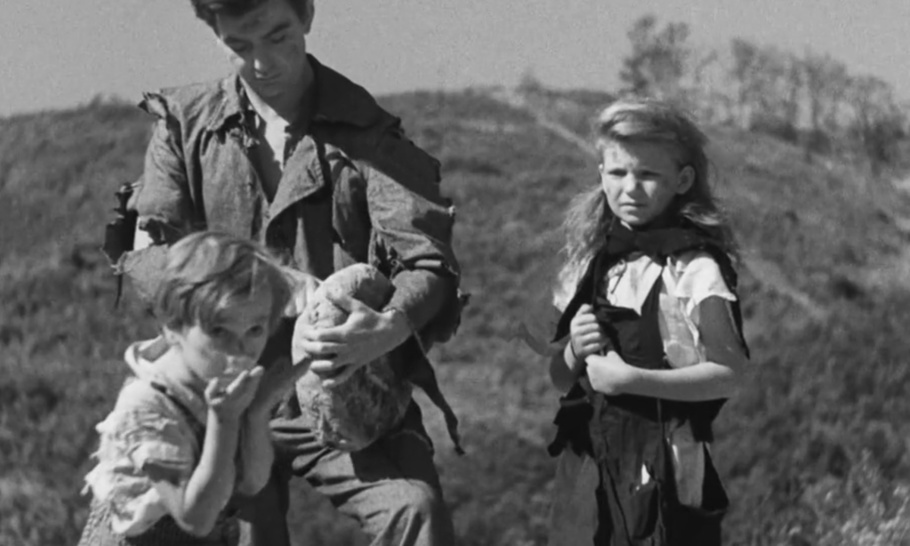
Somewhere in Europe (1947)
In January 1948, while Europe and indeed much of the world were still reeling from the devastation of the Second World War, I celebrated my 18th birthday in Budapest. It was around this time that I walked into a drafty cinema and first saw Géza von Radványi’s Valahol Európában (“Somewhere in Europe”). Having recently rewatched it, I am struck by how deeply it still resonates; my initial evaluation remains entirely unchanged. After a long career as an electrical engineer—while occasionally moonlighting as an amateur historian, playwright, plumber, builder, and book critic—I am now launching a new chapter as a film critic by sharing my impressions of this remarkable piece of cinema.
The Story and its Protagonists
The film drops us directly into the chaotic last days of the war, a brutal landscape where all social order has vanished. It follows a desperate gang of orphaned children wandering the ruined Hungarian countryside, foraging, raiding, and taking whatever they can find to stay alive.
The narrative shifts when the children seek shelter in a ruined hilltop castle. There they encounter Simon Péter, a reclusive former orchestral conductor, hiding from the world. Rather than treating them as criminals and calling the police, the musician slowly wins them over through empathy, generosity, and music. Under his roof, the castle is transformed into a sanctuary where these hardened street children finally begin to unlearn the cruelty of war.
The group’s emotional weight rests on a few key figures whose street nicknames reflect their survival personas:
Hosszú (“Tall”): a teenager of about 19, whose physical maturity naturally forces him into a protective, parental role.
Éva/Suhanc (“Rascal”): a girl whose street name serves as a vital disguise, allowing her to masquerade as a tough boy to shield herself from danger.
Kuksi (“Peeper”): A name stemming from Hungarian slang for “little onlooker”, beautifully capturing his innocent, wide-eyed gaze in a broken world.
Simon Péter: The reclusive musician whose quiet humanism offers them a blueprint for a civilised world.
What makes these performances so authentic is Géza von Radványi’s choice to cast actual war orphans and street children instead of professional actors. When we see the hunger and suspicion in the eyes of characters we are looking at genuine survival instincts. Even the street-smart kids carried real trauma. Among them was Endre Harkányi, a Jewish orphan who had survived the terrors of the Budapest Ghetto, and who would later leverage this life-changing film debut to become one of Hungary’s most celebrated actors.
Intimate Tragedies
The film handles the immense trauma of the Holocaust through deeply visual, intimate tragedies. We see this acutely in two distinct stories of separation and loss.
The Cattle Car: a harrowing sequence where a desperate father thrusts his young son out of a moving train window—a last-gasp effort to save the boy from deportation to the death camps. The child joins the gang, carrying the invisible weight of a shattered family.
Éva’s Backstory: In a sequence of brilliant directorial restraint, Éva complies with a Nazi officer in a futile bid to protect her family. The camera pans to her loved ones—an old man and two young children—waiting anxiously on a sofa. When the camera cuts back, the sofa is empty. They have simply vanished.
The primary antagonist in the film is not a single villain, but the cruel adult world itself. Driven by fear and scarcity, the local villagers hunt the children down with weapons and zero empathy. This escalating hostility culminates in a brutal siege of the castle, leaving little Kuksi mortally wounded.
My Own Looting Career
Watching these children scavenging through ruins, I do not judge them from the detached perspective of a modern critic. Instead, I see a raw reflection of my own youth, though my own desperate survival tactics lacked any cinematic polish.
As I previously recalled in my memoir piece, “My Career as a Looter: Budapest, 1945”, I returned in January 1945 to a liberated but freezing Pest as a 15-year-old boy. Our flat on Miksa Street was ours again, we had a stove but nothing to burn and nothing to eat. The brutal necessity of survival completely rewrote my morality.
Compared to the grim determination of Radványi’s orphans, my own looting career was defined by spectacular amateurism. My first real triumph came on Lehel Road, where I discovered an open warehouse full of peas and carried 20 kilograms home in my rucksack. They turned out to be rock-hard marhaborsó (cattle fodder) that required hours of desperate boiling just to be chewable. My subsequent raid on an exotic fruit shop yielded absolutely nothing because I was too physically weak to lift the heavy bulk boxes.
Securing fuel was equally clumsy; I managed to sneak into the abandoned Hotel Bristol and made three successful trips in a single day to rip up its dry oak parquet floor for firewood. In my youthful short-sightedness, I failed to strip the entire hall while I had the chance, and when I finally returned two weeks later, smarter scavengers had picked the place completely clean.
Heartbreak and Hope
Returning to the film now with these memories in mind, the emotional climax balances devastating tragedy with a powerful message of resilience. The ultimate heartbreak comes with the death of little Kuksi, a loss that underscores the brutal cost of adult violence on innocent lives.
Yet, the film refuses to succumb to despair. Hope emerges through the unifying power of music — most iconically when the children rally together to whistle the Marseillaise — and Simon Péter’s decision to legally deed the castle to them, a symbol of a new generation inheriting the future.
Rewatching this masterpiece today, I am struck by how its humanistic message has not aged a day. Nearly eight decades after I first walked into that Budapest cinema in 1948, Valahol Európában remains a timeless reminder that even in the ruins of humanity empathy, art and solidarity can still build a road back to civilisation.
A Message from TheArticle
We are the only publication that’s committed to covering every angle. We have an important contribution to make, one that’s needed now more than ever, and we need your help to continue publishing throughout these hard economic times. So please, make a donation.


