Ten lessons from the Iran crisis


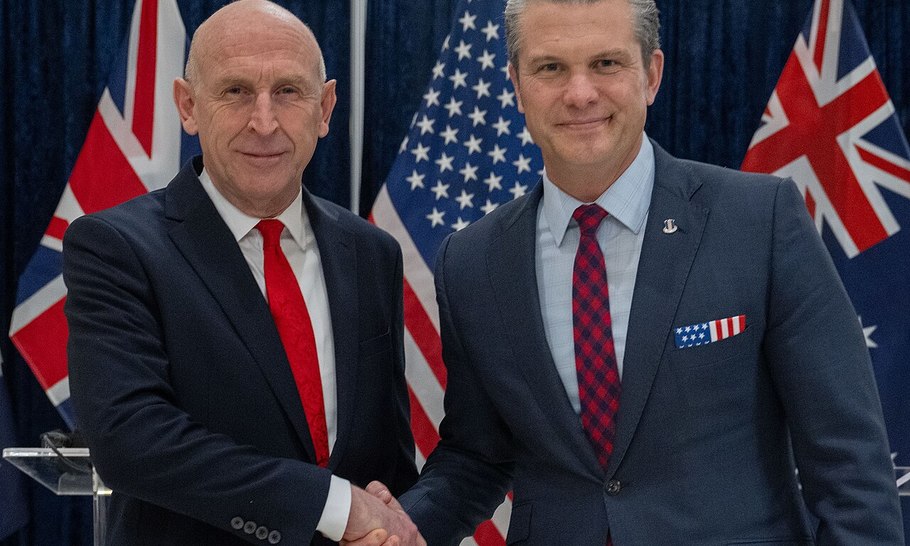
Secretary of War Pete Hegseth hosts United Kingdom Secretary of State for Defense John Healey for a meeting prior to a trilateral exchange with Aus...
First, there are the lessons for the UK. The Labour government has had a bad time with the economy, with law and order and immigration. But the Iran crisis has badly exposed the weaknesses of the Starmer government. The Prime Minister has dithered and failed to take a strong position, either with President Trump or with our European allies. Yvette Cooper once seemed a rising star under Blair and then Brown as Chief Secretary to the Treasury, before being promoted to Secretary of State for Work and Pensions. She has failed under Starmer, first as Home Secretary, failing to deal with immigration and then as Foreign Secretary, where she has been almost invisible, whether dealing with the terrible crisis in Ukraine or now Iran.
But perhaps worst of all has been John Healey, the Secretary of State for Defence, who had a disastrous interview with Nick Ferrari last month when he was unable to say how many warships were at his disposal. On his watch, Britain’s armed forces have been exposed as badly underfunded, especially the Royal Navy. There is also the urgent question of the Defence Investment Plan, due last autumn and still not published. Without it, Healey is whistling in the wind about rebuilding our military capability.
Second, Iran has seen the end for the time being of the Special Relationship. Trump admires strong figures like Putin, Netanyahu and Orban. Starmer has seemed weak and vacillating throughout the crisis in the Middle East. Was he opposed to Trump’s policy? Or opposed to his language, threatening to bomb Iran into “the stone ages” and end its civilisation (a war crime)? Or was he keen to preserve Britain’s most important alliance at any cost?
In the meantime, Trump openly mocked Starmer as another Chamberlain and made fun of Britain’s declining military resources. In the meantime, at least in the Middle East, it is clear that Trump’s Special Relationship is with Israel, and in particular with Netanyahu. Israeli intelligence, the way it picked off key figures from the Iranian regime, and its military strength, made it a more suitable candidate. One could imagine Trump getting on much better with Boris Johnson or Tony Blair, albeit for different reasons, than a human rights lawyer like Starmer.
Third, who have been the winners and losers in the White House during the Iran conflict? The obvious recent big losers have been Pam Bondi, the onetime Attorney General, and Kristi Noem, fired for the debacle over ICE in Minnesota. But while Marco Rubio and Pete Hegseth have seemed to rise in stature during the Iran crisis, Vice-President JD Vance has been sent off to Budapest to act as Trump’s cheerleader for Orban in the run up to Sunday’s election. If Orban loses, as is widely expected, this will not go well for Vance. Clearly, key figures are angling for positions in the Trump White House as everyone gets ready for the midterm elections in November.
Fourth, for the first time since the Democrats’ disastrous presidential campaign in 2024, with Biden’s descent into senility and Kamala Harris’s poor showing, the Democrats have started to emerge as likely winners in the midterm elections, certainly for the House and possibly even for the Senate. Trump’s unpopular war and the rise in petrol prices in Middle America have not gone well for the President, less than two years after his successful campaign against the woeful Democrats.
Fifth, though BBC News and Sky News have continued to attack Israel, in particular, its campaign in Lebanon, the truth is that Israel has done a superb job of picking off numerous key figures in the Iranian regime. These include the Supreme Leader Ayatollah Khamenei and possibly his son and successor, Mojtaba Khamenei, who has mysteriously disappeared from sight, a mystery which neither Sky nor the BBC seem at all interested in trying to solve.
Sixth, and not unrelated to the issue of the lack of curiosity by two of our major TV news networks in how Israel has been able to kill off so many leading Iranian figures, is a similar lack of curiosity by the same reporters and presenters about Lebanon. They are always happy to report on dead children and alleged war crimes, but less curious about why Lebanese governments have been so happy to host Hezbollah for all these years and let them murder numerous Israeli civilians, not to mention anyone in Lebanon who stands in their way.
Seventh, the Iran crisis has seen the final eclipse of the UN as a dignified player in international relations. For years, the UN has gone on bended knee to the post-colonial regimes which dominate its votes. This has led to years of attacks on Israel, in particular, and now a failure to help launch substantial peace talks over Iran. António Guterres has been a disastrously weak Secretary-General, reluctant to condemn the countless human rights abuses perpetrated in Africa and the Middle East, including the massacres of so many Christians and Jews, the terrible homophobia and attacks on women from Afghanistan to Iran. It is time for the UN to be moved from the comfortable lifestyle of the Upper East Side to one of the post-colonial nations Guterrres is so happy to deal with. Let’s see how these ambassadors’ expense accounts fare far away from Manhattan.
Eighth, of course, you will not hear any of this on BBC News or Sky News, who have made a curious pact with various UN spokesmen and UN-supported NGOs. This was a recurring problem in their biased coverage of Israel during the Gaza conflict. After the Iran crisis, it is clear that the BBC’s ancien regime – John Simpson who refused to call Hamas a terrorist organisation immediately after the massacres of October 7, Jeremy Bowen and Lise Doucet (where has she been, by the way, during the Iran crisis?). Do any of them speak any of the relevant languages in the Middle East? How much Iranian history do they actually know? How can it possibly be appropriate for them to turn up in Ukraine, then covering the India-Pakistan conflict, and then Gaza or Ukraine? This kind of TV and radio journalism belongs to a bygone age, the world of old-style BBC reporters like Charles Wheeler and Alistair Cooke.
Ninth, this brings us to a new age of TV news experts, people like Shashank Joshi, the Defence Editor of The Economist, for almost ten years, and former Senior Research Fellow at the Royal United Services Institute (RUSI) and Research Associate at Oxford University’s Changing Character of War Programme; Cecilia Helena Rouse, head of the Brookings Institute; Professor Michael Clarke, Director of the Royal United Services Institute from 2007 to 2015 and since the start of the 2022 Russian invasion of Ukraine, Sky News’ security and defence analyst; and various other experts from Chatham House and the British military. These people actually know something and they will be the new guard of international coverage come the next crisis.
Finally, what is striking about these new experts is not only that they know what they are talking about, but they also show none of the anti-Israel bias that has disfigured BBC News and Sky News in recent years. It will be interesting to see whether under a new head of BBC News and Current Affairs there will be more time for pro-Israel spokesmen and women like Natahsa Hausdorff, the legal director of the advocacy group, UK Lawyers for Israel, the retired military veteran, Colonel Richard Kemp, Douglas Murray, and various figures from Camera UK, who have done so much to challenge media bias about Israel over the past few years.
It is time to openly debate some of these lessons from the Iran crisis. I am so sorry for the people of Iran, who have suffered terribly under the current regime and look as if they, just like the brave people of Ukraine, are going to be sold out yet again by the UN and the great powers. It is a tragedy.
A Message from TheArticle
We are the only publication that’s committed to covering every angle. We have an important contribution to make, one that’s needed now more than ever, and we need your help to continue publishing throughout these hard economic times. So please, make a donation.


