The ‘empty quarter’: global institutions and British foreign policy

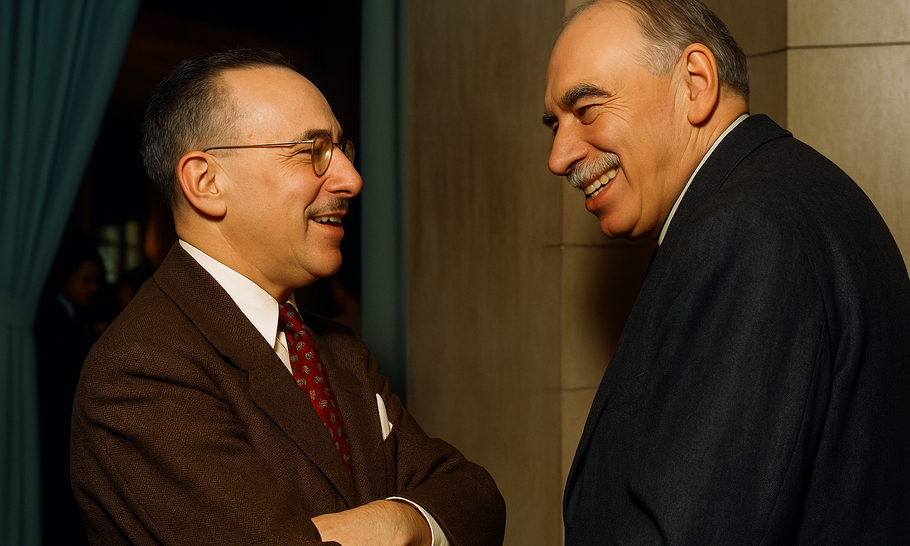
Keynes (right) and the US representative Harry Dexter White at the inaugural meeting of the International Monetary Fund's Board of Governors in Sav...
Something is badly missing in the great debate on Britain’s role and future in an utterly changed world, something very big and very distorting to the whole debate by its absence. I mean a proper and deep understanding of our discontents and their global roots, which nearly all originate externally. I mean a serious approach and response to the real causes of the many things that seem to be going wrong for us, or the wrong way, or no way at all. Like frenzied fire-fighters rushing from outbreak to outbreak our Prime Minister and his colleagues whirl around struggling with an unending stream of crises. Indeed, the PM has been criticised (I personally think unfairly) for spending too much time on the wing.
But no-one seems to stop and ask just why so many of the institutions underpinning the world order for the last eighty years or so (not, admittedly with total success, but at least avoiding Armageddon) are now crumbling and ineffective. Nor do they explain why, far from being a remote concern, this failure directly threatens our own welfare, safety and future here at home.
Last time almost all the world’s international institutions were in ruins was in 1945. The world’s best brains, including Britain’s best brains and thinkers, were focussed centrally on rebuilding them, or re-inventing them, since they knew that without them they knew there could be no stability, no prosperity and no security anywhere. Countries like Britain could deploy their talents and remaining resources as best they could (Britain was bankrupt at the time) but without the pillared foundations of trusted and respected world institutions order was not safe, peace was not safe and the democracies could not be sustained.
This time, eighty years later, as most of the architecture of 1945 fails in the face of the march of technology, well though much of it performed earlier in the pre-digital era, there is an eerie silence. We have a complete absence of comment, analysis and explanation on how external factors are fundamentally re-shaping all our lives and relationships, daily, intimately – and dangerously. It all seems to have gone into the “too difficult” box.
It is as though a deep chasm has opened up, cutting across the entire new map and distribution of world power – a chasm which most British commentators (although not all) and most political leaders (although not all) are incapable of bridging, or even interpreting and connecting to current domestic ills and dilemmas.
Beyond the chasm lies a kind of intellectual empty quarter, a waste zone of what are dismissed as dangerous “global headwinds” or “powerful undercurrents”. These are compounded by super-complex but no longer trustworthy technology, the two-edged sword no-one knows how to blunt and is best not to touch or play with. This technology is said anyway to be out of any government’s or anybody’s control and only met with a shrug of the shoulders and further feverish home legislation, in a vain and unsuccessful attempt to keep pace with world conditions.
Faced with what are portrayed as hostile international barriers and inexplicable outside forces, the world becomes a game without rules. Media and vox populi readily find more accessible targets at home on whom to turn their wrath. When you can’t understand, let alone explain, what is really happening on the world stage, turn the blame and anger lens onto the nearest targets.
That will no longer work.
In 1979 Jim Callaghan tried the excuse of “being blown off course”, but it was swept aside by his political adversaries and the press. More recently Conservative governments have been tarred with the Covid brush, as well as targeted with brickbats for the leaping cost of energy, spurred on by Russia’s illegal assault on Ukraine. With the causes of neither event did the British Government of the day have much to do. Nor was there much choice when it came to paying the bill (around £2 trillion) to save the economy from capsizing and society from disintegrating.
Now Labour has been caught in a similar trap. With no explanation, no public discussion or analysis, no remotely convincing (or agreed) line from financial or economic or social experts, self-appointed or official, and currently no trusted or effective international financial authority to take some of the blame, it has become open season for every crank remedy, for every rumour, for every conspiracy theory and condemnation. Streams of disinformation and misinformation are let loose, for hitting out at whoever happens to be in charge and in reach nationally.
In 1945 we faced the same wreckage of international institutions which had to be rebuilt from scratch. They were, starting with the signing of the United Nations Charter that year, in San Francisco. The victors of five and a half years of horrific world war found the framework institutions of world order reduced to rubble and rightly resolved this must never happen again.
Nothing like that is happening today. Why has focus been absent this time on repairing the great shelters of international order, triggering instead ever more inward and ever more parochial preoccupations in region after region? Why has the simple, obvious proposition been sidelined — that the return of stability, order and security, for us as for others, cannot be achieved locally in a now completely networked world without effective and trusted global institutions?
There is an answer to that mystery — or at least a starting point on the road to understanding. In 1945 the damage could not be missed. There were the ashes of Hiroshima, the flattened cities of Europe, the refugees and starvation, the awful death toll, the impossible debts accumulated, all the residue of hideous and prolonged conflict — and the looming Cold War.
In 2025, there is no world war to recover from. Instead there are the revolutionary consequences of the microchip: so profound, so swift, so widespread, so plain miraculous, that they change every relationship between peoples, institutions, communities, nations and governments.
This is surely the biggest missing piece in Britain’s foreign relations jigsaw. Driven by the microchip’s colossal growth (50 years ago there were 4 transistors on the latest smartest chip, now there are 16-17 billion), we have now already moved very deep into a network world.
In such conditions diplomacy works quite differently from past patterns. Diplomatic activity has to take on a far more populist tone. Geographic blocs and alliances become redundant because networks reach everywhere all the time.
The lessons bequeathed to us by Harvard’s late Joe Nye, a real friend of Britain — that networks and alliances have to be worked at, kept warm and alive (like personal friendships) at all times and that networking should be open, and flexible — these become the only reliable guide to stability, the only handrail in a world of turmoil and anarchy. Joe Nye saw that, in conditions of revolutionary new connectivity, influence could be gained by soft power and persuasion rather than by aggression or by pigeonholing others as “East and West” or “Left and Right”.
Here were lessons both Putin and Trump needed to learn – the one by support rather than hate-preaching and mass murder, saving the lives of a million Russian boys : the other by an America made “great” again by positive engagement, rather than small by fear and bullying.
Less obvious on the surface, but in fact far deeper, come lasting impacts on humanity and progress. For historical comparison one would have to turn to the birth of the printing press, to the Renaissance, the Industrial Revolution, the vicious divisions of Marx-Leninism, two hot and bloody world wars or the subsequent Cold one which followed. But the comparisons would still mislead, mainly because past moments of history affected a world population six to eight times smaller than now and because today events come upon us a thousand times faster.
Behind domestic failure (and blame) lies international institutional failure, blame and ignorance. Of course there is nothing new in any society about underdogs blaming those in authority for everything and doing so continuously. The difference now is that with the incredible capacities of communications technology it has become infinitely easier, quicker and cheaper to do so. If every action and step of governing authority is met with avalanches of counter-information and large-scale counter-organisation, it can, and does, make national government almost impossible. Respect evaporates. Facts can be denied with impunity. Large-scale rejection of measures and laws can be organised without effort, turning balanced public debate and analysis into a jumble of hate-filled assertion, with no kind of compromise ever being reached.
Lord Keynes argued that while he was ready for robust and continuous challenge to his views, it was those who simply ignored what was changing around them for whom he had the most contempt and the least trust — and who could do the most damage to the world.
And here we come to the heart of the problem. and the zone of deepest danger. Many are in denial, refusing to recognize that anything has changed very much – in human relations at all levels, in the governance of nations, the texture of public debate or relations between communities, nations and world powers. The whole international dialogue has changed and with it the domestic context in which the consequences of change play out.
One would have thought that a governing party or ruling group anywhere who wanted to generate stability and uphold the law, both within and without its jurisdiction, national and international, would turn first to the root causes of the so-called permacrisis, making the maintenance or restoration of effective world institutions the absolute and overriding priority.
But no, that’s not the way it goes. The United Nations remains paralysed by its archaic structure. A leader in The Times reckons that with more conflicts raging round the world than at any time in the last 80 years, “the UN is missing in action”. The IMF and the Bretton Woods architecture lose their authority and relevance as new financial structures and methods sweep in via the digital age. Defence and security cooperation weakens as the prospect of American NATO withdrawal grows. New alliances are needed to defend against completely new war technology – a world away from Clausewitz.
Meanwhile, the rule of law is tossed aside. Nuclear proliferation is out of control. Trade regulation collapses and the big trading nations have to retreat to new arrangements and deals outside the WTO. Immigration legislation is overwhelmed by the sheer size of refugee and migrant mass-movements. Debt burdens undermine fiscal responsibility. While demands on governments to deliver soar almost everywhere, the capacity to deliver shrinks. World health regulation falters as the next pandemics loom, and past ones cast their baleful shadow across the present day.
The unspoken truth is that every single one of the crises now rattling round in Britain has been triggered by world institutional weaknesses, rules cynically disregarded, and utter failures of implementation. Leave these unresolved and every single problematic domestic issue will persist and probably worsen. Leave them unexplained or un-addressed and every advanced nation will turn in on its worst inner traits, and towards politics which is narrow, local and nasty. This is exactly what has happened to Keir Starmer, making smooth administration, even with his enormous parliamentary majority, almost impossible.
Wider and deeper analysis would point the finger unwaveringly not at the leader of a party, not even at the ideological inclinations of a party, measured on the old Left-Right spectrum to which commentators cling, but at the party political system itself as it has developed or failed to develop. And beyond that, at the danger of a world without umpires, a game without rules.
Since, as Lord Macaulay reminded us long ago, politics is the outcome of social change, not the other way round, the new realities of the digital age will in due course do their work and reshape much of the parliamentary process we know, with a good deal of volatility and constitutional stress along the way. In particular, memberships of weaker or smaller parties, armed with their smartphones, iPads and other devices, will be far less ready to be drawn into long standing compromises with other parties and other leaders, making the future of party coalition much harder to achieve and rules much easier to break. Political instability and extreme volatility are guaranteed.
This leaves the respected UK political commentator Daniel Finkelstein with the thought that at the next General Election the prospect of Parliament delivering a result “in which no-one can really govern is very possible” (my italic). It leaves another shrewd columnist, Andrew Marr, wondering “whether the modern democratic state is fit to govern at all”. To which the only answer is that without guardrails, without rules, without trusted authority to supervise and judge adherence to those rules, it is not.
Meanwhile, The Times suggests that “little has really changed”. If that complacency reflects the general view then the scene is set, both in the UK and other societies, for more bewildered recrimination at home, more internal division, more anger and violence, more blame, more “headwinds”, less investment and innovation.
All this is exactly the opposite of the view taken by most of the world’s statesmen and women, with substantial British input, back in 1945 as they surveyed the wreckage of the previous international order. The one central and obvious tenet was that there could be no lasting recovery, no ambience of stability and trust, until the international institutions had been repaired or re-invented. If, they reasoned, a degree of trade liberalisation, firmly upheld trade and investment laws and a robust international legal structure to underpin all trade agreements, and accompanying treaties had to be re-attained, then the machinery of international order had to be in place.
First things first. That was the priority above all other priorities, and it extended not only to world economics, finance and business, not only to respect for human rights, but crucially as well to disarmament procedures. These were needed against the new and chilling arsenals of death, weapons of mass destruction in all their hideous variety — the control of nuclear weapons and who should own or develop them in particular.
Gone now are the security and disarmament frameworks of the last century and the Cold War, which kept us from incineration. Gone, too, are the old bindings of international finance, agreed at Bretton Woods, with the pattern of trade, now tipping towards more services than actual goods, and facing new challenges from Trumpian protectionism.
But all this is lost in that “empty quarter” of national and international debate. No new ideas emerge from or for that area at all. Instead, nationalistic blinkers are being donned almost everywhere. Double danger and damage results. Not only are whole sectors of activity, social and economic, nuclear and health-connected, allowed to deteriorate. They are also deprived of vigorous international competition, regulation, innovative and technical interplay.
A vivid example of the consequence on this front is lack of finance for infrastructure, public and privately sourced, leading directly to social unrest. Unable to devise new ways of harnessing plentiful private funds and enterprise for much needed world infrastructure (badly needed as much in the UK as in every other economy) the UK has followed the borrowing path, Surprise, surprise: we are seeing the debt burden rise to new levels. New ideas or financing in this grey area do exist in scattered parts of the globe, especially in the energy sector (in Japan, Korea, and the USA, for instance). The UK’s Private Finance Initiative of the 1980s and 90s did work for a while and could be improved. But with minds closed out of international innovation in this vital area, the UK government has been sucked into an unnerving tussle between the vital needs of infrastructure and the patience of the bond markets.
The unsolved riddle that preoccupied the Thatcher Cabinets (of which I was a member) for hours on end was how to finance big and long term projects that the private sector could not risk without the State, and the state could not afford without the private sector.
Round the world new solutions to the riddle are being tried all the time to get round this dilemma. When we come, for example, to the giant new nuclear plant planned at Sizewell C, the astonishing decision is being made to choose a financing route where most of the money will have to be raised by vast additional borrowing – the worst and riskiest course. The chosen design has a history of snags and the model already being constructed at Hinkley Point in Somerset is already 12 years behind completion time (it will be more) and at least £14 billion over original budget. Anything better conceived to bring about cancellation at the next fiscal crisis – and severe job losses to boot — would be hard to think up, except in a novel.
The examples go on and on :
- Without a strong global trade and investment overseer the downward spiral away from free trade accelerates. (Many suggest that the US protectionist Smoot-Hawley legislation of the 1930s was a prime cause of World War Two).
- New and very different kinds of Dumbarton Oaks and Bretton Woods are now needed, with a discredited IMF reformed and the IBRD possibly replaced.
- Without restored world trade policing. More than 60 countries, including the UK, have now given up on the WTO and set up an “interim” replacement, named MIPA, in the search for better trading rules, better attuned to modern world trading conditions. A patchwork of sector-specific agreements, changeable overnight, looks like the successor trade order.
- Without revision of the nuclear non-proliferation Treaty, (NPT), the reform of the Security Council of the UN, remains stymied by its archaic structure, with the two largest economies sitting, like giant cuckoos in the UN nest, on all initiatives for reform and on almost all security and disarmament initiatives
- Without the delicate balance preventing the spread of nuclear weapons to proliferation,mainly held back for 80 years, nuclear arms production will gather speed, with middle-sized nations like Poland and Korea making enquiries about joining the club, and unofficial and privately financed initiatives multiplying.
- Without revision of the World Health Organization the muscle needed to control the next pandemic will be absent.
- Without an institutionally strong and sensitive environment authority to police all moves affecting both the living and growing environmentally , consent to and faith in climate change measures will dissolve.
- Without a powerful agency to update the refugee and migrant legislation (the 1970 Geneva Convention), the dam will burst and violence will replace legal movement and administration.
- Without agencies underpinning the Law of the Sea, the laws of inner space and the laws of outer space, the standards of the Wild West will prevail.
This is the nexus, with which we all live and which shapes all our thoughts, ideas, and analysis of what is really happening. This is where the combination of responsible nations with liberal values can again be allowed to work and where democracy can be saved and strengthened, and popular capitalism spread. And this is where our priorities should unquestionably be and where the great web of modern existence allows us to be in the network .
Collapse in the architecture of world order is not just dangerous: it is fatal, especially for Britain.
In an already transformed world we need to bring forward, with our island ingenuity, a new British resource and contribution: the combination of the absolute unfaltering rule of law and the contribution of rebuilding the institutions of world order. We must place them together again where they must stand, deliver and safeguard each one of us, on common ground in a network world.
A Message from TheArticle
We are the only publication that’s committed to covering every angle. We have an important contribution to make, one that’s needed now more than ever, and we need your help to continue publishing throughout these hard economic times. So please, make a donation.


