The ROH ‘Parsifal’: bizarrely staged but musically triumphant


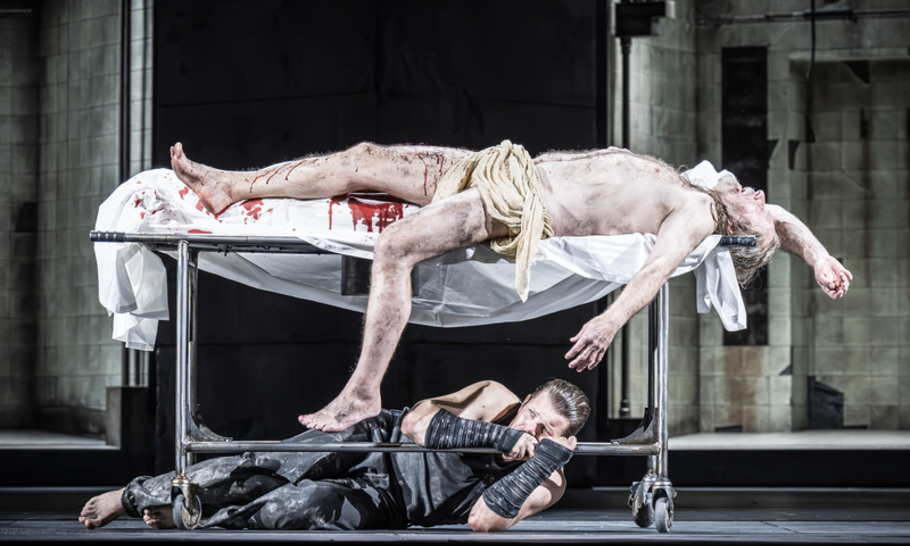
Stanislas de Barbeyrac as Parsifal and Christian Gerhaher as Amfortas in Evgeny Titov's production of Parsifal, The Royal Opera ©2026 Marc Brenner
The success of Wagner’s final opera Parsifal depends on the principal singers, the chorus, orchestra and conductor. On the opening night of the Royal Opera’s new production, all were superb. The staging itself is secondary, although the team that created it received an array of boos that would make audiences at Bayreuth proud. At that holy grail of Wagner performances they really know how to boo directors, and do so with gusto. So what did the Russian director Evgeny Titov do that was so terrible? I can’t speak for the opinions of others but there were some unusual features.
Particularly notable were the ugly flower maidens of Act 2 who looked like bald-headed Valkyries from the Ring. According to the libretto their leading seductress, Kundry, arrives on a horse, and the Second Esquire calls out, “Behold, the wild rider!” (Seht dort, die wilde Reiterin!), but did they really need to look so frightful? Another jarring aspect was in Act 3 when Parsifal uses the sacred spear — taken back from the defeated magician Klingsor in Act 2 — to touch the wound of Amfortas, releasing him from his agony and allowing him to die peacefully. But here he stabbed him three times to make sure he was dead. I’ve certainly never seen Parsifal kill Amfortas, but since he’s about to take over as king it’s something they once did in that foreign country of the past. As for the Knights of the Grail, they looked a mess: a scruffy army of no-hopers wrapped up as if they were living in the very cold north. It is not just their king who is lost, but the whole lot of them.
Whatever you think of the staging, however, the musicianship was fantastic. The conducting by the Royal Opera’s music director Jakub Hruša, elegant in white tie and tails, was sublime. The orchestra and chorus excelled themselves, and the six principal singers were outstanding. German baritone Christian Gerhaher gave us the most memorable Amfortas I have ever heard, and Russian mezzo Ekaterina Gubanova sang the shape-shifting Kundry with huge feeling and emotion. The vital bass role of Gurnemanz was memorably sung by Brindley Sherratt, the sepulchral voice of Titurel was firmly sung by James Platt, and the baritone role of Klingsor was strongly sung by Mark Stone, though I would have preferred more menace in his portrayal. As for Parsifal himself, the young French tenor Stanislas de Barbeyrac was perfection, his youthful looks suiting the role far better than others I have seen.
Despite my quibbles about the production, notably the flower maidens, the director has emphasised the idea that the emasculated Klingsor has paedophile tendencies. When Parsifal first enters his magic garden lots of little girls in pretty ballet-style dresses run onto stage and sit themselves down. They soon disappear and we are given the Valkyrie-style flower maidens. This opera, or sacred music drama as Wagner preferred to call it, was characterised by Marxist philosopher Ernst Bloch as a “metaphysical adagio”, well captured under the baton of Jakub Hruša. I only wish we still had that lost play by Euripides, perhaps one of Wagner’s inspirations. There Telephus has been wounded by Achilles’ spear, and is told by the Oracle of Apollo that he would only be cured by his assailant’s spear. He goes to Argos where Achilles cures him using rust scraped from his spear.
If I could change one thing about this production it would be the deliberate stabbing of Amfortas by Parsifal. But opera directors like to be remembered for something, and that is probably why the audience booed the production team at the end.
A Message from TheArticle
We are the only publication that’s committed to covering every angle. We have an important contribution to make, one that’s needed now more than ever, and we need your help to continue publishing throughout these hard economic times. So please, make a donation.


