Thomas Mann’s ‘Doctor Faustus’

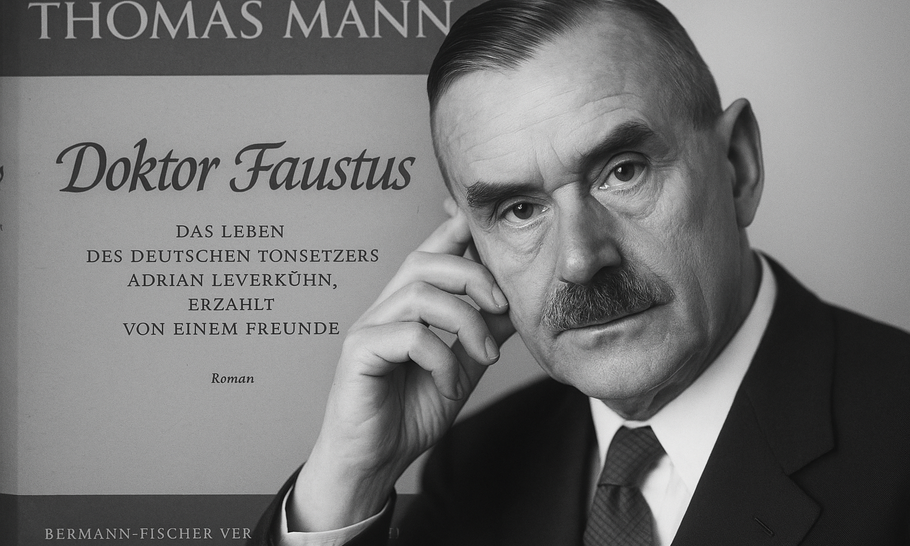
It’s unusual for an author to create a great novel and then, fearing readers would not understand it, to write another book that explains it. Thomas Mann’s The Genesis of a Novel (1949) describes how he composed Doctor Faustus (1947) and provides valuable insights into that difficult book. After working on Joseph and His Brothers for 16 years, the 69-year-old author finally completed that tetralogy in January 1944. He first thought of finishing his early satiric novel Confessions of Felix Krull (1922), but decided to take up the challenge of writing the far more ambitious Faust novel.
As he began the new project Mann found that “a sizeable pile of notes had accumulated, testifying to the complexity of the plan. I found I had some two hundred half-quarto sheets: a wild medley of disordered boxed-in notes from many fields—linguistic, geographic, political-social, theological, medical, biological, historical and musical.” He then had to sort out the apparently chaotic notes. All this specialised information gives extraordinary depth to the novel, but also makes it perilously pedantic and difficult to read.
Despite the hurdles Mann brilliantly transformed the intellectual sources of the novel. They included the Faust legend; Martin Luther and the Protestant Reformation (Kumpf, the fanatical professor of divinity, imitates Luther by throwing a roll at the devil lurking in a dark corner); Albrecht Dürer’s engraving Melencolia I; Christopher Marlowe’s play Doctor Faustus; Shakespeare’s Love’s Labour’s Lost; Beethoven’s biography and the interpretation of his last piano sonata Opus 111; Ivan’s confrontation with the devil in Dostoyevsky’s The Brothers Karamazov; Peter Tchaikovsky and his mysterious patron Nadezhda von Meck; the syphilitic insanity of Friedrich Nietzsche and of the Austrian composer Hugo Wolf, both infected by their visits to a bordello; Joseph Conrad’s novels; Theodor Adorno’s musical expertise; meetings with his Los Angeles neighbour Igor Stravinsky, “speaking alternately in German, English and French”; and the torture-to-hear 12-tone music of Alban Berg and of Arnold Schönberg, who was furious about what he considered Mann’s appropriation of his musical theories.
Mann shapes the novel as a biography of the composer Adrian Leverkühn, narrated by his old friend and emotional antithesis, Serenus Zeitblom. Adrian lived from 1885 to 1930, and Serenus is writing his life during World War Two. He mentions many crucial turning-points: the battles of Stalingrad in Russia and Alamein in Egypt, the fall of Mussolini, the attempt to assassinate Hitler and the Yalta Conference. These events suggest an analogy between the Allies winning the war and Mann finishing the novel. Mann had to fuse all the complex elements while establishing the dominant themes and transforming all the factual material into art. He notes, after his first ecstatic breakthrough, “I had escaped from the tangle of motifs in the expositional part of the book and saw clear action before me. . . . Felt deep enjoyment at integrating material studied and assimilated into the atmosphere and context of the book.”
Nietzsche’s The Will to Power (1901) provides a major theme of the novel, the morbid connection between disease and art: “The sick and weak have had fascination on their side. The great adventurers and criminals are sick at certain periods of their lives: the great emotions, the passions of power, love, revenge, are accompanied by profound disturbances.” Mann also believed, from personal experience, that “periods of physical well-being and blooming health . . . are not at all periods of outstanding creativity. I wrote the best chapters of Lotte in Weimar [The Beloved Returns] during a six-month attack of infectious sciatica.”
The dominant theme of Doctor Faustus is “demonic intoxication and its liberating but catastrophic effects”. Adrian’s “pact with the devil is the craving of a proud mind threatened by sterility, for an unblocking of inhibitions at any cost”. Mann creates a “parallel between pernicious euphoria ending in collapse and the nationalistic frenzy of Fascism”. Hell is fiery, Adrian is cold. His laughter has “the uncanny element of religious diabolism. In that laughter the devil, the secret hero of the book, is invisibly present.” Adrian’s syphilis is the devil’s means of inspiring his music. His first principal composition, Apocalypsis cum figuris (“Apocalypse with pictures”), inspired by Dürer’s 15 woodcuts based on the Book of Revelation, is in a paradox “satanically religious, diabolically pious”.
Mann reminds himself that in contrast to his previous works he now has to invent “meaningful subsidiary figures. In The Magic Mountain these were provided by the personnel of the sanatorium, in Joseph by the Bible”. Rudi Schwerdtfeger is the most lively character. The charming, charismatic and talented violinist “lays siege to Adrian, the would-be hermit, and lures him into an intimacy in which the homosexual element plays an impish part”.
Mann portrays “the relationship of poet, lover and friend; the motif of the treacherous wooing” that appears in Shakespeare’s sonnets and several plays. In the fatal triangular courtship Rudi, on behalf of shy Adrian, acts as an amorous go-between with the French-Swiss painter Marie Godeau. Mann explains that in the superb scene, when the jealous Inez Institoris shoots Rudi, her former lover, “the electric fires that flash and hiss under the wheels and at the top of the contact pole of a tram-car presage the murder that is to be committed.”
Another vivid character is based on Mann’s favorite grandson, little Frido. He “was charmed by the sky-blue eyes of the utterly enchanting child”, who actually did say, “Well, you are glad I did come, yes?” But “the ‘divine child’ was to be snatched away from the man who was not permitted to love, the man of ‘coldness.’ ” Nepo, left with his Uncle Adrian to recover from measles, dies in agony of spinal meningitis. Frido’s parents, Mann’s youngest son Michael and his Swiss wife Gret, were naturally upset about the cruel death of Nepo in the novel.
The composition of Doctor Faustus was frequently interrupted by Mann’s schedule of many punishing cross-country American train trips and exhausting lecture tours. But in his spare time he always kept working while travelling. He also had to deliver many dutiful propagandistic speeches for the Allied cause, and to give many other talks to commemorate dead friends and to celebrate the birthdays of aged survivors. In June 1944, when Roosevelt was still President, Mann became an American citizen. Some influential friends wanted him to become the President of postwar Germany.
The second great obstacle to progress on the novel was Mann’s life-threatening operation for lung cancer in April 1946. Like the patients he’d described in The Magic Mountain, he had a pneumothorax procedure, and a rib and two-thirds of his lung removed. He gratefully observed, “just as the operation had proceeded classically and uneventfully, in the clinical sense, so the convalescence progressed speedily and without complications.”
Mann knew he was creating a novel of supreme importance and believed that no difficulty, including the near-fatal illness, would prevent him from completing it. To elicit encouragement and advice he often read his work-in-progress aloud to a select audience of family and friends, who were honored to witness the genesis of this majestic work. Mann began writing Doctor Faustus on May 23,1943 and finished it, 3½ years later, on January 29, 1946.
The musical, military, pathological and political themes magnificently merge at the end of the novel as the four stages of Adrian’s disease—migraines, infection, remission and collapse—tragically fuse with Germany’s predisposition to Reformation-inspired demonology, deliberate choice of Nazism, decade of military conquest and apocalyptic destruction.
Jeffrey Meyers published Thomas Mann’s Artist-Heroes (Northwestern, 2014).
He took photo of a hearse-gondola on the dust jacket during his first trip to Venice in 1956.
A Message from TheArticle
We are the only publication that’s committed to covering every angle. We have an important contribution to make, one that’s needed now more than ever, and we need your help to continue publishing throughout these hard economic times. So please, make a donation.


