Tom Wintringham: forgotten hero of the Left

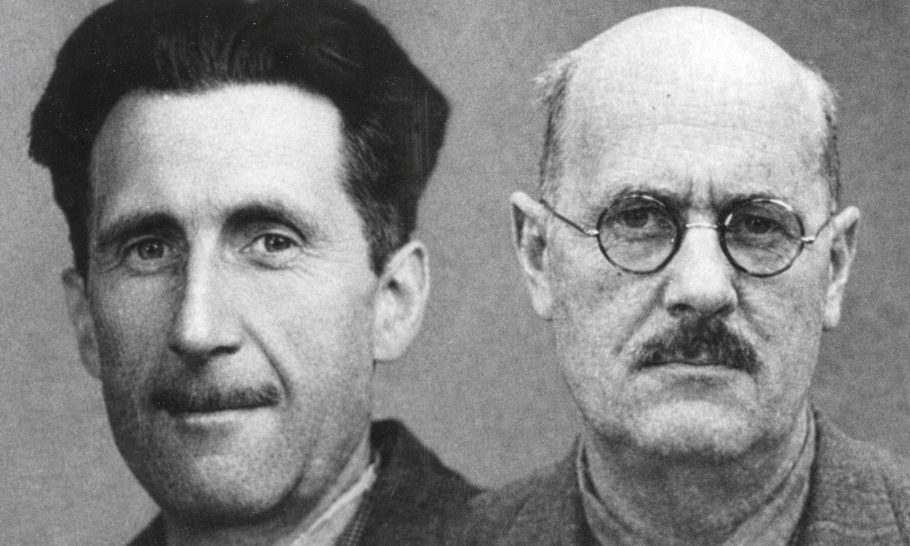
George Orwell and Tom Wintringham .
I
Until Animal Farm made Orwell famous in 1945, Tom Wintringham (1898-1949) was better known. He was a Spanish Civil War hero, founder of the Home Guard in World War Two, autobiographer, military expert and popular Left-wing propagandist. Orwell’s books became classics; Wintringham’s fame was short-lived and he deserves to be remembered.
They were close contemporaries, though Wintringham was old enough to fight in World War I. Both boys were educated at public (i.e. private) schools: Wintringham at Gresham’s, Orwell at Eton, and had military experience with the Officer Training Corps. Both wrote poems at school — Wintringham on the death of Lord Roberts, Orwell on the death of Lord Kitchener — and, later, patriotic poems about Spain. (Wintringham’s verse echoes lines from Chaucer, Keats, Kipling, Sassoon and Rupert Brooke.) They also wrote book reviews and political journalism, and made frequent broadcasts on the BBC.
Wintringham was a Communist, Orwell a socialist, and both published with the Left-wing Victor Gollancz. Both sympathised with the working class, volunteered to fight in the Spanish Civil War and were intoxicated by the early revolutionary atmosphere in Barcelona. Wintringham, who was wounded twice, visited and came under fire at Huesca on the Aragon front where Orwell was also wounded. The English poet John Cornford, killed in Spain, wrote “Full Moon at Tierz”, summing up the idealism of the volunteers: “Stand by our guard on Huesca’s plain, / Swear that our dead fought not in vain.”
Both wrote memoirs of the Spanish Civil War. Orwell’s great work Homage to Catalonia (1938) describes his change from high idealism to bitter disillusion. Wintringham’s English Captain (written before Franco’s victory but only published long afterwards by Faber in 1941) is matey, prosaic, propagandistic and, denying reality, predicts that the Falangists would lose the war.
Both men married twice. Orwell brought his first wife to Spain, Wintringham met his future wife in the Civil War. Wintringham, who had a higher rank and more authority than Orwell, lectured, trained and commanded troops. Both were shot by snipers, hospitalised in grim conditions and almost died from their wounds. Like Robert Graves in the Great War and Hemingway after two plane crashes in Africa, Wintringham in Spain was once mistakenly reported as dead. Orwell adopted a son in 1944; Wintringham had a son in 1947. Both moved to Scotland at the end of their lives, and died in middle age in the same year, 1949.
Orwell reviewed one of Wintringham’s books, discussed his political ideas, trained under him in the Home Guard, saw a lot of him in July 1941, recalled one of their conversations and portrayed him with qualified respect. Orwell’s review of Armies of Free Men—in the New Statesman of December 14, 1940, a year after the Republican defeat in Spain—criticised Wintringham’s adventurous stories of past glories that were “most spiritedly retold, much as A. G. Henty would have told them if he had a Marxist training. His theory of war is perhaps more valuable as propaganda than as a contribution to military science. It is the romantic or guerrilla theory of war, which insists on the superior morale and inventiveness of the soldier who feels himself free and knows what he is fighting for.”
On January 3, 1941, he praised Wintringham’s contribution to wartime morale in England: “Certain leftwing writers who had fought in Spain, notably Tom Wintringham, did a lot to stem the tide of defeatism.” On August 29, 1942 Orwell was critical of the recently formed Common Wealth party: “They have now been joined by Tom Wintringham, a useful demagogue, but I don’t think these people should be taken seriously, though they have won one by-election.” During a conversation on April 18, 1942, they discussed Sir Stafford Cripps’ recent mission to keep India loyal to the British war effort, which was rejected by the Indian nationalist leaders, who wanted immediate independence. Wintringham said that even in Spain some of the Russian delegates tended to treat the Spaniards as ‘natives.’ ”
II
Wintringham was born into a prosperous Liberal family in Grimsby, Lincolnshire, where his father was the town’s senior solicitor. After public school, Wintringham served as a private in World War I. He hoped to join the Royal Flying Corps but had weak eyesight. Hugh Purcell writes in The Last English Revolutionary: A Biography of Tom Wintringham,1898-1949 (2004), he was “a mechanic and dispatch rider attached to the balloon corps. His job was to pick up and deliver to base information about enemy artillery placements and trench lines in pouches thrown from balloons.” After the war, to please his father he read law at Balliol College, Oxford, but never practised.
In August 1920, during the Russian Civil War, Wintringham visited the Soviet Union and was tremendously impressed. George Bernard Shaw agreed, as did the American journalist Lincoln Steffens, who famously proclaimed, “I have seen the future and it works.” In 1923 Wintringham joined the British Communist Party, which was controlled by Russia. He was blindly unaware “of the huge costs in Russia of the Five-Year Plans; the Ukraine famine, the failure of collectivisation, forced labour, the movement of entire populations and the Purge Trials”. He refused to see that Russia was a dictatorship and was never willing to criticise Stalin. Orwell lamented the widespread allegiance to Stalinism, despite all the evidence to the contrary, on the British Left.
Like his politics, Wintringham’s tangled sex life with three women was often disastrous. He married Elizabeth Arkwright in 1923 and they had a son, Oliver. In 1929 he began a long affair with a woman called Millie, who changed her name to Wintringham by deed poll. In 1930 he left Elizabeth and their son. The following year he and Millie had a daughter, Lesley. He put her into a children’s home, where she spent her childhood. Later on, he rarely saw Lesley and she was naturally embittered. He was cited as co-respondent in Millie’s divorce. In 1932 he returned to Elizabeth after pressure from his strong-willed, moral mother, but continued his affair with Millie. He later became involved with another woman in Spain.
In Crusade in Spain, the English sculptor Jason Gurney described Wintringham in 1937: “He was a slim man of medium height, with large, round, steel-framed spectacles, a high-domed bald head and an academic stoop. He always wore a khaki beret, a shiny black mackintosh coat of vaguely military cut, riding breeches and high laced boots. The total effect suggested a motor-cyclist rather than a soldier.” Like his hero T. E. Lawrence, who died in a motorcycle accident, in the autumn of 1918 Wintringham had crashed his motorbike in northern France and ended up in an English hospital.
Tom Driberg, the journalist and Labour MP, portrayed the witty Wintringham in 1949: “He was a friendly, bald, slight man, blinking through his glasses as he held forth, with authority and charm and never boringly. I asked him once why ‘spit and polish’ Guards regiments were outstanding in battle. ‘I suppose, broadly speaking,’ he said in his slow, slightly nasal drawl, ‘it’s because if you can’t get proper officers, gentlemen make the best substitute.’ ”
In the early summer of 1918, Wintringham was arrested on the serious but bogus charge of mutiny, later reduced to “absent without a pass” and a fine of six days’ pay. In October 1925 he was again arrested for mutiny. He was proud to have gone to prison for urging army officers not to fire on their own men. He believed he had been arrested in order to put him in prison during a General Strike.
Wintringham first entered the Spanish Civil War as a Machine Gun instructor at the base in Albacete. In February 1937 he commanded the British Battalion of the International Brigade in the battle of Jarama. The Brigade prevented the Falangists from capturing the Madrid-to-Valencia Road that linked two Republican cities. But it was a bloodbath, and 250 of the 400 British volunteers were killed, wounded or captured. He was also wounded, caught typhoid in the hospital and was out of action for four months.
The Hungarian János Gálicz (1890-1939) planned and ordered the disastrous attack in Jarama, and was later shot during the Soviet Purge. Wintringham wrote, “Square, gruff, grim-faced, Colonel Gal said nothing except: ‘You will advance at once in this direction’ ” and hold at all costs. The frontal attack was suicidal. The British managed to keep their vital positions but were unable to counterattack. In his preface to Last Crusade (1940) by Gustav Regler—the German writer, revolutionary and Political Commissar of the XII Brigade—Hemingway attacked Gal: “the Battalion had been almost destroyed in one single, idiotic, stupidly conceived and insanely executed attack in the hills above the Jarama River. The man who planned and ordered that attack was afterward shot when he returned to Russia. He should have been shot at the time.”
In English Captain, his memoir of the Spanish Civil War, Wintringham refers to himself in the third person, and describes the confusion, chaos and slaughter from the commander’s point of view. He ominously mentions the notable volunteers in the British Battalion—Churchill’s nephew Esmond Romilly, the poets John Cornford and Julian Bell, and the revolutionary journalist Ralph Fox—all of them killed in Spain.
He confesses that “we were totally unprepared for what was going to happen to us”. In their first battle, the young and inexperienced Englishmen fought against professional German soldiers and well-trained Moorish infantry from Franco’s Army of Africa, who moved almost invisibly across the land. There were no reliable field telephones, and Wintringham had to communicate by runners, who sometimes got lost and failed to deliver important messages. They had several different kinds of machine guns, but were given the wrong ammunition. A truck sent to fetch the bullets was driven by a drunkard and careened over the side of a steep hill. When the ammunition was finally recovered, it fitted only a few of the guns. One British officer lost his nerve and went completely out of control. Wintringham was threatened with court martial and execution if he refused to follow Gal’s suicidal orders.
Jason Gurney, who was on the scene, recalls that when “Wintringham stood up to lead the charge, he was almost immediately shot through the thigh, and collapsed into the sunken road.”
He arrived in hospital on the night of February 13, 1937 and remained there for two weeks. Orwell was shot three months later in May 1937. In the Valencia hospital Wintringham caught typhoid, and was helped by the wealthy American journalist Kitty Bowler who, with a British nurse, saved his life. His weight had fallen from 180 to 130 pounds. The wounded Gustav Regler was also a patient in that hospital.
Night came; the firing died down and the Nationalists, exhausted by heavy casualties and tough Republican resistance, halted their offensive. Hugh Purcell concludes, “the Jarama had been crossed but the vital Madrid-Valencia Road was not cut. They contained an offensive by the finest troops the enemy could muster, but the cost was appalling.” In The Spanish Civil War, the British historian Paul Preston writes of the battle of Jarama: “The Republican forces had again demonstrated that while they were heroically brave in defence, they had little left for a counter-attack. The casualties were enormous. The Republicans lost 25,000 including some of the best British and American members of the Brigades. The British contingent was almost wiped out in one afternoon.”
Verses sung to the tune of “The Red River Valley” celebrated the sacrifice of the soldiers:
There’s a Valley in Spain called Jarama,
It’s a place that we all know so well,
It is there that we gave of our manhood,
And so many of our brave comrades fell.
In 1937 Wintringham blindly supported the Stalinist slaughter of “Trotskyite” political enemies on their own side, which took place at the same time as the Purge Trials in Moscow. Orwell’s POUM (the Unified Marxist Workers Party) was a prime target. Though it had been founded by Trotsky’s disciples, very few soldiers were his followers and some had never even heard of him. Orwell fought in the losing faction of the losing side. Homage to Catalonia describes how POUM members were hunted down and killed by the Stalinists.
Paul Preston explains one of the reasons why the Loyalists lost the war: “The revolutionary elements in the Republican zone—the anarchists and the quasi-Trotskyists of the POUM—would face the most determined opposition not from the Fascist forces of Franco, but from the Moscow-dominated Communists.” The Russian aim was not only to put Spain under Communist control, but also to suppress the Trotskyists and liquidate POUM.
Wintringham approved of this self-destructive policy, and his devotion to Stalinist rule caused excruciating political and emotional contortions. He encouraged the savagery by fiercely and falsely attacking Orwell’s POUM: “They did more to disorganize and disunite the Republic’s forces than to strengthen them; would produce a stillborn abortion [though all abortions are stillborn] of a revolution, a rising in the contradictory names of libertarian anarchy and proletarian dictatorship against the Republic.” Preston tragically concludes, “if the Communists had been able to find some way to harness the revolutionary enthusiasm of the first months, instead of simply crushing it, the war might have been won.”
On August 24, 1937, Wintringham returned to Quinto, 75 miles south of where Orwell had been shot on the Aragon front. The next day, for the second time on the second day of battle, he was hit in the shoulder by a sniper’s bullet. He was moved by train to a hospital at Benicassim, on the Mediterranean coast 50 miles north of Valencia. While there he wrote “Hospital in August,” echoing Keats’ “Ode to a Nightingale,” “The weariness, the fever, and the fret”:
The long hours lying wounded in the sun—
The ache and throb and rattle of the train—
The weariness of waiting and the pain—
Little are these besides the tortured mind.
In between the battles and wounds Wintringham and Kitty Bowler, who had cared for him early in 1937, became lovers. Petite and vivacious, she was slender, with large brown eyers and bobbed hair. In that manic wartime atmosphere of suspicion and fear, she was arrested as a Trotskyite spy and expelled from Spain. He refused to end their notorious affair and in July 1938 he was expelled from the Communist Party— for personal, not political reasons. Back in England, he divorced Elizabeth, married Kitty in January 1941 and had a son, Ben, with her.
Despite the slaughter and bitterness of defeat, and the murderous orders of the Political Commissar André Marty, Wintringham still believed in the revolution and remained idealistic about Spain. He exclaimed: “Spain woke me up. Politically I rediscovered democracy, realizing the enormous potentialities in a real alliance of workers and other classes. I was disgusted by the sectarian intrigues of Marty & Co. Two bullets and typhoid gave me time to think. I came out of Spain believing in a more radical democracy, and in revolution of some sort as necessary to give the ordinary people a chance to beat Fascism. Marxism makes sense to me, but the ‘Party Line’ doesn’t.” Orwell, similarly inspired by his first visit to Barcelona in December 1936, felt the same way: “The pervading sense of freedom, of intelligence, justice and companionship, the enormous upthrust in backward and penniless people of the desire for liberty and education, are things that have to be seen to be understood. I have seen wonderful things & at last really believe in Socialism, which I never did before.” In an exalted passage, Albert Camus spoke for both Wintringham and Orwell about the defeat of these ideals: “In Spain men learned that one can be right and still be beaten, that force can vanquish spirit, that there are times when courage is not its own reward. It is this, without doubt, which explains why so many men throughout the world regard the Spanish drama as a personal tragedy.”
Like Orwell, Wintringham believed that World War Two provided the best opportunity for a socialist revolution, which was necessary to defeat Fascism, and both counted on the working class to bring about that revolution. Again like Orwell, he blamed the workers for failing to seize their revolutionary chance in the atmosphere of wartime defeat in 1940.
At home, Wintringham used his military experience to create the volunteer Home Guard. It was meant to defend England and resist the threatened German invasion after their victory at Dunkirk in June 1940. In July the Earl of Jersey, who owned Osterley Park, allowed the Home Guard to use his mansion and lavish grounds, ten miles west of London. Members of the Home Guard came to Osterley from all over the country for a two-day crash course. The Surrealist painter Roland Penrose, friend of Picasso and married to the photographer Lee Miller, taught camouflage. Using T. E. Lawrence’s ideas in Seven Pillars of Wisdom (1926) and Hemingway’s in For Whom the Bell Tolls (1940), Wintringham taught street fighting, hand-to-hand combat, ambushing tanks, hit-and-run raids and guerrilla tactics.
Orwell joined the Home Guard in June 1940. In July 1941 he took a course at Osterley Park and was trained by Wintringham. Promoted to sergeant, Orwell returned to London and commanded twenty men, including his publisher Fredric Warburg. Orwell praised Wintringham’s work during the war: “He has had very great influence, as thousands of men from all parts of the country have passed through his hands in three-day training courses. The training schools started by Tom Wintringham and others in the summer of 1940 did invaluable work in spreading an understanding of the nature of total war and an imaginative attitude towards military problems.” Hugh Purcell writes that “during the Second World War Wintringham became a household name as a result of his regular articles about home defence and the war abroad in Picture Post and the Daily Mirror, his columns in the Tribune and New Statesman, his best-selling books on war, and his many talks on the BBC.”
In July 1942 Wintringham founded the Common Wealth party, whose name suggested sharing the riches of Britain. He believed that major industries and land should be under common ownership; that voters through workers’ councils should have a far more extensive say in the running of the country; and, a more idealistic goal quite impossible to achieve, that they should create “a brotherhood of man, selflessly dedicating itself to the public good.” Orwell wryly wrote of the first plan, “in effect the bourgeois is to be given a small life pension instead of a firing squad.”
In January 1943 Wintringham, standing as a Common Wealth candidate for a parliamentary seat in Edinburgh, gained 48% of the voters but lost by only 869 votes. He stood again in Aldershot, Hampshire, in the General Election of July 1945, halved the Conservative vote but lost by a greater margin of 5,000 votes. But one Common Wealth candidate won in Chelmsford, Essex, and two Communists also gained seats. Purcell adds that “both parties polled over 100,000 votes, a rare success for minor parties in a general election.” In 1949, while harvesting on his sister’s farm, Wintringham died suddenly of a heart attack. Kitty committed suicide in 1966.
Wintringham, a Public School Communist revolutionary, impressively combined ideas and action in the International Brigade, the Home Guard and the Common Wealth party. Orwell, a far greater writer, had many literary friends who wrote memoirs about him and inspired hundreds of books. Wintringham’s military and political friends were silent, and there’s only one book about his impressive achievements.
Jeffrey Meyers, FRSL, has had thirty-three books translated into fourteen languages and seven alphabets, and published on six continents. Forty-Three Ways of Looking at Hemingway came out in November 2025. The Biographer’s Quest will appear with Mercer University Press in April 2026.
A Message from TheArticle
We are the only publication that’s committed to covering every angle. We have an important contribution to make, one that’s needed now more than ever, and we need your help to continue publishing throughout these hard economic times. So please, make a donation.


