Two Timurs, Shah Rukh and Bodhanna


Bodhanna Sivanandan
There is something particularly appropriate in the fact that Uzbekistan should have won the Open section of the 2026 Chess Olympiad upon its own soil, in Samarkand. The Uzbeks defeated Ukraine 2½ –1½ in the final round and thereby claimed their second Olympiad title after Chennai 2022. India took silver, following a 2–2 draw with Hungary, while Germany secured bronze with a 2½ –1½ victory over the Netherlands.
China claimed the Women’s gold medal with a convincing 3–1 victory over Vietnam in the final round, while Kazakhstan secured silver after a 2–2 draw with Poland. India took bronze on tiebreak after also drawing 2–2 with Georgia.
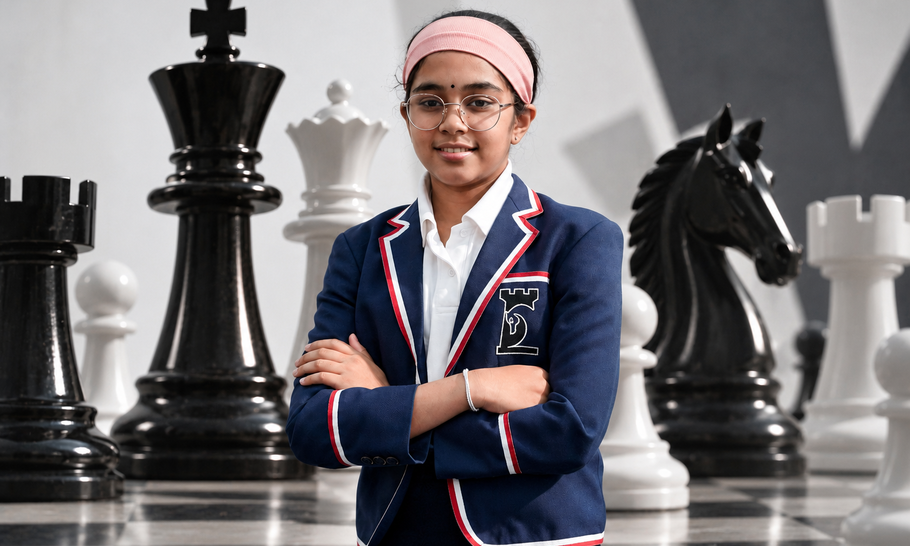
The England men’s team finished a mediocre 12th. The absence of David Howell was keenly felt. Our former superstar appears to have abandoned serious chess completely in favour of journalism and commentary. What a sad waste of an outstanding playing talent and vital resource for England. By contrast, the 11-year-old Bodhanna Sivanandan, representing English women on top board, earned the world’s youngest ever Women’s Grandmaster title. This amazing result quite rightly made front-page news in The Times.
In the FIDÉ presidential election Timur Turlov — Russian-born but a Kazak citizen since 2022 — won out, though rumblings continue that he may have infringed some electoral rules en route to his triumph. More of this in a later column.
Timur Turlov, elected as the eighth FIDÉ President, made the ceremonial first move in the last round game for Nodirbek Abdusattorov, playing 1. e4, after congratulating all the players on their performances throughout the Olympiad. Turlov also shared a heartfelt handshake with Ukrainian chess legend Vasyl Ivanchuk, who was playing on board two.
There is, however, a curious historical quality about Uzbekistan which makes a chess Olympiad there seem less like a sporting event than a meeting between the present and a rather formidable past.
During the Golden Age of Islam, around a thousand years ago, the Uzbekistan region was the cradle of that great Muslim philosopher Ibn Sina, known in the West as Avicenna.
Avicenna (980-1037) was a Persian polymath, who wrote almost 450 treatises on a wide range of subjects, of which around 240 have survived. In particular, 150 of his surviving treatises concentrate on philosophy and 40 of them concentrate on medicine.
His most famous works are The Book of Healing, a vast philosophical and scientific encyclopaedia, and The Canon of Medicine, which was a standard medical text at many medieval universities. His corpus also includes writing on philosophy, astronomy, alchemy, geology, psychology, theology, logic, mathematics and physics, as well as poetry. Along with Ibn Rushd (Averroes) and Ibn Khaldun, Avicenna is regarded as the most influential polymath of the Islamic Golden Age.
Several centuries later, Uzbekistan also produced the world conqueror, President Timur Turlov’s namesake, Timur, known as Tamerlane or Tamburlaine. Tamburlaine was reputedly the inventor and passionate player of a form of enlarged chess to rival the Great or Grant Chess of the Iberian monarch Alfonso the Wise, covered in my column of June 26, 2021.
Both variants were characterised by the creation of exotic new pieces, such as giraffes, bulls, war engines, camels, lions, elephants and even sea monsters. However difficult it may have been to master Alfonso’s version, Tamburlaine’s invention seems even more fiendishly complex, as befits, perhaps, the megalomaniac mindset of an aspirant to world conquest.
Christopher Marlowe’s plays Tamburlaine the Great Parts I and II contain my favourite line in the whole of English literature: “Egregious viceroys of these Eastern parts”, the thunderous opening of the second play. Sadly these lines are, nowadays, largely either omitted or egregious is replaced by most noble, which loses a lot of the meaning.
According to The Oxford Companion to Chess (Hooper and Whyld, OUP, 1984), Timur, or Timur-Leng (Timur the lame) (1336-1405), known as Tamerlane, Mongol emperor who named one of his sons Shar-Rukh, meaning CHECK-ROOK. In his court was the Persian lawyer and historian Ala’addinat-TABRIZI (the Aladdin of children’s stories), known as Ali ash-Shatranji because of his skill at chess. Timur said he had no rival as a ruler, Ali ash-Shatranji, none as a chessplayer. Timur also played GREAT CHESS and ROUND CHESS.
There are few things more curious than the fact that Shah Rukh was born on 20 August 1377; the youngest of Timur‘s four sons. Rukh is also, as we have seen, the Persian term for the chess piece, which we know as a Rook. According to Ibn ‘Arabshah, Tamburlaine, who was a talented chess player, was, indeed, involved in a game when he received the news of Shah Rukh’s birth, using this chess piece as a name for the newborn child. The legendary Aladdin of the pantomimes was also reputed to have originally been a legal scholar and expert chess player in the Timurid Court. Perhaps Tamburlaine even played against Aladdin at the expanded form of chess which Marlowe’s scourge of God invented. If so, no record has survived. Yet it is hard to suppress the thought that the spirit of the mighty warlord was smiling on the Uzbek team as they conquered the world, not on the battlefields of Asia, but on the chessboard.
Not many people, let alone rulers, are named after a chess piece. Youngest son of the Central Asian conqueror who founded the Timurid dynasty in 1370, Shah Rukh ruled over the eastern region of the empire conquered by his father, comprising most of Persia and Transoxiana, the western territories having been lost to invaders after Tamburlaine’s death. Nevertheless, Shah Rukh’s empire remained both vast and united throughout his reign, and was recognised as a dominant power in Asia.
Shah Rukh was fortunate in controlling the chief trade routes between Asia and Europe, including the legendary Silk Road. As a result of his chess loving father’s legacy, Shah Rukh became immensely wealthy. He located his capital, not in Samarkand as his father had done, but in Herat, now in Afghanistan. Herat was to become the political centre of the Timurid Empire and the principal residence of his successors, though both cities benefited from the wealth, prestige and power of Shah Rukh’s court.
Shah Rukh was a significant patron of the arts and sciences, both of which flourished under his rule. He spent his reign focusing on stability, maintaining political and economic relations with neighbouring kingdoms, instead of obliterating them, as his warlike father might have done. In the view of later historians, unlike his father, Shah Rukh ruled the Timurid empire, not as a Turco-Mongol warlord-conqueror, but as an Islamic sultan. In dynastic chronicles he is exalted as a man of great piety, diplomacy, and modesty—a model Islamic ruler.
Uzbekistan can boast a glorious past as a cauldron of the intellect. Also as the crucible of a form of chess, so complex that it would baffle most modern grandmasters of the orthodox game, and finally as the epicentre of a vast empire which rivalled that of Alexander the Great, the Rome of the Caesars and Genghis Khan, from whom Tamburlaine himself claimed direct lineal descent.
As mentioned earlier, the English team will have been disappointed to finish out of the top ten with 27½ points. But it should also be noted that this was only one point behind the second placed Indian team, who scored 28½ points – four clear points behind the outright winners. In fact, so strong were Uzbekistan, that England could have shared second, had they not succumbed 1½-2½ to the Uzbek second team in round eight.
Abdusattorov again led the winning team with distinction, playing in every round and picking up the gold medal for Board One with 8½/11 and a performance rating of 2869.
Richard Rapport (HUN) vs. Nodirbek Abdusattorov (UZB)
Samarkand Olympiad (Open), Uzbekistan, 2026, round 5
- e4 c5 2. Nf3 d6 3. d4 cxd4 4. Qxd4!?
This minor sideline in the Sicilian is known as the Chekhover variation. White is later prepared to forgo the two bishops to counter Black’s natural reposte with …Nc6. The line is perfectly playable and quite typical of Rapport’s ever-cavalier attitude towards convention.
4… Nf6 5. Bg5 Nc6 6. Bb5 Bd7 7. Qd3 e6 8. Nc3 h6 9. Bh4 a6 10. Bxc6 Bxc6 11. O-O-O Be7 12. Nd4 Bd7 13. f4 O-O 14. a3 Rc8 15. Nde2 Bc6 16. Rhg1!?
Signaling his intentions here is either brave or foolhardy. After 16. Nd4, Black is faced with the question of where his light-squared bishop belongs.
16… Qc7 17. g4?
Inevitable, but quite premature, relying as it does, on white’s exploitation of the g-file being complete before Black’s c-file play. Again, after 17. Nd4! Rfe8 18. Bxf6 Bxf6 19. g4 Bxd4 20. Qxd4 e5 21. fxe5 Rxe5 22. Qxd6 Bxe4 23. Qxc7 Rxc7 24. Rde1 Rce7, the position is level.
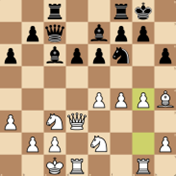
17… Bxe4 18. Qh3?
White optimistically avoids the exchange of material that might stop his dogmatic attempt to penetrate Black’s kingside before dealing with his own c-file issues. In doing so, things slip from bad to worse. Necessary was 18. Nxe4! Nxe4 19. Bxe7 Nf2 when White can try either a) 20. Qb3 Qxe7 21. Rdf1 Ne4 22. g5 hxg5 23. fxg5 Qc7; or b) 20. Qd2 Qxe7 21. Rdf1 Ne4 22. Qb4 Nf6 23. g5 Qc7. In both cases, Black retains his extra pawn and the edge, but White still has some counterplay.
18… d5 19. f5 Nh7?!
A slow response. By now, Black boasts a tangible advantage, and can choose between whether to prosecute a queenside attack with …b5-b4 or controlling when and whether to allow the g-file to open, for example with 19… h5 20. gxh5 Bxf5 21. Qg2 Ne8 22. Bg5 Bxg5+ 23. Qxg5 Qd8 24. h4 Qxg5+ 25. hxg5 Nd6, after which Black has the centre and a pawn.
- Bxe7 Qxe7 21. Qe3?!
A slight inaccuracy which, among other effects, seeks to cover the g5-square, rather than d6. After 21. Qg3 Kh8 22. fxe6 Ng5 23. Nf4 Nf3 24. Nfxd5 Bxd5 25. Nxd5 Qg5+ 26. Kb1 fxe6 27. Nb6, White has almost equalised, despite Black’s small and residual initiative.
21… Qg5!?
Logical, but we are silicon-informed that 21… Rc4! 22. Qg3 exf5 23. gxf5 Qg5+ 24. Kb1 Bxf5 25. Qd6 Qe3 26. Qxd5 Rc5, is a stronger way for Black to develop his advantage.
- Nf4 Nf6?!
And similarly to the comment after 21… Qg5, the line with 22… Rc4! 23. h4 Qxh4 24. fxe6 fxe6 25. Nxe6 Rf6 26. Nd4 Qf2, remains the more forceful progression.
- h4 Qxh4 24. fxe6 Nxg4 25. Qd2 Bf5 26. Qxd5??
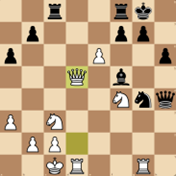
White, two pawns down, is in a serious predicament. But this pawn grab effectively loses because, as we shall see, Black’s pin on the f4-knight lands a good deal sooner than White’s on the g4-knight. Best was 26. e7 Qxe7 27. Nfxd5 Qh4 28. Qf4 Be6 29. Ne4 with counterplay.
26… Qg5 27. exf7+ Rxf7 28. Rdf1 Rf8 29. Qb3 Kh7 30. Ne2 Be4 31. Qg3 Qc5 White resigns 0-1
After 32. Kb1 Bxc2+ 33. Ka2 Bf5 34. Rc1 Qe5, White faces inevitable annihilation.
In the Ladies section of the Olympiad, our newest and brightest superstar took board one in all eleven rounds, finishing with a creditable 8½/11, to finish just outside the top ten placed Board Ones, on the basis of her rating performance. But as noted earlier, this was sufficient to earn the Women’s Grandmaster (WGM) title at the precocious age of a mere eleven years old. This was her game against the top board of Barbados.
Hannah Wilson (BAR) vs. Bodhanna Sivanandan (ENG)
Samarkand Olympiad (Ladies), Uzbekistan, 2026, round 1
- d4 d5 2. c4 c6 3. Nf3 Nf6 4. e3 Bf5 5. Nc3 e6 6. Nh4 Be4 7. f3 Bg6 8. Qb3 Qc7 9. Nxg6 hxg6 10. g3 Bd6 11. f4 Nbd7 12. Bd2 dxc4 13. Bxc4 b5 14. Bd3 a6 15. e4?
Having negotiated the opening safely, White presumes too much in threatening to open the centre without perhaps fully realising Black’s superior tactical disposition. Correct is 15. a4 O-O 16. axb5 axb5 17. Rxa8 Rxa8 18. O-O, with equality.
15… c5 16. dxc5??
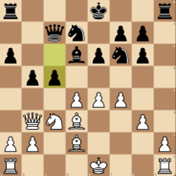
And in these last two moves, White has allowed her opponent a tactical situation, which the young British WGM relishes. It is possible that White had initially intended 16. e5 c4 when 17. exd6 fails to 17… Qb7 18. Bxc4 Qxh1+ 19. Bf1. But the alternative 17. Qd1 cxd3 18. Qf3! Rd8 19. exf6 gxf6 20. Qxd3, although superior, still leaves White with serious problems. With a flourish, Black seizes on the opportunity to finish off her opponent.
16… Nxc5 17. Qc2 Rd8 18. Be3 Nxd3+ 19. Qxd3 Bb4 20. Qc2 Qc4 21. a3 Bxc3+ 22. bxc3 Nxe4 23. Rc1 Nxg3 24. Rg1 Nf5 25. Bb6 Rd6 26. Qf2 Qe4+ 27. Kf1 Rh3 White resigns 0-1
Ray’s 206th book, “ Chess in the Year of the King ”, written in collaboration with Adam Black, and his 207th, “ Napoleon and Goethe: The Touchstone of Genius ” (which discusses their relationship with chess) can be ordered from both Amazon and Blackwell’s. His 208th, the world record for chess books, written jointly with the late chess playing artist, Barry Martin, Chess through the Looking Glass , is now also available from Amazon.
A Message from TheArticle
We are the only publication that’s committed to covering every angle. We have an important contribution to make, one that’s needed now more than ever, and we need your help to continue publishing throughout these hard economic times. So please, make a donation.


