Wanderer in the darkness: Paul Celan

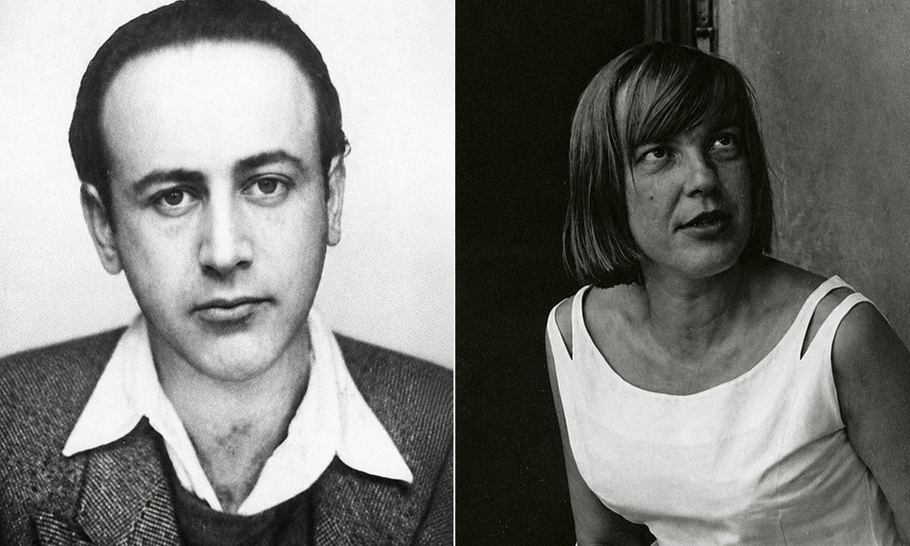
f Paul Celan, the Romanian-born Jewish poet of the Holocaust, and his Austrian lover Ingeborg Bachmann.
A stranger and afraid
In a world I never made.
A.E. Housman
Paul Celan (1920-70) is the Franz Kafka of modern poetry. Like Kafka in Czech-speaking Prague, Celan in the Romanian-speaking region of the Austro-Hungarian Empire was a depressed German-Jewish writer. He collected Kafka’s books and boasted about his precious first editions. He translated Kafka into Romanian and the author remained an important literary touchstone. Like Kafka, his natural environment was gloom, his words were made of wounds, his nerves were exposed as if he had been flayed, yet his misery inspired his art. Both authors saw no light at the end of the tunnel, just an endlessly dark tunnel. Celan lamented, “I am an outsider”; “If only you knew how I suffer”; “It’s not that I’m afraid, I just feel dread.” As Kafka had told his fiancée, the intolerable Celan told his wife, “Only I am capable of bearing myself.” The moribund Kafka had warned his doctor, “If you save me, you’re a murderer”; Celan, confined in a psychiatric clinic, lamented, “They’ve healed me to pieces.” Celan was also influenced by other German writers, Rainer Maria Rilke and Georg Trakl, and by the Russian Osip Mandelstam. Celan’s poems evoke the twisted, tormented figures of the Austrian artist Egon Schiele.
Celan’s birthplace Czernowitz, in the southwest corner of today’s Ukraine — once ruled by Ottoman Sultans, Hapsburg Kaisers, Romanian Kings, Russian Commissars and Ukrainian Princes — was a strange mixture of nationalities, languages and religion. The authors Gregor von Rezzori (born 1914) and Aharon Appelfeld (born 1932) also came from that remote provincial town. The modern Romanian writers, Mircea Eliade and Emil Cioran, were both fascists. During the Soviet wartime occupation of Czernowitz, the Jewish temple was burned down, converted into a movie theater and bitterly called the “Cinegogue”.
The teenaged Celan crossed Germany on a train to France on Kristallnacht, the widespread Nazi attacks on Jews on November 9, 1938. He studied medicine for a year in Tours on the Loire, returned to Czernowitz when the war broke out, was forced to work in labour camps during the German occupation of Romania, but survived the Holocaust. He lived in Bucharest from 1945 to 1947, and was briefly in postwar Vienna, en route to Paris, during the filming of Graham Greene’s sinister The Third Man.
Celan lived in France from 1948, married a French woman in 1952 and became a French citizen in 1955. After surviving for years as a translator, he finally secured a position teaching German at the prestigious École Normale Supérieure, where he conscientiously explained the works of Thomas Mann, Rainer Maria Rilke and Günter Grass to French students. But depression smothered his genius, and he committed suicide in April 1970.
A gifted linguist, Celan learned Hebrew, Latin and Greek in school. He was the German translator of Shakespeare’s sonnets; of writers from Spanish and Portuguese; Rimbaud, Valéry and Apollinaire from French; Lermontov, Chekhov, Blok, Mandelstam and Yesenin from Russian. Born in a German-speaking enclave that was destroyed by the Germans, he nevertheless wrote in German (with a few works in Romanian and French). After the war, he felt Germany and Austria were still poisoned by the Nazis, and spent only six months in Vienna, his sole residence in a German-language country. He felt some pleasure on a brief visit to Israel and bitterly commented, “All those Jews, and no ghetto.” Ancel, the Romaniaed version of his birth name Antschel, was the anagram of his pseudonym Celan. Lance was another apposite anagram. (Anna, the first name of his biographer, is a palindrome; her surname Arno is an anagram of Nora and Rona.)
Anna Arno’s Paul Celan (Harvard UP, 404 pp, £30/$35) is readably translated from Polish by Soren Gauger. Born in 1984, Arno has a degree in art history from NYU and lives in Krakow. She is good on the historical background, and on Celan’s troubled marriage and many lovers. But Arno discusses the strange relations of Celan’s wife Gisèle, and his lover Ingeborg Bachmann, before she introduces Gisèle and describes her troubled marriage to the poet. Arno offers sensitive readings of his difficult poems, but misses allusions to several crucial phrases. She doesn’t note that Celan’s “dark, drunk sea” echoes Homer’s “wine dark sea”; that “the people-of-the-clouds” are Luftmenschen (dreamy people); that “a glittering candle, / lit by a black sun” is the Yahrzeit candle lit in memory of the dead; and that “Jackdaw” is the literal Czech meaning of Kafka. Three errors appear. The German name should be Stefan (not Stephen); Not in German means need (not death); know-it all should be Besserwisserismus (not Besserwisserism).
Celan’s friends vividly described the stages of his youthful, mature and morbid character. He was dashing, full of charm and curious, but also wanted to be adored. He had delicate, boyish features, was sickly pale and smoked copiously. A trim man with dark hair and complexion, he seemed quite sensitive and withdrawn, and had a melancholy gaze. He was good-looking, exuded an air of distance and ironic superiority, and had contempt in his eyes. His reserve and timidity were beyond description, he moved friends by his very presence, his subtle spiritual radiance. When reading his poems his voice seemed metallic, resounding with the tragedy of his fate. He spoke in a soft voice, seemed modest, almost terrified. Frail and unimposing, he begged for understanding, seemed older than his actual age and sunk inside himself. Hungry and downtrodden, he called himself a wanderer in the darkness. He clung to his prejudices, nurtured his suspicions and insisted that the world was unbearable. He had a pathological fear of being wounded, and everything wounded him. His deeply buried despair, moral severity and tempestuous personality provoked sudden and violent fits.
His character evolved from his tragic personal history. After Celan’s parents had refused to flee with him from Czernowitz, they were arrested and sent to concentration camps. His father, infected by typhus, was deemed unfit to work and executed; his mother, exhausted by forced labour, was shot to death. His mother-tongue, without the mother, was also the language of her murderers. His profound sense of guilt kindled the severe mental illness that led to his suicide.
Celan had a tempestuous, agonising, Strindbergian liaison with the Austrian writer Ingeborg Bachmann. It lasted from 1948 to 1951, and was reignited, after his marriage. in 1957. Arno writes, “she was chaotic and independent, utterly impractical. Celan lived almost like a hermit: he was introverted and incapable of making the compromises a relationship required.” She said she wanted to liberate him, to “take your strange, dark head between my hands and push the stones off your chest.” She hopelessly asked, “do you still remember we were very happy together in spite of everything, even in our worst moments, when we were worst enemies?” When he finally broke with her, she was utterly devastated, begged him “for a shred of her future” and cried “you managed to hurt me better than I ever hurt you.” When Celan told his wife that he’d been unfaithful, she sympathetically said, “I love you and will be calmly waiting for you to return. Ingeborg loved you so deeply, she suffered so much. How could you have been so cruel to her? Now that I have come to know her, I will agree to let you see her.”
His wife, Gisèle Lestrange, was a graphic artist, seven years younger than he, and came from a wealthy aristocratic family. They naturally opposed her marriage to a Jewish refugee with no regular employment. She thought herself unworthy of the poet who translated, simplified and explained his difficult poems to her. They married in December 1952, and their first child, after medical blunders, died the day after he was born. Their second son, called Eric, was born in 1955. Gisèle rejoiced in the child’s resemblance to his father, though Celan had dark hair and dark eyes, and the boy had fair hair and blue eyes.
Celan said, “I don’t have many friends,” and wryly told an acquaintance, “the ‘fame’ you mention—you could add some extra quotation marks.” Though his closest companions came from his youth in Romania, he had significant friendships with three future Nobel Prize winners—Heinrich Böll, Günter Grass and Nelly Sachs, as she descended into madness—and with the French writers Henri Michaux, René Char and Yves Bonnefoy. In Paris in 1951, Celan met the Romanian sculptor Constantin Brancusi. The poet began reminiscing about Romania, which made no impression on the artist, who remained silent, turning his Bird in Space on its pedestal or stroking the skull of Princess X. Egoistically calling attention to his work, the great man wanted praise instead of nostalgic memories.
Celan got off to a slow start and struggled to achieve fame. His first pamphlet, Typescript of 1944, was privately printed in a total of three copies. His 1948 debut volume, Sand from the Urns (though urns usually contain ashes), sold only nine copies and the publisher pulped the remaining 320. Celan finally achieved fame and recognition with his second volume, Poppy and Memory (1952).
Celan read his masterpiece, Todesfuge (“Deathfugue”), at a Group 47 writers’ conference in May 1952, and felt bitter when the audience considered it “overwrought and opaque, shocking and unacceptable”. When one supposed friend said, “that lunatic reads like Goebbels in a synagogue,” Celan furiously exclaimed, “He tried to put me in the shoes of a former Nazi.” Other critics both praised and condemned his work. They justifiably complained that his dream-logic was dark, hermetic, esoteric and divorced from reality, that it wandered away from comprehension and logic.
Celan was a friend of the Franco-German writer Yvan Goll (1891-1950) and had visited him on his deathbed. Well aware of his hypersensitivity, Goll’s widow Claire decided to enhance her late husband’s fame while sabotaging Celan’s reputation. Reversing the chronology of their poems to suggest that Goll had published the contested works before Celan, she accused him of plagiarism. She even absurdly but persuasively claimed he tried to rape her while her husband lay dying in the hospital. Celan felt tormented by his enemies and abandoned by his silent friends, who defended him “as the rope supports the hanged man”. “Half vatic, half betrayed,” he felt trapped and fiercely adopted his role as victim. Claire Goll’s false and malicious smear campaign plagued the oversensitive Celan, obsessed him for the rest of his life and was a major cause of his mental breakdown. It’s difficult to explain Claire Goll’s two decades of hatred and mania. Celan might have rejected the sexual advances of a woman who was thirty years older and emotionally distraught; she might have feared he was eclipsing Goll’s reputation and felt the urge to tear him down.
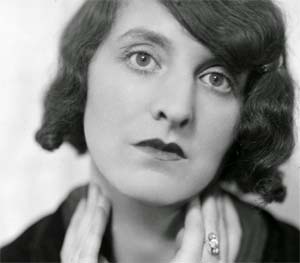
Photo of Claire Goll
Celan followed Friedrich Hölderlin and Friedrich Nietzsche into madness, and spent two of his last seven years in psychiatric hospitals. Self-destructive and violent, he cut his wrists and stabbed himself in the chest; he also threatened to stab his wife, who fled with her son to neighbours in the middle of the night. Gisèle, like Ingeborg Bachmann, recalled their sado-masochistic torments: “We loved each other, we hurt each other and arrived at a despairing impossibility of dialogue.” Celan both needed and resisted psychiatric treatment and pleaded, “I must stand up to them—now, when I am in dire need of help. I was behind asylum bars and thought it would be forever.” He lamented, “Out of shattered / madness/ I raise myself.” During all this turmoil and suffering, he tried hard to be a good father: “He saw his son regularly, took him to the cinema and exhibitions, wrote to him while travelling and gathered stamps for his collection.” But he still thought Christmas decorations looked like butcher’s hooks with hanged Jews. He wrote, “Paris swims on its tear” and tearfully swam in Paris. He drowned himself in the Seine on the night of April 19, 1970, and his body was not found until May 1.*
An anguished survivor, Celan felt obliged to record the tragic history of the Jews and emphasise the ashes of the Holocaust. His poems recalled the sacred biblical vow and the threat of punishment if that vow were violated: “If I forget thee, O Jerusalem, let my right hand forget her cunning” (Psalm 137:5). Celan felt trauma and guilt; he distrusted beauty and tried to be truthful. “Deathfugue” (1948), his greatest poem, alludes to the music played while Jews marched to their death in extermination camps. A fugue, interwoven musical melodies, suggests fugitive and escape, and also means a temporary loss of memory that leads to wandering away from home. (Arthur Miller’s Playing for Time, 1980, dramatised the women’s orchestra in Auschwitz.)
The critic John Felstiner defines the subject of the two-page poem as “Jewish prisoners tyrannized and murdered by a camp commandant” during the catastrophic war. The horrific images challenge the reader and offer splintered echoes of meaning. In the opening line, “Schwarze Milch der Frühe wir drinken sie abends” (“Black milk of morning we drink you evenings”), “Black milk” suggests poison and death, not nourishment and life. “Wir schaufeln ein Grab in den Lüften” (“we dig a grave in the air”) suggests gravediggers shoveling dirt into the air and ashes flowing from the chimneys as flesh turns into smoke. “Snakes” suggest the devil, evil, temptation and the writhing of Laocoön wrapped in serpents. “Ashen hair” is the hair cut off from Jews before they were exterminated, shipped back to Germany and sold for industrial use.
Shulamit is the beautiful Jewish woman in the biblical Song of Solomon (6:13). Margarete, by contrast, is the tragic Christian heroine in Goethe’s poem, seduced by Faust and later redeemed. Celan structures “Deathfugue” with the effective repetition of active verbs: drink, write, sing, play, scrape, dig and jab. A series of grim linked images emphasise the themes of the poem: black milk-blue eyes, whistle-dogs, bullets-guns, Deutschland-death, graves-snakes, air-smoke, golden-ashen, stars glisten-Jews die. “The presence of the dead is at the root of all of Celan’s poetry.”
Two eminent authors have praised Celan’s poems. George Steiner called him “the major poet of the period after 1945”. J. M. Coetzee confirmed that “ ‘Death Fugue’ is one of the landmark poems of the twentieth century” and “Celan is the towering European poet of the middle decades.”
*Many major poets have committed suicide: Thomas Chatterton, Gerard de Nerval, Georg Trakl, Cesare Pavese; Marina Tsvetaeva, Vladimir Mayakovsky, Sergei Yesenin; Hart Crane, Randall Jarrell, John Berryman, Anne Sexton and Sylvia Plath. Suicide seemed to validate the authors’ tragic destiny and enhance their reputations.
Jeffrey Meyers, FRSL, had thirty-four books translated into fourteen languages and seven alphabets, and published on six continents. Forty-Three Ways of Looking at Hemingway came out with LSU Press in November 2025. The Biographer’s Quest appeared with Mercer University Press in April 2026.
A Message from TheArticle
We are the only publication that’s committed to covering every angle. We have an important contribution to make, one that’s needed now more than ever, and we need your help to continue publishing throughout these hard economic times. So please, make a donation.


