We all wanted to play like Tal


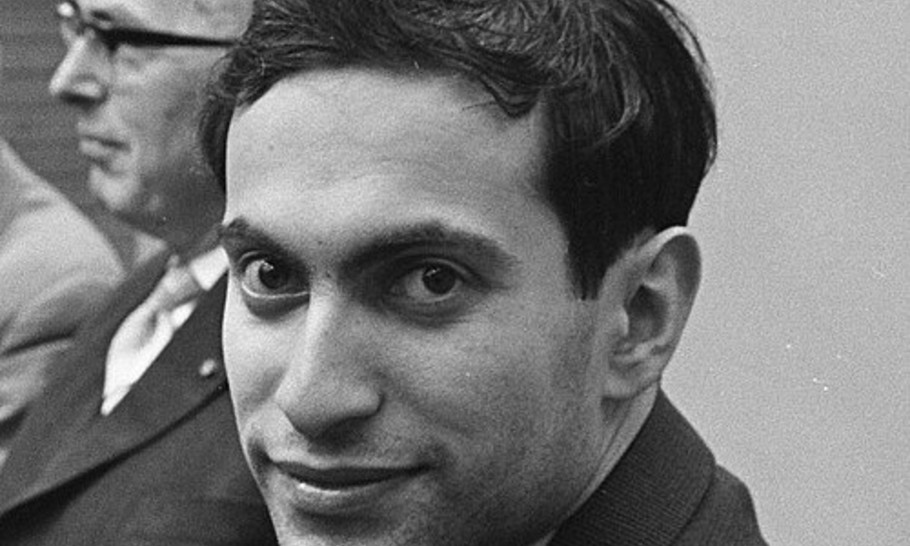
Mikhail Tal in 1962
Back in the Cretaceous Period, when babes and sucklings knew their place, instead of instantly qualifying to be Grandmasters, as they do now, we all wanted to play like that swashbuckling Wizard of Riga, Mikhail Tal. Our Bible was an anthology of Tal’s most impressive victories, compiled and annotated by Peter Clarke, a fine player and writer himself, who had represented the British Chess Federation on top board at the Havana Olympiad of 1966. In spite of facing such tough opposition as the Great Dane, Bent Larsen, then nearing the height of his powers, as well as the mighty Najdorf, whom we encountered last week as a connoisseur of Bobby Fischer’s exploits, Clarke only lost one game in this gruelling competition. And it wasn’t against Larsen or Najdorf!*
The supreme paradox was that Clarke’s playing style was the absolute antithesis of Tal’s. The energetic Rigan Magician loved to attack and to sacrifice, often without any sound basis for such extreme speculations. The Antipodean Clarke, in sharp contradistinction, was the veritable epitome of caution. If chess players could be compared to military commanders, then Tal would have equated to Napoleon Bonaparte, while Clarke’s role model would have been Quintus Fabius Maximus, the famous Cunctator or Delayer, who ground down the rampant Hannibal by systematically avoiding pitched battles against the Carthaginian ogre.
Clarke’s style over the board resonated far more closely with that of the circumspect Armenian, Tigran Petrosian, about whom Clarke was to produce a second anthology after Petrosian won the world championship in 1963. In spite of his temperamental consanguinity with Petrosian, this second volume focusing on the champion who was Clarke’s personal hero and role model, turned out to be somewhat less inspirational than his previously published catalogue of Tal’s blazing triumphs. A paradox indeed!
Tal’s triumphs included a storming conquest of the Soviet championship, first prize in the Interzonal qualifier from the world championship cycle and a shattering success in the subsequent Candidates’ tournament, where Tal defeated the young Bobby Fischer by the stupendous score of four to zero. Finally, Tal demolished the Red Czar of the Soviet chess Imperium, Mikhail Botvinnik, in their world title clash at Moscow in 1960.
*Clarke’s sole loss at the 1966 Havana Olympiad was against Carlos Cuartas of Colombia.
Clarke’s two books on Tal and Petrosian remain in print with Hardinge Simpole Press.
Mikhail Tal’s Best Games of Chess (Hardinge Simpole Chess Classics S)
https://a.co/d/0iqO8EFU
https://www.amazon.co.uk/Petrosians-1946-1963-Hardinge-Simpole-Classics/dp/1843820021
But, revenons à nos moutons! This column is not primarily about Mikhail Tal, it is about Tal’s influence on the then generation of young English players. At Dulwich College I had the privilege of facing two strong opponents in numerous games John Sugden and Graham Sandiford. Having such formidable sparring partners proved to be a huge bonus. John Sugden even went on to win the Major Open tournament at the British Championships, thus following in Alekhine’s hallowed footsteps, not just once, but twice. And of course, imbued with the spirit of Tal, attack and sacrifice were the order of the day, with little thought given to the soundness of the enterprise, or to consolidation and defence. It was only later that I learned the strategic and prophylactic lessons to be imbibed from the games and writings of Nimzowitsch and Petrosian.
Here are four examples of bygone youthful ardour, from les neiges d’antan, which our contemporary pre-teenage prodigies would doubtless have refuted, putting the perpetrator to the sword, without even deigning to get out of their prams.
John N Sugden vs. Raymond Keene
Match, Dulwich, 1961
- d4 Nf6 2. c4 d6 3. Nc3 Nbd7 4. e4 e5 5. Nf3 exd4
Giving up the centre but Black hopes for counter-play in the e-file.
- Nxd4 Be7
In the King’s Indian Defence Black develops his bishop actively at g7. In the old Indian he prefers a more solid square of the e7.
- Bd3 O-O 8. O-O Re8 9. f4 Bf8 10. Be3 c6 11. Qc2 a6 12. Rae1 Qc7
Black is careful, for the moment, to prevent White from ever advancing with e5. Neglect of this principle is what causes later problems. But instructively, over-attention to this principle deflects my noticing the improvement 12… Ng4 13. Bd2 b5 14. Kh1 Qb6 15. Nf3 Nc5.
- Bf2
Fortunately, White too fails to exploit my oversight with 13. Nf3 g6 14. Bd4 Bg7 15. h3 Nh5 16. Bxg7 Nxg7 17. Qd2 b5 18. g4), when he has gained the advantage.
13… b5 14. Bh4 b4 15. Nd1 Qb6 16. Bf2 Ng4 17. h3 Nxf2 18. Qxf2 Nc5?!
This inaccuracy lets slip the slim advantage Black had compiled. That initiative is best retained with either a) 18… d5 19. exd5 Bb7 20. Nb3 Rxe1 21. Rxe1 cxd5 22. Ne3 dxc4 23. Nxc4 Qc7; or b) 18… g6 19. e5 Nc5 20. Bc2 dxe5 21. fxe5 Ra7 22. Kh1 a5 23. Nf3 Rae7
- Nf3 Qc7 20. Bc2 Be6 21. e5 Bxc4??
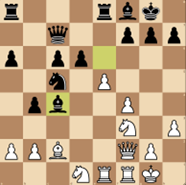
Much too overconfident. The cautious 21… h6 was called for, for example: 22. b3 dxe5 23. Nxe5 Nd7 24. Qg3 Rad8 25. Nf2 Bc5 26. Kh2 Nxe5 27. fxe5, with complete equality.
- Bxh7+ Kxh7 23. Ng5+
- Qh4+! is simpler with 23… Kg8 (23… Kg6 24. f5+ Kxf5 25. Qg4#) 24. Ng5 Bd3 25. f5 Bxf5 26. Rxf5 Be7 27. Qh7+ Kf8 28. Rxf7#.
23… Kg6
No better is 23… Kg8 24. Qh4 Bd3 25. f5 Bxf5 26. Rxf5 Be7 27. Qh7+ Kf8 28. Rxf7#.
- f5+ Kh5
24… Kxg5 25. Qg3+ Kh5 26. Qg4+ Kh6 27. Qh4# falls short.
- g4+ Kxg5
Forced: 25… Kh6 26. Qh4#.
- Qf4+ Kh4 Black resigns 1-0
As 27. g5+ Kxh3 (27… Kh5 28. Qg4#) 28. Rf3# is inevitable.
Raymond Keene vs. John N Sugden
Match, Dulwich, 1961
- d4 d5 2. c4 c6 3. Nc3 Nf6 4. Nf3 e6 5. e3 Nbd7 6. Bd3 dxc4 7. Bxc4 b5 8. Bd3 Bb7 9. e4 b4 10. Ne2 c5 11. Bg5 Qb6 12. d5?!
- Qa4 Bxe4 13. Bxe4 Nxe4 14. Ne5 Qb7 15. Be3 cxd4 16. Bxd4 Bd6 gives Black less.
12… exd5 13. e5 Ng4 14. O-O Ngxe5 15. Nxe5 Nxe5 16. Bf5 Bd6 17. Nf4 h6 18. Qh5 hxg5?
After this awful error, Black not only loses his considerable advantage, but leaves White with a slight edge. After 18… g6!, Black is close to winning whether White continues:
- A) 19. Bxg6 fxg6 20. Qh3 O-O 21. Bxh6 Rf6 22. Rfe1 Nf7 23. Qh4 Bxf4 24. Bxf4; or,
- B) 19. Qh4 gxf5 20. Bf6 Kd7 21. Qh5 Ng6 22. Qxf5+ Kc7 23. Nxd5+ Bxd5 24. Qxd5.
- Qxh8+ Ke7 20. Qxg7 gxf4 21. Rfe1 Qc7 22. Rxe5+ Bxe5 23. Re1 Qd6??
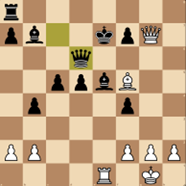
Catastrophic. Black is near-equal after 23… Kd6 24. Rxe5 Kc6 25. Bc2 Kb6 26. h4 Bc6 27. Qf6 Rd8 28. Re7 Rd6 29. Qxf7 Qd8 30. a3 bxa3 31. bxa3.
- Rxe5+ Kd8 25. Qg8+ Kc7 26. Qxf7+ Black resigns 1-0
Raymond Keene vs. John N Sugden
Match, Dulwich College, 1962, game 4
- Nf3 d5 2. d4 Nf6 3. c4 e6 4. Nc3 c6 5. cxd5 Nxd5?
Far superior is 5… exd5 6. Bf4 Bf5 7. e3 Nbd7 8. Bd3 Bxd3 9. Qxd3 with equality.
- e4 Nxc3 7. bxc3 c5 8. Bc4 Be7 9. O-O O-O 10. Ne5 a6 11. a4 Qa5 12. Bb2 Nd7 13. f4 Qc7 14. Bb3 b6 15. Nxf7!?
Gifting Black an initiative. Best was 15. Ng4 (15. Qe2 is also good) 15… b5 16. Ba3 Bb7 17. f5 e5 18. dxe5 Nxe5 19. f6 gxf6 20. Bd5 Nxg4 21. Qxg4+ Kh8 when the position remains level.
15… c4 16. Nh6+ gxh6 17. Qg4+ Kh8 18. Qxe6 Nc5 19. Qxc4 b5 20. axb5 axb5 21. Qxc5 Bxc5 22. Rxa8 Be7 23. d5?
After this mistake, Black should be able to press home a winning advantage. Necessary was 23. Bd5 Bg4 24. Rfa1 Qxf4 25. Rxf8+ Bxf8 26. Bc1 Qc7, when White is at least no worse off.
23… Kg7?
Black fails to capitalise, although mate was in the air: for example 23… Qb6+ (or …Qc5+) 24. Kh1 Qe3 25. Raa1 Qe2 26. Rab1 Bh3 27. Rg1 (27. gxh3?? Qxe4+ 28. Rf3 {28. Kg1 Rg8+ 29. Kf2 Bc5#} 28… Qxf3+ 29. Kg1 Bc5#) 27… Qxe4 28. Ra1, when Black is considerably better. After the move played, Black’s advantage is significantly depleted.
- c4+ Kg6?
And after a second consecutive error, Black’s advantage has disappeared entirely. Black could keep a lead with 24… Kf7 25. Be5 Qc5+ 26. Kh1 bxc4 27. Bd1.
- f5+ Kh5 26. Bd1+ Kh4??
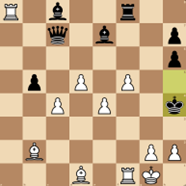
Black has been attempting to find king safety in a near suicidal manner over his last four moves, but there is no turning back after this terminal blunder. Necessary was 26… Kg5 27. Bc1+ Kf6 28. Bb2+ etc. with a draw by repetition.
- Rf3 Qxc4 28. Rf4+ Kg5 29. Rg4+ Kh5 30. Rg6+ Kh4 31. g3+ Black resigns 1-0
Raymond Keene vs. Graham K Sandiford
Match, Dulwich College, 1962, game 4
- e4 c5 2. Nf3 Nc6 3. Nc3 d6 4. Bc4 e6 5. O-O Nf6 6. d3 Be7 7. Nd2 d5 8. Bb5 a6 9. Bxc6+ bxc6 10. e5 Nd7 11. f4 O-O 12. Nf3 f6 13. Ne2 Qc7 14. d4?
Too automatic, this leaves White at a disadvantage. White keeps his slight edge with 14. exf6 Nxf6 15. Ng3 a5 16. Kh1.
14… cxd4 15. Nexd4 Nb6?
An inaccuracy that costs Black much of his initiative. After 15… fxe5 16. Nxe6 Qb6+ 17. Kh1 Rf6, White remains on the back foot.
- exf6 Bxf6 17. Qe2 c5?!
Necessary is 17… Nc4 18. Re1 Qb6 19. c3 a5 20. b3 Nd6 21. Ne5 c5, as after the move played, Black hardly even has equality.
- Nxe6 Qe7 19. f5 Re8 20. Re1 g6?
Seriously undermining the security of his king, Black must demonstrate a more robust response. After 20… Bxe6 21. fxe6 c4 22. c3 Rac8 23. Qd1 Qd8 24. Nd4 Bxd4+ 25. Qxd4 Rc6 26. b4 cxb3 27. axb3 Rcxe6, Black is not confronted with any difficulties.
- Bg5
White misses his first opportunity to exploit Black’s positional vulnerability when 21. Qf2 Qb7 22. Bg5 Bxe6 23. fxe6 Bg7 24. e7 constitutes a very dangerous assault.
21… Bxg5
This recapture hand White another opportunity to take the game by the scruff whereas the correct method, after 21… gxf5 22. Ng7 Qxe2 23. Nxe8 Qxe1+ 24. Rxe1 Bxb2 25. Nf6+ Bxf6 26. Bxf6 Ra7 leaves the two sides more or less level.
- Nfxg5 h6??
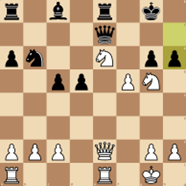
There is no way back after this further weakening of the king’s defences. Both 22… Qf6 23. Qd2 Bxe6 24. fxe6 Rac8 25. Rad1 Qd4+ 26. Qxd4 cxd4 and 22… Bxe6 23. Nxe6 Qf6 24. fxg6 hxg6 25. Qg4 Qf5 26. Qxf5 gxf5 27. Nxc5 Rec8, leave Black at a serious disadvantage, but not yet out of the game. After the move played, it is all downhill.
- Qf2 hxg5 24. Nc7! Qxc7 25. Rxe8+ Kf7 26. fxg6+! Kxe8 27. Re1+ Kd7 28. g7 Bb7 29. Qf7+ Kc6 30. Re6+ Qd6 31. Rxd6+ Kxd6 32. Qxb7 Black resigns 1-0
Ray’s 206th book, “ Chess in the Year of the King ”, written in collaboration with Adam Black, and his 207th, “ Napoleon and Goethe: The Touchstone of Genius ” (which discusses their relationship with chess) can be ordered from both Amazon and Blackwell’s. His 208th, the world record for chess books, written jointly with the late chess playing artist, Barry Martin, Chess through the Looking Glass , is now also available from Amazon.
A Message from TheArticle
We are the only publication that’s committed to covering every angle. We have an important contribution to make, one that’s needed now more than ever, and we need your help to continue publishing throughout these hard economic times. So please, make a donation.


