Governing in a multi-crisis


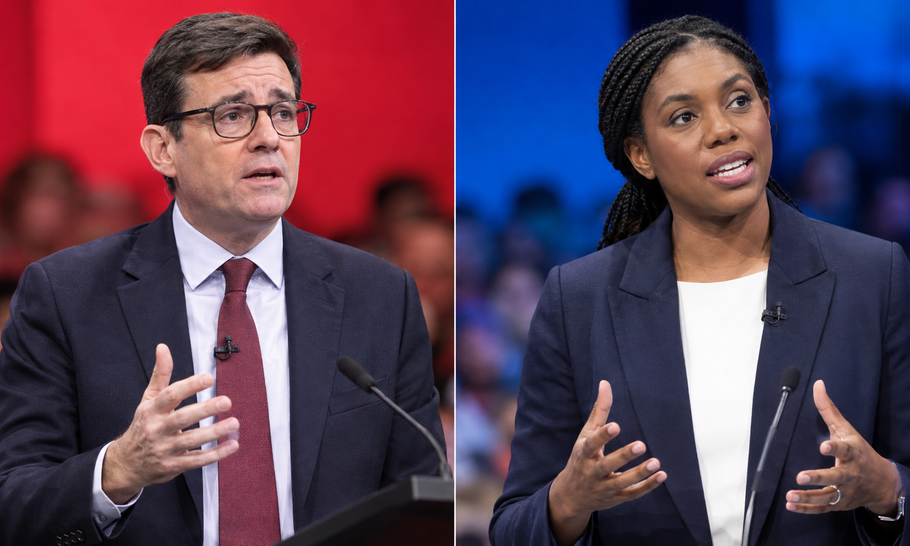
Andy Burnham and Kemi Badenoch at their party conferences
Three cheers for both leaders of Labour and the Conservatives. Andy Burnham and Kemi Badenoch are charismatic and able to communicate their vision, purpose, and priorities. After around twenty years of national stagnation and decline, these are vital attributes. But a re-run battle of the Labour 1970s and Conservative 1980s is not the answer.
This new AI era is much more complex, volatile and dangerous than in the 1970s and 1980s. The prime ministerial three to four layers of multi-dimensional chess then is closer to 10 layers today.
Close to Budget day the Prime Minister needs to address the nation, explain the context of the Budget, and explain why he is instigating a transformational top-down and bottom-up whole of nation effort to get Britain match-fit for the next ten years. A 10 year plan like no other in British history.
Too few key people are asking themselves the right question. Einstein famously said if he had 10 minutes to save the world that he would spend nine examining the question. Many political leaders and key advisers seem incapable of thinking beyond their single-party mindset and election winning manifestos. Most only conceive the national interest through the prism of their political path to power. The questions they should ask are: what do our nation and society need to face the AI era’s big challenges? Can single-party government even cope?
The public have become used to and now expect to have promised to them what they want, as opposed to what nation and society need. Our defective polity and fragile democracy cannot break out of the doom loop because our “punish the incumbent” voting habit inhibits any single party from doing the much tougher things required today than Attlee, Thatcher or Blair ever contemplated.
The really big issues and difficult questions, of course, are not suitable party conference topics. But given the dire state of the economy and restless society at home, the volatile international situation, and fact that decisions made in Washington, Moscow, Beijing, and Teheran will often trump those made in London, the burning question is: are we ready for the next ten years?
Join the dots and what very respectable authorities and experts are saying, and the answer is a resounding “No”.
British Economy: sick man of Europe, poorer than our peers of 20 years ago, struggling under record debt, welfare, bond yields and interest rate burdens.
British Society: less cohesive and more febrile than for generations; traditional family, community, and geographical boundaries breaking down; we have failed our youth and NEET generation (Gordon Brown’s latest book, Alan Milburn’s report). There’s a risk of serious social disorder under the surface.
Defence and Resilience: after thirty years hollowing out British defence and resilience resembles the slowly boiled frog; inexplicable failure to fund the Strategic Defence Review at the speed required and expected by NATO and allies. There’s a risk that we fail to deter enemies, protect vital interests and critical national infrastructure and supply chains, and encourage our enemies.
Climate and Environment: the Climate National Emergency Briefing initiative calls for the PM to address the nation and summon up a wartime-level effort in response to the climate emergency; around 140 MPs support the initiative – party whipping against has held back a majority of MPs from backing it and thereby forcing the government to be more proactive.
Malevolent AI: whilst radical improvements including in health care, food production and public services symbolise good AI, job losses, displaced human relationships, and empowerment of evil and malevolence symbolises the bad; “even under the best circumstances, transition to this new AI era will be one of the most turbulent times in history” (Bill Gates); William Hague has urged the PM to address the nation and mobilise society in order to grip AI and get ahead of others. A super-intelligence arms race is driving the pace of AI development and the private sector networks involved are hard to control and regulate.
The unsettling reality is that we are very under-prepared for the next decade and the scale and speed of preparation needed. We are teetering on multiple and inter-related brinks, and quite likely to go over one soon (bonds/economic crash, further escalation, or war?). Go over one brink, and there is a high likelihood that it will push us over another. We may find ourselves rapidly facing simultaneous crises – unlike during the Cuban missile crisis or 9/11.
Respectable commentators are not ruling out a full-blown fiscal crisis. In that event, consider what Putin could choose to do to make life doubly difficult at precisely the worst moment. This stubbornly under-resilient nation and society would be facing a historical level test. Is our governing system and society ready for this?
In short, there are Tier One (global existential) risks: nuclear exchange, climate change, and AI/Super-intelligence (the three horsemen). Tier Two Risks include some very serious ones to do with the three aged autocrats running the world. These risks are interchangeable, and second tier risks could rapidly spring out of control of rational human actors.
The rules-based order has gone, and the hierarchy of order is changing. Powerful nations sideline the international organisations that provided some restraint, and states are ceding power to global corporations and technical organisations and to their citizens empowered with direct access to information, knowledge, goods, and capital. Our world is in unprecedented flux. The old order is disappearing at breakneck speed and the multi-crisis has arrived.
The truth is that single party and multi-ministry government has failed us spectacularly these last twenty years. At home and abroad some things look set to get worse for a host of reasons. Only cross-party government and integrated decision making and directing a whole of nation effort will enable us to do the hard stuff: grow and diversify the economy (the top priority), tackle the debt, welfare, and bureaucracy drag anchors, prioritise the next generation, and reboot defence, national resilience, and climate and environment action.
Political leaders should, of course, convey hope and confidence in challenging times. But if hope and confidence is to endure beyond party conference sugar-rush days, the population need to be told some of the hard truths about the next 10 years that our leaders are not spelling out.
So, Prime Minister, what is the plan? The present governing system is patently unfit for the next decade and beyond. Who is overseeing the preparations for governing in multi-crisis, war, and chaos? We might need to know very soon. Do we wait for cataclysm? Or should we get ahead of the herd, as the UK has done time and again over the centuries?
We need a new governing system that makes decisions and delivers at AI-era tempo. Britain has some considerable strengths and assets, including next generation brains and technological skills, and the means to rise to the occasion and return to having a pivotal leadership role in Europe once again. But it needs the Prime Minister to grip this moment.
A Message from TheArticle
We are the only publication that’s committed to covering every angle. We have an important contribution to make, one that’s needed now more than ever, and we need your help to continue publishing throughout these hard economic times. So please, make a donation.


