What has the BBC done to itself?


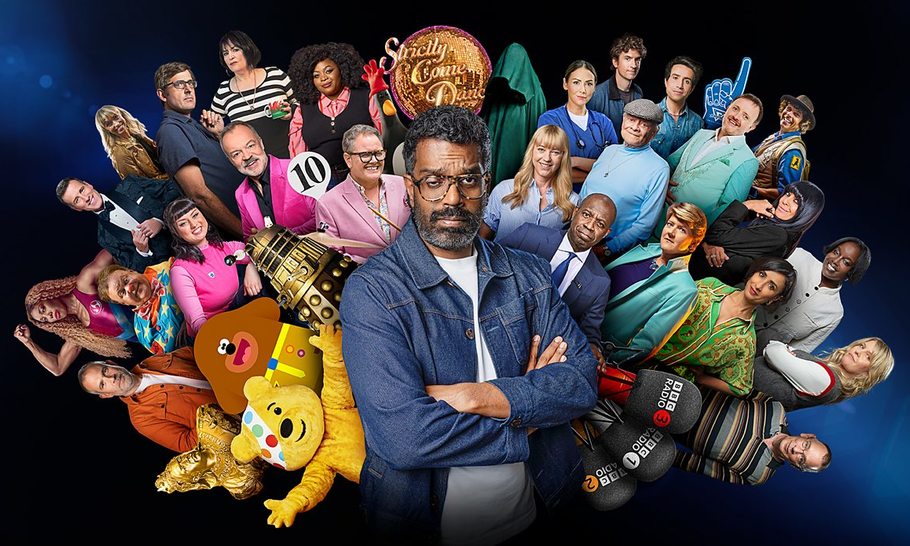
The timing for the current commercial for the BBC (“What has the BBC ever done for me?”) could hardly be worse. This is no reflection on the choice of the presenter, Romesh Ranganathan, a charming comedian and well-known TV personality. It was probably a good idea to choose someone of Sri Lankan heritage and the BBC must have thought it was good timing with Ranganathan appearing in the new series of Celebrity Traitors.
However, the problem is with the product itself, reflected in the falling number of licence fee payers. The number of active BBC TV licences dropped by 539,000 to 23.3 million at the end of the 2025/26 financial year—the lowest total since 1999. The BBC’s audience is voting with its feet.
There are a number of obvious reasons for this dramatic decline in both ratings and licence fee payers. First, sport. Apart from flagship programmes like Wimbledon, the Olympics and major international athletics events, the FA Cup Final and the World Cup (shared with ITV), BBC TV has struggled to win or retain rights to popular sports programmes such as live football (especially The Champions League) and international cricket. Now the BBC is reportedly set to lose the majority of its rugby league broadcasting rights ahead of the 2027 season, this year’s Commonwealth Games were shown on TNT Sports, bringing an end to the BBC’s continuous coverage, dating back to 1950. Channel 5 rubbed salt into these wounds and snapped up the free-to-air highlights. The Boat Race and England’s Six Nations matches have also jumped ship. Match of the Day only has the rights to show Premier League highlights until 2029 and daily highlights of the England men’s cricket team home matches until 2028.
There is also the not insignificant matter of the quality of the coverage itself. The golden age of Cliff Morgan and Bill McLaren, Richie Benaud and Eddie Waring is long over. In recent years, Test Match Special (for many years a personal favourite of mine and countless others) has lost Brian Johnston (1993), the late great Bill Frindall (2008), Henry Blofeld (2017), Graeme Swann (2019) and Geoffrey Boycott (2020). Similarly, Match of the Day has lost their best pundit, Alan Hansen (2014), their most popular commentators, Barry Davies (2004) and John Motson (2018) and their longtime presenter, Gary Lineker (2025). The BBC’s Wimbledon coverage recently lost Sue Barker (2022) and this summer the commentator Andrew Castle made an emotional farewell.
Perhaps most damaging of all is the decline of BBC News and Current Affairs. The more ads you see for how trustworthy BBC News is, the more you realise BBC News cannot be trusted to be impartial, especially about Israel. I have written about this on numerous occasions for TheArticle, so I won’t repeat myself, but the most egregious examples were John Simpson and Today presenter, Mishal Husain, both refusing to call Hamas a terrorist organisation, even though it is designated as such by by the United Kingdom, the United States, the European Union and several other countries, including of course Israel. Simpson said, “terrorism is a loaded word, which people use about an outfit they disapprove of morally”. He maintained that the BBC’s job is not to tell audiences “who are the good guys and who are the bad guys, but rather to present the facts objectively and let the audience make up their own minds”. Yet there he is still pontificating about “world affairs” on the BBC News Channel. Mishal Husain got into a famous row with the then-defence secretary, Grant Shapps, about whether or not Hamas was a terrorist organisation. She left the BBC soon afterwards.
However, the biased coverage continues, with news programmes leading on stories about violent Israeli settlers on the West Bank, when not one of the Sunday papers led with this story the next morning. There are plenty of more trivial examples. In a recent broadcast of the Sunday with Laura Kuenssberg show, Dale Vince, one of her studio panel, was introduced as a donor to Labour. He wore a keffiyeh, creating a storm on social media.
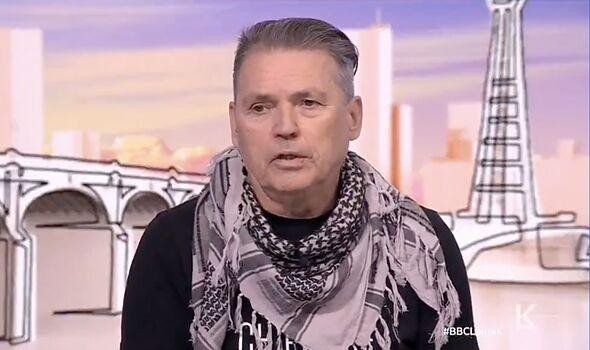
Dale Vince on Sunday With Laura Kuenssberg, BBC1
In addition to issues of bias, there is also the long-term decline of BBC news flagship programmes, most obviously Newsnight. This warhorse seems clearly set for the knackers yard, losing presenters at an alarming rate (Emma Barnett, Lewis Goodall and Emily Maitlis, all 2022) and Kirsty Wark (2024). Today on Radio 4 is also fast losing presenters: James Naughtie (2015), Sarah Montague (2018), John Humphrys (2019), Martha Kearney (2024), Mishal Husain (2024) and, most recently, Amol Rajan and Emma Barnett (both 2026). That’s seven presenters in eleven years. As The Spectator said, “As Oscar Wilde – were he a media correspondent – might have said, to lose one presenter is misfortune. To lose two looks like carelessness.” Indeed. Perhaps more significant is where they are going. Mishal Husain left for Bloomberg, Emily Maitlis and Lewis Goodall joined Jon Sopel (also formerly of the BBC) at a podcast called News Agents.
Third, there is the never-ending flow of scandals and controversies in recent years: In the days following Prince Philip’s death in 2021, the BBC received over 100,000 complaints, a record number for British television, accusing it of excessive coverage and its perceived attempt to manufacture an allegedly absent national grief. In 2021, accusations emerged that Martin Bashir, a former interviewer for the BBC programme Panorama, had lied to secure his 1995 interview with Diana, Princess of Wales. Allegations of sexual impropriety against the BBC’s highest-paid newsreader, Huw Edwards (2023) led to his resignation. In February 2025, BBC Two aired a documentary titled Gaza: How to Survive a Warzone as part of its This World series. The film was narrated by a 13-year-old boy, the son of Hamas‘s deputy minister of agriculture. At the Glastonbury Festival 2025, punk-rap duo Bob Vylan sparked controversy when they led the crowd in chants of “death to the IDF’, referring to the Israeli Defence Forces, during a live performance broadcast by the BBC. In the latter case, the then BBC Director-General Tim Davie publicly called the decision to air the set “a very significant mistake”, while the corporation’s Director of Music, Lorna Clarke, stepped down from her daily responsibilities following internal criticism. There is currently a lawsuit pending against the BBC for its editing of a speech by President Trump on Panorama, although there have been reports that the case is not going well for the White House. On 27 January 2026, during Holocaust Memorial Day coverage on BBC Breakfast and BBC Radio 4, several news bulletins and introductions failed to explicitly identify the “six million people murdered by the Nazi regime” as Jewish, causing widespread outrage.
This is partly a matter of bad governance. Again, the turnover is significant. Since 2012 there have been five people who have served as Director-General, not including Rhodri Talfan Davies who served as acting DG between April-May 2026. The longest serving since the 1970s were John Birt and Mark Thompson, both of whom lasted just eight years. Recent heads of the BBC were a curious mix of grey men from news and current affairs (Mark Thompson, George Entwistle and Tony Hall) and men from marketing or tech (Tim Davie, ex-Procter and Gamble and PepsiCo Europe and Matt Brittin, ex-Google).
What they had in common was that few will have heard of any of them and none of them made programmes anywhere at the BBC outside news and current affairs, which has produced more scandals than any other department at the BBC. Apart from John Birt and Greg Dyke no recent DG has come from a broadcaster outside the BBC. Big names like Jeremy Isaacs (former Director of Programmes at Thames and Chief Executive at Channel 4) and David Elstein (former Director of Programmes at Thames, Head of Programming at BskyB and Chief Executive at Channel 5) were never chosen.
The BBC is in a terrible state. It is losing licence fee payers, it has lost the trust of countless viewers and listeners, it cannot compete for sports rights, it is riddled with scandals and controversies, and for years it has been led by people most people have never heard of. The future is even worse, if it has a future at all. I say this with enormous regret and much anger having spent some of the best years of my life making programmes for BBC2 and Radio 4. It was a privilege working with people like Jeremy Isaacs, Melvyn Bragg and Michael Ignatieff. Watching the BBC squander considerable sums of money on promoting itself, as its product declines, is not.
A Message from TheArticle
We are the only publication that’s committed to covering every angle. We have an important contribution to make, one that’s needed now more than ever, and we need your help to continue publishing throughout these hard economic times. So please, make a donation.


