He was robbed: Nimzowitsch and nomenclature


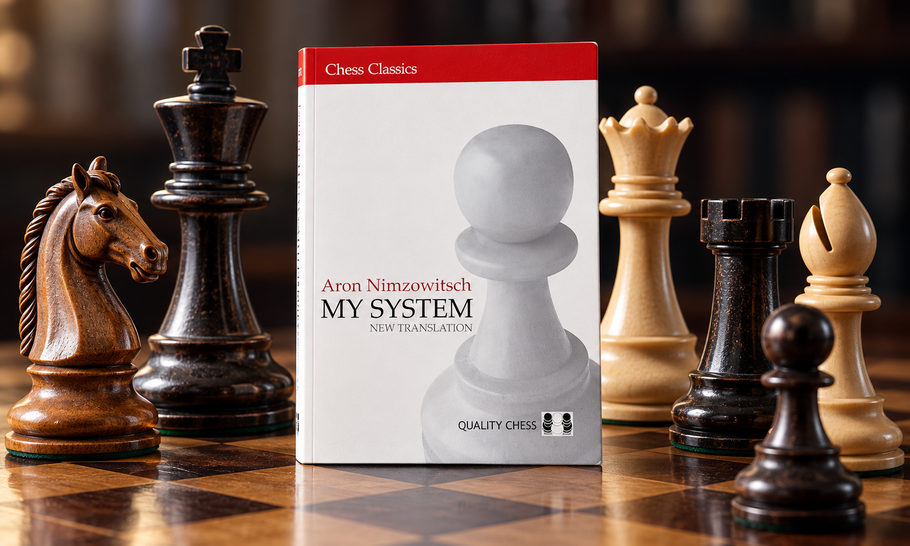
Posterity has named the following line of the Caro-Kann Defence as the Bronstein/Larsen Variation. However, my hero Aron Nimzowitsch introduced it already in 1907, before either of the two unintentional usurpers were even born. The variation goes like this: 1. e4 c6 2. d4 d5 3. Nc3 dxe4 4. Nxe4 Nf6 5. Nxf6+ and now …gxf6. Nimzowitsch introduced this, wielding his new weapon with consummate success, so it is quite unfair that David Bronstein and Bent Larsen (who have, admittedly adopted the line to considerable effect) should have been credited with the eponymous invention.
Perhaps it has been thought that the fertile brain of the author of My System was already overladen with attribution, and that the laurels needed to be distributed more equitably. True, 1. b3 is already associated with Nimzowitsch, as is 1. e4 Nc6, not to mention the provocative 1. e4 c5 2. Nf3 Nf6, and most famously of all, the Nimzo-Indian Defence, 1. d4 Nf6 2. c4 e6 3. Nc3 Bb4.
In my opinion, though, richness of creative inspiration should not grant carte blanche for the great man to be robbed of the laurels of appropriate identification of yet another of his legitimate intellectual offspring.
I have a strong affection for this particular concoction from the witch’s cauldron of Nimzowitsch’s turbulent imagination. This week’s selection of three games ram home that point.
Graham K Sandiford vs. Raymond Keene
Match, game 5, 1961
- e4 c6 2. d4 d5 3. Nc3 dxe4 4. Nxe4 Nf6 5. Nxf6+ gxf6 6. Nf3 Bf5 7. Bd3 Bg6 8. Bxg6 hxg6 9. Bf4 Nd7 10. O-O Nb6 11. Bg3 e6 12. Qe2 Bd6 13. c4 Bxg3 14. fxg3 Qd7 15. a4 Kf8 16. a5 Nc8 17. Qf2 Nd6 18. b3 Kg7 19. Rad1 Ne4 20. Qe3 f5 21. g4 Rae8 22. Ng5 Nxg5 23. Qxg5 f6 24. Qf4 g5 25. Qf2 Qc7 26. g3 Qxa5 27. gxf5 Qxf5 28. Qxf5 exf5 29. Rde1??
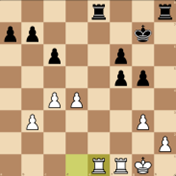
This blunder gifts Black an important central passed pawn, after which White is never permitted a re-entry into the game. Necessary was 29. Rxf5 Re2 30. h4 gxh4 31. Rdf1 Re6 32. d5 cxd5 33. Rxd5, with a playable game and a level position.
29… Re4 30. Rxe4 fxe4 31. Ra1 a6 32. Ra5 Rd8 33. d5 cxd5 34. cxd5 Rd6 35. Rc5 Kg6 36. g4 f5 37. gxf5+ Kxf5 38. Rc7 Rb6 39. d6 Rxd6 40. Rxb7 Rd2 41. Ra7 Ra2 42. b4 e3 43. Kf1 Kg4 44. b5 Rf2+ 45. Kg1 axb5 46. Ra3 Kf3 47. Rb3 Rg2+ 48. Kf1 Rxh2 49. Kg1 Rg2+ 50. Kh1 Rg4 51. Rb2 e2 52. Rb1 Kf2 White resigns 0-1
White cannot escape mate in two.
In the following encounter, I played with the Black pieces in a blindfold exhibition game. Four years later in 1975, my opponent would win the World Junior (Under-19) Championship.
David Goodman vs. Raymond Keene
London Chess Centre, blindfold exhibition, London, 1971
- e4 c6 2. d4 d5 3. Nc3 dxe4 4. Nxe4 Nf6 5. Nxf6+ gxf6 6. Ne2 Bf5 7. Ng3 Bg6 8. h4 h5 9. Be2 Nd7 10. c3 Qa5 11. Bd2 O-O-O 12. c4 Qb6 13. Bc3 e5 14. dxe5??
White destroys his chances with this one indiscretion, opening the d-file with his queen so precariously situated. Instead, 14. O-O Qc7 15. d5 Kb8 16. Rc1 e4 17. dxc6 Nc5 18. Bxf6 Rxd1 19. Rcxd1 Bg7 20. Bxg7 Rg8 21. Bf6 is a far more sensible process of development.
14… Nxe5?!
At the first time of asking, Black fails to take full advantage of White’s last blunder. Much better is 14… Nc5 15. b4 Rxd1+ 16. Rxd1 Na4 17. c5 Bxc5 18. bxc5 Qxc5 19. Ba1 Qa5+ 20. Kf1 fxe5 when the Queen is left hopelessly isolated, with the b3- and a4-squares unavailable.
- Qb3 Qc7 16. a4?
This slow and ponderous continuation presents Black with a second destructive opportunity. White must attend to king safety with 16. O-O f5 17. Rad1 Bc5 18. Qa4 f4 19. b4 Bxf2+ 20. Kxf2 fxg3+ 21. Kg1 a6 22. Qa5, when the position remains a level one.
16… Rd3?!
Black sees a workable exchange sacrifice, and cannot resist its lure, but objectively 16… Nd3+ (almost as good is 16… Ng4 17. O-O Bc5 18. Bb4 Qb6 19. a5 Qxb4 20. Qxb4 Bxb4) 17. Bxd3 Rxd3 18. Ne2 Bc5 19. Rd1 Qe7 20. Rxd3 Bxd3 21. Qd1 Rd8 is terminally toxic for White.
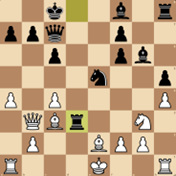
- Bxd3??
Even now, after two blunders in three moves, White could have salvaged equality with 17. O-O Bc5 18. Kh1 Rhd8 19. Bxd3 Nxd3 20. Bxf6 Bxf2 21. Rxf2 Nxf2+ 22. Kg1 Nh3+ 23. Kh1 Rd3 24. Qb4 Nf2+ 25. Kg1.
17… Nxd3+!!
Black needs no further invitation and strikes decisively.
- Ke2 Nxf2 19. Kxf2 Qf4+ 20. Kg1 Bc5+ 21. Kh2 Qxh4 checkmate 0-1
Finally, I would like to close with an interesting game because Black is playing on both sides of the board and in the centre simultaneously. First of all Black has to avoid losing the isolated h-pawn for nothing. Then he has to attack White’s weakened queenside and thirdly, the only avenues of breakthrough involve smashing open the centre with …c5. I recall at the time thinking that this was one of the most difficult strategic games I had ever played.
The only dangerous line for Black, in my opinion, is for White to play 6. c3, followed by 7. Nf3 once the black queen’s bishop is on f5; and then 8. g3!
The idea is to make White’s kingside bombproof and then attack Black’s king with the fianchettoed bishop if they castle queenside, which is what Black wants to do. Black has various resources but this is the sole line I consider a serious theoretical test.
Oddly enough if Black prefers to play 5… exf6, another of my favourites, the sole serious test in my opinion, is again 6. c3!
U.K. Open Teams, England, 1985
- e4 c6 2. d4 d5 3. Nc3 dxe4 4. Nxe4 Nf6 5. Nxf6+ gxf6 6. Nf3 Bg4 7. Be2 Qc7 8. O-O e6 9. Nh4 Bxe2 10. Qxe2 Nd7 11. f4?!
The pendulum swings in Black’s favour after this inaccuracy. White could maintain an edge in the game by preferring, for example, 11. g3 Be7 12. c4 Nf8 13. d5 Ng6 14. Nxg6 hxg6 15. dxe6 Qc8 16. Re1 Qxe6 17. Qxe6 fxe6 18. Rxe6.
11… O-O-O 12. Be3 f5 13. Nf3 Nf6 14. c3 Bd6 15. Ne5 Bxe5 16. dxe5 Ne4 17. Rad1 Kb8 18. Rd4 Rxd4 19. Bxd4 h5 20. b4 h4 21. Rf3 Qe7 22. Rh3 b6 23. Qe1?!
After an admirably fluent transition into the middlegame, White again tilts the initiative in his opponent’s favour. After either 23. Rd3 h3 24. Rxh3 Rxh3 25. gxh3, or 23. Bf2 c5 24. Be1 cxb4 25. cxb4, White maintains parity within the position.
23… Qd8 24. a4??
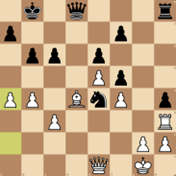
This loose move could lead to remarkably serious repercussions. Necessary was something like the following, 24. Qe2 Qd7 25. Bf2 Rd8 26. Kf1 Qd1+ 27. Qxd1 Rxd1+ 28. Be1 Ra1 29. Rxh4 Nxc3 30. Rh8+ Kb7 31. Rh7 Nd5, when White is still the master of his own destiny.
24… Ka8?
Over cautious. Had Black have spotted the more direct 24… Rg8 (24… Qd5 is also good) 25. Rf3 Qd5 26. h3 Nd2 27. Qxd2 Qxf3 28. Kh2 Qd5, he would have been close to winning.
- a5?
Not terminal, but a gift nevertheless. After, for example, 25. Bf2 Nxf2 26. Kxf2 c5 27. bxc5 bxc5 28. Qe2 Qa5 29. Qf3+ Kb8 30. Qc6, or 25. Qe2 Qd7 26. Bf2 Rd8 27. Kf1 Nxf2 28. Kxf2, White could still boast of full equality.
25… c5 26. bxc5 bxc5 27. Bf2 Qxa5 28. c4??
White cannot afford this error. Necessary is 28. Bxh4 Qa2 29. Re3 Rb8 30. Qf1 Qd2 31. Re1 Qxc3 32. Qa6 Qd4+ 33. Kh1, after which he is worse, perhaps much worse; but not losing.
28… Qa4 29. Bxh4 Qxc4 30. Re3 Rb8 31. Re2 Qd3 32. Re3 Qd4 33. Bf2 Nxf2 34. Kxf2 Rb3 35. Kf3 Qe4+ 36. Kf2 Qxf4+ 37. Rf3 Rxf3+ 38. gxf3 Qxh2+ 39. Kf1 Qh1+ 40. Kf2 Qxe1+ 41. Kxe1 White resigns 0-1
Mate will surely follow.
Ray’s 206th book, “ Chess in the Year of the King ”, written in collaboration with Adam Black, and his 207th, “ Napoleon and Goethe: The Touchstone of Genius ” (which discusses their relationship with chess) can be ordered from both Amazon and Blackwell’s. His 208th, the world record for chess books, written jointly with the late chess playing artist, Barry Martin, Chess through the Looking Glass , is now also available from Amazon.
A Message from TheArticle
We are the only publication that’s committed to covering every angle. We have an important contribution to make, one that’s needed now more than ever, and we need your help to continue publishing throughout these hard economic times. So please, make a donation.


