Symbolism in Orhan Pamuk’s ‘Snow’


One must have a mind of winter
To regard the frost and the boughs
Of the pine-trees crusted with snow.
Wallace Stevens, “The Snow Man”
The Turkish Nobel Prize-winner Orhan Pamuk says that he writes because of “intense anger with everyone, wish to tell the world what sort of life he lived, belief in literature, fear of being forgotten, quest for glory and immortality.” Snow (2002), his most ambitious novel, begins with the poet-hero’s arrival on a bus and ends with his departure on a train. Back from a twelve-year political exile in Frankfurt, Ka goes to the remote town of Kars (pop. 97,000) in northeast Turkey on the border of Armenia. Ruled for centuries by Seljuks, Mongols, Armenians, Ottomans and Russians, Kars was recaptured from Armenia by Turkey in 1920. Kars is one of the country’s snowiest regions, and has long freezing winters and deep blankets of powder.
The characters in the novel loathe Kars, the worst town in Turkey: “To visit our border city is a great sadness”; “Life here is so poor and hopeless”; “If you’re unlucky enough to live in Kars, you might as well flush yourself down the toilet.” Ka grimly observes how “the ice on the window gave an orange glow to the light from the streetlamps and the surrounding houses. Let the snow keep falling, he thought; let it fall for days and months on end; let it cover the city of Kars so completely that no one will ever find it again.”
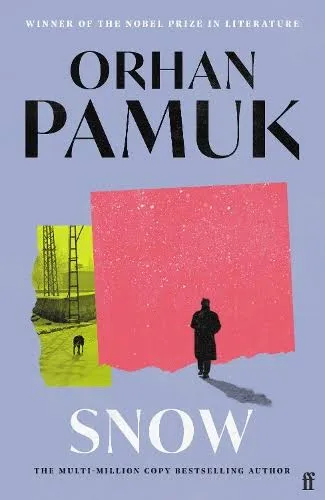
“Kar” means “snow” in Turkish. Ka’s multivalent name suggests both Kafka and kaka (excrement). Ka has come to Kars as a journalist to report on the municipal elections, the terrorists’ waves of murder and the recent suicides of schoolgirls. He makes his way through the snow-covered streets, brushes the snow off his coat and stays at the Snow Palace Hotel. It’s managed by his old lover, Ipek, now divorced from her husband but still attached to him.
Pamuk includes a precise scientific and anthropomorphic entry: “Snow is the solid form taken by water when falling, crossing, or rising through the atmosphere. Each crystal snowflake forms its own unique hexagon. Since ancient times mankind has been awed and mystified by the secrets of snow. Once a six-pronged snowflake crystallizes, it takes between eight and ten minutes for it to fall through the sky, lose its original shape, and vanish; the form of each snowflake is determined by the temperature, the direction and strength of the wind, the altitude of the cloud, and any number of mysterious forces. Ka decided that snowflakes have much in common with people.” The beauty and geometry of the large six-pointed diagram of a snowflake, reproduced on page 261 with Ka’s name in the center, represents the complex structure of the novel and the themes of reason, imagination and memory. The scientific and aesthetic aspects of snow also inspire the structure and themes of Ka’s poems. His poem “Snow” describes a mystical experience. Like the poems in Boris Pasternak’s Doctor Zhivago (1957) inspired by Lara, the poems in Snow, inspired by Ipek, are embedded in the novel.
The changeable and influential snow is an active force in the novel. After Ka enters the town, snow falls heavily and all the roads are blocked. As he leaves town at the end of the book, the snow melts, the roads re-open and the trains begin to run. By trapping and then releasing the characters, the snow influences their feelings and behavior. Snow seals in and cloisters all the people. So the tragic plot, which includes the performance of an Elizabethan play, Thomas Kyd’s The Spanish Tragedy (c.1587), seems to take place on a confined stage. It traps Ka in the remote, violent, depressing town from which he can’t escape. Snow envelops and covers up the suicides, murder and massacre, and Ipek bitterly declares, “Most of the time, being a Turk is either an excuse or a pretext for evil.”
Snow is distant and inspiring in Hemingway’s “The Snows of Kilimanjaro,” poetic and obliterating in David Guterson’s Snow Falling on Cedars. The volatile snow, which appears when the temperature falls below freezing, has contrasting qualities in Pamuk’s novel. It can turn to ice and hail; be solid and melting; heavy and light; fixed and flowing; raging and tranquil; threatening and comforting; festive and depressing; harsh and beautiful; ghostly and pure; silent and clean; real and dreamy. Like the feathery lace of a bridal veil flung into the air, it swirls aimlessly in easy wind and downy flake. It also plays a political role; it obscures clear sight, hardens the earth, buries the dead and reveals the murdered victims when it dissolves. Snow is oppressive when it symbolizes the state and traps Ka, liberating when it melts and allows him to escape.
Snow keeps the lovers isolated and together, but prevents Ka from having sex with his old mistress Ipek (which means sensual “silk” in Turkish). She won’t sleep with him when her father is in their hotel, and the old man doesn’t leave during the storm. When Ipek changes her mind and finally submits, the melting snow symbolizes an orgasmic release after their sexual union. The hypnotic and erotic snow illuminates the woman and unifies them in silent reverie: “For a long time the lovers lay side by side in bed, gazing silently at the snow. From time to time, Ka turned his head to watch the snow falling in Ipek’s eyes.”
Snow images frequently reappear. They both create and reflect contrasting feelings from depression and misery to tranquility and exaltation: “Ka continued dragging his feet down Ataturk Avenue, slowing down to negotiate the icy street corners and pausing from time to time to admire the huge snowflakes, the endless repetition of an ordinary miracle.” He sees boys throwing snowballs and making snowmen in the crystalline air. The snow-covered windows are like a scene from an old fairy tale. The branches bend under the weight of the snow. “The snowflakes had stopped moving; as he watched them hover in midair, it seemed as if time itself had stopped.”
Snow reflects Ka’s changing moods and “spoke to him of hopelessness and misery.
Outside, the snow was falling thicker and faster than ever; just the sight of it made Ka feel lonely. The pale streetlamps cast their ghostly glow over the empty snow-covered courtyard, the stillness of the scene brought him peace.” The sight of snow makes Ipek think how beautiful and short life is. When there’s no programme on television, the bored and passive inhabitants watch a flickering screen with mechanical snow, “an accurate description of our weather here.”
Two crucial passages in Snow were clearly influenced by Thomas Mann and by James Joyce. In the visionary “Snow” chapter of Mann’s The Magic Mountain (1924), the lifeless Alpine landscape, entirely buried beneath the icy symmetrical form of individual snowflakes, symbolizes death. Skiing on a sunny mountain and confused by its dazzling whiteness, the hero Hans Castorp realizes that his morbid mental state resembles a disease, and succumbs to the powerful temptation to lie down in the snow and freeze to death. But the very real threat of extinction strengthens his resolve to “let death have no mastery over my thoughts,” and fortifies his belief that “love is stronger than death.” In Pamuk’s novel Ka is also threatened by death, chooses life and explains, “I decided to leave this life and stretched out on the frozen pavement under a tree to wait for sleep and death to take me. You can withstand that sort of cold for four or five minutes before freezing to death. As the soft drowsiness spread through my veins, I saw before me the child I never had. At the same moment, a shaft of light pierced the place where I lay; shining right into my eyes, it went straight through me and woke me up.”
A more lyrical passage was influenced by the brilliantly rhythmic and poetic last paragraph of James Joyce’s “The Dead” (1916): “Snow was general all over Ireland. It was falling on every part of the dark central plain, on the treeless hills, falling softly upon the Bog of Allen and, farther westward, softly falling into the dark mutinous Shannon waves. He heard the snow falling faintly through the universe and faintly falling, like the descent of their last end, upon all the living and the dead.” Pamuk also writes poetically and appreciatively, “How large the snowflakes were, and how decisive. It was as if they knew their silent procession would continue until the end of time. The wide avenue was buried knee-deep; it climbed up a slope to disappear into the night. How white and how mysterious! The icicles from one of the oleander trees reached down as low as the snow blanket draping an invisible car; the snow and ice had merged to form a tulle curtain.” The mysterious anthropomorphic snow seems to have a will of its own. It moves decisively, buries a street, climbs a hill and disappears. Like a human being, its frozen form drops down to touch the softer snow. Like an artistic decorator, it forms a curtain and drapes a car.
Ipek first agrees to escape with Ka, then changes her mind and decides to remain. When the snowstorm stops, Ka leaves Kars on the first train out of town. Liberated from the horrors but weeping about the loss of Ipek, he ends in a dark mood: “All the people on the platform disappeared into the thick-falling snow. As I looked out the window through the snow at the orange lights of the outermost houses of the outlying neighborhoods, and the last snow-covered rooftops, the thin and elegantly quivering ribbons of smoke rising from the broken chimneys at last seemed a smudge through my tears.” Like the snow in Mann and Joyce, Pamuk’s snow is symbolic, thematic and tragic.
Jeffrey Meyers has recently published James Salter: Pilot, Screenwriter, Novelist and Parallel Lives: From Freud and Mann to Arbus and Plath (2024), Forty-Three Ways of Looking at Hemingway (2025) and The Biographer’s Quest (2026).
A Message from TheArticle
We are the only publication that’s committed to covering every angle. We have an important contribution to make, one that’s needed now more than ever, and we need your help to continue publishing throughout these hard economic times. So please, make a donation.


