Heroes from Havana


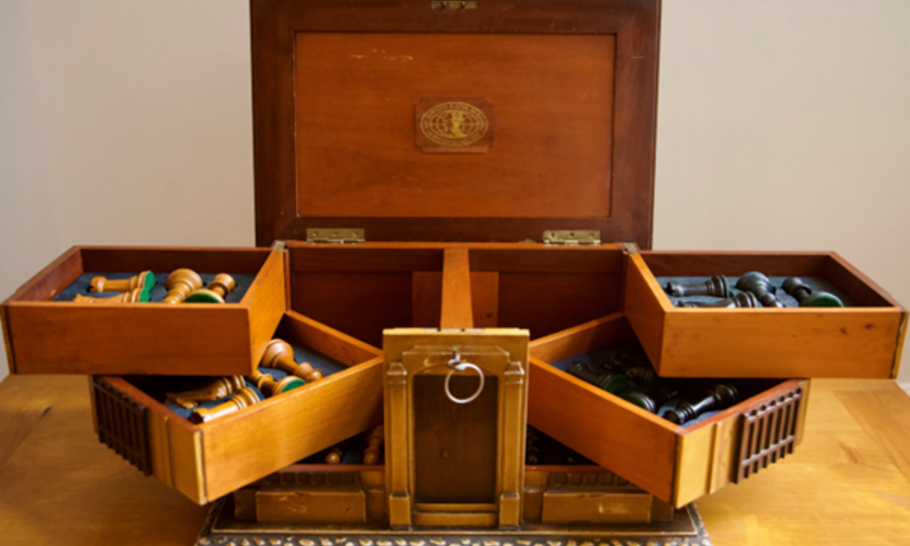
photo credit: Aiden Ronstrom
I have recently acquired Fidel Castro’s personal chess set (above), together with one of the specially designed tables used for the 1966 Havana Olympiad. The historic set and tables were created by María Victoria Caignet, a prominent Cuban designer. In 1960, she had joined the Furniture Department of the Ministry of Construction (MICONS), where she worked on major projects promoting Cuban design during the early years after the Revolution.
My attention has , therefore, naturally returned to the immortals of Havana—Larsen, Spassky, Najdorf, Tal, Gligoric, Portisch and the rest—and especially to the reigning champion and a future champion. In 1966 Tigran Petrosian, the wily Armenian Grandmaster, had just defeated his fellow Soviet challenger Boris Spassky, becoming the first reigning champion since 1934 to win a title match. Meanwhile, a rampant Bobby Fischer was already laying claim to the future, while the Danish Grandmaster Bent Larsen, having twice defeated Petrosian in the Piatigorsky Cup, annihilating him in two games at Santa Monica, was about to begin the triumphant tournament procession that would make 1967 his annus mirabilis.
All these men, and the author of this column, assembled in Havana in the latter part of 1966 for the Olympiad, the great world team competition. The event was presided over by the cigar-smoking Cuban revolutionary dictator Fidel Castro, with whom I and the other team members attended several official dinners and functions. At one, Castro was mobbed by diners seeking autographs on their menus. I, having practised the small art of foresight, had brought his autobiography, History will absolve me. When I presented it, he was so pleased that he signed it twice—once at the beginning and once on the final page.
Acknowledgement of source:
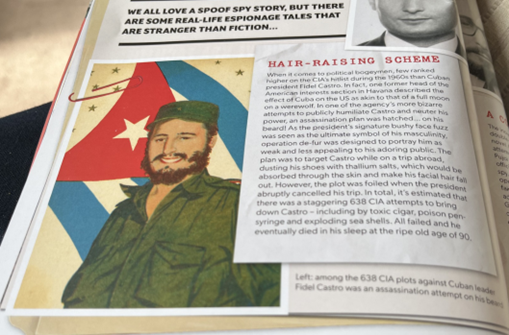
The performance programme of The Comedy about Spies, currently playing at London’s Adelphi Theatre.
There is another controversial point worth remembering. Of all his many distinctions, Fischer never won the Olympiad gold medal for the best individual score on top board. In 1960 it went to Mikhail Tal; in 1962 to Fridrik Olafsson; and in 1966, as we shall see, to Petrosian. In Fischer’s final Olympiad, in 1970, the gold went to the then world champion Boris Spassky, who defeated the American Meteor in their mano a mano encounter.
At Havana in 1966, where Petrosian won the first of his golds, it was openly said that he had ducked his most dangerous opponent, Bobby Fischer. Fischer himself, having been on course for the gold medal, overreached at the last moment and lost to the nervous — but talented — Romanian Grandmaster Florin Gheorghiu, allowing Petrosian to sneak past at the final post.
So the story goes. The truth is more curious. For the USA v USSR match, the original pairing was indeed Fischer v Petrosian. I was there. I saw the name cards, and I know why the game never took place. Owing to some footling complaint by Fischer concerning the half-baked timetable of a new-age religious cult, to which he had temporarily subscribed, the USA team failed to appear and was defaulted. Petrosian therefore won the first round without playing, defeating Fischer by default because the American top board simply did not turn up.
Yet, in accordance with the principle of noblesse oblige, the USSR generously permitted a replay later, on what had originally been designated a free day. By then Petrosian was entangled in several lengthy adjournments and may quite understandably have been reluctant to replay a game he had already won. Six years later, when Boris Spassky defended his crown against Fischer in Reykjavik, Fischer was also a no-show for game two, and Spassky accepted the defaulted point. He did not claim the entire match, though he might have done so, but nobody criticised him for taking the point. I know from experience that it is psychologically difficult to replay at full strength a game one has already won. Spassky knew it in 1972, and Petrosian knew it in 1966.
Back in Havana, with the Americans given their second chance, the USSR rested Petrosian and put Spassky on top board; the game with Fischer was drawn. Yet another neglected fact is that the Soviets regarded Bent Larsen, rather than Fischer, as the chief threat to Petrosian. Larsen had twice beaten the World Champion in the Piatigorsky Cup and was about to begin the extraordinary sequence of tournament victories that would carry him almost to the summit.
Petrosian, however, did not duck Larsen. He faced him with Black and set out to win. For the World Champion this was surely the supreme challenge of the Olympiad, his reputation resting on the result. Victory would bring revenge and confirm his position as number one; a third consecutive defeat by the same opponent would have struck hard at his prestige. If Petrosian had been animated by cowardice or base calculation, this was precisely the contest he ought to have avoided.
Instead, he won a nerve-wracking battle by means of his characteristic exchange sacrifice. And what of Larsen and Fischer? Who won that encounter? Strangely enough, Fischer, who had himself lost to Larsen in the Piatigorsky Cup, chose to rest that day and allowed another team member to meet the great Dane. The “Bobby was robbed” lobby, in its vigorous demand that Fischer should have won the gold medal, was understandably less eager to mention this inconvenient fact.
Here is my best game from the Havana Olympiad, which was reproduced in the official tournament book as one of the best of the competition. Aged 18, I was the youngest English player ever to compete at that level. Nowadays, with our British champions, Bodhana Sivanandan and Shreyas Royal, such former records have been easily smashed.
Raymond Keene (ENG) vs. Matti Rantanen (FIN)
FIDÉ Chess Olympiad, Finals (Group B), Havana, 1966
- d4 Nf6 2. c4 e6 3. Nc3 Bb4 4. e3 O-O 5. Bd3 d5 6. Nf3 c5 7. O-O dxc4 8. Bxc4 Nbd7
This game is included partly to demonstrate the value of studying a fine example. White consciously based his layout of the middlegame on the game Reshevsky – Donner, Santa Monica 1966, which now saw 9. Bd3 b6 10. a3 cxd4 11. exd4 Bxc3 12. bxc3 Bb7 13. Re1 Qc7 14. Bd2 Rfe8 15. Qe2 Rac8 16. Rac1 Bd5 17. c4 Bb7 18. a4 Qc6 19. Bf4 Qxa4 20. Ra1 Qc6 21. Rxa7 Ra8 22. Rxa8 Rxa8 23. h3 Ra3 24. d5! exd5 25. cxd5 Qxd5 26. Bc4 Qc5 27. Bxf7+ Kxf7? 28. Qe6+ Kg6 29. Bd6 Qa5 30. Ne5+ Nxe5 31. Rxe5 Ra1+ 32. Kh2 Qa8 33. Qf5+ Kf7 34. Re7+ Kg8 35. Be5 Re1 36. Rxg7+ 1-0.
- Qe2 b6 10. Bd2
Shunning the complications of the “theoretical” 10. d5!?, e.g. 10… Bxc3 11. dxe6 Ne5 12. exf7+ Kh8 13. bxc3 Bg4 14. e4 Qe7 15. Re1 b5 16. Bxb5 Nh5 17. Bg5 Qe6 18. Qe3 Bxf3 19. gxf3 Qxf7 20. Be2 h6 21. f4 Nxf4 22. Bxf4 Qxf4 23. Rad1! Gligoric – H. Olafsson, Lone Pine 1979. Conceivably 17… Nxf3+ is stronger.
10… Bb7 11. Bd3 cxd4 12. exd4 Bxc3!?
Surrendering a tempo, although that is not necessarily a disaster. However, a constructive waiting move, such as 12… Re8, would have been more in keeping with the needs of the position.
- bxc3 Qc7 14. Rac1 Rfe8
14… Ng4? loses to 15. Bxh7+ Kh8 16. Be4.
- Rfe1 h6 16. h3 Rac8 17. a4 Bd5 18. c4 Bb7 19. a5 Ba6
Too direct a method of assailing the hanging pawns. Black must intensify his pressure along the a8-h1 diagonal with …Qc6! The main point of this is to freeze White’s knight on f3.
- axb6 axb6 21. Rc3
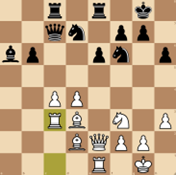
Protecting the c-pawn and also preparing to swing the rook across to the kingside via the third rank.
21… Bb7 22. Bb1 Ba6
There was still time for 22… Qc6! 23. Bd3? Intended as a harmless repetition, but it gives Black a further chance for …Qc6 on move 24.
23… Bb7 24. Bb1 Ba6? 25.Ne5!
Renders Black defenceless against the mass transfer of white pieces to the king’s wing.
25… Nxe5 26. dxe5 Nd7 27. Rg3 Bxc4 28. Qh5
Even simpler is 28. Qg4, which would force an advance of Black’s g-pawn, but the move chosen has the merit of creating an elegant sacrificial conclusion.
28…f5
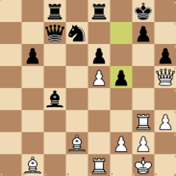
- Rxg7+!
From now on all of Black’s moves are forced.
29… Kxg7 30. Qxh6+ Kg8 31. Re3 Nxe5 32. Rg3+ Ng4 33. hxg4 Re7 34. gxf5+ Rg7 35. f6 Rxg3 36. fxg3 e5
A forlorn attempt to retrieve the services of his bishop.
- Qg6+ Kh8 38. Qh6+ Kg8 39. Qg6+ Kh8 40. Bh6 Bd5 41. Bg7+ Kg8 42. f7+ and mate next move. 1-0
Ray’s 206th book, “ Chess in the Year of the King ”, written in collaboration with Adam Black, and his 207th, “ Napoleon and Goethe: The Touchstone of Genius ” (which discusses their relationship with chess) can be ordered from both Amazon and Blackwell’s. His 208th, the world record for chess books, written jointly with the late chess playing artist, Barry Martin, Chess through the Looking Glass , is now also available from Amazon.
A Message from TheArticle
We are the only publication that’s committed to covering every angle. We have an important contribution to make, one that’s needed now more than ever, and we need your help to continue publishing throughout these hard economic times. So please, make a donation.


