John Wain: a memoir and a tribute

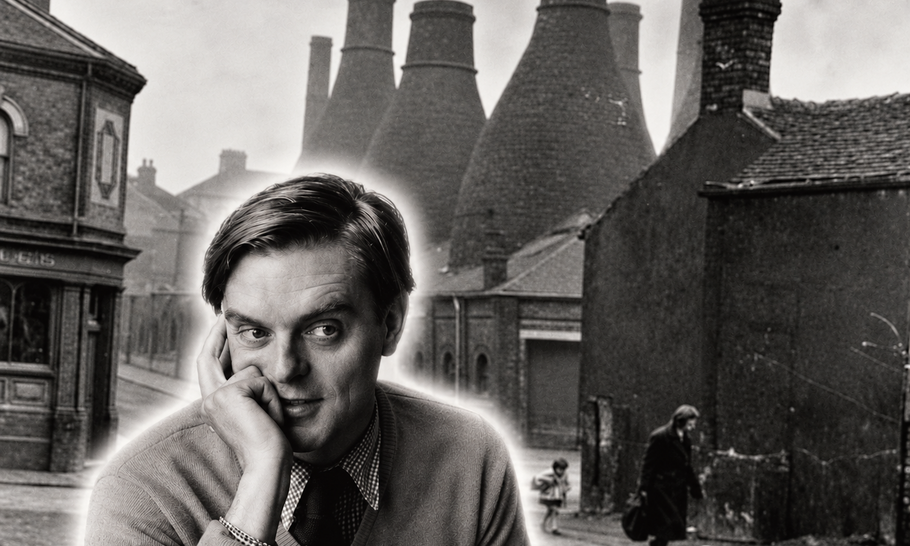
John Wain and 'The Potteries'
The reputation of John Wain (1925-1994) has been overshadowed by the extensive scholarship on his friends Kingsley Amis and Philip Larkin, but his achievement as poet and novelist deserves greater recognition. Wain was born in the gritty industrial pottery and coal-mining city, Stoke-on-Trent in Staffordshire, which he called “a strange barbaric region of smoking chimneys and unintelligible accents”. The son of a prosperous dentist specialising in false teeth, he was educated in local schools. A detached retina and impaired vision exempted him from military service during World War Two.
Sprightly Running (1962), the precocious autobiography of his life until 1960, did not describe his crucial interviews for admittance to Oxford and merely recalled, “I had passed no examinations except the simplest kind that qualified one for entrance, won no scholarships. I was going to Oxford because my father was able and willing” to pay for it. He read English at St. John’s College from 1943 to 1946. His tutor was the distinguished scholar and political reactionary C. S. Lewis, and he earned a First Class degree. In 1946-49 he was a Fellow of St. John’s and held a simultaneous position as Lecturer in English Literature at Reading University, 1947-1955. He married his colleague at Reading, Marianne Urmston, in 1947. He became seriously ill and depressed in 1953, took a leave of absence from Reading and spent a recuperative winter in the Swiss Alps.
Rather perversely, his autobiography hints at but doesn’t fully discuss the most tumultuous and interesting aspects of his life. “All the misfortunes of the next ten years: exhausting inward conflicts, breakdowns of mind and body, illnesses, painful operations, wild behaviour, quarrels with old friends, and finally heartbreak and isolation” after his first divorce. “The central crisis of my life, which broke so much in me that a dozen lifetimes would not suffice to mend it all, was the parting from my first wife.” In 1956 his marriage came to grief, “messily, in a welter of tears and agony. We tore out our own entrails in the process, wounding and wrenching where we longed to give love and comfort.”
Wain explained why he resigned from a safe berth at Reading University, and became a freelance author, journalist and broadcaster: “I wanted to spare the university the embarrassment of witnessing a divorce between two members of its teaching staff.” He left teaching because he wanted to write, thought he would be better as a critic than as a scholar, and “decided that I should be more useful as well as happier as a free-lance.”
He spent 1958-59 in America. He was invited to the MacDowell Writers’ Colony in New Hampshire; then lived near Manhattan in Brooklyn Heights, where his neighbours were W. H. Auden, Arthur Miller and Truman Capote. An inspiring and effective teacher, he did not entirely abandon academic life. To supplement his income, he was the Elliston Poetry Lecturer at the University of Cincinnati in 1962; visiting professor at Bristol University in 1967; and visiting professor in Paris in 1969. He taught creative arts at Brasenose College, Oxford, in 1971-72; and was Professor of Poetry at Oxford in 1973-75. An all-round literary man—novelist, poet and critic—Wain was loosely associated with the Angry Young Men and the Movement poets. After his miserable divorce, in 1960 he married his second wife Eirian James, who worked in the sound recording department of the British Council, and they had three sons. She died in 1988, and the next year he married his third wife, the art teacher and editor Patricia Dunn.
The title of Sprightly Running comes from a poem by John Dryden and the structure of the book is odd. He devotes 74 long pages to his childhood, and describes his frequent beatings on the way to school and in school by tough lower-class boys. Though his parents and teachers did nothing to prevent this public brutality, Wain unjustly accuses himself of cowardice. The bullies taught him the Darwinian lesson “that life was a perpetual effort to survive” and helped him “to understand the nature of totalitarianism”.
Wain writes only three discreet but suggestive pages on his first marriage: “my personal life, lurching from crisis to crisis”, was a “ghastly failure”. He includes 33 long pages on his friend, the obscure, eccentric, wealthy homosexual and flagellant E. H.W. Meyerstein, “a perfect example of a life smashed by collision with the academic Establishment.” Wain devotes a few pages to C. S. Lewis, F. R. Leavis and the Oxford University Press publisher Charles Williams; his positive impressions of America and negative view of Russia in 1960; his difference from the Angry Young Men; and all-too-brief references to Samuel Johnson, George Orwell and his friends Philip Larkin and Kingsley Amis. He also offers a teasing glance at Arthur Miller and “the soft, gentle, sleepy-eyed, cooing” Marilyn Monroe during a brief period of peace in their troubled marriage. Wain slyly adds a double entendre on petting: “I had no girl for whom I felt anything,” and was often witty: His family was “too poor to have ancestors”; “My plays, since they have not yet been written, cannot be known by any other mind than mine.”
After reading Wain’s autobiography I felt a kinship with him in several ways. He wrote a life of our moral and intellectual hero Samuel Johnson in 1972; I wrote my first dissertation on Swift and Johnson, and published a biography of Johnson in 2008. Like him, I became a freelance writer. We both found it difficult to obey orders and rebelled against authority, hated and got poor grades in science and math. I also felt “my school career was stupid, it was wasteful and it taught me nothing.”
In the fall of 1970, when I first wrote to Wain, I’d luckily been refused tenure at Tufts University, near Boston, for not publishing enough. I did not find another academic job and spent the next four years, the best time of my life, as a full-time writer in a traditional village overlooking the Mediterranean coast in southern Spain. When I began to write A Reader’s Guide to George Orwell (1975), the first of my five books on that author, I thought Wain was the best-ever critic on Orwell. So I sent him my article on Burmese Days in the University Review (1968) and a long piece on four of Orwell’s early works in Philological Quarterly (1969). He responded enthusiastically, was willing to help and eager to meet.
Our first meeting took place in Oxford in the summer of 1971. He was a handsome man, with fine features and a lively expression, affable and responsive. His house in Wolvercote, outside Oxford, was indescribably squalid. He and his wife, absorbed in their work and indifferent to their surroundings, couldn’t be bothered with domestic tidiness. We retreated to The Trout, an attractive pub next to a millrace in Wolvercote. He seemed to like my youth, my enthusiasm, my passion for Orwell, and saw my potential as a writer. He treated me as an equal, and gave me valuable advice and encouragement. He read and praised my unpublished book on Orwell, offered to enhance it with an introduction and suggested possible publishers. This was surely an extraordinarily kind, generous and time-consuming offer to make to an unknown writer and complete stranger.
John wrote 13 letters to me, 3 handwritten and 10 typed, from 1970 to 1993. On October 21,1970, his first letter in response to mine, asked to see the typescript of my book on Orwell: “If I can in any way assist with the publication of this book it will give me great pleasure.” He’d never had any dealings with the unhelpful people who ran the Orwell Archive at University College in London University. Orwell’s religious friend Malcolm Muggeridge and the American academic John Aldridge had hoped to attempt Orwell’s biography but fortunately gave it up. Wain said, “I was approached two or three years ago to see if I would like to write a big biography of him, but decided that it would be giving a number of years to someone else’s books instead of my own, and I thought it would be too much of a sacrifice to make even for Orwell.”
Instead of forgetting his promise, as many well-known authors would have done, John faithfully kept his word. December 2, 1970: “I have now read the typescript of your book on George Orwell and think it is admirable. It is full of illumination and common sense. If any publisher would like to bring out the book with a foreword by me I should be happy to do it.” On the same day he sent me a copy of his letter to my agent: “I think very highly of it. I do not see how anyone could read it without having his understanding of Orwell very much increased,” and repeated his willingness to write “a fairly substantial introduction”.
February 17, 1972: He thanked me and saw eye-to-eye with my negative review of Raymond Williams’ book on Orwell. John regretted that “I was so much under the weather when you called at my house, and that it happened to coincide with total chaos, including me having a house-guest who was eating up all the available food so that we could not even ask you to lunch after you had come such a long way. I look forward to putting it right at some convenient time.” He also noted “the fantastic amount of work you are doing”.
June 5, 1972: He told the University of Minnesota Press that “I was certainly prepared to write a preface for the book, but would not do a report on it for nothing.” He concluded, “I note that you are coming to England this month, so please do not hesitate to get in touch and I hope to see you again.” August 24,1972: On holiday in North Wales, there was “no time to write proper letters among the wet bathing dresses, seaweed, and thudding footballs.” But “if you’d like to come down for a drink, talk, meal, just ring me and we’ll fix a date.” November 13, 1972: He apologised “for being scatty, dilatory, disorganized, unsociable, but am working terribly hard amid multitudinous temptations.”
December 20, 1973: He expressed great sympathy and encouragement: “You’ve been writing articles at your usual torrential rate. Three more books this year! I’ve never known anything like it. And I find it utterly astonishing that with the amount of work you’ve been doing, and your willingness to contribute to literary and social thinking generally, you find it impossible to get a teaching job. Surely this can’t last!” February 19,1974: He tried to get me a temporary position at Wolfson College, Oxford, but the dates didn’t work out.
April 26, 1974 provided a salutary lesson about the permission fee to reprint his essay, “The Last of George Orwell”, in my edition of George Orwell: The Critical Heritage (1975): “Since I have nothing to live on except the income from my writing, if I were to let my work be reprinted at give-away prices by everyone I happen to know, since I know a great many people, I should virtually never be able to ask a reasonable fee.” He was quite right. I published his excellent essay and paid the proper fee for it.
On February 4, 1975 he wrote a careful, strong, and eventually successful letter of recommendation, allaying any fears about my character, to the English Department at the University of Colorado: “I have always found him perfectly amiable, co-operative and pleasant. We have never worked as colleagues, but I have known him on a personal basis for several years and have seen a good deal of his work. He appears to me to be friendly and good-humoured, his interest in literature and ideas is surely attested by his large number of publications, and in one respect at least he would certainly be a good example to young people. He is very hard-working, in fact it would not be an exaggeration to describe him as the most indefatigable worker I have ever met. Surely so much energy and application, coupled with so much good will, should earn him a place somewhere in the academic structure. John Wain, Professor of Poetry, Oxford University.” His letter was effective and I finally landed a position at Colorado. May 5, 1975: “I am so glad to learn that you have a got a job in such a splendid place. You had a long search and I am sure it was worth it, and I am very glad if any efforts of mine were at all helpful to you. I have visited the University at Boulder, and fell in love with the place immediately. From the point of view of situation, and also of the delightful Italianate buildings, it struck me as the most pleasant place one could imagine.”
I had no influence in the mid-1970s and could not reciprocate John’s help. But I listed five of his essays from 1954 to 1968 in the bibliography of my Reader’s Guide to Orwell, cited him several times and described the influence of Orwell’s Keep the Aspidistra Flying on his first novel Hurry on Down (1953). I last saw him, frantically and for the last time, by chance on the High Street in Oxford. He’d just been painfully stung by wasps, was running into a pharmacy for help and in no condition to talk.
As we drifted apart, we had a gap of eighteen years in our correspondence. But I got in touch with John when I was writing a life of Edmund Wilson, and he replied on August 28, 1993, a year before his death: “I shall shortly be planning, and then writing, a volume of memoirs to which I shall be giving the title of EARTHTRACK. There will be quite a lot about Wilson in it. Since I knew him well and greatly admired him, I believe what I have to say is of some value. I am in agreement with you in believing that my ‘quintessential memories’ would be a valuable element in your book. The fact that I shall not have the leisure to contribute them before your book goes to press is a calamity that we must both bear in fortitude.” But John had interviewed Edmund Wilson in his home in Talcottville, upstate New York, for the Observer in November 1957. Despite his gentle irony in the last sentence of his last letter, I was able to use the perceptive essay he published in An Edmund Wilson Celebration, which he edited in 1978, in my biography of Wilson (1995).
John defined himself as “the sort of person who rushes headlong at life, collides with it, and gets hurt”. But he was not at all that way with me, and I’m deeply conscious of the debt I owe to him when I was struggling to publish my book and get a job. His friendship was a rare example of loyalty and kindness amid the frequent treachery and backstabbing of academic life.
`Jeffrey Meyers, FRSL, had thirty-four books translated into fourteen languages and seven alphabets, and published on six continents. Forty-Three Ways of Looking at Hemingway came out with LSU Press in November 2025. The Biographer’s Quest appeared with Mercer University Press in April 2026.
A Message from TheArticle
We are the only publication that’s committed to covering every angle. We have an important contribution to make, one that’s needed now more than ever, and we need your help to continue publishing throughout these hard economic times. So please, make a donation.


