Andrew Wyeth: America’s visionary realist


Wyeth (right) receiving the National Medal of Arts from George W. Bush in 2007.
The seven-decade artistic career of Andrew Wyeth (1917-2009) focused exclusively on the people and landscape of Chadds Ford, Pennsylvania, 25 miles west of Philadelphia, and of Port Clyde in the mid-coast region of Maine. William Coleman writes that Wyeth painted with “egg tempera on panel, in which mineral pigments are ground to a fine powder, mixed with egg yolk and distilled water, and applied to a prepared rigid surface primed with gesso”. Wyeth used a single short-haired sable brush to achieve “the translucency of many fast-drying layers that build up in a painting and produce a sense of moonlit luminosity from within.” His tempera paintings recreated the Flemish detail of Jan Van Eyck, in a tradition that continued from Albrecht Dürer and Hans Holbein to the modern artists Lucien Freud and Alex Colville. The illuminated dark sky and brightly lit coast in Wyeth’s Night Hauling (1944) echoes Van Gogh’s Starry Night (1889).
William Coleman’s Andrew Wyeth: The Masterworks (Rizzoli, 2026, 248p, 52p of text, 150 illustrations, $50/£36.95), includes a Chronology, Family Tree and Location of Pictures. He provides an intelligent general survey rather than a detailed analysis of specific paintings, but tediously emphasises the assistance of Betsy Wyeth, whom he thinks “could have signed” her husband’s paintings. In 2022 Wyeth’s Day Dream (1980) sold for $23.3 million.
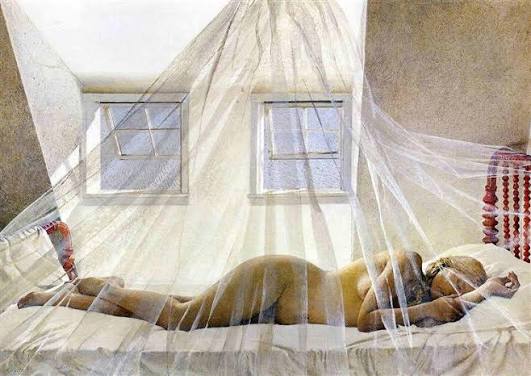
Day Dream by Andrew Wyeth, 1980
Faraway (1952): Wyeth’s dreamy son Jamie, age six but looking older and wiser, sits on a hill of dry brown grass with his hands folded across his raised knees. He wears a huge racoon-tail hat resting low on his forehead, each strand of fur painted as exactly as the tall grass that surrounds him. He’s dressed in a dark winter coat, blue jeans and soft brown boots. His eyes look right, his face is wintry pale, his lips firm. The little boy, at one with his setting, is unusually contemplative and content.
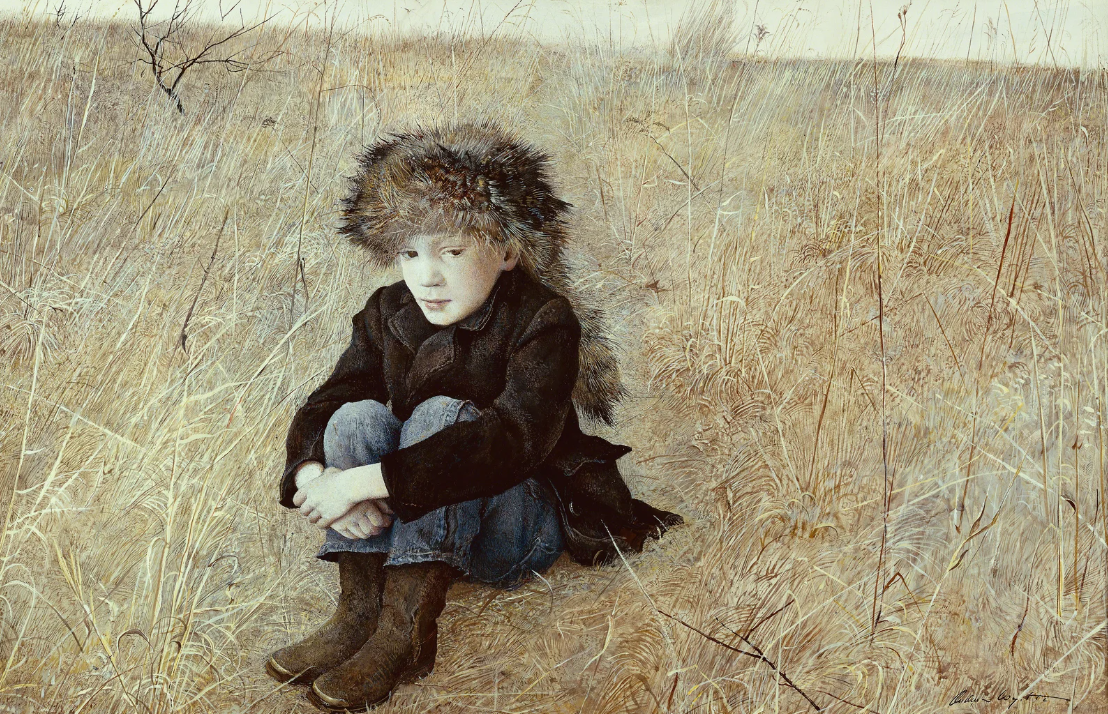
Faraway by Andrew Wyeth, 1952
Wyeth’s art is precise and poetic, yet his mood is often bleak. Many of his local subjects look depressed, ill, even moribund, and seem to have led tragic lives. In Oil Lamp (1945) different textures of wood, embossed metal, newspaper, cloth, glass and three-pointed flames are reflected on the lined face of a working man. He sits in front of a greyish-green wooden door latched with a heavy iron handle, wears a dark open-collar shirt crossed with suspenders and rests his left hand on his lap. A strand of hair falls across his forehead and above his lined face, half in shadow, and he has deep-set eyes, prominent nose and tight mouth. He seems exhausted after a life of hard labour.
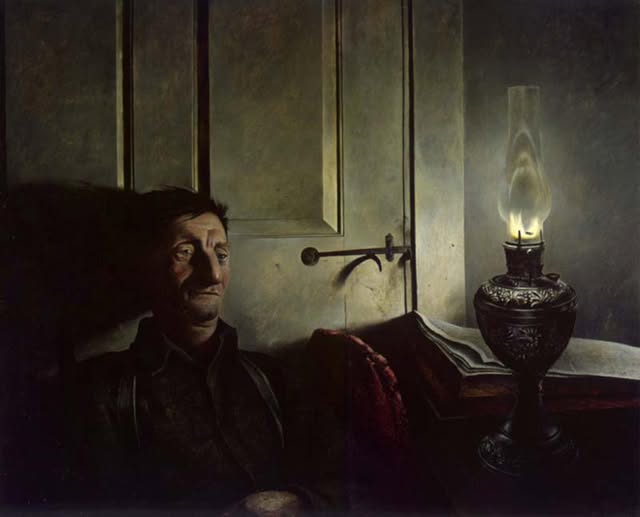
Oil Lamp by Andrew Wyeth, 1945
The Patriot (1964): Wyeth’s neighbour Karl Kuerner, who’d been a German machine-gunner in the 1916 Battle of Verdun, wears his old, high-collar, khaki military uniform decorated with a round bronze medal and a black Iron Cross. Looking toward the light in a three-quarter view, this still-powerful subject has a smooth bald head, slightly raised eyebrows, small blue eyes, strong nose, grooved cheeks, thin lips, bulging chin and wrinkled neck. This old-world figure has survived the war and welcomed the peace he’s found in America.
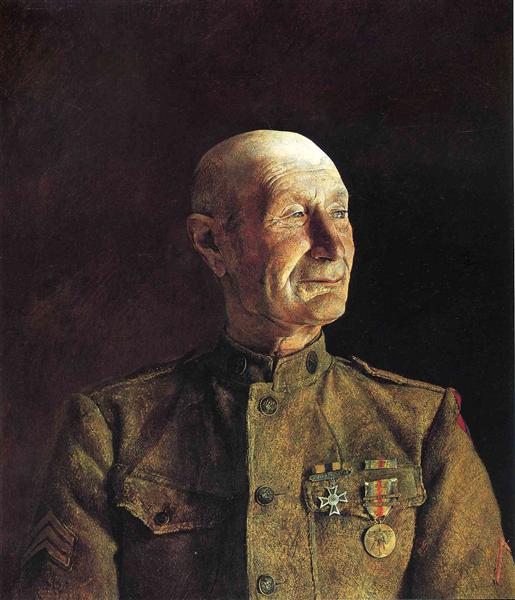
The Patriot by Andrew Wyeth, 1964
Chambered Nautilus (1956): The open-mouthed nacreous shell resting on the lower right table provides the title, suggests the sexual chambers of the woman and sets the mysterious mood of this painting. The thin bedridden subject wears a white nightgown and sits up in the large four-poster bed while her bony knuckled hands grasp her bent knees. She’s surrounded by the white bed canopy and by the flowing white curtains that seem to shroud her body, sweep across the picture, flow into the closed but drafty window and lead to the white curved shell. She’s seen in profile, hair dangling down her back, gazing through a twelve-pane window at a cloudy grey sky. She seems to be an invalid, close to death, trapped in her sickroom and hopelessly longing to escape from her confinement and her disease.
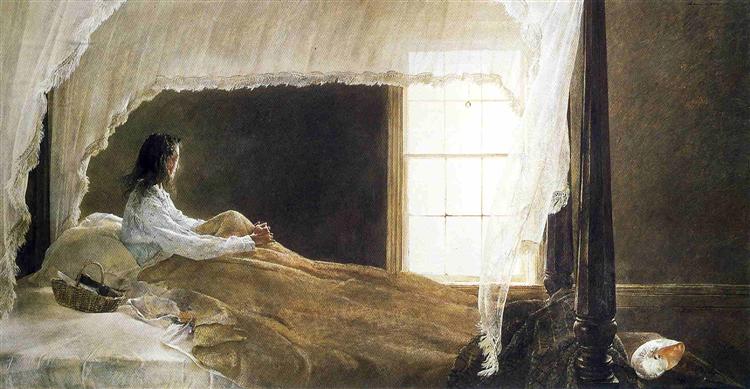
Chambered Nautilus by Andrew Wyeth, 1956
Christina Olson (1947): Aged 54, Christina seems prematurely old. Her beaky nose juts out in profile and her pale skin is echoed in the ivory doorknob. She sits in an open entrance, folding her skeletal-thin arms in the lap of her black dress. Placed between her domestic interior and the external locale of tall grass and bare-branched trees, she’s fixed and immobile, unwilling to leave her secure existence and venture into the unfamiliar outer world.
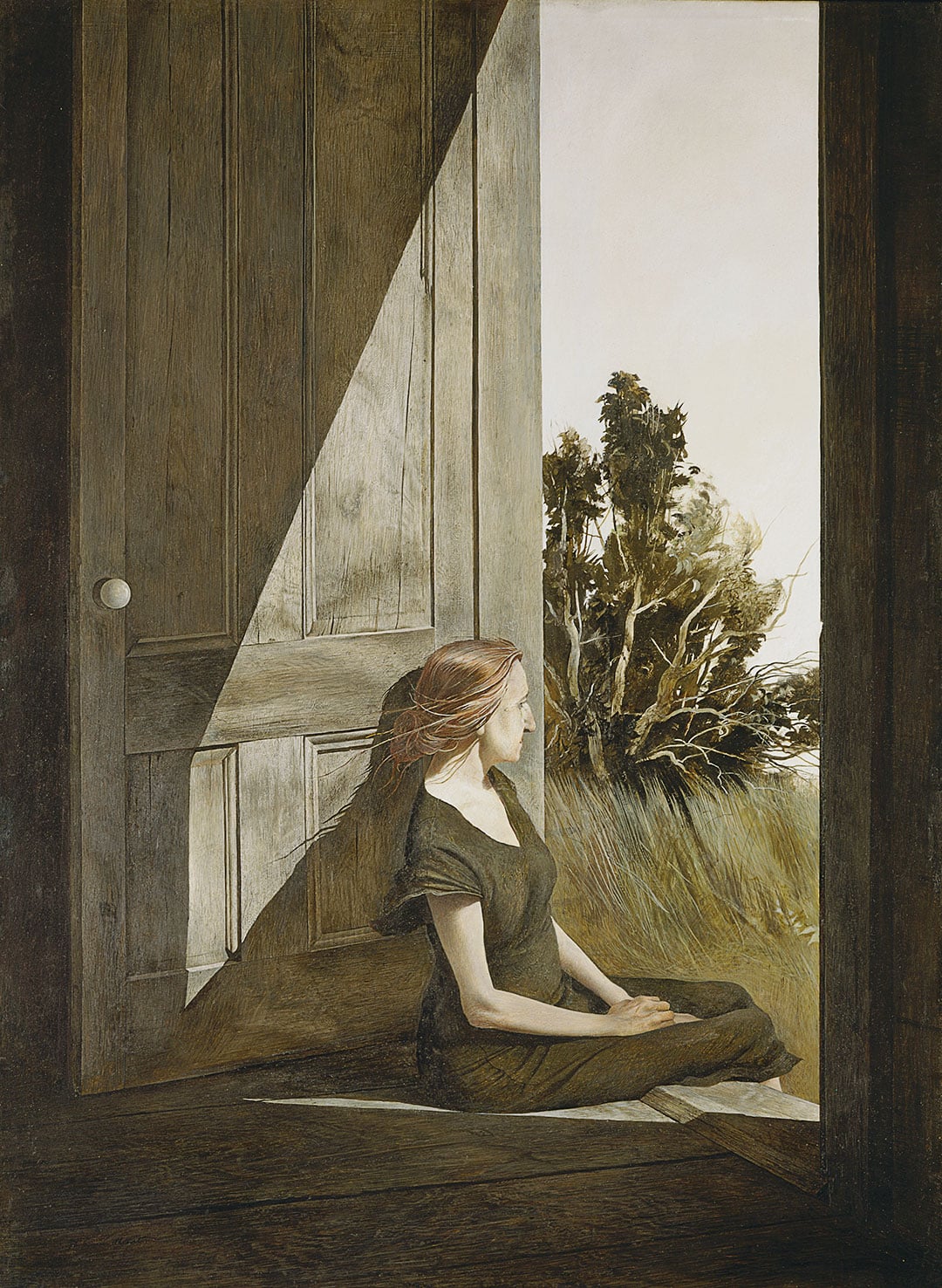
Christina Olson by Andrew Wyeth, 1947
William Coleman explains that Christina “suffered from a degenerative disorder that led to partial paralysis of her legs and inability to walk. She refused to use mechanical mobility aids, making her way through the house and land by using her arms to crawl along the ground. Wyeth was struck by her stoic strength.” Christina’s World (1948), Wyeth’s most famous picture, was painted only a year after Christina Olson, but she seems much younger when seen from behind. She has dark hair, and wears a pink dress secured with a black belt, white stockings and grey shoes. Painfully thin, with fingers spread and clutching the ground, she’s crawling up a steep grassy hill to a distant spooky grey house. It’s not clear why she’s dragging herself toward the difficult destination, if she’ll ever get there or what she’ll do if she arrives.
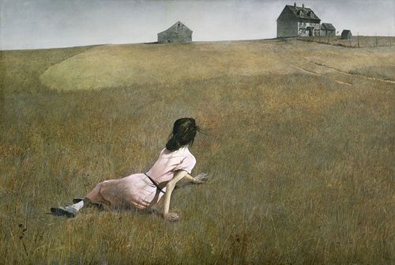
Christina’s World by Andrew Wyeth, 1948
Black Velvet (1972): Like a Titian or Manet nude on a soft dark sofa that contrasts with her ivory skin, this young woman is stretched out from head to toe. Seen in profile with her head turned to the right, she has long dangling hair, a velvet choker that provides the title, arms resting above and below her full breasts, a sprinkling of coppery pubic hair, long legs and crossed feet. Self-absorbed, perhaps asleep, she remains exposed but elusive.
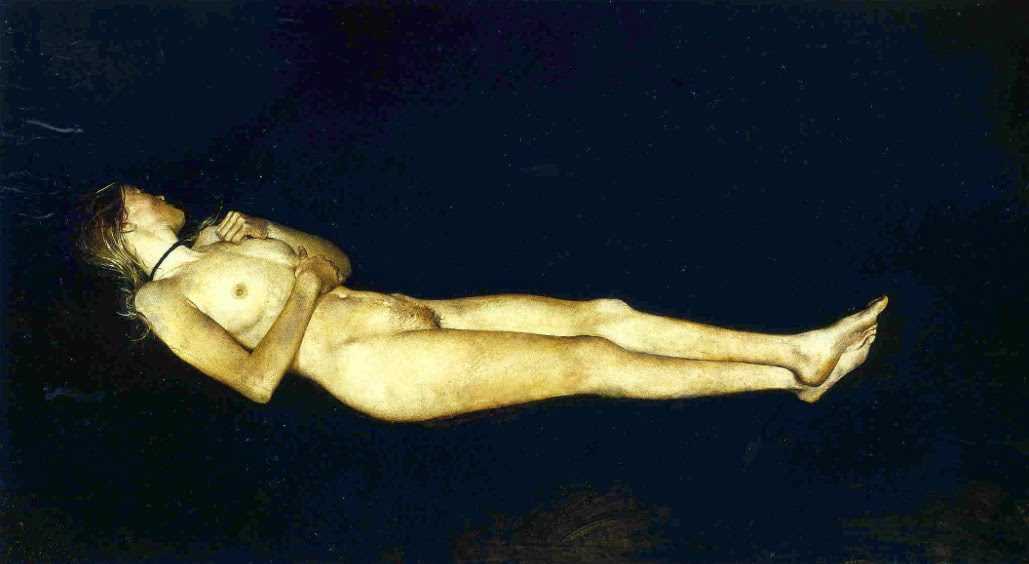
Black Velvet by Andrew Wyeth, 1972
Maga’s Daughter (1966) is a portrait of his wife Betsy, titled with her mother’s familiar name. Standing bust-length before a tan wall, she wears a wide flat cardinal’s hat with dangling strings like those portrayed in Renaissance paintings of St. Jerome, and a brown high-collared velvety suit. The handsome bright-eyed woman looks to the left, has short dark hair, a highlight on the tip of her nose and glossy lips. Wyeth was clearly in love with this impressive, self-assured woman.
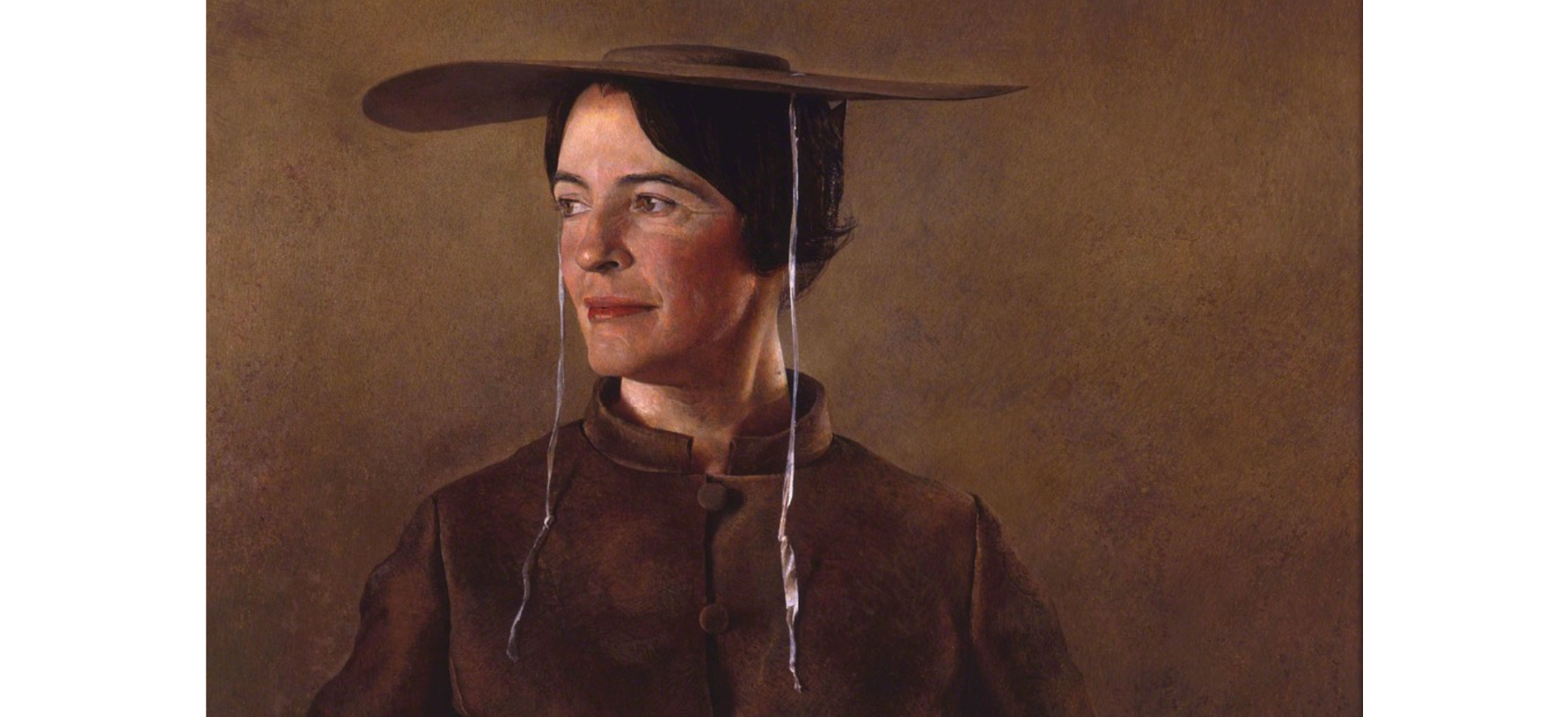
Maga’s Daughter by Andrew Wyeth, 1966
Braids (1977), modeled by Helga Testorf who posed for Black Velvet, is a fitting companion to Wyeth’s portrait of his wife in Maga’s Daughter. Portrayed bust-length and close up in three-quarter profile, she wears a grey turtle-neck sweater with ribbed high collar, and has red hair parted in the middle and hanging down her chest in twisted braids. The young beauty has a high, slightly freckled forehead, blueish-grey eyes, straight nose, ruddy cheeks and sensual lips. She’s tranquil and seems to be looking far out and in deep.
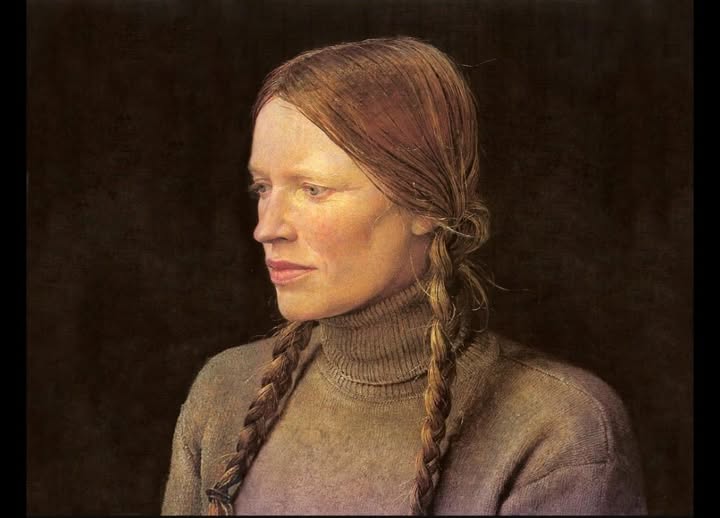
Braids by Andrew Wyeth, 1977.
Dryad (2000): Wyeth’s strangest and most fantastic creation imagines a naked woman as a mythical nymph who lives in a tree. She stands half in shadows inside a tall, triangular, carved-out dead tree trunk with spiky branches curving above it, in a flat grassy landscape that includes white houses in the distant background. The soft skin of the sensual young nude enfolded in the arboreal cavern contrasts with the rough texture of the wood. Her dark hair is pulled tightly back and tied with a red ribbon. She looks to the left in profile, with one arm touching the tree, the other hanging at her side. She has full round breasts with wide aureoles, furry pubic hair and feet protruding from the edge as if she were taking her first step outside. The vaginal shape of the open tree trunk suggests the birth of the young mythical Venus. Both protected and exposed, the confined Dryad is eager to be free to dance, sing and frolic with her companions in the forest.
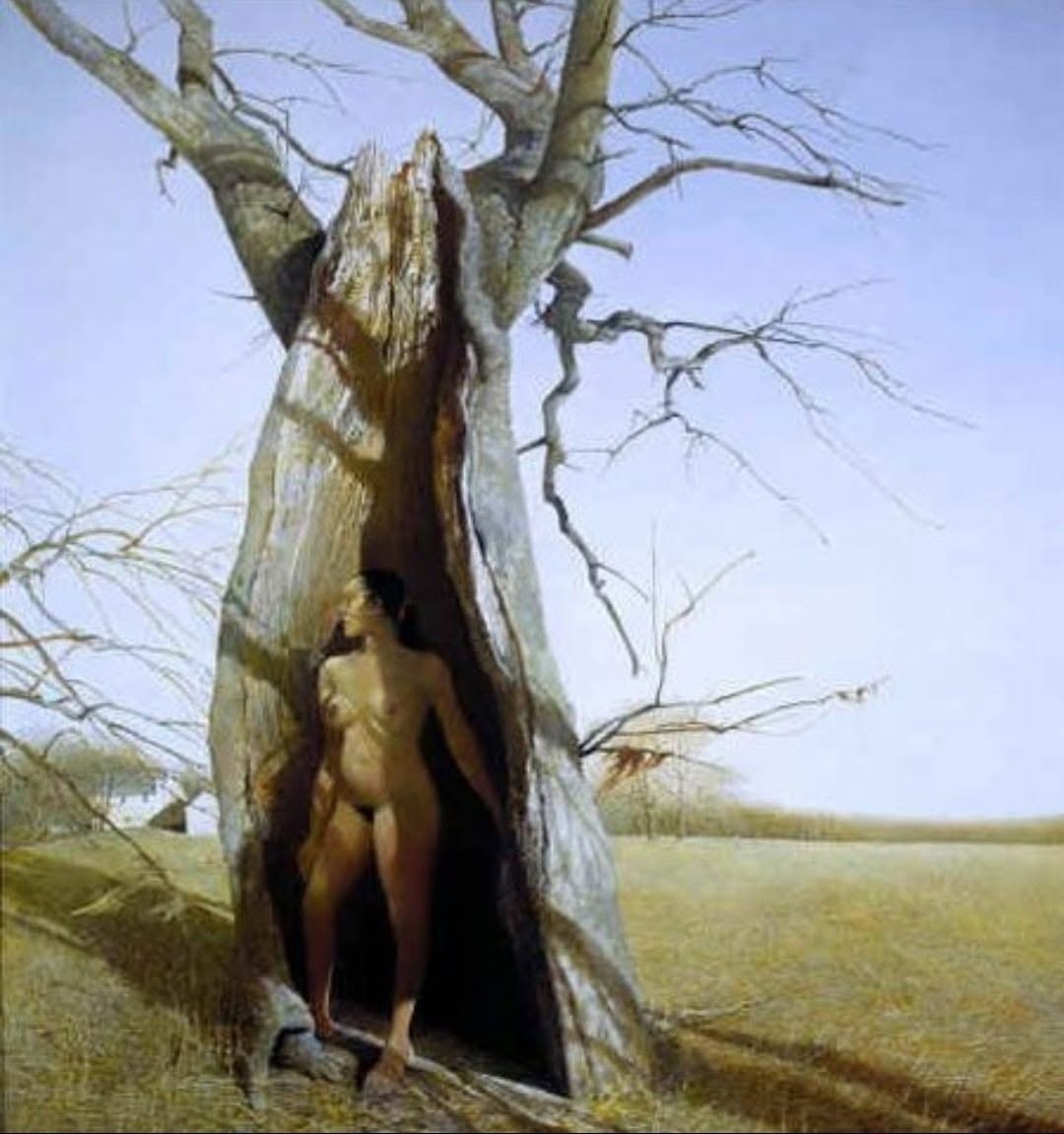
Dryad by Andrew Wyeth, 2000
Coleman defines Wyeth’s essential qualities as a restricted colour palette, reduction of details to austere essentials, cropped perspectives, empty scenes, exclusion of modern life, local architecture, a sense of timelessness, a visionary image that significantly alters the real setting that inspired it, and an implied but undefined narrative that leaves the viewer to interpret the mystery of the real.
Jeffrey Meyers has published Painting and the Novel, Impressionist Quartet, biographies of Wyndham Lewis and Modigliani, and a book on the Canadian realist painter Alex Colville.
A Message from TheArticle
We are the only publication that’s committed to covering every angle. We have an important contribution to make, one that’s needed now more than ever, and we need your help to continue publishing throughout these hard economic times. So please, make a donation.


